Badminton Balance Exercises: Improving Coordination And Stability (Balance Guide)
Every shot in badminton is hit from a balance position, good or bad. The clean net kill comes from a body that arrived steady. The wild clear comes from a body still tipping as the racket swings. Balance exercises train that steadiness directly: ankles that adjust, a trunk that stays quiet, landings that stick. This page explains why balance leaks during rallies, which exercises fix it, from ankle warm ups and core control to lunges and landings on court, and how to test your progress honestly.
Balance Check #1
Balance Is the Shot Before the Shot
Balance is not standing still on one leg at a party. In badminton it is dynamic: arriving at the shuttle already organised, striking while moving, and landing ready for the next shot. A player can look fine standing in the kitchen and still leak balance on every lunge, because the skill that matters is balance at speed, under load, on one leg.
That is good news, because dynamic balance is trainable. The body balances through three systems working together: the eyes, the inner ear, and the sensors in muscles and joints that report where everything is. Training challenges those systems in small, safe doses, and they respond by adjusting faster and more accurately during real movement.
Balance Check #2
Why a Wobble Costs You the Rally
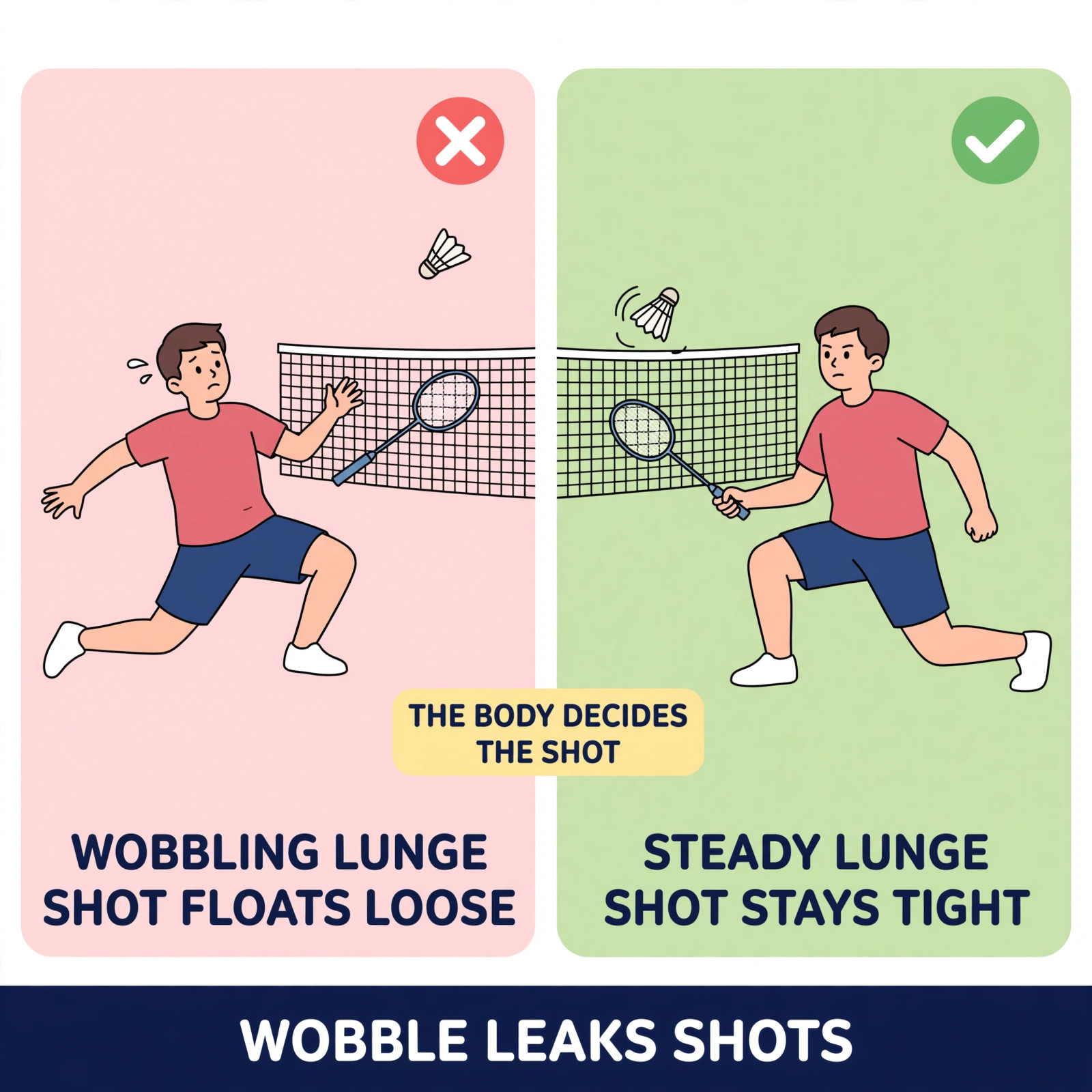
A rally rarely fails at the racket. It fails a moment earlier, when the trunk tips past the front foot in a lunge and the weight cannot come back, or when a landing rolls slightly and the recovery step starts late. Each wobble costs a fraction of a second, and fractions decide who reaches the next shuttle comfortably.
The leaks have patterns. Weak or sleepy ankles sway at the base. A trunk that cannot hold its line lets the shoulders lead the body off balance. Eyes that drop to the floor remove the horizon the balance system steers by. Fix the pattern that leaks for you and whole areas of your game steady at once, which is why balance work pays back so quickly.
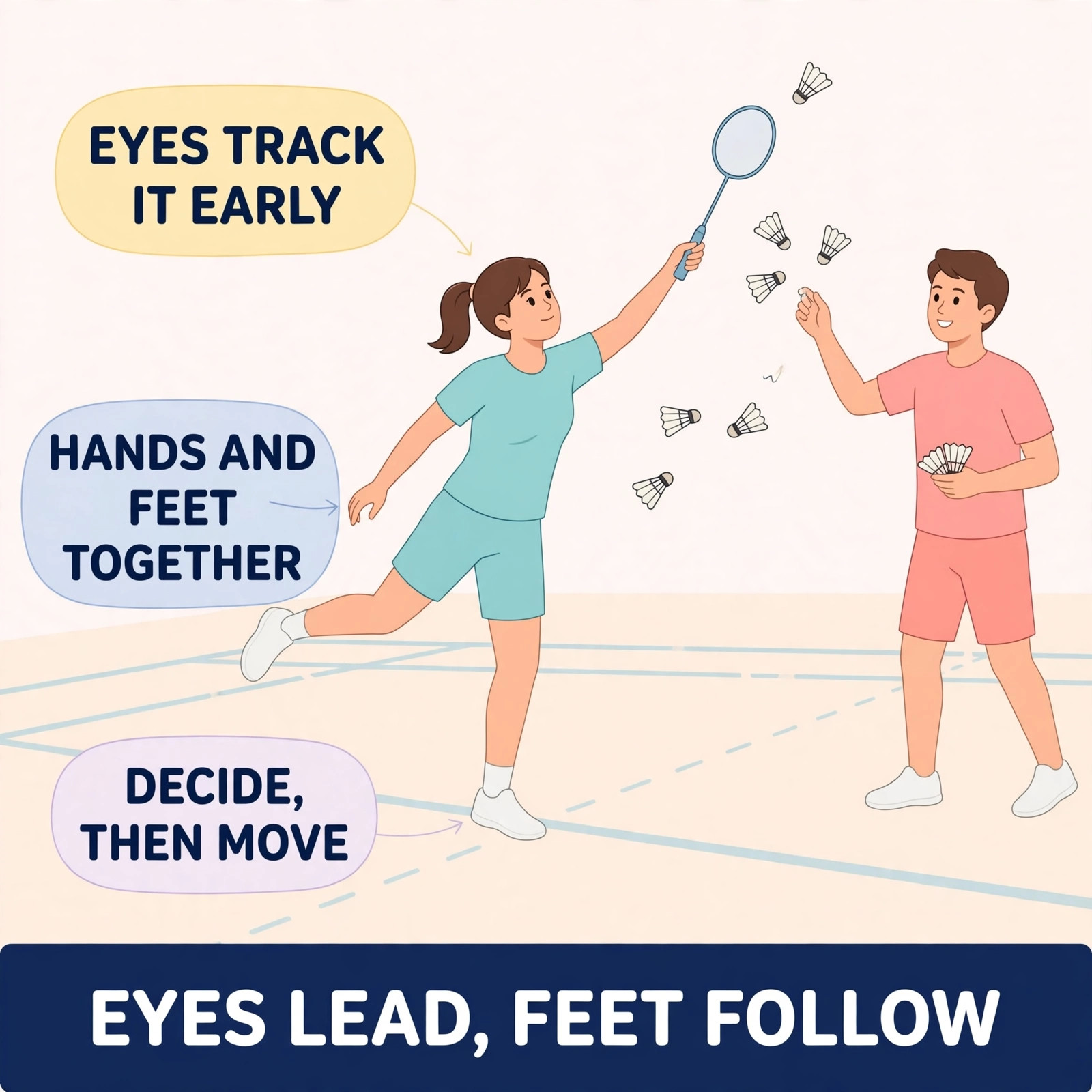
Eyes matter more than most players expect. The balance system steers by the horizon, so a gaze that drops to the floor at the end of a lunge removes its best reference right when it is needed most. Train the habit in drills: eyes up, fixed on a point ahead, even when the legs are shaking. On court, that same habit keeps the head still at contact, and a still head is the platform every accurate shot is built on.

Balance Check #3
Warm Up the Ankles, Wake Up the Balance
Start every balance session at the ankles. Slow ankle circles in both directions, then heel raises done slowly, up and down with control. Follow with gentle hops in place, landing quietly on the forefoot. Two quiet minutes here tells the sensors in the ankle joint that work is coming, and balance drills done on warm ankles teach far more than the same drills done cold.
Then stand on one leg. Keep the standing knee soft, the trunk tall, eyes fixed on a point ahead. Aim for calm seconds, not heroic ones: if you are windmilling, the dose is too big. Progress by time first, then by reaching gently in different directions with the free leg, then by adding a slow head turn. Each stage challenges the systems a little more without ever turning practice into falling practice.
Heel raises deserve a slow count. Rise on both feet first, three seconds up, three seconds down, with no bouncing at the bottom. When that feels easy, shift more weight to one side, then work single leg raises beside a wall. The calf and ankle complex is the first responder in every balance correction, and slow raises build the strength that lets it answer quickly when a landing goes slightly wrong.

Balance Check #4
Core Exercises That Keep the Trunk Quiet
The trunk is the mast of the whole system. Core exercises that suit balance work are the quiet kind: dead bugs done slowly, side planks with a straight line from head to heels, and single leg bridges that keep the hips level. The goal is a trunk that stays organised while the limbs move, which is exactly what a stretched out backhand or a deep lunge demands.
Breathing is part of the skill. Players hold their breath when balance gets hard, and a held breath stiffens everything, including the adjustments balance needs. Practise breathing out slowly during holds and hard reps. A calm breath is a sign the dose is right, and it carries straight into rallies, where tense players wobble and relaxed players recover.
Fatigue is the real test. Balance that holds in the first rally often leaks in the third game, when the trunk is tired and the ankles are slow to answer. That is why some balance work belongs near the end of a session, in small doses: a set of quiet holds or slow lunges after the main drills, while the body is warm and tired. Control that survives tired legs is the only kind a match ever meets.
Balance Check #5
Lunges, Landings and Coordination on Court
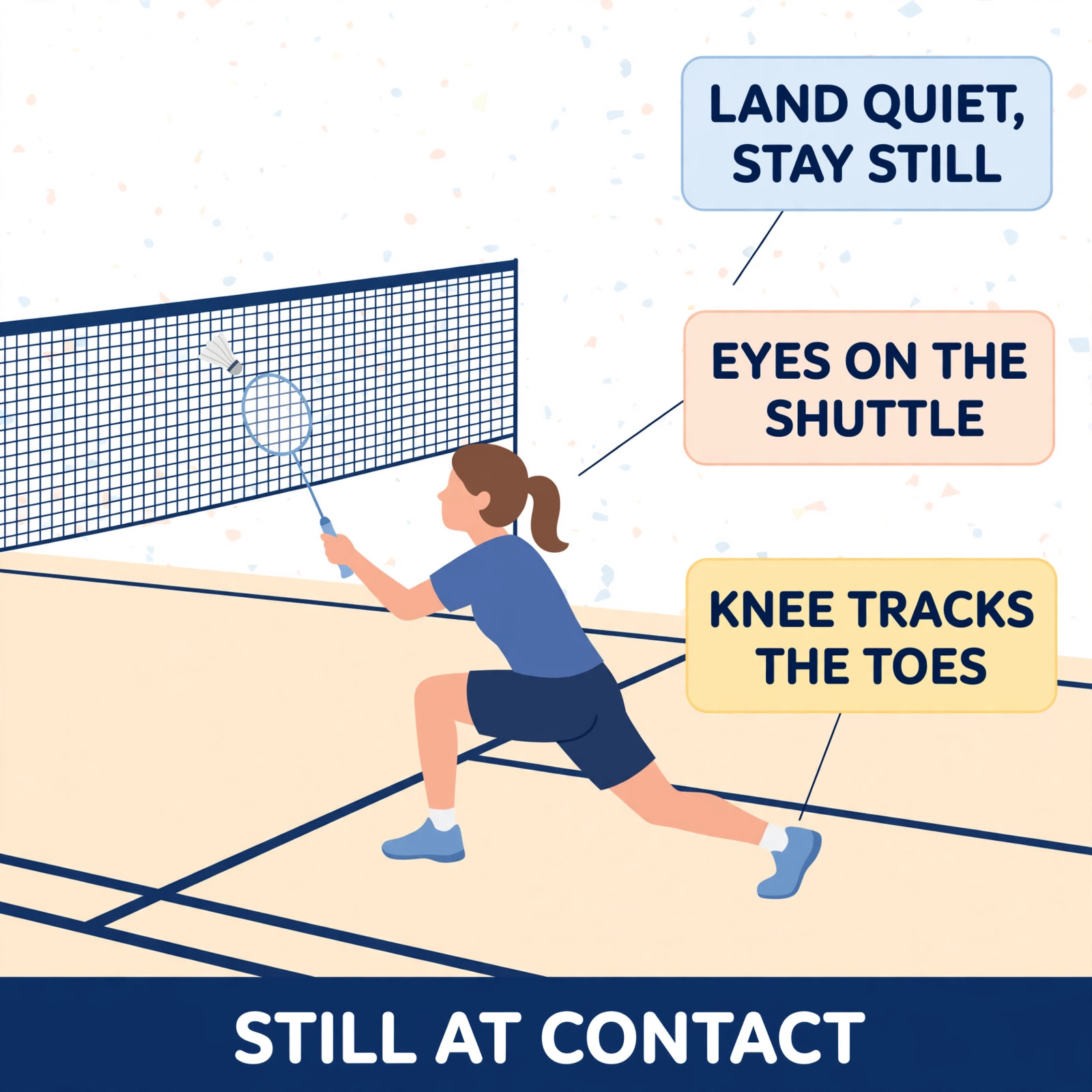
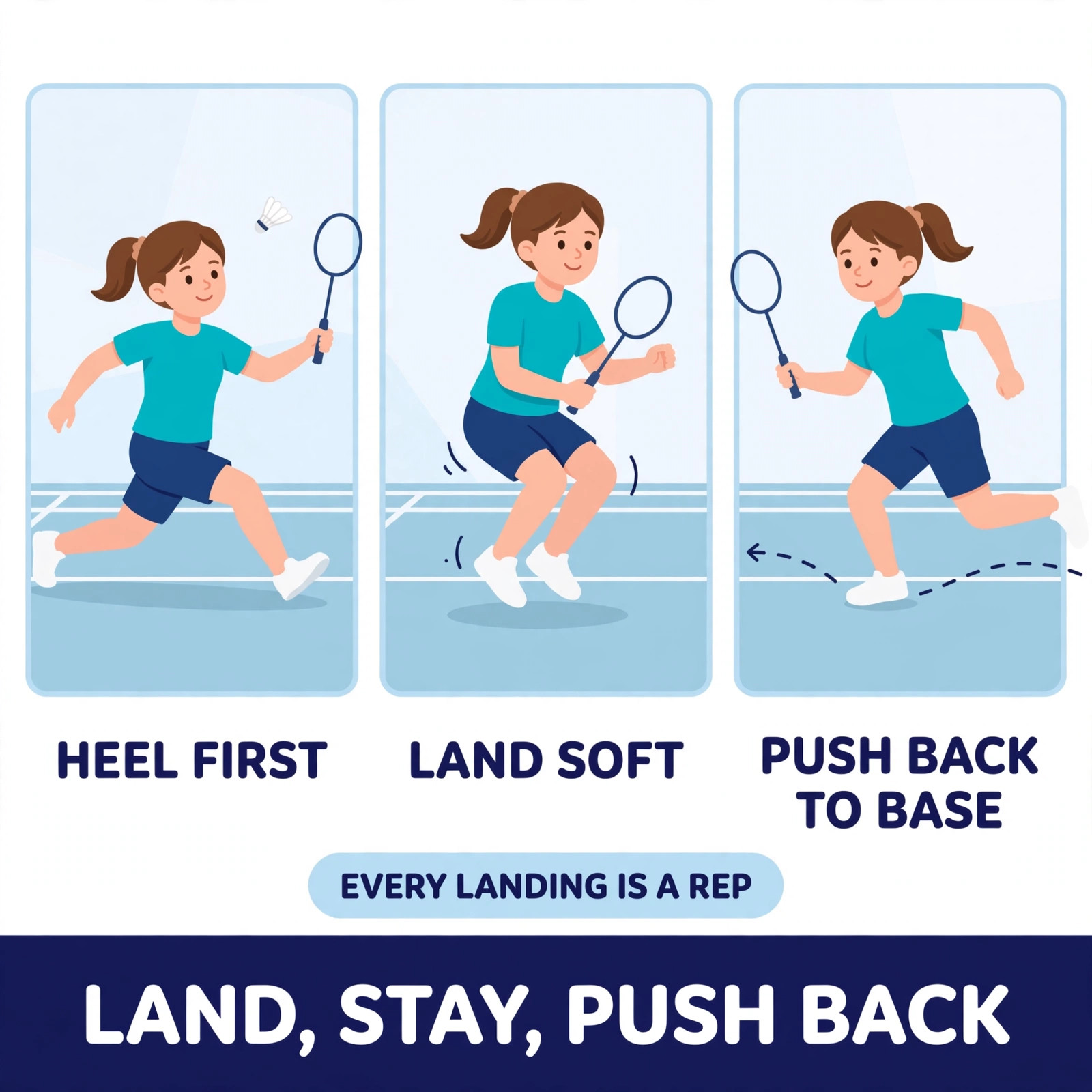
On court, balance training becomes specific. Practise the lunge itself in slow motion: step, land heel first, knee tracking over the toes, trunk tall, hold for two seconds, then push back to base. Add the racket and a shadow swing once the shape is steady. Slow lunges build the exact strength and control the fast lunge borrows.
Landings deserve the same care. Jump, land on one leg, and stick it: no extra hop, no rolling, knee soft and in line. Hold two seconds, then step out. Landings happen after every smash and clear, and a landing that sticks turns defence into attack, because the next step starts from balance instead of from rescue.
Coordination ties the pieces together. Move the eyes first: look to the corner, then move. Practise mirror drills with a partner, and shadow sequences that change direction on a call. Balance is never just muscles; it is the whole system reading, deciding and adjusting, and coordination drills train the reading as much as the holding.
Myth vs Reality
Myths About Natural Balance
The first myth is that balance is something you either have or you do not. Balance is a skill built on systems that adapt. Players who look naturally steady have usually spent years challenging those systems, in sport or in childhood play. Late starters improve just as surely, dose by dose, because the systems respond at any age.
The second myth is that balance training means wobbling on unstable toys. Wobble boards and cushions are one tool, useful at the right stage, but most badminton balance is built on a flat floor: one leg stands, controlled lunges, stuck landings. The court is flat. Training that respects that fact transfers best.
The third myth is that balance work is only for older players or players returning from injury. Every player lands, lunges and recovers in every rally. Young, fit players leak balance too; they just leak it at higher speed. Training it early builds the base that power and speed will stand on for years.

Why Choose Us
Why Players Choose ST Badminton Academy
Every session at ST Badminton Academy is planned around the player in front of the coach. Groups are kept to a maximum of 4 students, so your lunge shape, your landing line and your weaker side are seen and corrected in the session itself. Balance faults hide in big groups; in small ones they get fixed.
Your coach is Eric Chuar, who has coached badminton in Singapore and Malaysia for more than 15 years. His balance standard is simple and testable: hold the lunge, stick the landing, recover through the middle. Players repeat simple tests monthly, so steadiness is a record you keep, not a compliment you are given.
The academy is based in Setapak, Kuala Lumpur, and has run classes there for years. If your shots feel fine in drills but scatter in rallies, balance is the first place an experienced coach looks. Come and have yours checked properly, lunge by lunge and landing by landing.
FAQs: Badminton Balance Exercises in Malaysia (KL)
Balance work raises sensible questions about testing, safety and how much is enough. Here are direct answers you can act on today.
How can I test my balance at home?Gombak?
Stand near a wall for safety, lift one foot, and time how long you can stand calmly on the other leg, eyes open and fixed ahead. Note the time for each side and any big difference between them. Retest monthly under the same conditions. Wild flailing ends the test; the honest number is your calm, controlled seconds.
What is the difference between balance and coordination?KL?
Balance is staying organised: keeping your centre over your base while still or moving. Coordination is organising several parts at once: eyes, hands and feet working in time. They overlap heavily in badminton, because a good lunge needs both. Training one usually lifts the other, which is why this page treats them as one system.
Why do I wobble when I lunge to the net?level?
Usually one of three leaks: the ankle is not controlling the landing, the knee drifts inward as you land, or the trunk tips past your front foot and pulls you forward. Eyes dropping to the floor makes all three worse. Slow lunge practice with a tall trunk, a knee tracking over the toes, and eyes up fixes the pattern gradually.
How long should I hold a balance position?
Start with calm holds of ten to twenty seconds per leg, breathing normally. Build toward thirty seconds and beyond as the wobble shrinks. Once a hold feels easy, make it harder by reaching with the free leg or turning your head slowly, rather than simply holding longer. Quality seconds count; desperate seconds teach desperation.
Can balance training help with falls and injuries?
Balance training can help lower the risk of falls and some injuries, because stronger, faster adjustments catch you before a stumble becomes a fall, and controlled landings load joints more evenly. It is not a guarantee and it does not treat injuries. Players with pain or a recent injury should get checked first, then train within guidance.
Do I need a wobble board or special equipment?Maju?
No. A flat floor, a wall nearby and your own body cover nearly everything on this page: stands, reaches, lunges and landings. A cushion or wobble board can add difficulty later, once flat floor work is steady. Expensive gear is optional; honest progression is not. Spend on coaching before you spend on equipment.
How often should I train balance?Malaysia?
Short and often beats long and rare. Five to ten minutes inside your warm up, plus balance elements inside court drills, suits most players. Daily small doses work well because the balance systems learn from frequent small challenges. Add a monthly test to confirm the practice is actually turning into steadiness you can measure.
Can beginners do balance exercises safely?
Yes, with sensible progressions. Start near a wall or rail, keep both feet close to the floor, and choose holds you can do calmly. Beginners improve quickly because the first doses are gentle and the feedback is instant. Stop and reset whenever form breaks down, and build difficulty in small steps rather than jumping to advanced variations.
Should I train my weaker side more?badminton?
Yes, carefully. Most players have a steadier side, and rallies do not let you choose which leg lunges. Give the weaker side an extra set, or start sets with it while you are fresh, until the test times sit close together. Never force a painful side; a big or painful difference is a reason to get checked, not pushed.
Badminton Balance Training in Action


One Standard for Every Player and Every Session
Balance at this academy is a standard, not a slogan. Lunge shape, landing line and recovery position are taught, tested and retested, inside groups small enough for the coach to see every repetition that matters.
| Factor | Hope and Momentum | Trained Balance BALANCE |
|---|---|---|
| Frequency | 1 or 2 times a week. Mostly for fun and sweat. | Short balance doses most days, inside warm ups and drills. |
| Drills Focus | Basic static feeding. Minimal footwork pressure. | Ankle warm ups, one leg holds, slow lunges and stuck landings. |
| Physical Conditioning | Rarely included. Just playing games on court. | Core, agility, and speed training included in every session to prevent injury and build stamina. |
| Tactical Awareness | "Just hit it over." No real game plan. | Video analysis, point construction, and learning to read the opponent's game. |
| Coach Ratio | Large groups (8-10 kids). Coach barely watches you. | Max 4 students. Mr Eric Chuar personally corrects every stroke and movement detail. |
| Goal Setting | Fun and exercise. | Steadier lunges, quieter landings and faster recoveries. |
| Long Term Result | Good recreational player. | A player whose shots stay true because the body stays organised. |
Badminton Balance Training in Kuala Lumpur
Book a trial session and let a coach watch your lunges and landings at real pace. Most players are surprised by what one honest look reveals, and by how quickly the fixes start to hold. Steadier feet are closer than you think.






