Master Badminton Doubles Strategy With Expert Tips (Doubles Strategy Guide)
Doubles is not two singles players sharing a court. The doubles court is wider, 6.1 metres across, the rallies are faster, and almost every rally contains a moment where both partners could play the shot, or neither does. Those moments are where matches are won and lost, and they are decided by strategy, not by who owns the biggest smash. This guide covers badminton doubles strategy the way we coach it at ST Badminton Academy in Setapak, Kuala Lumpur: the two jobs in a pair, who takes the middle, the serve plan, choosing your target, and turning defence into counter-attack.

Pair Check #1
Why Doubles Is a Game of Decisions?
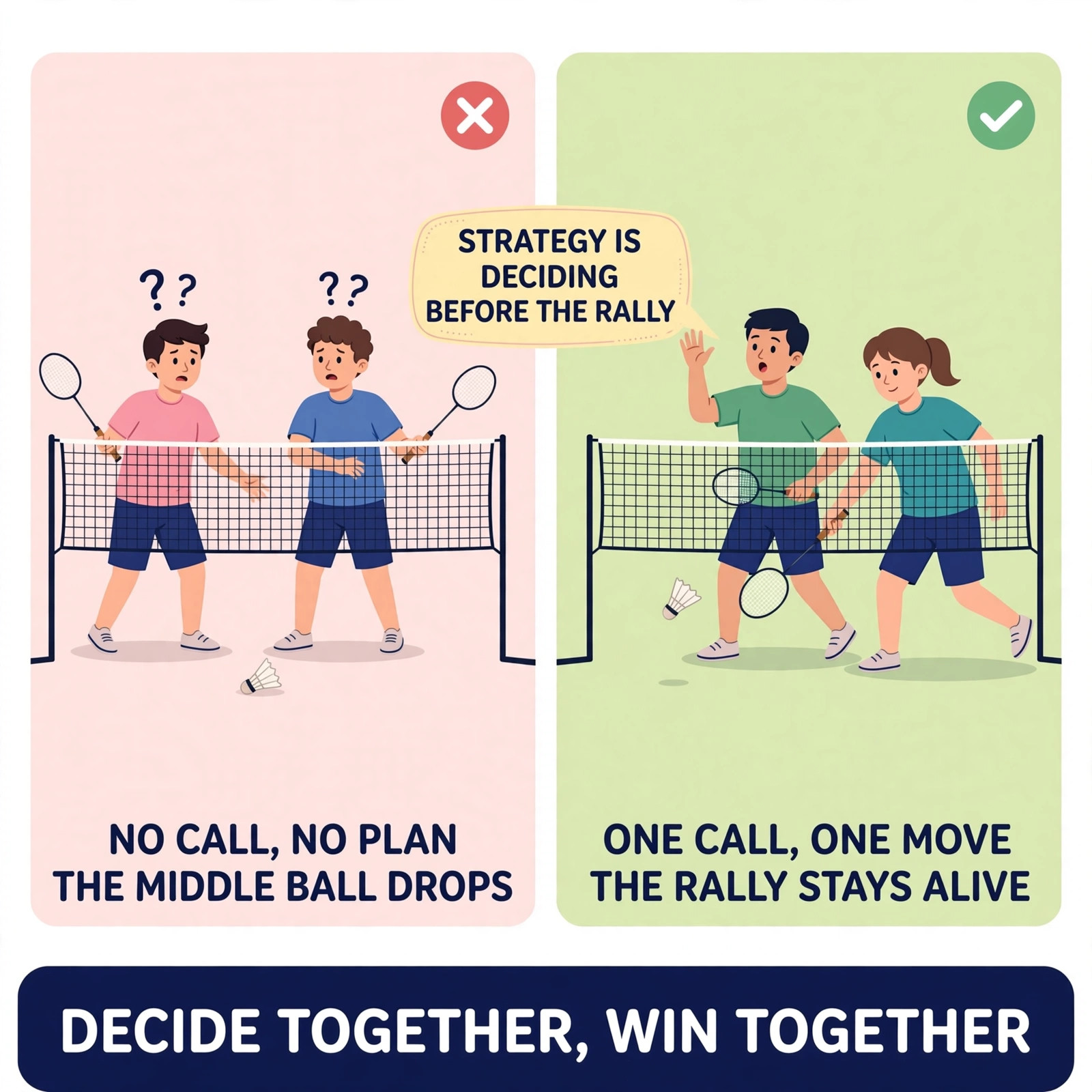
Watch a club doubles match closely and count the free points. A shuttle lands between two partners who both shaped to hit it. A middle shot drops while both rackets pull away. A pair wins a great attacking position, then gives it back with one hopeful lift. Very few of those points were lost on technique. They were lost on decisions: no agreed plan for the middle, no call, no shared idea of what the pair was trying to do. Doubles strategy is simply those decisions, made before the rally starts.
The heart of it is a shared picture. At every moment, both players should hold the same answers: are we attacking or defending, who owns the middle, and where should the next shot go? That picture changes as the rally turns, and short calls keep it updated. Pairs who share the picture move at the same time and cover the court like one player with four legs. Pairs who do not are two singles players, and two singles players leave twice the space.
Pair Check #2
Two Jobs, One Plan: Who Takes Which Shot
Every pair has two jobs. The rear court player is the engine: from the back they play clears, drops and smashes, building pressure and creating the loose reply. The front court player is the finisher: they own the net area, intercept anything loose, and end rallies the engine created. Neither job is more important. An engine without a finisher builds pressure nobody collects. A finisher without an engine waits at the net for replies that never come.
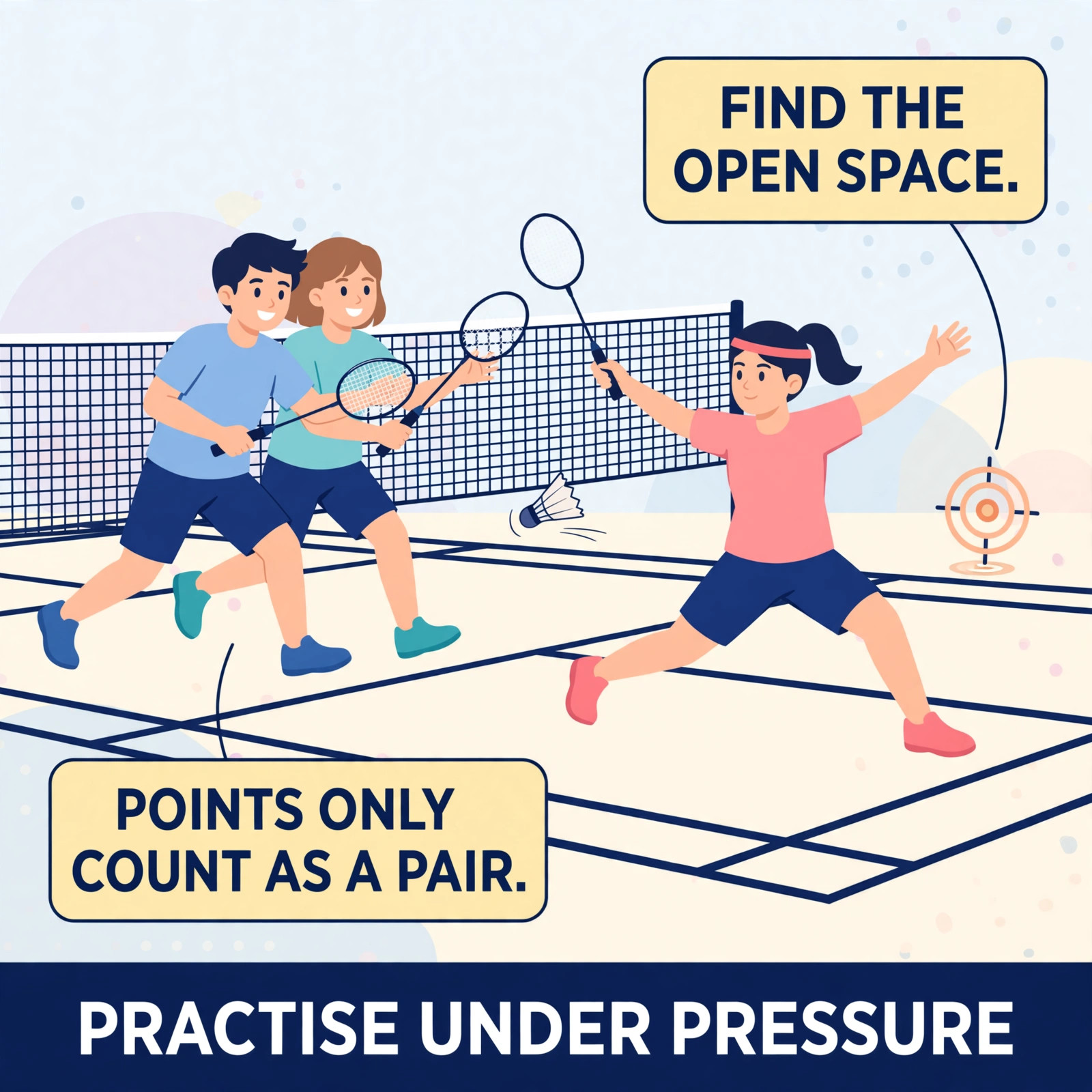
Most pair arguments, and most lost middle balls, come down to one shot: the one played straight between you. Agree your middle rule before the match and keep it simple. A common pair rule is that the player who can take the middle ball on the forehand takes it, and the player moving forward has the right of way. Your pair can choose its own version, but choose one. A middle ball taken by the wrong player is still a point alive. A middle ball watched by both is a point gone.
Calls make the rule work. Keep them short and early: mine, yours, leave. Call as you move, not after the shuttle passes. And commit together: if a call is wrong but both players act on it, the rally usually survives. If both players decide privately and differently, the rally dies. After an error, the best pairs say nothing and reset. Blame is a strategy too, and it only ever works for the other pair.

Pair Check #3
Serve With a Plan: the First Three Shots
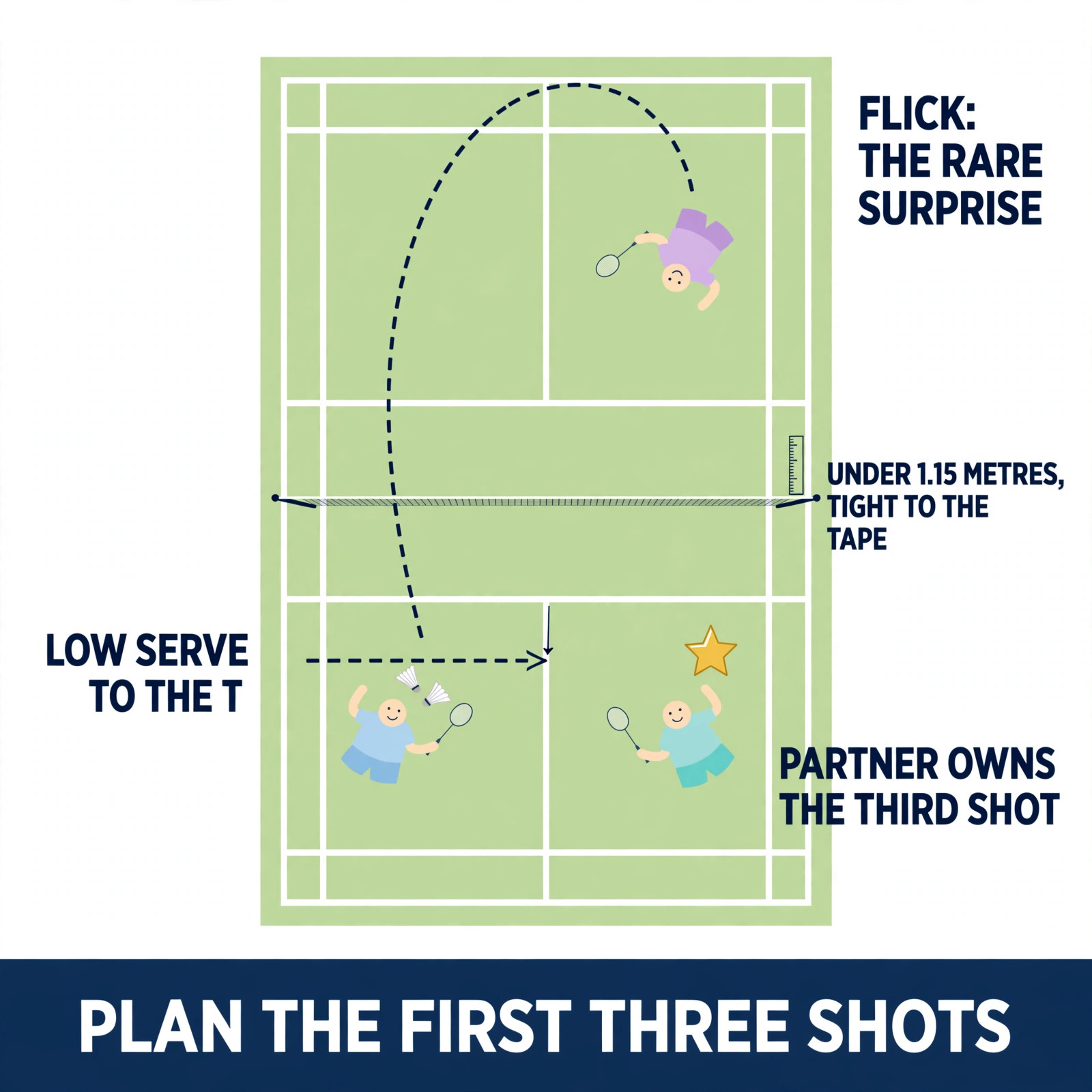
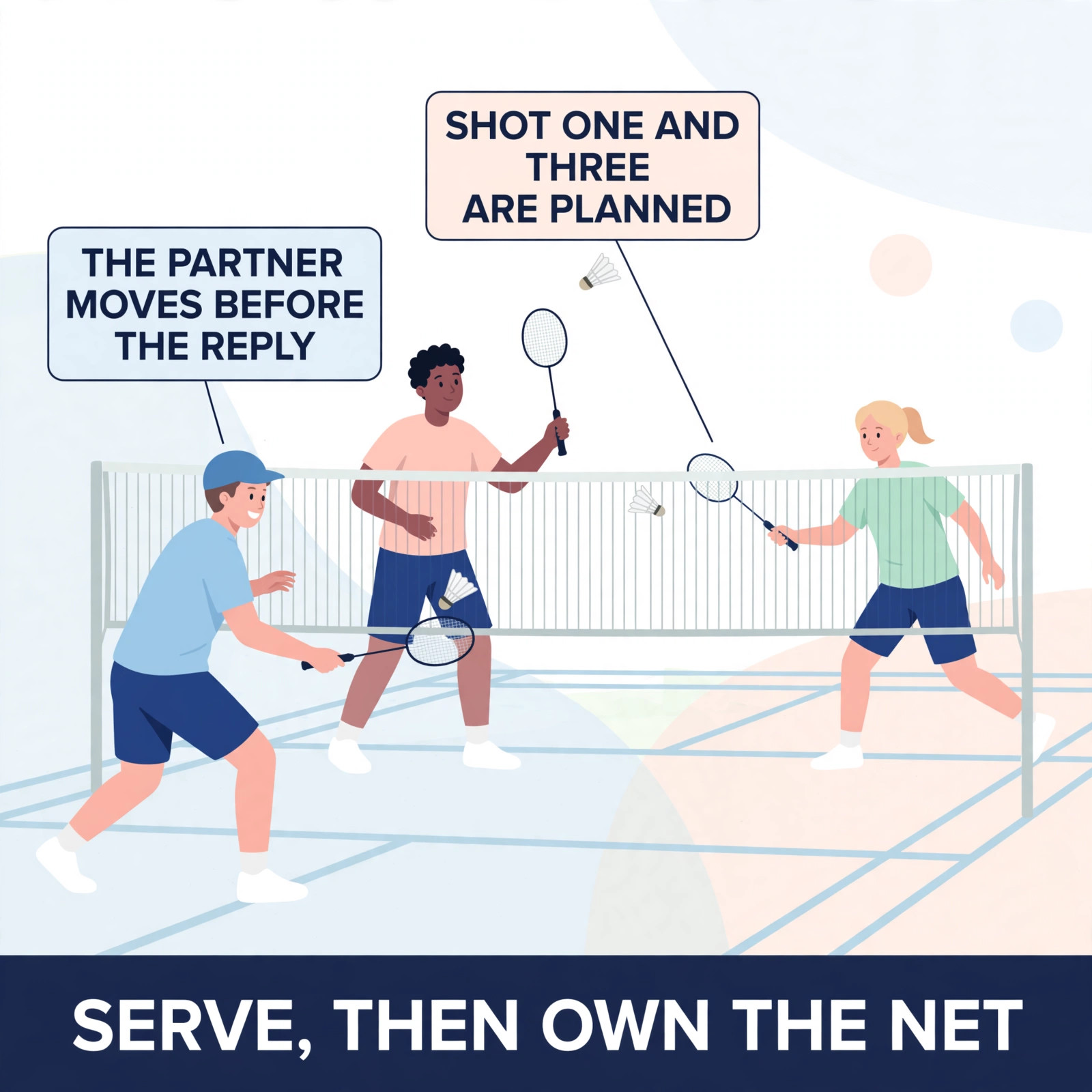
The serve is the first decision of every rally, and the low serve is the pair’s main weapon. Serve tight over the tape, below the service line height of 1.15 metres, mostly towards the T where the service boxes meet. A good low serve does not win the point. It does something better: it stops the receiving pair from attacking, and it lets your partner step in ready for the third shot. Treat the serve as a pair plan, not a solo routine.
Build the plan in threes. Shot one: the low serve to the agreed target. Shot two: their return, which a tight serve keeps predictable. Shot three: yours, played by the partner who has already stepped in towards the net. When the first three shots are planned, rallies start on your terms. Add the flick serve as the variation: used rarely, behind a trusted low serve, it catches a receiver who is leaning in. A flick used every other serve is not a surprise. It is a habit your opponents will enjoy.
Receiving has decisions too. The receiver steps in and attacks a loose serve early, or holds back and respects the flick, based on what the pair agreed. The receiver’s partner watches the flick and the cross-court reply, not the serve. And agree who takes the drive that comes back down the middle on the return: it is the middle rule again, tested at the fastest moment of the rally. Pairs who plan receiving give away far fewer cheap points.
Pair Check #4
Choose Your Target: the Player Out of Balance
Once the rally runs, choose your target like a pair. The simplest target is the weaker opponent: the one who is slower to the back, weaker at the net, or shakier under pressure. Keep more of the rally on them, but not all of it. Attack only one player and they settle into a rhythm, camping where your shots keep going. Vary the target enough that neither opponent can relax, while the weaker one still sees most of the work.
The sharper target is the player who is out of position. Hit behind the player who has just rushed forward. Play into the space a stretched player has just left. When one opponent is pulled wide, the next shot goes to the far side or straight at the recovering player before their feet reset. This is decision-making, not power: the same smash aimed at a set player comes back, while a softer shot into empty space wins the rally.
Whatever your target, guard the attack you have built. In doubles, the side that lifts usually defends the next shot, so choose drives and pushes over lifts while the rally is even. When you are stretched and must lift, lift with a plan: high and deep, to a corner, early enough that both partners are set side by side before the smash comes. A planned lift is a reset. A hopeful lift is an invitation.

The Pair Plan
Turning Defence Into Counter-Attack
Defence in doubles is a decision, not a surrender. When the attack comes, stand side by side, low and balanced, and aim your blocks at the front corners. A soft block forces the smasher to run in and lift, and the rally turns. The pair that only ever lifts from defence stays defending forever. The pair that blocks with intent is one good block away from attacking, and both players should know that before the smash arrives.
The drive is the counter-punch. A smash driven flat back at the rear player changes the rally in one shot: now they are reacting, and your pair can step in together. Cross-court blocks and drives work when the front opponent is camping on your straight reply. Choose one counter and commit to it as a pair. Half-hearted counters, where one player blocks and the other stays back expecting a lift, leave the court exactly as open as no counter at all.
Between rallies, keep the pair a pair. Ten seconds is enough: what scored for us, what scored for them, one change to make. Change the serve target, adjust the middle rule, switch the main target. Pairs that talk briefly between points keep adjusting all match. Pairs that go quiet drift back into two singles players, each solving the match alone. Strategy is not a speech before the match. It is this small conversation, repeated until the last point.

Myth vs Reality
Myths About Doubles Strategy
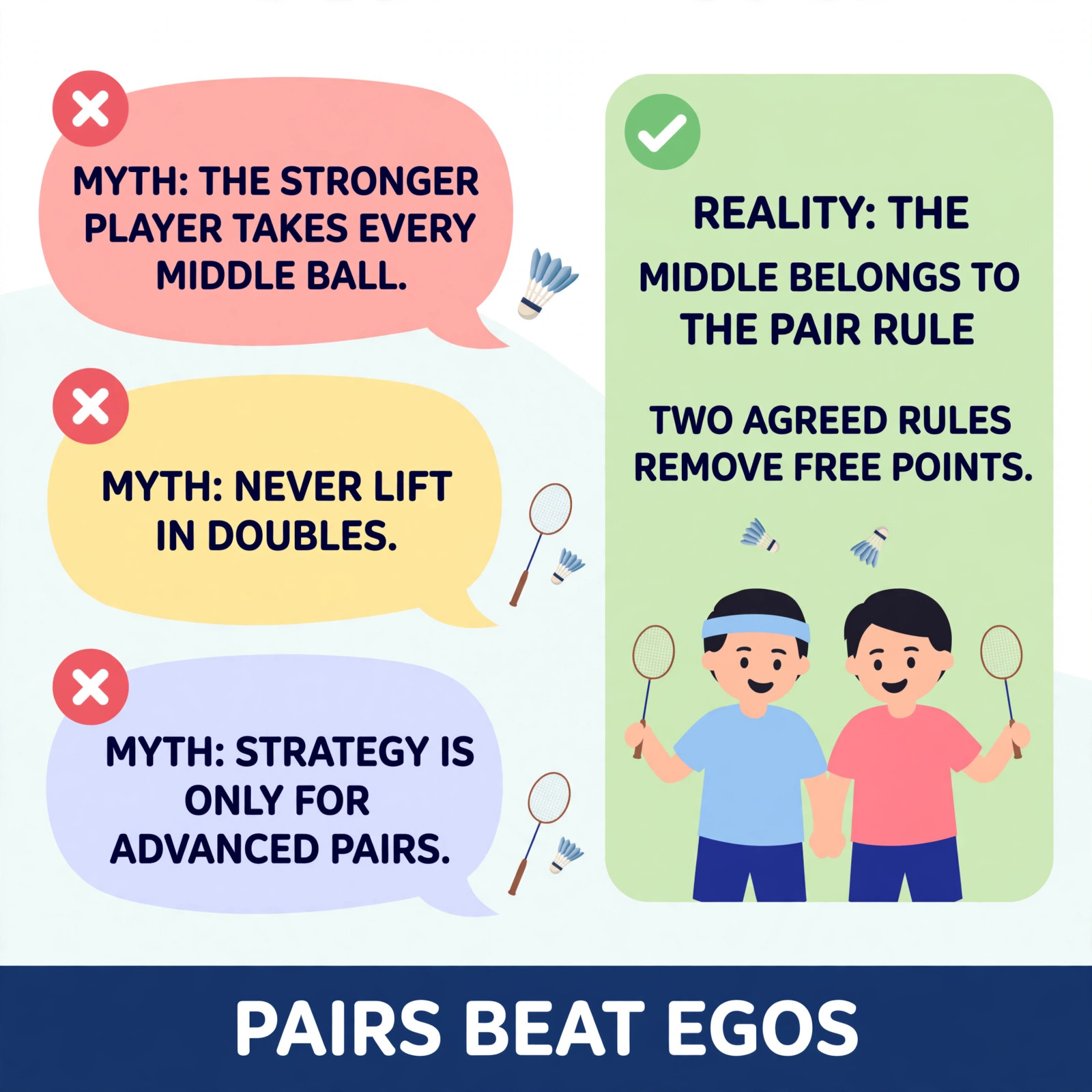
Myth: “The stronger player should take every middle ball.” Reality: the middle belongs to the pair rule, not to the stronger ego. A star who takes everything leaves their partner cold, unused and out of position for the next shot, and clever opponents aim at exactly the space that creates. The best pairs look almost boring in the middle: the agreed player takes it, every time.
Myth: “Never lift in doubles.” Reality: never lift hopefully. A high, deep lift played early, when your pair is stretched, is a correct reset that lets your defence set. Myth: “Calling and talking slows a pair down.” Reality: a short call made early is the fastest thing in doubles. It is hesitation that is slow, and silence is where hesitation lives.
Myth: “Strategy is only for advanced pairs.” Reality: new pairs gain the most from it. Two agreed rules, who takes the middle and where the serve goes, remove most of the free points club pairs give away every game. Advanced pairs add layers later. Every pair, at every level, starts with the same two decisions made together.
Why Choose Us
Doubles Decisions, Coached as a Pair
At ST Badminton Academy KL, doubles is coached as a pair inside small group classes capped at max 4 students. Four students means two pairs on a court, so your partnership practises decisions against a real opposing pair, not against a feeding coach alone. Conditioned games force the choices this page describes, and the coach freezes rallies to ask the only question that matters: whose ball was that?
Mr Eric Chuar has over 15 years of coaching experience in Singapore and Malaysia. His pair rule is simple: decide together, call early, blame never. When he watches a new pair, he reads their decisions before their shots: who hesitated, who called, who covered. Then he fixes one decision at a time, a middle rule this week, a serve plan next, until the pair starts moving as one.
Our academy is based in Setapak, Kuala Lumpur, convenient for players from Wangsa Maju, Melati Utama, Danau Kota and Gombak. If your pair keeps donating the middle, or your matches together feel like two separate games happening on one court, bring your partnership to a session. One frozen rally usually shows a pair more about itself than a month of playing on.
FAQs: Badminton Doubles Strategy in Malaysia (KL)
These are the questions pairs ask us most about doubles strategy and communication in Malaysia. If your question is not here, message us, tell us where your pair keeps losing points, and we will give you a straight answer about which decision to fix first.
How can our pair build a doubles plan if we live in Setapak or Gombak?
Bring your partner and start with two agreements: who takes the middle ball, and where the low serve goes. In our Setapak sessions, pairs practise those two decisions against a live opposing pair, inside groups of max 4 students, so your plan is tested under real pressure from the first session.
What matters most in badminton doubles strategy in KL?
Shared decisions. The pairs that win club matches are rarely the pairs with the biggest smash. They agree who takes the middle, call early, serve to a plan, and choose their target together. Technique matters, but it only pays off when both players are playing the same rally.
How often should we practise as a pair to improve at a steady level?
Practise as a pair at least once a week, on top of your own training. Decisions need shared repetitions: the same partner, the same calls, the same middle rule, until they happen without discussion. Add friendly matches regularly, because a plan only becomes real when another pair tries to break it.
Can a school pair learn doubles strategy while still in school?
Yes. School pairs gain more from strategy than almost anyone, because two agreed rules remove most free points: who takes the middle, and where the serve goes. Coaches keep the plan small, practise it against other school pairs, and add one new decision at a time as the pair grows.
What should our pair agree before a match we enter?
Agree four things: the middle ball rule, the main serve target, which opponent you will test first, and who leads the calls when the score gets tight. Write them down if it helps. Pairs who decide these before the match spend the match playing, not discussing.
Do you coach doubles pairs in classes near Wangsa Maju?
Yes. ST Badminton Academy KL is based in Setapak, a short drive from Wangsa Maju, Melati Utama and Danau Kota. Pairs are welcome in our small groups of max 4 students, which means two pairs per court, so your partnership practises decisions against real opponents in every session.
Does your academy teach doubles communication and decisions in Malaysia?
Yes. Communication and decisions are coached as skills at ST Badminton Academy in Malaysia, not left to chance. Pairs learn short calls, a middle ball rule and a serve plan, then test them in conditioned games where the coach freezes play and asks whose ball it was.
Where is ST Badminton Academy KL located for doubles strategy training?
ST Badminton Academy KL is based in Setapak, Kuala Lumpur, where doubles work happens inside small group classes of max 4 students. The academy is convenient for players from Gombak, Air Panas, Sentul, Jalan Genting Klang and Ampang. Message us before your first session and we will confirm the venue details.
What makes Mr Eric Chuar a suitable coach for doubles pairs and badminton?
Mr Eric Chuar has over 15 years of coaching experience in Singapore and Malaysia. His pair rule is simple: decide together, call early, blame never. He watches how a pair shares the court before he watches their shots, then fixes one decision at a time until the pair moves as one.
Badminton Doubles Strategy in Action


What It Takes to Play as One Pair
A pair meets our partnership standard when five habits hold: the middle rule is agreed before the match, calls are short and early, the serve follows a shared plan, targets are chosen together during the rally, and the pair still talks and resets between points when losing. Our partnership standards below are the checkpoints our coaches use.
| Factor | Two Singles Players | One Real Pair PAIR |
|---|---|---|
| Frequency | 1 or 2 times a week. Mostly for fun and sweat. | Before the match, the pair agrees who takes the middle, who serves where, and who attacks first. |
| Drills Focus | Basic static feeding. Minimal footwork pressure. | During rallies, calls are short and early, so both players move at the same moment. |
| Physical Conditioning | Rarely included. Just playing games on court. | Core, agility, and speed training included in every session to prevent injury and build stamina. |
| Tactical Awareness | "Just hit it over." No real game plan. | Video analysis, point construction, and learning to read the opponent's game. |
| Coach Ratio | Large groups (8-10 kids). Coach barely watches you. | Max 4 students. Mr Eric Chuar personally corrects every stroke and movement detail. |
| Goal Setting | Fun and exercise. | Targets are chosen together: the weaker player, the open corner, the player out of balance. |
| Long Term Result | Good recreational player. | A pair that wins rallies before the smash, because the decisions were made together. |
Badminton Doubles Strategy in Kuala Lumpur
This page covered badminton doubles strategy: the two jobs in a pair, the middle ball rule and short calls, the serve and third shot plan, choosing targets together, and turning defence into counter-attack. ST Badminton Academy KL coaches doubles in small group classes of max 4 students in Setapak. If you are in Wangsa Maju, Gombak, Cheras or nearby, contact us today.






