Get The Best Badminton Shoes For Men (Court Shoe Guide)
Ask experienced players what gear matters most and many will name the racket first. Coaches usually name the shoes. Badminton is played on your feet: lunges, jumps, hard stops and quick changes of direction, rally after rally. In Malaysia, where many games happen in community centres and school halls with dusty or slippery floors, the right court shoes are safety equipment, not fashion.
This guide explains how to choose the best badminton shoes for men: the types available, the grip and cushioning that protect your knees and ankles, how a proper fit should feel, and when a pair is ready to retire. At ST Badminton Academy Malaysia in Setapak, Kuala Lumpur, we check new students’ shoes early, because half the footwork problems we fix start below the ankle.

Shoe Check #1
Can You Play Badminton in Running Shoes?
Every season, new students arrive in running shoes or general trainers. It is an easy mistake: they look sporty, they feel soft, and they cost real money. But running shoes are built to move in one direction, forward. They have a tall, soft heel made for heel-strike jogging, and almost no support for sideways movement.
Badminton moves sideways. The basic lunge throws your weight across one leg at an angle a running shoe was never designed to hold, and the tall heel gives the ankle a longer lever to roll over. Court shoes sit low and stable, with gum rubber soles that grip hall floors. If a player only upgrades one piece of gear this year, experienced coaches will point at the shoes first, ankles and knees cannot be replaced as easily as footwear.

Shoe Check #2
What Should Men Check First?
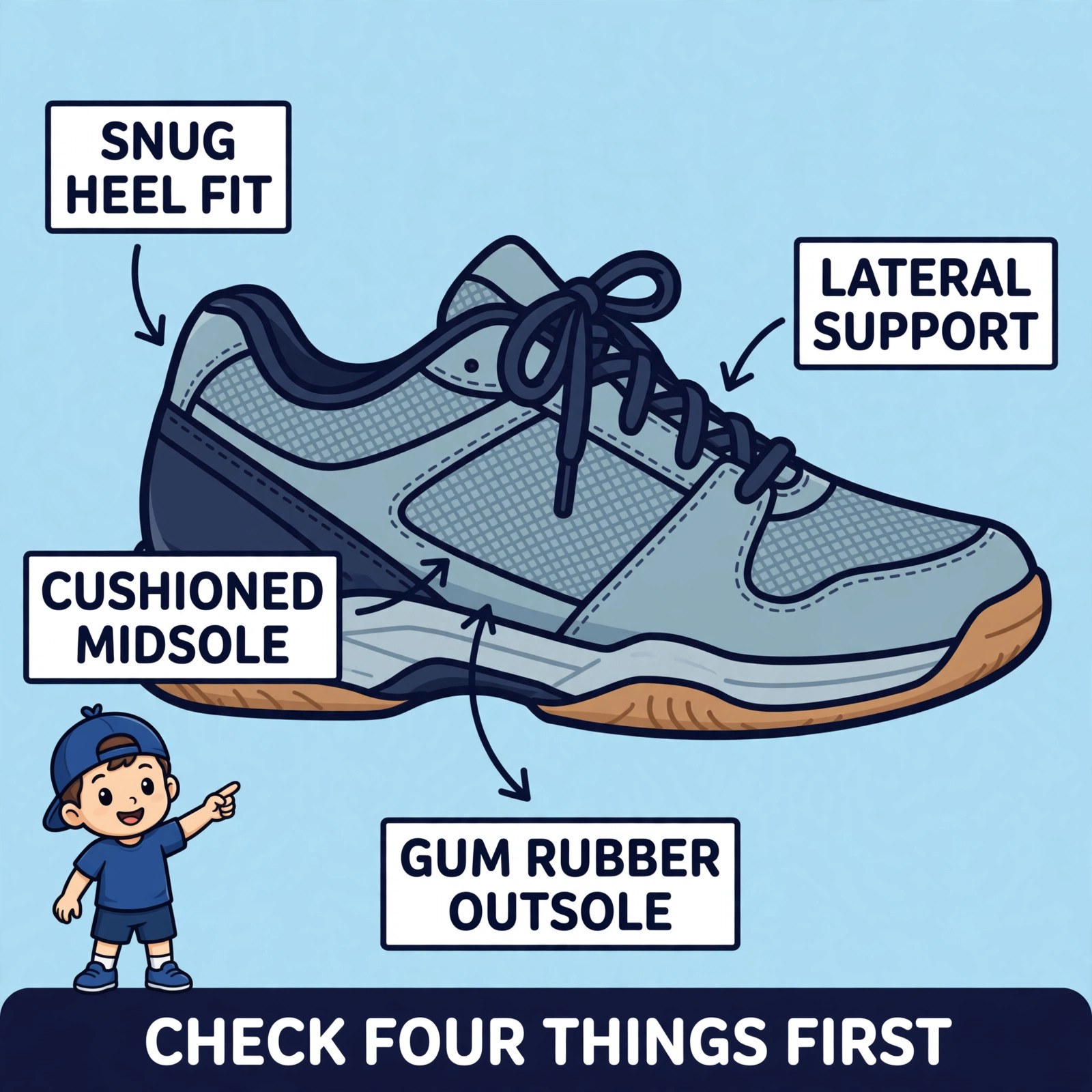
Check the outsole first. A badminton shoe needs a gum rubber sole: soft, slightly sticky rubber that grips wooden and synthetic hall floors without leaving marks. Look at the pattern too, hexagons or herringbone shapes bite in every direction, which is exactly what lunges and shuffles need. A flat, hard or heavily worn sole will slide no matter how famous the brand is.
Next, cushioning and support. The midsole absorbs the shock of jump landings and hard stops, protecting your knees over hundreds of rallies. Then feel the upper and the heel counter: when you lunge sideways, the shoe must hold your foot in place instead of letting it slide over the edge of the sole. A firm heel counter and a supportive upper are what keep hard stops safe.
Finish with fit, and test it properly. Leave about one finger’s width of space behind your heel, make sure the toes are not pressed against the front, and check the width, squashed toes change how you lunge. Try shoes with the socks you actually play in, ideally in the evening when feet are slightly bigger. Then do what you do on court: lunge to both sides and shuffle. If the heel slips or the toes jam, keep looking.
Shoe Check #3
Why Do Grip and Cushioning Decide Your Footwork?
Grip is trust. When you believe your shoes will hold, you push off harder, lunge deeper and recover faster. When you do not, every movement gets careful and slow, and in badminton, slow footwork means late shots. This is why court grip is not a comfort feature. It decides how much of your real speed you dare to use.
Cushioning is the other half of the job. Every jump smash landing, every emergency stop at the net, sends force up through your legs. A good midsole spreads that force out. Players feel the difference late in games: with proper cushioning the legs still jump and drive in the third game; with dead, flattened cushioning the same legs feel heavy by the second. Fresh legs are a footwork advantage money cannot fake, only the right shoes provide it.
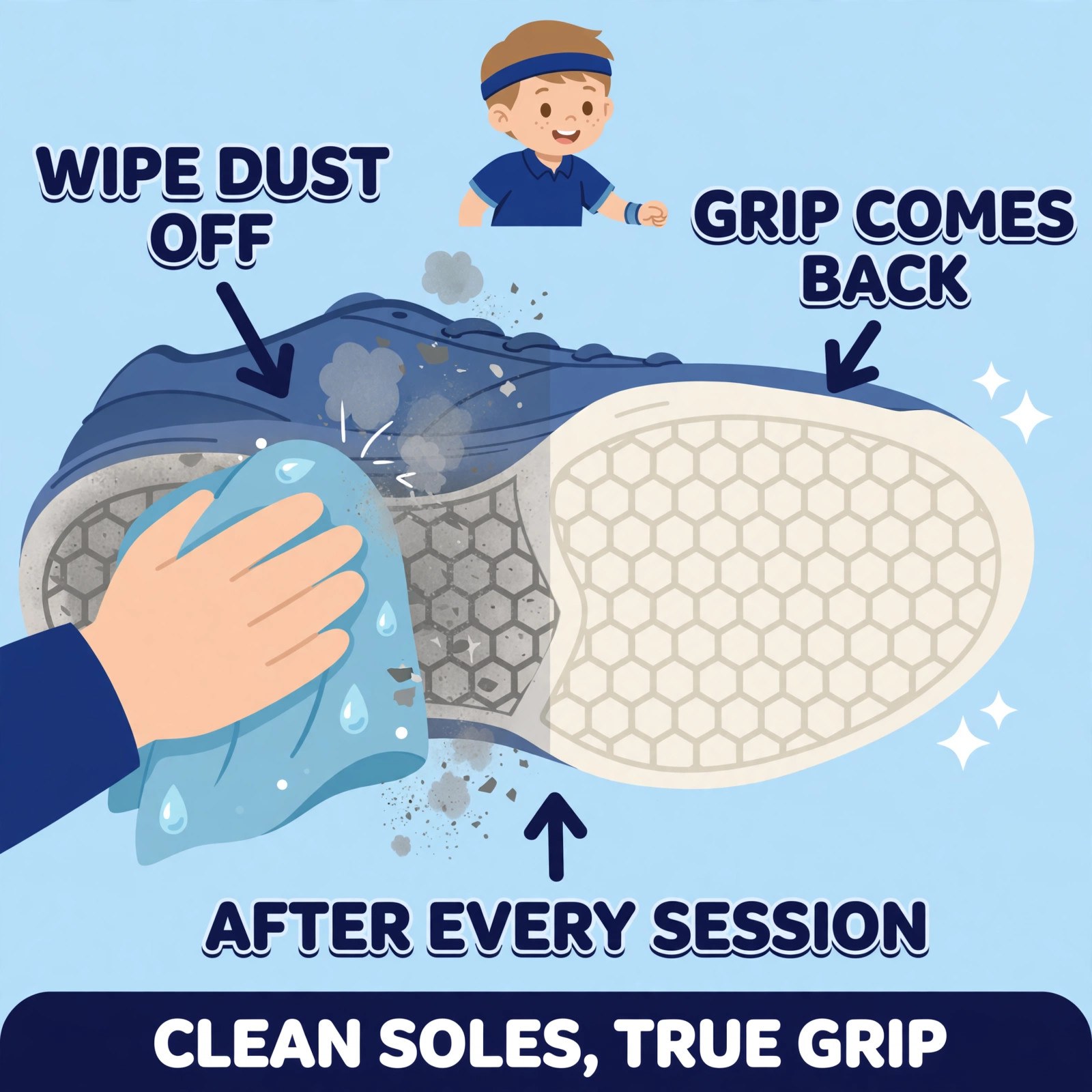
Both halves wear out quietly. Dust and dirt clog the gum rubber pattern, a quick wipe with a damp cloth after sessions brings much of the grip back. But once the tread has worn smooth in the middle, or the midsole feels flat and hard, no cleaning will save the shoe. Our coaches in Setapak look at students’ soles the way mechanics look at tyres: the pattern tells you how much safe grip is left.

Shoe Check #4
Indoor or Outdoor Shoes: What Is the Real Difference?
Indoor badminton shoes are built for hall floors: a thin, flexible gum sole for maximum grip, a light breathable upper, and a low cut that lets the ankle move. Outdoor shoes are a different tool: thicker tread for rough ground, more material around the ankle, and a heavier build that shrugs off concrete and wet patches.
Most badminton in Malaysia is played indoors, academy halls, community centres, school halls, so almost every player here needs the indoor type. Outdoor shoes on a hall floor feel clumsy and grip less than you expect, while indoor shoes taken outside die young: rough concrete chews through soft gum rubber in weeks. Pick the shoe for the surface you actually play on, which for our students means the court.
That leads to a simple habit that doubles shoe life: one pair, for the court only. Change into your badminton shoes when you arrive at the hall, and change out of them when you leave. Street dust, stones and wet pavements are what kill grip fastest. Carry them in your kit bag with your racket, and the same pair stays grippy for many more months of training.

The Fitting
What Happens in a Proper Court Shoe Fitting?
A proper shoe fitting starts before you touch a shoe: measure both feet. Most people have one foot slightly longer than the other, and the bigger foot decides the size. Stand while measuring, because feet spread under your weight. Compare against the size chart, then ignore the number if the shoe itself tells you something different.
On your feet, run three checks. First, the heel: about one finger’s width of space behind it, and no lifting when you walk. Second, the toes: room to wiggle, never pressed hard against the front. Third, movement: lunge forward on both legs, shuffle side to side, and stop sharply. A court shoe should feel like part of your foot in all three, snug at the heel and midfoot, free at the toes.
This is the same fitting we encourage at our Setapak academy. In a new student’s first weeks we watch how their shoes behave in footwork drills: heel slip shows up as slow lunges, worn grip shows up as careful, short steps. Sometimes the fix is a heel-lock lacing pattern; sometimes the honest answer is that the shoes are done. Either way, the player hears it before an ankle does.

Myth vs Reality
Myths About Badminton Shoes
Myth: “Any sports shoe can be used for badminton.” Reality: Running shoes are tall and built to go straight; basketball shoes are heavier and grip for a different game. Badminton lunges load the ankle sideways, and only a low, stable court shoe is shaped for that job. The wrong shoe is the most common cause of rolled ankles we see in adult social games.
Myth: “The most expensive shoe is automatically the best shoe.” Reality: Fit and grip decide how a shoe performs on your feet. A mid-range shoe that fits your foot shape will always beat a flagship model that slips at the heel. Myth: “Badminton shoes are only for serious players.”
Reality: Beginners need proper court shoes most of all, because their footwork is still forming and their ankles are not yet strong. Good shoes let a learning player lunge with confidence from the first month. At ST Badminton Academy KL we would rather see a new student in basic court shoes and an old racket than the reverse, feet first, always.

Why Choose Us
Real Shoe Planning for Court Players
ST Badminton Academy Malaysia in Setapak runs small groups: max 4 students per group, always. Small groups let the head coach watch footwork closely, and footwork is where shoe problems announce themselves, the slide on a lunge, the heel that lifts on recovery, the player who stops trusting their stops. In a big group nobody notices. In a group of four, we notice in the first session.
Our head coach, Mr Eric Chuar, has over 15 years of coaching experience in Singapore and Malaysia. He checks students’ footwear the practical way: how the sole looks, how the foot sits, how the player moves in them. His advice is honest and boring in the best way, clean the soles, lace the heel lock, replace the pair when the grip goes. No sales talk, because safe feet keep students training.
If you are choosing your first real pair of badminton shoes, bring them, or your current pair, to a session and ask us to look. We train in Setapak, a short reach from Wangsa Maju, Gombak and Danau Kota. The right shoes will not win matches for you, but they will let you chase every shuttle like you mean it.
FAQs: Badminton Shoes for Men in Malaysia (KL)
Here are answers to common questions from male players and parents in Kuala Lumpur about choosing badminton shoes.
Where can I buy good badminton shoes for men if I live in Setapak or Gombak?
Try them on in a sports shop if you can, so you can lunge and shuffle before paying. Bring the socks you play in and go in the evening, when feet are at their biggest. Our academy is in Setapak, close to Gombak, and our coaches are happy to check the fit of a pair during your session with us.
What is the best order to check grip, cushioning and fit in KL?
Check in this order: the gum rubber outsole first, because grip is the whole job; cushioning second, for jumps and hard stops; lateral support third, so your foot stays over the sole on lunges; and fit last, one finger’s width at the heel, room at the toes. A shoe failing the first check fails overall.
How do I know if a court shoe fits a player at beginner level?
Use the three checks: one finger’s width of space behind the heel with no lifting when you walk, toes free to wiggle instead of pressed to the front, and no sliding when you lunge or shuffle. Feet also grow and change, so junior players should repeat the check every few months, not just when buying.
Can running shoes work for badminton if a player is 13 or 14?
It is risky at any age, teenagers included. Running shoes have tall, soft heels built for straight-line jogging, and badminton lunges load the ankle sideways. Young players are still building ankle strength and clean footwork habits, so the low, stable base of a court shoe protects them while they learn to move properly.
What badminton tournaments in Malaysia should new players enter?
Start with school competitions, club leagues and small local open events around Kuala Lumpur and Selangor. Wear proper court shoes: hall floors change from venue to venue, and some are dusty and slick. We prepare our students step by step, so their first event feels like a slightly bigger training game, with footwear they already trust.
Do you offer shoe checks and badminton coaching near Wangsa Maju?
Yes. Our academy is based in Setapak, a short drive from Wangsa Maju, Melati Utama and Danau Kota. During sessions our coaches watch how students’ shoes grip and fit, and we flag worn soles or wrong sizes early. Groups stay small, max 4 students, so details like footwear never get missed in a crowd.
Does your academy help players choose the right court shoes in Malaysia?
Yes. We look at students’ shoes as part of coaching: grip pattern left, cushioning feel, heel fit and lacing. If a pair is fine, we say so; if it is worn out or the wrong type, we explain what to look for in the next pair. The advice comes from watching you move, not from a shop counter.
Where is ST Badminton Academy KL located for beginner training?
We are based in Setapak, Kuala Lumpur, easy to reach from Gombak, Air Panas, Wangsa Maju and nearby areas. Most students train after school or in the evening in small groups of max 4. If you are nearby, come and watch a session first, and feel free to ask the coach about your shoes.
What makes Mr Eric Chuar a suitable coach for badminton?
Mr Eric Chuar has over 15 years of coaching experience in Singapore and Malaysia, and he teaches the small groups at our Setapak academy personally. He reads footwork the way stringers read rackets: worn grip, dead cushioning and a loose heel all show up in how a player moves, and he corrects the cause, not just the step.
Badminton Shoes in Action



What It Takes to Pick the Right Court Shoe
Good badminton shoes are not a lucky guess either. They follow simple standards: gum rubber that grips, cushioning that lasts, support that holds the foot on every lunge, and a fit checked by moving, not by standing still. Our standards below are the same checks we run on every new student's shoes in Setapak.
| Factor | Any Old Shoes | Real Court Shoes COURT |
|---|---|---|
| Frequency | 1 or 2 times a week. Mostly for fun and sweat. | A gum rubber outsole that grips wooden and mat hall floors without marking them. |
| Drills Focus | Basic static feeding. Minimal footwork pressure. | Cushioning under the heel and forefoot that absorbs jumps, lunges and hard stops. |
| Physical Conditioning | Rarely included. Just playing games on court. | Core, agility, and speed training included in every session to prevent injury and build stamina. |
| Tactical Awareness | "Just hit it over." No real game plan. | Video analysis, point construction, and learning to read the opponent's game. |
| Coach Ratio | Large groups (8-10 kids). Coach barely watches you. | Max 4 students. Mr Eric Chuar personally corrects every stroke and movement detail. |
| Goal Setting | Fun and exercise. | Clear fitting targets: no heel slip, room for the toes, and support on every sideways lunge. |
| Long Term Result | Good recreational player. | A player who moves fast, stops safely and trusts every step on court. |
Badminton Shoe Advice in Kuala Lumpur
This guide shows how to choose the best badminton shoes for men: gum rubber grip first, cushioning for jumps and stops, support for sideways lunges, and a fit you test by moving. ST Badminton Academy KL provides small-group coaching in Setapak, and our coaches check students' shoes as part of training. If you are in Wangsa Maju, Gombak, Cheras or nearby and want a coach to look at your current shoes before you buy a new pair, contact us today.






