Find The Perfect Badminton Racket For Beginners (Beginner Guide)
Choosing your first badminton racket can feel like a test you did not study for. The shop wall is full of rackets, every frame is covered in numbers and bold claims, and nobody explains what any of it means for a beginner. This guide breaks the specs down in plain words: what weight, balance point, shaft flex, grip size and string tension really do on court, and how a new player in Malaysia can pick a racket that helps them learn instead of fighting them.
At ST Badminton Academy Malaysia in Setapak, Kuala Lumpur, new students train in small groups of max 4, and our head coach Mr Eric Chuar is also a certified stringer. So the advice below is the same advice we give when a student hands us a racket and asks: is this one right for me?

Racket Check #1
Does the Most Expensive Racket Make a Beginner Better?
Many beginners walk into a shop and buy the racket their favourite pro player uses, or the most expensive frame on the wall. It feels like a safe shortcut: if it works for a world champion, surely it will work for a school player. A few sessions later the truth shows up. The clears fall short, the arm aches by the second game, and defence feels slow and heavy.
Pro players use stiff, heavy setups matched to years of strength and polished technique. A beginner needs the opposite: a forgiving racket with a big sweet spot, a shaft that bends a little to help the clear, and a weight the wrist can move quickly. The right first racket is not the most famous one. It is the one that fits your hand, your swing and your current level, so good habits form from the first week.

Racket Check #2
What Should a Beginner Check First?
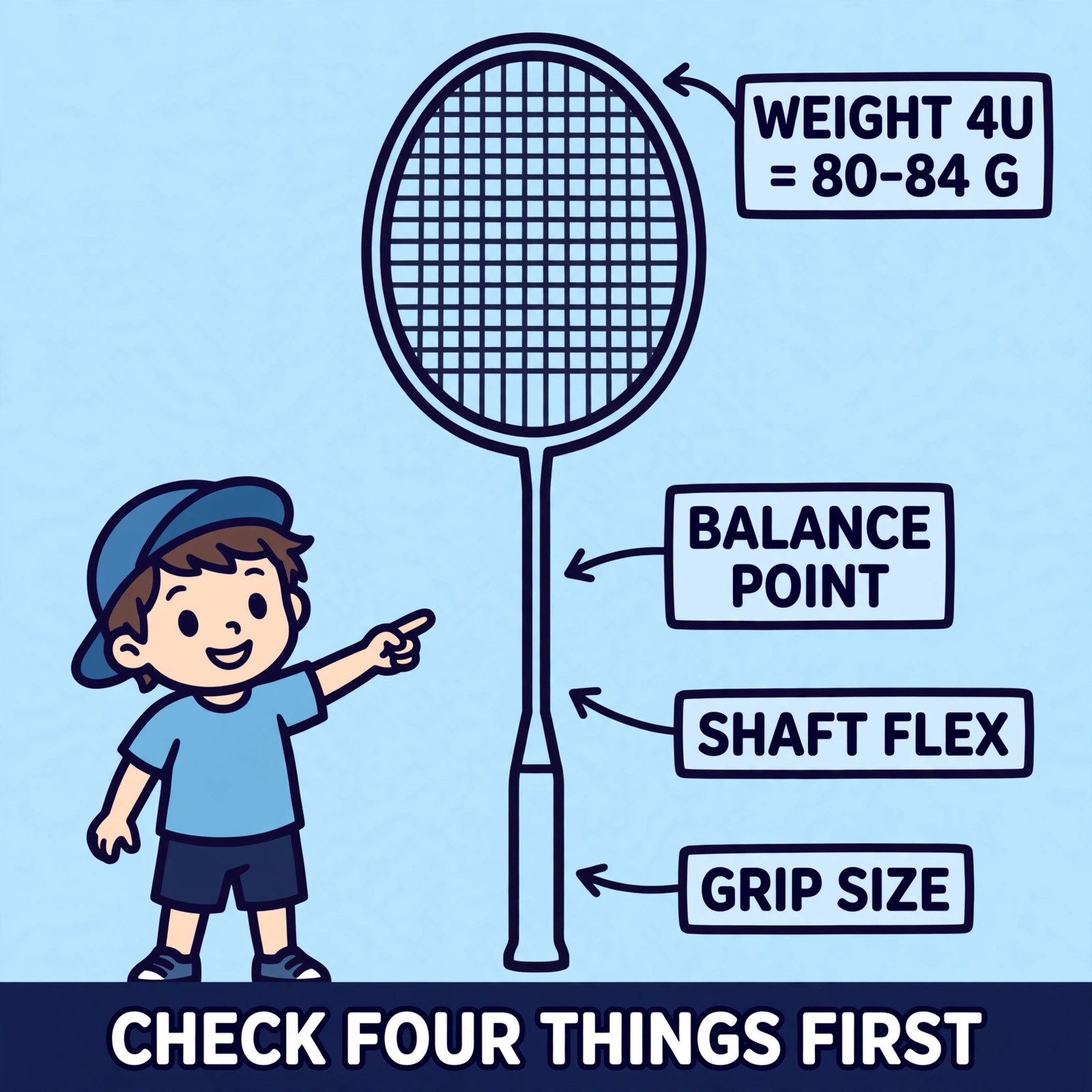
Start with weight. Badminton rackets are grouped in U classes: 3U is about 85 to 89 grams, 4U is 80 to 84 grams, and 5U is 75 to 79 grams. Most beginners do best with 4U or 5U. Light enough to defend quickly and play a full session without a tired arm, yet solid enough to feel the shuttle. Very heavy rackets slow down your defence, and defence is where beginners spend most of every rally.
Next, the balance point and the shaft. Balance tells you where the weight sits: head-heavy rackets put power into smashes, head-light rackets swing faster for defence, and even-balance rackets sit in the middle, the safest starting point while you learn every shot. Shaft flex matters just as much. A flexible or medium shaft bends during your swing and helps you clear to the back line even before your technique is strong. A stiff shaft only rewards players who already swing fast and clean.
Finish with grip size and a swing test. Grip sizes run from G3 (large) down to G6 (small); most Malaysian juniors and adults with smaller hands suit G5 or G6. Wrap your fingers around the handle: there should be a small gap before your fingertips touch your palm. Then take ten shadow swings and a few practice clears. If the racket feels like an extension of your arm instead of a tool you are carrying, you are close.
Racket Check #3
Why Do Weight and Balance Change Every Shot?
Weight and balance change every shot because they decide how fast the racket head moves and where it wants to go. A head-heavy racket keeps travelling forward once it starts, which is why it smashes hard, but that same weight makes it slower to bring back for the next defensive shot. In a fast rally, a heavy head turns small delays into lost points.
A head-light racket does the opposite job. It changes direction quickly, so net shots, drives and blocks feel easy, but you must supply more of the power yourself on clears and smashes. Even balance splits the difference, which is why coaches in Kuala Lumpur usually start beginners there: you can learn attack and defence on the same racket without either side feeling like hard work.
This is also why copying a friend’s favourite racket so often disappoints. Two players with different strength, swing speed and playing style need different setups. When our coaches fit a racket at the academy, we watch the player hit first, how they clear, how they defend, how tired the arm gets, and only then talk about grams and balance points. The player comes first; the specs follow.

Racket Check #4
What Do the Numbers on the Shaft Mean?
The numbers printed on the shaft and cone are a small spec sheet, once you know the code. The U number is the weight class: 3U, 4U, 5U, with bigger numbers meaning a lighter racket. The G number is the grip size: G3 is the thickest handle, G6 the thinnest. Many frames also print a balance figure in millimetres and a recommended string tension range.
Strings deserve their own minute. Most new rackets arrive with factory strings set low for storage, and they feel loose and dull after a few weeks of play. Beginners play best around 20 to 24 lbs of tension: the string bed gives a little, the sweet spot feels bigger, and clears travel further with less effort. Very high tensions belong to advanced players; on a learning arm they shrink the sweet spot and send shock into the elbow.
One more number hides in plain sight: the frame material. Full graphite and graphite-composite frames are light, stable and kind to the arm. Cheap steel and aluminium frames are heavier and vibrate more, which is fine for a school hall spare but slows real learning. If you only remember one line from this section, make it this: read the shaft before you admire the paintwork.

The Fitting
What Happens in a Beginner Racket Fitting?
A beginner racket fitting at our Setapak academy starts with the rackets you already own or are thinking of buying. We weigh them, check the balance point, and look at the grip: is the handle the right thickness, is the grip worn smooth, are the strings past their best? Small fixes, a fresh overgrip, a restring at beginner tension, often rescue a racket that felt wrong.
Then you play. Short rallies, clears to the back, quick defensive blocks at the front. The coach watches whether the racket helps or hinders: can you lift under pressure, does the smash come back fast enough for the next shot, does your forearm tire before the drill ends? Two or three candidate rackets usually get tested side by side, because feel is easier to judge in comparison than from memory.
You leave with a simple answer, not a sales pitch: keep this racket and restring it, add an overgrip and play on, or look for a 4U even-balance frame with a medium shaft when you are ready to buy. Parents appreciate that the same person who coaches their child also strings the rackets, so the advice and the setup always match.

Myth vs Reality
Myths About Beginner Rackets
Myth: “Buying the racket a pro player uses will make me play like them.” Reality: Pro setups are stiff, heavy and strung very tight, matched to elite strength and technique. In a beginner’s hand that same racket produces weak clears, slow defence and a sore arm. Fit beats fame at every level below the pros.
Myth: “Tighter strings always give more power.” Reality: It works the other way. Tighter strings give control to players who generate their own power; looser strings give beginners a trampoline effect and a bigger sweet spot. Myth: “A heavier racket is a stronger racket.”
Reality: Heavier only means harder to move. For learning players, a lighter racket builds faster hands, cleaner technique and longer rallies. At ST Badminton Academy KL we see the same pattern every term: the student who switches from a heavy, famous frame to a light, well-fitted one improves within weeks, with no change in talent, just a racket that finally suits the player holding it.

Why Choose Us
Real Racket Planning for New Players
ST Badminton Academy Malaysia in Setapak is built around small groups: max 4 students per group, always. That matters for gear advice too, because the coach sees your shots up close every session. When a student’s clears keep dying at mid-court or their defence is always late, we can tell whether the problem is technique, footwork, or a racket that does not suit them.
Our head coach, Mr Eric Chuar, has over 15 years of coaching experience in Singapore and Malaysia, and he is a certified stringer. That combination is rare and useful: the person correcting your grip on court is the same person who can restring your racket at the right tension and fit a grip that matches your hand. Students get one honest setup instead of separate advice from a shop and a coach who never meet.
We keep the advice straight. Sometimes the answer is that your current racket is fine and you should spend on coaching and court time instead. Sometimes a restring at the right tension fixes everything. And sometimes a new player really is fighting the wrong frame. If you train in Setapak, Wangsa Maju, Gombak or nearby, bring your racket to a session and let us check it with you.
FAQs: Beginner Badminton Rackets in Malaysia (KL)
Here are answers to common questions from beginners and parents in Kuala Lumpur about choosing a first badminton racket.
What should I look for in a first badminton racket if I live in Setapak or Gombak?
Start with four checks: a light weight around 4U or 5U, an even balance, a flexible or medium shaft, and a grip that fits your hand with a small finger gap. Bring your current racket if you have one. At our Setapak academy we check new students’ rackets in their first session and adjust grips or strings on the spot.
What is the best order to check weight, balance, flex and grip in KL?
Check in this order: weight first, because it sets how tiring the racket feels; balance second, because it shapes your shots; shaft flex third, matched to your swing speed; grip size fourth, in your own hand; and strings last, set around 20 to 24 lbs. Skipping the order is how beginners end up with a frame that fights them.
How do I know if a racket fits a child who plays at beginner level?
Look for a light 5U or 4U frame, a small grip their fingers can wrap with a gap, and a flexible shaft that helps them clear while their technique grows. Avoid stiff, head-heavy pro models: young wrists are still developing, and a forgiving racket builds cleaner habits and keeps practice fun for longer.
Is a stiff, head-heavy pro racket suitable for a child who is 13 or 14?
Usually, no. A stiff, head-heavy pro racket asks for strength and timing that most 13 and 14 year olds are still building. It slows their defence, shortens their clears and can strain a growing arm. A light, even-balance racket with a medium shaft serves them far better now; the pro-style frame can wait until their game is ready for it.
What badminton tournaments in Malaysia should new players enter?
Start with school competitions, club friendlies and small local open events around Kuala Lumpur and Selangor. Bring a racket you already trust, strung at a tension you can control. We prepare our beginners step by step, so their first event feels like a slightly bigger training game, and the focus stays on rallying well rather than on gear.
Do you offer racket checks and beginner coaching near Wangsa Maju?
Yes. Our academy is in Setapak, a short drive from Wangsa Maju, Melati Utama and Danau Kota. Bring the racket you use or plan to buy, and our coach, a certified stringer, will check its weight, balance and grip, and restring it at a beginner-friendly tension if needed. Groups stay small, max 4 students.
Does your academy help beginners choose and restring rackets in Malaysia?
Yes. We help students choose a first racket before they spend, restring rackets at tensions matched to their level, and replace worn grips. Because our head coach coaches and strings, the setup on your racket matches the technique you are learning in sessions. Ask us to look at your racket during any training session at Setapak.
Where is ST Badminton Academy KL located for beginner training?
We are based in Setapak, Kuala Lumpur, easy to reach from Gombak, Air Panas, Wangsa Maju and nearby areas. Beginner groups run with max 4 students, so the coach sees your grip and strokes in every rally. If you are nearby, come and watch a session first, and bring your racket for a quick check.
What makes Mr Eric Chuar a suitable coach and stringer for beginner badminton?
Mr Eric Chuar has over 15 years of coaching experience in Singapore and Malaysia, and he is also a certified stringer. He fits rackets the way he coaches: watch the player first, then adjust the gear. Students get honest advice on weight, balance and tension, plus corrections to the grip and technique that make any racket play better.
Badminton Racket Fitting in Action


What It Takes to Choose the Right First Racket
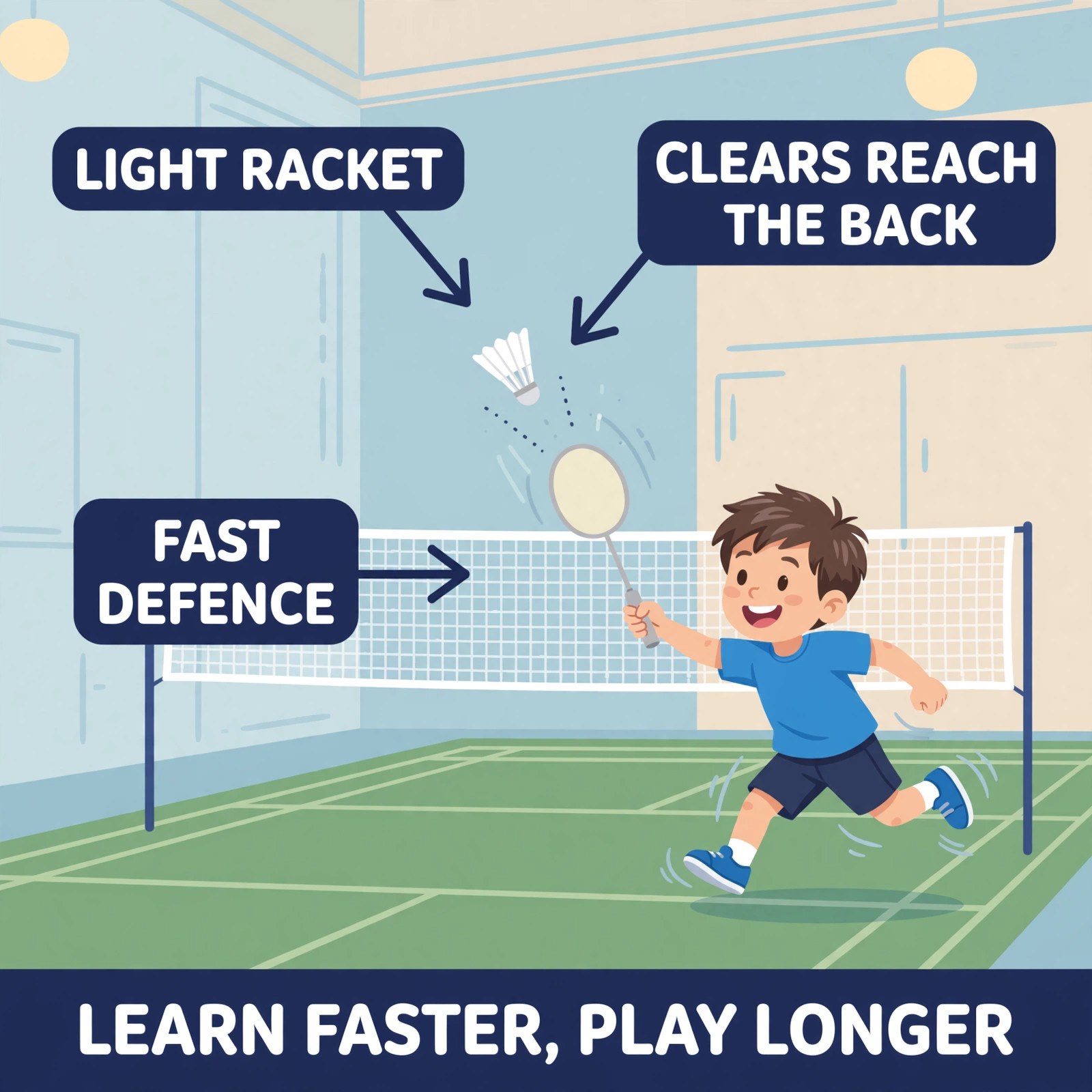
A good beginner racket is not a lucky guess. It follows simple standards: light enough for fast defence, balanced enough for every shot, strung soft enough for a learning arm, and fitted to the hand that holds it. Our standards below are the same checks we run on every new student's racket in Setapak.
| Factor | Guessing in the Shop | Fitted Beginner Setup FITTED |
|---|---|---|
| Frequency | 1 or 2 times a week. Mostly for fun and sweat. | Weight, balance and shaft flex matched to your hand, your swing and your current level. |
| Drills Focus | Basic static feeding. Minimal footwork pressure. | Grip size checked in your own hand, with strings set at a tension beginners can control. |
| Physical Conditioning | Rarely included. Just playing games on court. | Core, agility, and speed training included in every session to prevent injury and build stamina. |
| Tactical Awareness | "Just hit it over." No real game plan. | Video analysis, point construction, and learning to read the opponent's game. |
| Coach Ratio | Large groups (8-10 kids). Coach barely watches you. | Max 4 students. Mr Eric Chuar personally corrects every stroke and movement detail. |
| Goal Setting | Fun and exercise. | A clear fitting target: clears that reach the back line and defence that stays fast and relaxed. |
| Long Term Result | Good recreational player. | A beginner whose racket helps every shot instead of fighting their technique. |
Beginner Badminton Racket Help in Kuala Lumpur
This guide shows how to find the perfect badminton racket for a beginner: check the weight, feel the balance, match the shaft flex to your swing, fit the grip to your hand, and set strings you can control. ST Badminton Academy KL provides small-group coaching in Setapak, and our head coach is a certified stringer who checks rackets personally. If you are in Wangsa Maju, Gombak, Cheras or nearby and want a coach to look at your current racket before you buy a new one, contact us today.






