The Mental Game Of Badminton: Overcoming Anxiety And Nerves On The Court (Nerves Guide)
Almost every badminton player knows the feeling. You are standing behind the service line, or waiting for your name to be called, and your stomach is doing somersaults. Your grip feels too tight, your heart is thumping, and your head is already playing the match three different ways, none of them good. This guide is about that feeling: where match nerves come from, why they are normal, and the simple routines that help you play well with them. Breathing, cue words, process goals and a steady pre-match routine, taught the way we coach them at ST Badminton Academy in Setapak, Kuala Lumpur.

Nerves Check #1
Why Nerves Show Up Before a Match
Nerves are your body getting ready, not your body failing you. Before a match that matters to you, your system does what it is built to do: the heart beats faster to move blood to the muscles, breathing gets quicker, the stomach tightens, and your attention starts scanning for danger. On a badminton court the danger is ordinary: a stronger opponent, a watching parent, a score you do not want to lose. The feelings are the same ones athletes in every sport report before they compete, from school finals to world finals.
The trouble is rarely the butterflies themselves. The trouble is what a player does next. One player decides the feelings mean disaster, grips the racket like a hammer, rushes the serve and stops moving her feet. Another player feels the same butterflies, breathes out slowly, says her cue word and plays the first rally exactly as planned. Same body, different routine. That is the honest starting point of this guide: you may never remove nerves completely, and you do not need to. You need a way of playing well while they are there.

Nerves Check #2
Slow Breathing: The Fastest Way to Settle
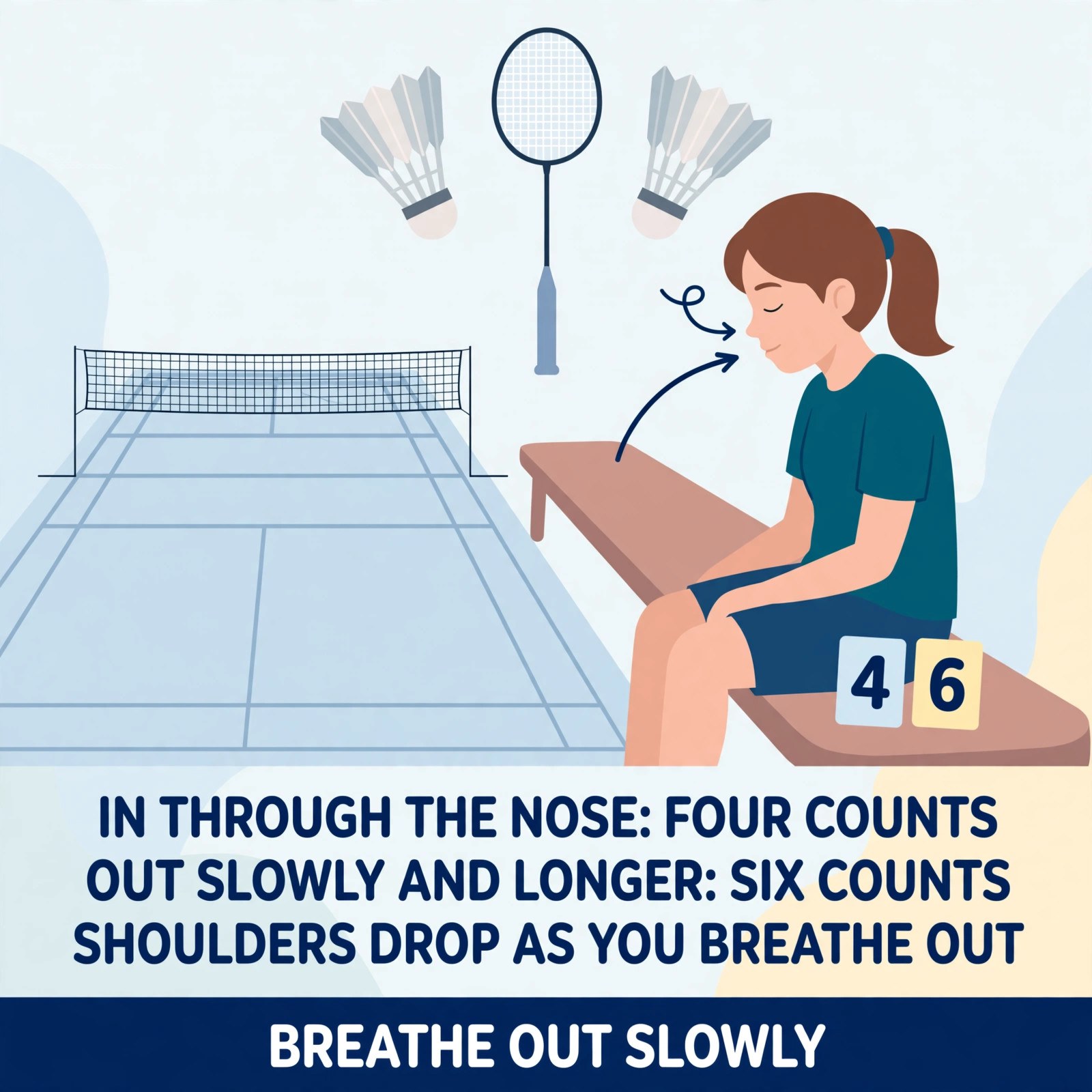
Slow breathing is the fastest settler you own, because it works on the body first and the mind follows. When you breathe out slowly, you send your system the signal that the rally, or the waiting, is over. The heart rate eases, the shoulders drop, and the tight jaw and tight grip soften with them. Players are often surprised that something this plain does anything at all, until they try it properly in a match instead of only reading about it.
The pattern we teach is simple. Breathe in through the nose for a count of four, then breathe out through the mouth for a count of six. The out breath is longer than the in breath; that is the whole trick. Do it three or four times while you walk back to your position, towel off, or wait for the serve. There is no special equipment and nobody watching can tell you are doing it. It fits inside the natural pauses of a badminton match, which is exactly why it works there.
Like every other skill in this guide, breathing settles you best when it is practised before you need it. We build it into training: slow breaths during the rest between drills, before every practice serve, after a hard rally in a training game. A routine you have used a hundred times in training is still there on match day. A routine you only read about tends to vanish the first time the score gets tight.
Nerves Check #3
Cue Words and Self Talk That Actually Help
Listen to what players say to themselves after a mistake and you will hear the real opponent. I always mess this up. Everyone is watching. I cannot lose to him. Those sentences are not descriptions; they are instructions, and the body follows them. The shoulders rise, the feet slow down, and the next shot is played scared. Harsh self talk feels honest in the moment, but it is usually the least accurate commentary at the match.
Cue words are the replacement. Pick one or two short phrases that tell your body what to do next: next point, watch the shuttle, light feet, loose grip. Short beats clever. The word is a handle for your attention: it gives the mind one job instead of ten worries. Say it quietly as you walk back, or just before the serve, every rally, the same way. In time the word and the settled feeling become linked, and the word alone starts the settling.
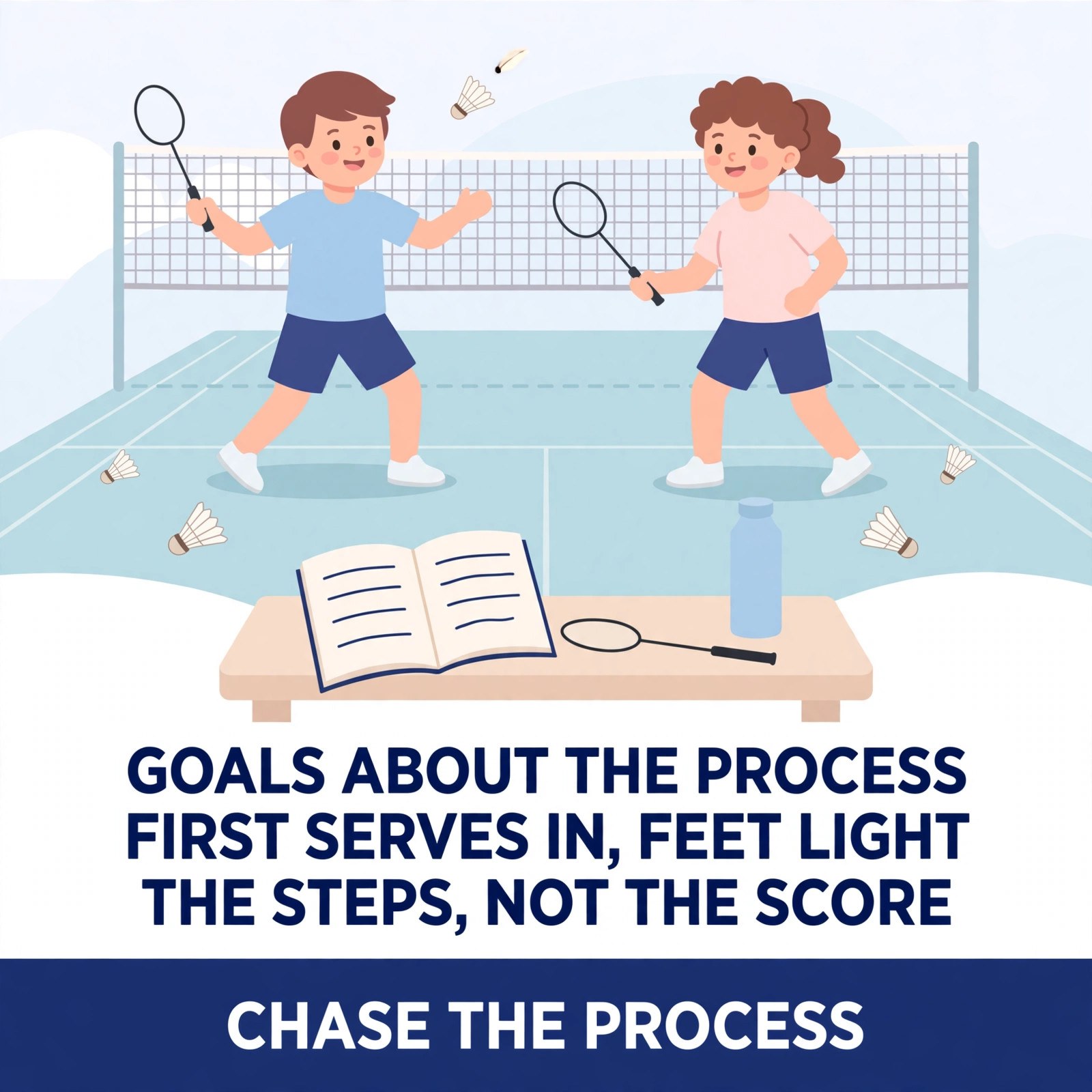
Process goals are the other half. An outcome goal says win this match, which you cannot fully control. A process goal says get my first serves in, or recover to base after every shot, which you can control, rally by rally. Nerves grow when attention sits on things outside your control: the score, the opponent, the crowd. Process goals shrink the match back down to the next action, and the next action is always playable.

Nerves Check #4
Mistakes, Scores and Stronger Opponents
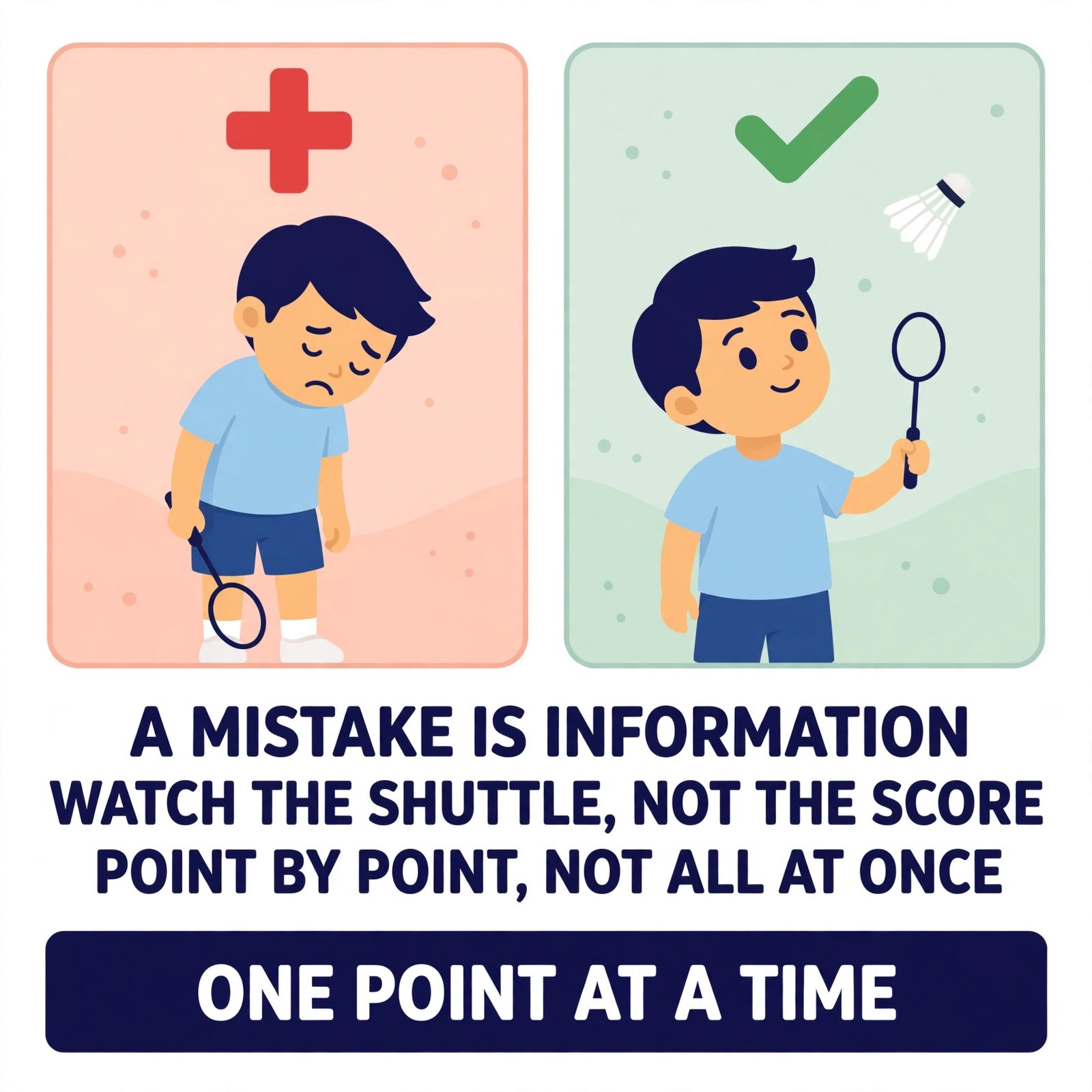
Fear of mistakes is the most common nerve at club and school level. A player misses an easy net shot, decides the whole hall saw it, and starts playing safe: clearing everything, avoiding the net, hoping the opponent makes the errors. Safe badminton is slow badminton, and it usually loses slowly. A mistake is better treated as information. The net shot was rushed, or the feet were late. Note the cause, fix the cause on the next rally, and let the point go.
The scoreboard feeds nerves because it is always about the past or the future: the points already gone, or the points you still need. Neither can be played. The only point you can play is the one in front of you. This is why coaches keep saying one point at a time. It is not a poster slogan; it is an attention rule. Between rallies, use your reset: turn away, breathe out, say your cue word, then turn back and watch the shuttle.
Playing someone stronger brings its own nerves, plus a strange freedom. Nobody expects you to win, so the process goals can take over completely: return well, make them play one more shot, test their backhand. Many players produce their best badminton in these matches once they stop protecting a result they were never promised. Judge the match afterwards by your process goals, not only by the score, and the next meeting feels smaller.
Nerves Check #5
A Pre-Match Routine That Calms You Down
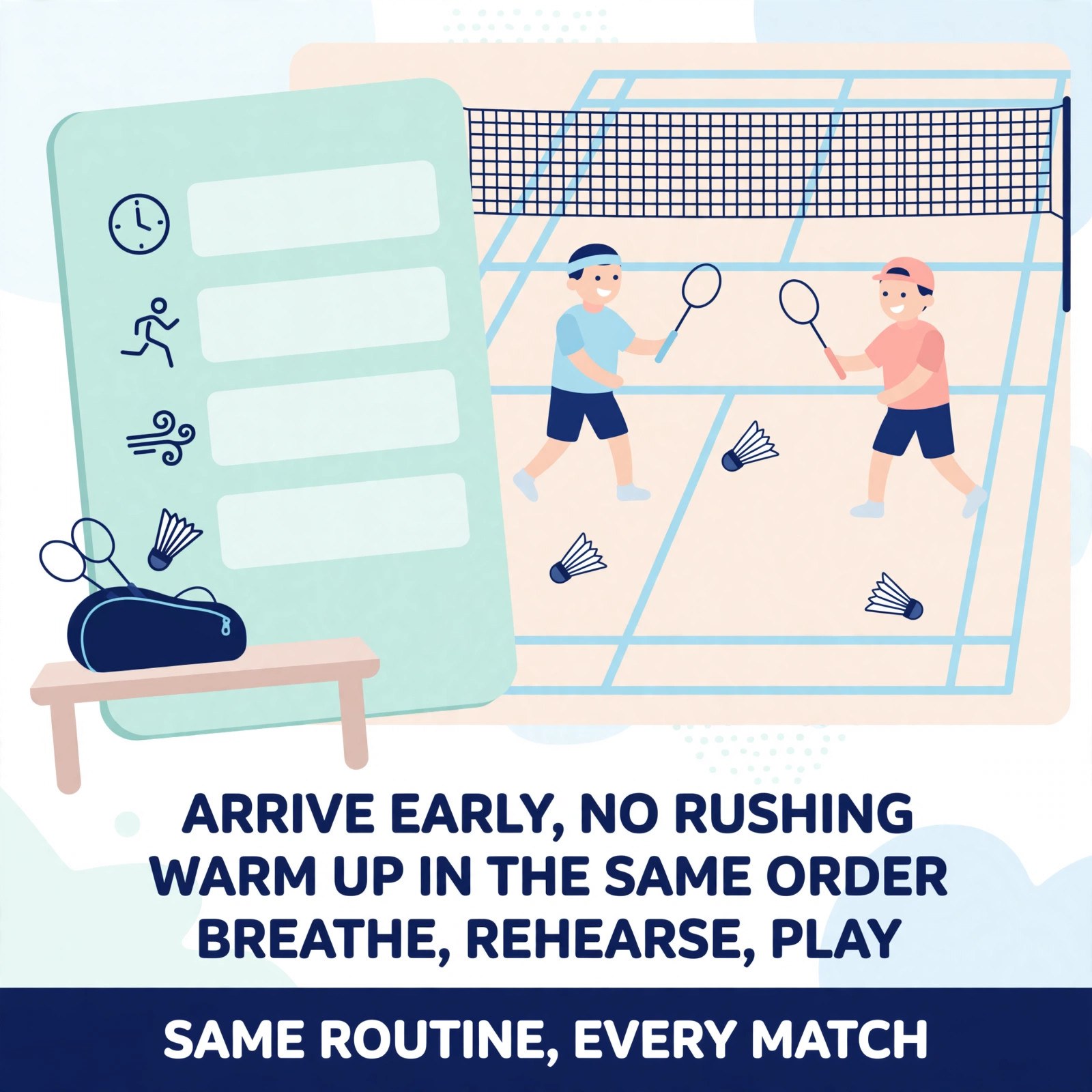
A pre-match routine turns a nervous hour into a familiar one. The details matter less than the order: arrive with time to spare, change and settle, warm up in the same sequence, practise your breathing during the warm up, rehearse the first rally in your head for a minute, then step on court. When the order is always the same, match day stops feeling like a new event and starts feeling like a bigger training day.
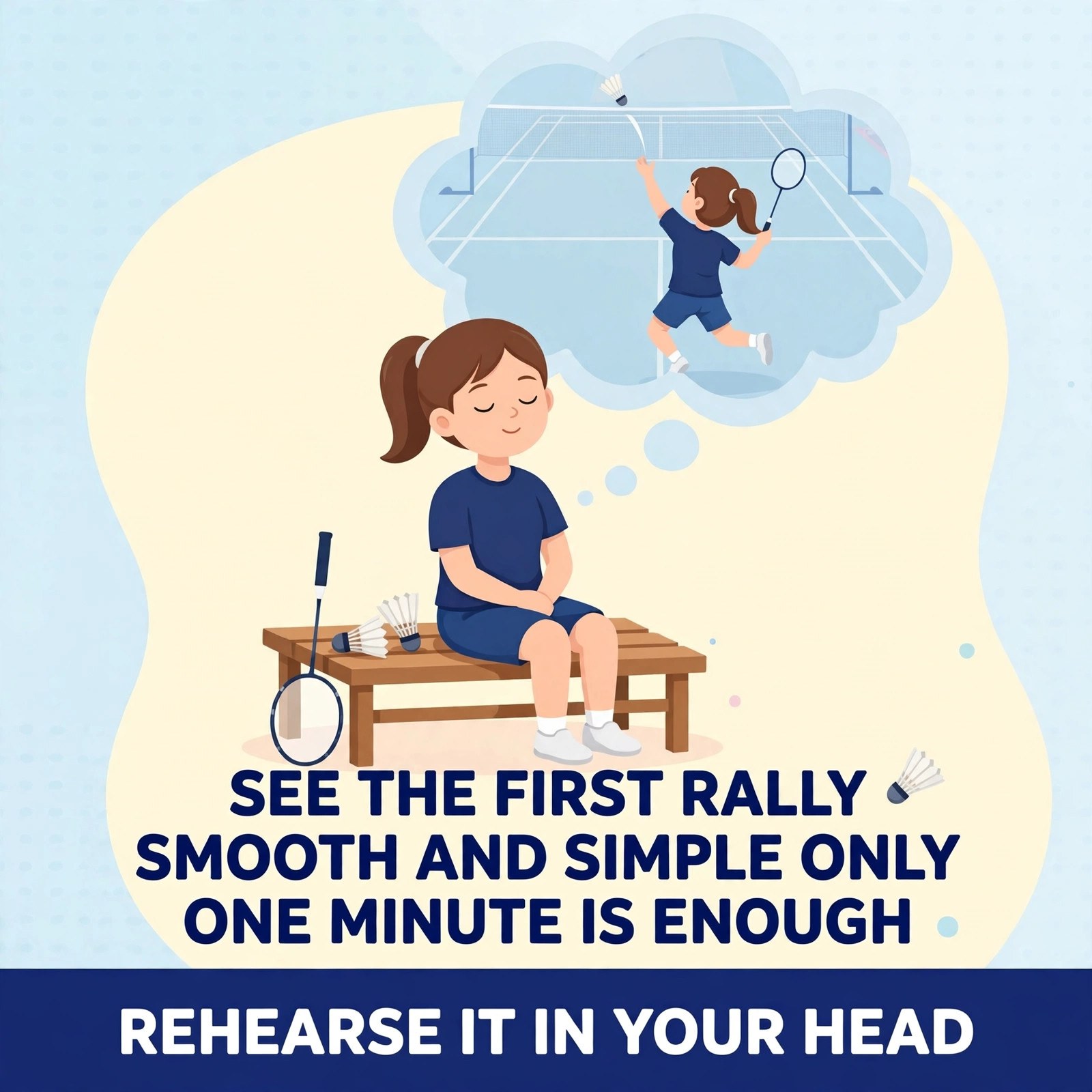
The head rehearsal is simple. Close your eyes for a minute and see the first rally played smoothly: your serve low and tight, your feet moving, your first clear deep. See it at normal speed, from your own eyes, and keep it ordinary: no trophies, no slow motion. Short and smooth beats long and dramatic. If your mind wanders to disaster scenes, that is normal too; walk it back to the first rally and run it again.
Routines are built across a season, not invented the night before a final. Start with one piece: the breathing in training. Add the reset between rallies. Add a cue word. Then put the pre-match order together for a small event before you trust it at a big one. After each match, note what helped in a notebook: two lines is enough. Over months you end up with a routine that is yours, tested, rather than a list copied from the internet.
Myth vs Reality
Myths About Match Nerves
Myth one: good players feel no nerves. Watch the best players in the world before a final and you will see the same habits as any nervous junior: the towel breaks, the slow walks, the deep breaths, the fixed routines. They are not calm because they feel nothing. They look calm because they have a routine that carries them through what they feel.
Myth two: you must be fully calm before you can play well. Some of your sharpest badminton will be played with your heart up and your stomach loud, because a raised body is also a ready body. The goal is not zero nerves. The goal is nerves at a level where your feet still move and your head still works, and that level is different for every player.
The reality is plain: nerves are a normal part of caring about your match, and they respond to practice like everything else in this sport. Breathing, cue words, process goals, a reset between rallies and a fixed pre-match order are small tools, but they are real ones. Used together and practised in training, they let most players compete far closer to their training level, which is all any mental routine can honestly promise.

Why Choose Us
Why Players Choose ST Badminton Academy
At ST Badminton Academy, the mental side of the game is coached on court, inside normal training, in groups of no more than four students per coach. That small group size matters here: a coach can see the rushed serve, the dropped head and the disappearing footwork that give nerves away, and can teach the reset and the cue words while the feeling is actually happening, not in a classroom afterwards.
Juniors and adults learn the same toolkit in ways that suit them. Juniors learn routines as habits first: the reset between rallies, one cue word, breathing during rests. Adults usually add the notebook work and the pre-match order. Nobody is asked to share feelings in a circle or perform confidence. The work is practical: spot the moment the nerves take over, apply the tool, get the feet moving again.
We are also clear about the boundary of coaching. We teach routines for ordinary match nerves, the butterflies before a school final or a club match. We are not counsellors or doctors, and this guide is not treatment for anything. If worry is heavy enough to affect sleep, school, work or daily life away from badminton, the right step is a proper conversation with a doctor or a counsellor, and we will say so plainly.
FAQs: Badminton Match Nerves and the Mental Game in Malaysia (KL)
These are the questions players and parents ask us most about nerves before and during matches. The short answer running through all of them: the feelings are normal, the tools are simple, and all of them work better when they are practised in training first.
What can I do about match nerves if I train in Setapak or Gombak?
Start with the tools in this guide: slow breathing between rallies, one cue word, and a fixed pre-match order, practised in training at our Setapak base until they feel automatic. Small groups mean a coach watches your match habits up close and helps you build the routine piece by piece.
Why do I still feel nervous before friendly games in KL?
Because nerves answer to caring, not to the size of the event. If the result matters to you, even a friendly game against a regular partner can switch them on. That is normal, and friendly games are actually the best place to practise your breathing, your reset and your cue words.
How do I stop one mistake from ruining the rest of my match in level?
Give the mistake a job and a time limit. Name the cause in one short line, late feet or rushed swing, then run your reset: turn away, breathe out slowly, say your cue word, and play the next point on your process goal. The point is gone; only the habit carries forward.
Should I try to remove nerves completely, or learn to play with them at any level?
Learn to play with them. Even top players feel nerves before big matches; what they own is a routine that works while the butterflies are there. Chasing total calm usually adds a second worry, being worried about being worried. Aim instead for settled enough: breathing steady, feet moving, head on the next point.
What breathing pattern helps when nerves rise during a match?
The pattern we teach is four counts in through the nose, six counts out through the mouth, repeated three or four times. The long out breath is the settler. Use it while you walk back to position, during a towel break, or before you serve, and practise it in training first.
Do you coach the mental side of the game near Wangsa Maju?
Yes. Our base is in Setapak, a short drive from Wangsa Maju, and the mental routines are taught inside normal sessions rather than a separate course. Breathing, resets, cue words and pre-match order are practised during drills and training games, with a coach watching how you respond when the score tightens.
Can juniors learn match day routines for nerves in Malaysia?
Yes, and juniors often learn them fastest because routines suit how young players already train. We keep it simple and practical: one cue word, a breathing habit during rests, and the same reset after every point. No lectures and no pressure to perform confidence, just habits repeated until match day feels familiar.
Where does ST Badminton Academy coach badminton in Setapak?
Our home base is Setapak in Kuala Lumpur, and that is where the full programme runs, including the mental skills work in this guide. Players join us from Wangsa Maju, Gombak and across the city. Tell us your area when you book a trial and we will confirm the session times that suit you.
What makes Mr Eric Chuar a good coach for nervous players in badminton?
Mr Eric Chuar has coached in Singapore and Malaysia for over fifteen years, and he treats nerves as a coaching topic, not a character flaw. In his small groups he spots the rushed routines and dropped heads early, teaches the reset on the spot, and keeps the whole thing practical and unembarrassed.
Badminton Mental Game Training in Action


One Standard for Every Player and Every Session
One standard runs through every tool in this guide: practise it in training before you trust it in a match. At ST Badminton Academy, breathing, cue words, resets and pre-match routines are drilled the same way footwork is drilled, in small groups, with a coach watching. Players log what helped after matches and adjust one piece at a time. Nerves do not disappear under this standard, and we never promise they will. What changes is the player carrying them: steadier feet, a quieter grip, and a head that stays on the next point.
| Factor | Chasing the Score | Playing Point by Point NERVES |
|---|---|---|
| Frequency | 1 or 2 times a week. Mostly for fun and sweat. | A fixed routine before every match: arrive, warm up, breathe, play. |
| Drills Focus | Basic static feeding. Minimal footwork pressure. | Cue words and slow breaths between rallies, practised in training first. |
| Physical Conditioning | Rarely included. Just playing games on court. | Core, agility, and speed training included in every session to prevent injury and build stamina. |
| Tactical Awareness | "Just hit it over." No real game plan. | Video analysis, point construction, and learning to read the opponent's game. |
| Coach Ratio | Large groups (8-10 kids). Coach barely watches you. | Max 4 students. Mr Eric Chuar personally corrects every stroke and movement detail. |
| Goal Setting | Fun and exercise. | One point at a time, with mistakes treated as information, not verdicts. |
| Long Term Result | Good recreational player. | A player who still feels the butterflies, and plays well with them anyway. |
Badminton Mental Game Coaching in Kuala Lumpur
This guide gives you the full picture: nerves are normal, breathing settles the body, cue words steer the head, process goals shrink the match, and a fixed pre-match order makes the day familiar. None of it is magic, and all of it improves with practice. If you want the routines taught and watched rather than guessed, come and try a session with us in Setapak, Kuala Lumpur. Bring your next match with you, in your head, and we will build your routine around it.






