Perfect Your Badminton Drop Shots For Strategic Wins (Drop Shot Guide)
The drop shot is the quiet shot that wins loud rallies. Played from the rear court, it floats over the tape and dies in the front court, dragging your opponent out of position and forcing a lift or a weak reply you can finish. Most players treat it as a soft option for tired moments. Used properly, it is an attacking weapon, and it works because it shares its preparation with your clear and your smash. This guide covers badminton drop shots the way we coach them at ST Badminton Academy in Setapak, Kuala Lumpur: the disguise, the touch, the targets, the combinations, and how to defend against a good drop yourself.
Touch Check #1
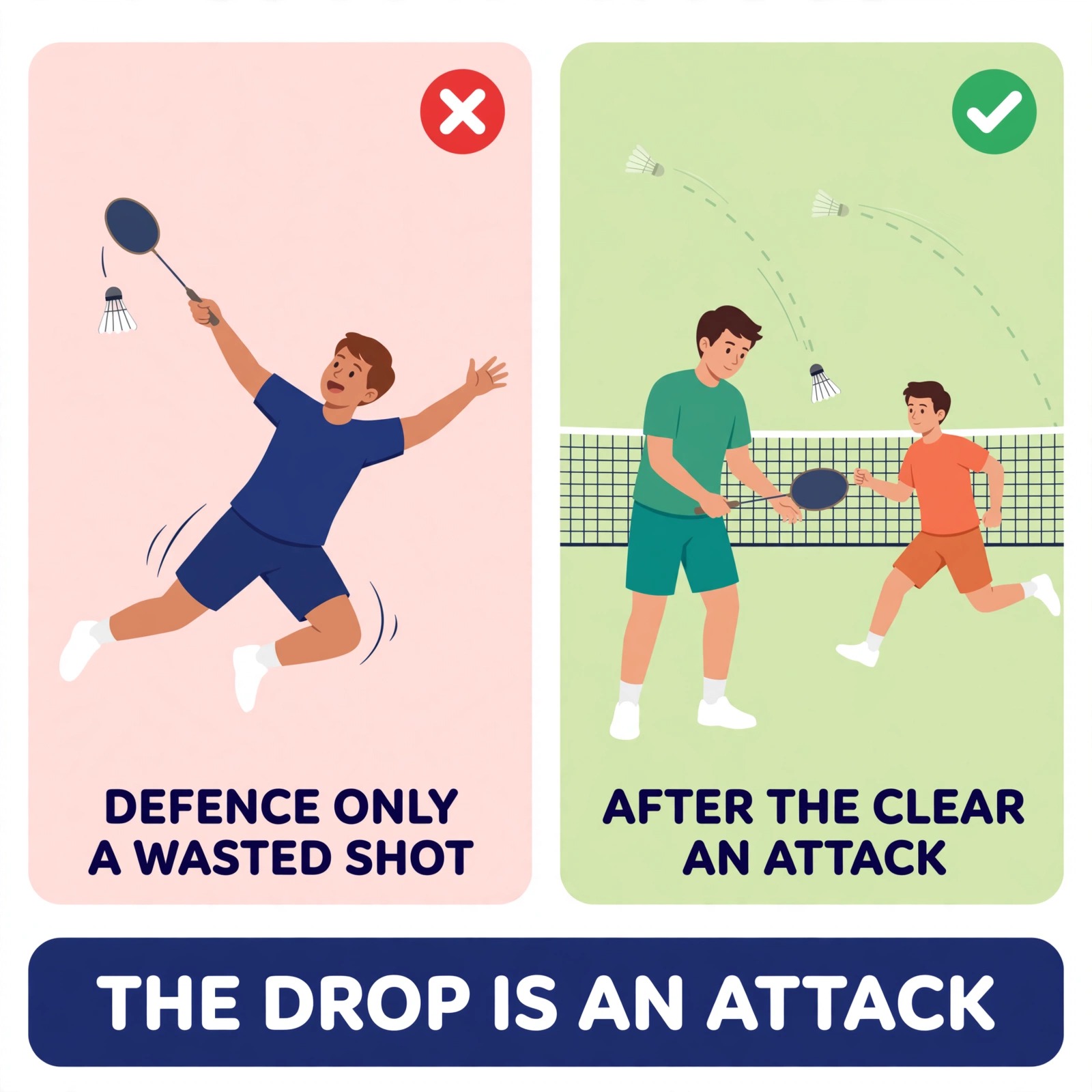
Is the Drop Shot Only a Defensive Shot?
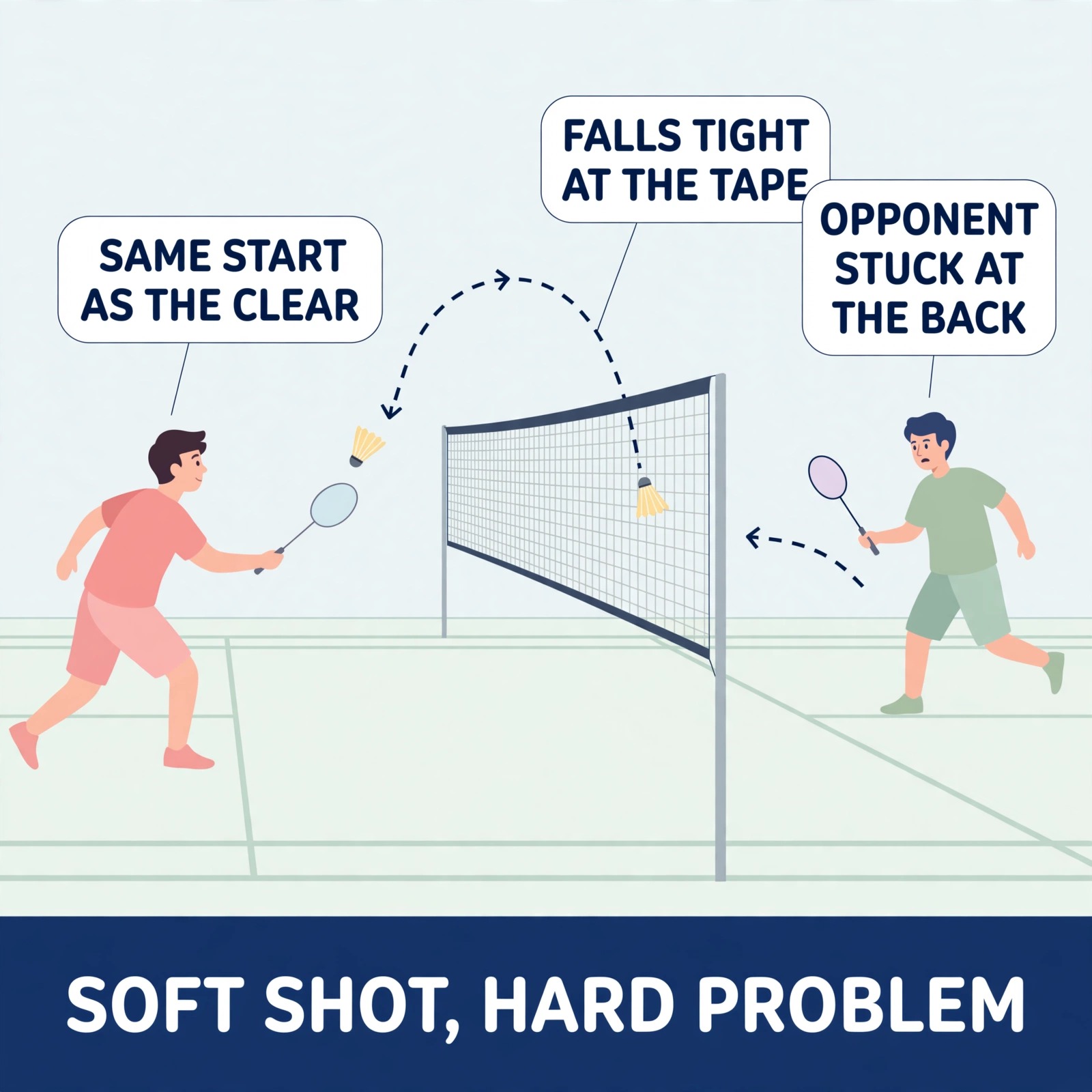
A drop shot is played from the back of your court and lands tight in the front of theirs, as close to the net as you can control. It is not a failed clear or a gentle lob. Done well, the shuttle climbs just enough to cross the tape, then loses its fight and drops almost straight down. The opponent, waiting deep for your clear or smash, has to sprint forward and play upward, and playing upward is where rallies turn in your favour.
That is the strategic point of the shot. The drop is how you move a strong defender without out-hitting them. Push them deep with clears, drop them short, and the court suddenly becomes very long. Alternate the two and even fast players start guessing, and a guessing player is a late player. The sections below build the shot in order: disguise first, because a drop everyone can read is just a slow gift to the net.
Touch Check #2
One Preparation, Three Shots
Disguise is the drop shot’s power source. The preparation must look exactly like your clear and your smash: same approach, same side-on shape, same backswing, same speed of arm until the last moment. Only at the end does the swing soften and the shuttle get guided instead of hit. If your drop has its own special wind-up, shorter, slower, apologetic, your opponent reads it early and is standing at the net before the shuttle crosses.
The hand does the softening. Use the normal forehand grip and keep the fingers relaxed; a drop played with a tight grip and a locked wrist has no feel in it, and feel is the whole shot. Contact stays high and in front of the body, the same contact as your clear. From there, touch is a matter of how much of the swing you let through: full speed for a clear, a checked, softer finish for the drop, with the racket face guiding the shuttle rather than punching it.
Know your two speeds. The fast drop travels flatter and lands a little deeper, around the front service area, rushing an opponent who is slow to come forward. The slow drop climbs higher, stalls over the tape and tumbles down tight against the net; it is harder to control and deadly against a player camped deep. Neither is better. The right one is the one your opponent’s position is asking for, which is why reading comes before touch in a real rally.

Touch Check #3
Where Should a Drop Land?
The straight drop is the percentage play: down the same side you are standing, into the front corner near the tramline. It travels the shortest distance, so it is the easiest to control, and it pulls the opponent forward on their forehand or backhand side, whichever you have been working on. Played after two or three deep clears to the same corner, it lands in the space their retreat created.
The cross-court drop is the artist’s shot and the risk-taker’s. It travels the long diagonal, spends longer in the air, and needs finer height control, because a cross drop that sits up is a net kill waiting for your opponent. Use it when the opponent has started camping on your straight drop, or when their cross side is clearly the slower one. In doubles, add a third target: the middle, dropped between two partners, where the reply belongs to neither of them cleanly.
Slicing adds the final layer of control. Instead of meeting the shuttle flat, the racket cuts slightly under and across the base of the cork, so the shuttle spins, slows, and stays tight to the tape. The reverse slice, cutting the other way, sends it cross court with the same effect. Spin comes from that cut at contact, not from a big theatrical follow-through. Keep the action small and the preparation identical, and the slice becomes a touch weapon instead of a party trick.

Touch Check #4
When Does a Drop Win the Rally?
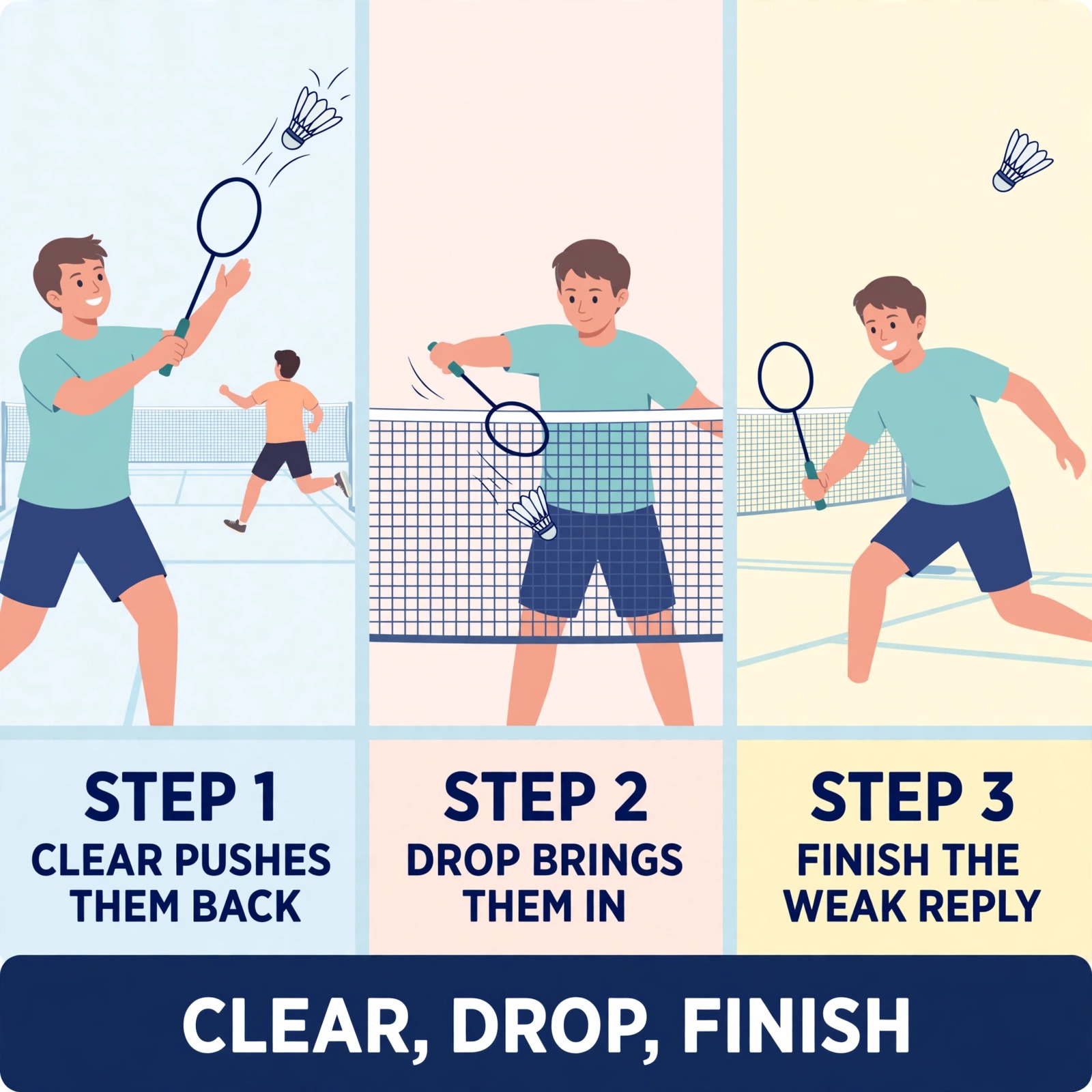
A drop wins when the rally was built for it. The classic pattern: clear deep twice, make the opponent respect the back, then drop the third shuttle from the same preparation. They are a half step late starting forward, the reply is a lift or a stretched net shot, and both leave you attacking. Dropping from a neutral first shuttle, against an opponent standing ready at mid court, gives away the front and invites exactly the pressure you were trying to create.
After the drop, move. The shot is only half the plan; the other half is you stepping in behind it, ready at the front for the weak reply. Drop and admire it, and a good opponent plays a cross net shot into the space you vacated. Drop and follow, and you own the front court: their lift feeds your smash, their net reply meets your racket first. Combinations win rallies; single shots just visit them.
Know when the drop is the wrong shot. When you are late, stretched, and hitting from below your best contact at the very back, a drop is a donation: it floats, sits up, and gets killed. From there, the clear buys you time and resets the rally honestly. The same discipline applies when your drops keep catching the tape: the fault is usually contact height or a grip that has gone tight, not courage. Fix the cause, then bring the shot back.
The Reply
Defending and Returning Drop Shots
Defending the drop starts before it is hit. Split step as your opponent swings, balanced on the balls of your feet, ready to drive forward. Because a well-disguised drop looks like a clear, you cannot wait to see the shuttle’s flight; you read the preparation and move on the swing. Players who wait for certainty arrive in time to watch it land. Players who split and read arrive in time to play.
When you get there, you have real choices. Balanced and early, play your own net shot tight and take the front away from them. Stretched and late, lift deep to the back and rebuild the rally from defence instead of donating a net error. The cross-court net reply is the escape artist’s option when the straight reply is covered. What you cannot do is nothing: a drop returned passively is a smash invitation with your name on it.
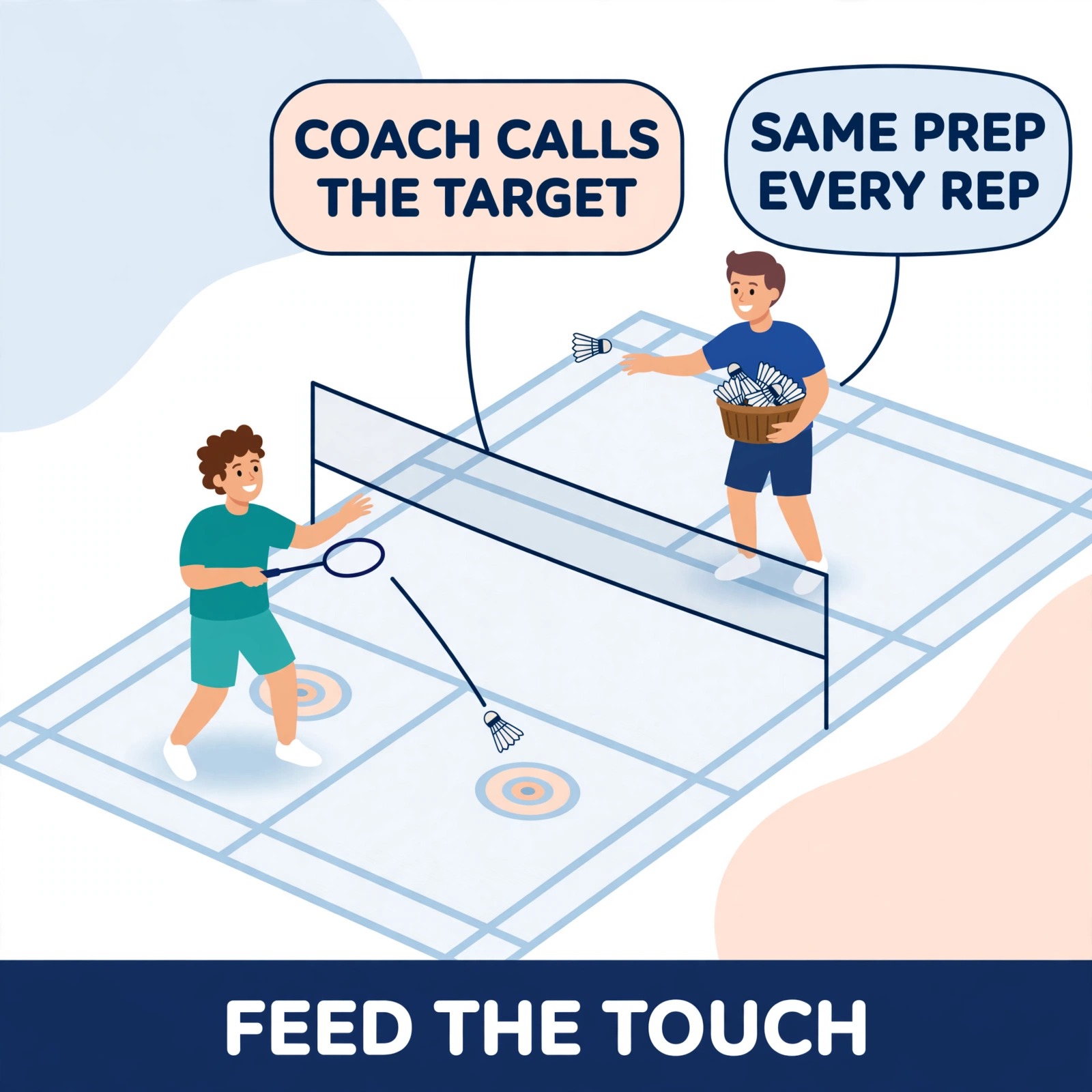
Touch is trained like everything else: in patterns. Multi-shuttle feeding from the rear court groves the same preparation with drop and clear called late by the coach. Shadow work builds the footwork so you arrive early enough to have touch at all. Drop and net rallies, where the rally must continue at the front after your drop, teach the follow-in. A note on shuttles: feather shuttles reward touch with finer control than plastic, and playing with a speed grade that suits your hall keeps drops honest in practice.

Myth vs Reality
Myths About Drop Shots
Myth: “The drop shot is a defensive shot.” Reality: a drop played from a good position, after your clears have pushed the opponent deep, is an attack. It forces the weakest reply in the game, a lift played while sprinting forward. Defence is what the opponent is doing while you play it.
Myth: “Disguise means a trick grip or a late flick.” Reality: disguise means the opposite: nothing changes. Same preparation, same swing shape, one softened finish. Myth: “The slow drop is always the better drop.” Reality: against a player who is slow coming forward, the fast drop that lands deeper wins more rallies with far less risk.
Myth: “You need very tight strings for touch shots.” Reality: touch lives in relaxed fingers and a clean contact, not in the string bed. A tighter bed can even punish a developing drop by shrinking the margin for error. Fix the hand first; the equipment conversation can wait until your contact is consistent.

Why Choose Us
Drop Shot Touch, Coached in Small Groups
At ST Badminton Academy KL, drop shots are coached inside small group classes capped at max 4 students. Touch faults are small and personal: a grip that tightens at contact, a preparation that changes shape, a follow-in that never happens. In a group of four, the coach sees them all and feeds your exact pattern, drop and clear mixed, until your opponent’s guess is a coin flip.
Mr Eric Chuar has over 15 years of coaching experience in Singapore and Malaysia. His touch rule is simple: same preparation, relaxed hand, follow the shot in. When he teaches the drop, he starts from your clear, because a drop built on your clear’s shape is disguised from the first day, and then he sharpens the targets one corner at a time.
Our academy is based in Setapak, Kuala Lumpur, convenient for players from Wangsa Maju, Melati Utama, Danau Kota and Gombak. If your drops keep finding the tape, or your opponents read them before you play them, bring them to a session. Touch faults are quick to spot from the side of the court and satisfying to fix.
FAQs: Badminton Drop Shots in Malaysia (KL)
These are the questions players ask us most about drop shots and using them to win rallies in Malaysia. If your question is not here, message us, tell us where your drops are breaking down, and we will give you a straight answer about what to fix first.
How can I learn drop shots that win points if I live in Setapak or Gombak?
Bring your clear with you, because that is where we start: your drop gets rebuilt on the same preparation, inside small groups of max 4 students at our Setapak base. Feeding mixes drops and clears so your disguise is tested properly, and your follow-in becomes part of the shot from the first session.
Why do drop shots win so many rallies in KL?
Two things: it looks exactly like your clear until the last moment, and it lands where your opponent is not. Same preparation removes their early read, and choosing the target by their position, straight, cross or middle, removes their late one. A drop with both is very hard to return well.
How many drop shots should I practise each week to reach a steady level?
Short sets, often. Touch fades when you are tired, so twenty clean drops inside your normal sessions beat one long drop marathon a month. Practise them in patterns: clear, clear, drop, then follow in. Two or three sessions a week at that rhythm builds feel faster than volume does.
Is the drop shot a good shot for beginners, or only for advanced players?
It is one of the best shots a beginner can own. Beginners play against opponents who camp at the back, and the drop punishes exactly that. The preparation is your clear’s preparation, so you are learning two shots with one shape. Start straight, add the cross court when the straight one is landing tight.
What is the difference between a fast drop and a slow drop, and when do I use each?
The fast drop flies flatter and lands around the front service area; use it against an opponent who is deep and slow to come forward. The slow drop climbs, stalls and tumbles tight at the tape; use it when you are balanced and your opponent is camped at the back. When in doubt, choose the fast one.
Do you coach drop shots and front court play near Wangsa Maju?
Yes. Drop shots and front court play are part of regular group classes at our Setapak base, a short trip from Wangsa Maju. You will train the disguise, both speeds and the follow-in against live opponents, not just feeding, because touch only counts when someone is trying to read it.
Does your academy teach how to return drop shots in Malaysia?
Yes, returning drops is trained as seriously as playing them. Split step timing, reading the preparation, moving on the swing, and choosing between the tight net reply and the deep lift when stretched. Most players discover their own drops improve once they learn how the good ones are defended.
Where is ST Badminton Academy KL located for drop shot training?
We are based in Setapak, Kuala Lumpur, close to Wangsa Maju, Melati Utama, Danau Kota and Gombak. Sessions run in small groups of max 4 students. Message us for the current class schedule and we will place your touch work in a group at your level.
What makes Mr Eric Chuar a suitable coach for touch shots and badminton?
Fifteen years of coaching in Singapore and Malaysia, and a simple belief: touch is taught, not inherited. Eric builds your drop on your clear, checks the hand stays relaxed at contact, and feeds mixed patterns in small groups where every rep is seen. Players leave with a drop their opponents have to guess at.
Badminton Drop Shots in Action


What It Takes to Drop With Control
A player meets our drop standard when five habits hold: the preparation matches the clear, the grip stays relaxed through contact, the contact is high and in front, the target is chosen from the opponent's position, and the player follows the shot in ready for the reply. When those five hold, the drop stops being a hope and becomes a plan.
| Factor | Telegraphed Drop | Disguised Drop TOUCH |
|---|---|---|
| Frequency | 1 or 2 times a week. Mostly for fun and sweat. | Before the shot, the preparation is identical to the clear: same approach, same shape, same swing speed. |
| Drills Focus | Basic static feeding. Minimal footwork pressure. | During the swing, nothing changes until the last moment, when the finish softens and the shuttle is guided. |
| Physical Conditioning | Rarely included. Just playing games on court. | Core, agility, and speed training included in every session to prevent injury and build stamina. |
| Tactical Awareness | "Just hit it over." No real game plan. | Video analysis, point construction, and learning to read the opponent's game. |
| Coach Ratio | Large groups (8-10 kids). Coach barely watches you. | Max 4 students. Mr Eric Chuar personally corrects every stroke and movement detail. |
| Goal Setting | Fun and exercise. | The target is chosen from the opponent position: straight, cross court, or the middle in doubles. |
| Long Term Result | Good recreational player. | A reply played under pressure: a lift or a stretched net shot, and your side attacks the next shuttle. |
Badminton Drop Shot Training in Kuala Lumpur
This page covered the badminton drop shot: the disguise it shares with the clear, the relaxed hand behind its touch, its targets straight, cross and middle, the combinations that make it win rallies, and how to defend against it yourself. If your drops are being read or finding the tape, the fault is small and fixable. Bring them to Setapak and let us sharpen them with you.






