Badminton And Pilates: Exercises For Core Strength And Stability (Pilates Guide)
Badminton is a one sided sport wearing a full body costume. The same shoulder hits almost every overhead, the same leg leads most lunges, and the trunk twists one way thousands of times a month. Pilates, the mat based method built on breathing, alignment and control, answers that imbalance almost perfectly. It trains the middle of the body to brace, move and breathe in an organised way, which is what core strength and stability actually mean on a badminton court. This guide explains why Pilates suits badminton players, the breathing and alignment base, and the mat basics we teach at ST Badminton Academy in Setapak, Kuala Lumpur.
Core Check #1
Why Pilates Suits the Badminton Body
Start with what stability means in a rally. A stable player is not a stiff player. Watch a strong defender take a smash at full stretch: the arm reaches, the leg lunges, yet the middle of the body stays organised, so the next movement can start at once. An unstable player folds at the waist, stumbles a half step, and arrives late for the reply. That difference is core stability: the trunk holding its shape while the limbs work around it. Badminton asks for it on nearly every shot, which is why a method devoted to it earns a place in a player’s week.
Pilates also answers the one sided problem. The hitting side of a badminton player gets strong and tight; the other side gets forgotten. Mat work is symmetrical by habit. Both legs circle, both sides bridge, both halves of the trunk learn to work, and the neglected side quietly catches up. Players often discover their imbalance in the first session, when one side of a simple exercise feels like a stranger. Finding it on a mat, slowly, is far kinder than finding it through a sore back in the third game of a tournament.

Core Check #2
Breathing and Alignment: The Pilates Base
Everything in Pilates starts with the breath. The pattern is simple to say and takes practice to own: breathe in to prepare, breathe out on the effort, letting the ribs soften down as the deep trunk muscles draw in. The exhale is not decoration. It is the switch that turns the centre on, the same brace a player needs in the instant before a smash or a deep lunge. Practised slowly on a mat, breath by breath, the brace becomes a habit that shows up on court without being summoned. Players who hold their breath through rallies usually gasp through them too; this is the fix.
Alignment is the second half of the base. Lying on the mat, you learn where neutral lives: head, ribs and hips stacked in one long line, the spine in its natural curve, neither flattened hard into the floor nor arched away from it. From that line, limbs move one at a time while the line itself refuses to shift. It sounds easy and feels surprisingly hard, which is the point. A player who can keep the line while a leg circles on a mat owns the same skill as a player whose trunk stays tall while reaching wide on court. Different stage, same actor.
Coaches call the deep middle muscles the centre, and Pilates treats them as the house everything else is built on. The work is deliberately slow. A rep that takes six seconds with full attention teaches the centre more than twenty rushed reps, because the muscles being trained are the patient, stabilising kind. This is also why Pilates suits badminton players in heavy training weeks. It loads the trunk without loading the legs, and it leaves joints alone. Ten focused minutes can do real work on a day when another court session would only dig the hole deeper.

Core Check #3
The Mat Basics: Hundred, Bridge and Leg Circles
The hundred is the classic starting exercise, named for its hundred arm pumps. You lie on your back, lift head and shoulders, stretch the legs long and low, and pump the arms gently while breathing in for five pumps and out for five, ten times over. The trunk must stay perfectly still while the arms move and the breath counts, which makes it a stability drill disguised as a warm up. Beginners bend the knees, rest the head sooner, and build up. The goal is never suffering. The goal is a centre that stays organised while everything around it is busy.
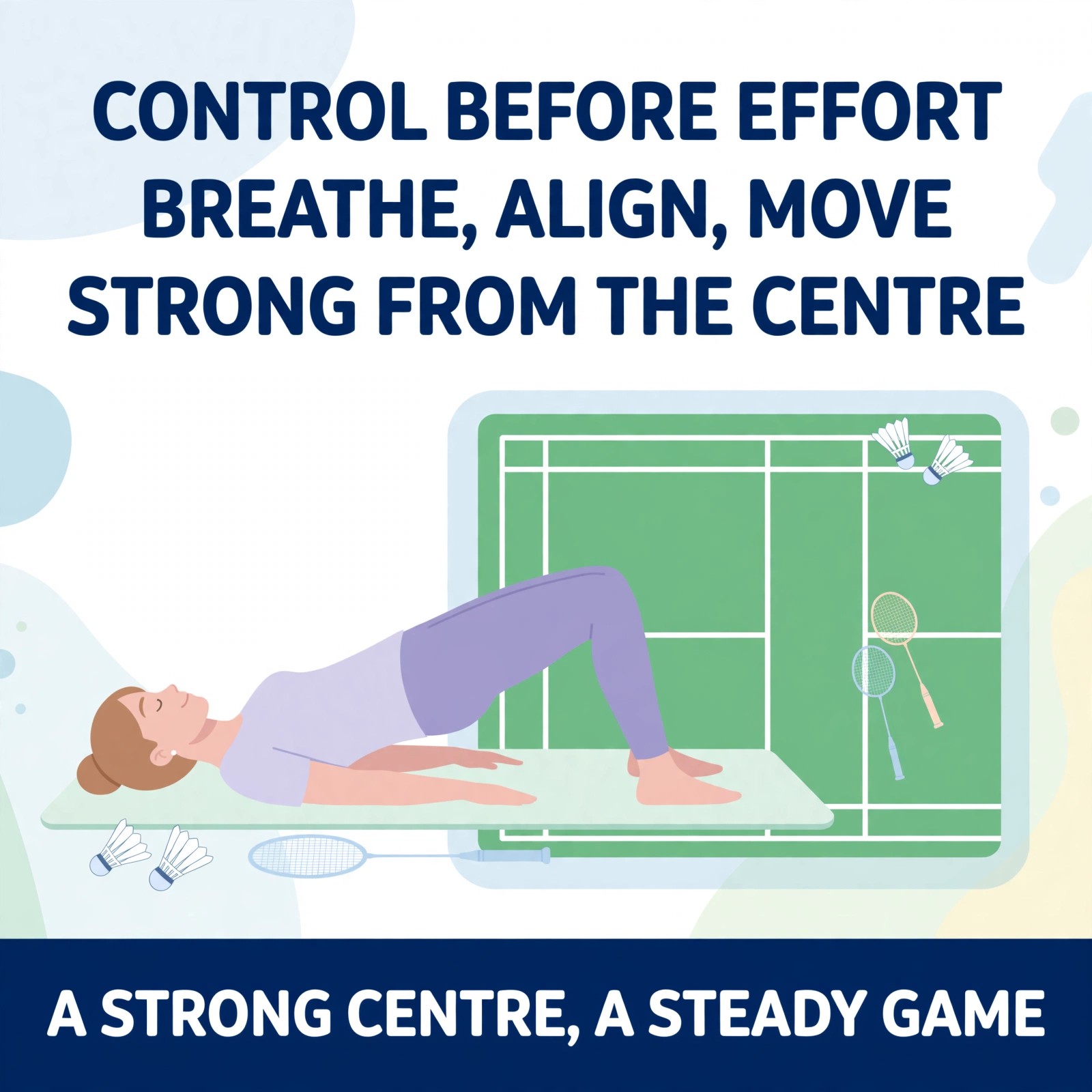
The bridge builds the back of the body. Feet flat, you lift the hips until knees, hips and shoulders form one line, hold with level hips, then lower slowly, placing one bone at a time back onto the mat. Bridges train the glutes and the back of the thighs, the muscles that pull a player upright out of a lunge and steady the pelvis when landing. A one leg version, earned later, is one of the finest stability tests we know: if the hips stay level while one leg reaches long, the centre is genuinely doing its job.
Leg circles teach control at its purest. One leg reaches to the ceiling and draws a small circle while the hips are forbidden to rock. The circle stays small because the rule is absolute: the moment the pelvis shifts, the circle was too big. Players are humbled by how little movement the exercise contains and how much work it holds. Both sides get equal turns, which quietly services the one sided problem from earlier. Add the dead bug pattern, opposite arm and leg reaching while the back stays calm, and the mat basics cover most of what a badminton trunk needs.

Core Check #4
How Pilates Control Shows Up on Court
The transfer shows first in the lunge. A player whose centre works arrives at the net with the trunk tall, plays the shot while balanced, and pushes back without a stumble or a hand on the knee. Coaches call it being still at contact, and it is worth real points: a balanced player can choose the shot, while a folding player can only survive it. Pilates does not teach the lunge. It builds the organised middle that lets the lunge you already know finally behave at full stretch and full speed.
Rotation is the second place it shows. Every overhead shot turns the trunk: coil as the racket goes back, unwind as it comes through. If the centre cannot control that turn, power leaks and the lower back takes the strain the muscles should have shared. Mat work trains rotation slowly and in both directions, including the forgotten one, so the turn becomes strong and even. Players describe the result plainly: the smash feels connected, as if the legs and the arm finally agreed on something. That connection is trunk control, learned at walking pace.
The third place is late in matches. Posture is a fitness quality: as legs tire, unfit trunks fold, shoulders round, and shots start leaking into the net or floating long. A player with a trained centre stays tall in the third game almost without noticing, because holding the line costs them little. This is the quiet prize of mat work. It does not add a new shot to your game. It keeps all your existing shots available at the moment matches are decided, which is the only moment that was ever in question.

Core Check #5
How Pilates Fits the Training Week
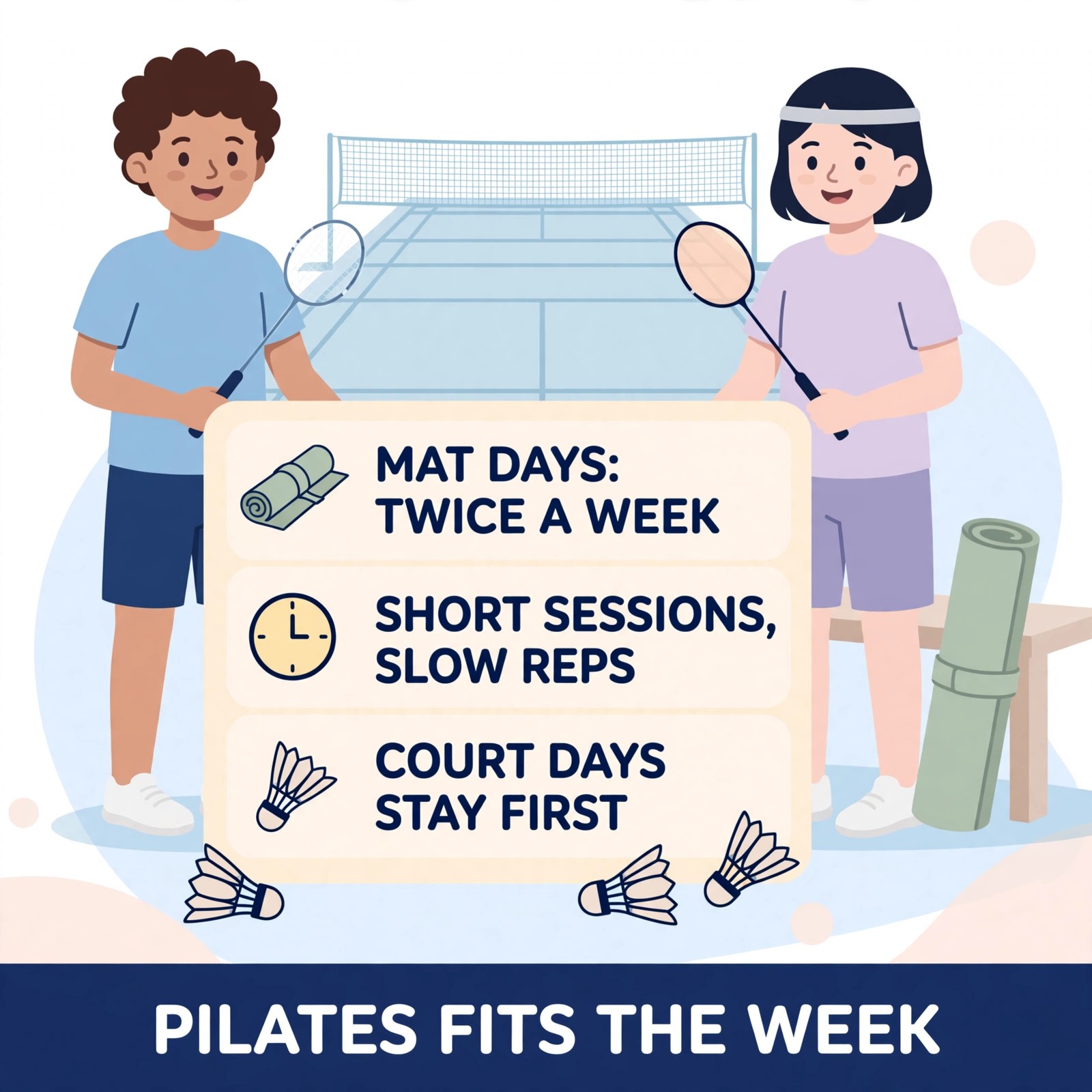
Pilates fits the badminton week in the spaces other training cannot use. Two short mat sessions a week, twenty to thirty minutes each, cover the basics on this page with room to spare. Because the work is slow and low impact, it sits happily on days between court sessions, and a gentle version even works as part of a warm up or a cool down. Keep hard Pilates progressions away from the morning of a big match if your trunk feels worked; the centre should arrive at matches fresh like everything else. Otherwise, the mat is the most flexible training partner you own.
At home, the equipment list is one mat and some floor. That is the whole list. The exercises scale by shape, not by shopping: knees bent makes the hundred kinder, a smaller circle makes leg circles honest, a two leg bridge precedes the one leg version. What home cannot provide is a second pair of eyes on your alignment, which is why the shapes are best learned with a coach first. After that, the mat becomes the easiest session in your week to keep, in a living room, a hotel room or a hall corner.
Progress in Pilates is measured in control, not exhaustion. The tests are simple. Can you hold the bridge line for slow, even breaths without the hips dropping? Can one leg circle while the pelvis stays silent? Can you finish the hundred with the trunk still and the breath counted, not gasped? Write the answers down monthly. When the same exercises feel organised instead of wobbly, stability has genuinely grown, and it will show on court before it shows anywhere else. A season of this quiet work changes a player’s whole outline.
Myth vs Reality
Myths About Pilates for Players
Myth one: Pilates is just stretching with better marketing. Stretching lengthens muscles; Pilates organises them. The hundred, the bridge and leg circles are strength and control exercises performed slowly, and anyone who has held a bridge with level hips for ten breaths knows the difference in their glutes. Flexibility improves too, as a side effect of moving joints through full, controlled ranges. But the heart of the method is a trunk that works on demand, which is a strength quality, not a stretching one.
Myth two: Pilates is only for dancers and women. The method was built by Joseph Pilates for rehabilitation and for training athletes and soldiers before it ever met a dance studio, and its logic is pure sport: breathe, align, control, then move. Badminton players of every age and level use mat work because the trunk problems it fixes do not check who you are. A male junior with a folding lunge and a veteran with a sore back are working on the same centre. The mat does not care. Neither do we.
The honest summary is that Pilates gives badminton players the thing their sport spends: an organised centre. Breathing that switches the brace on, alignment that stacks the body in one line, and slow mat exercises that teach the trunk to hold while limbs work. It will not teach you to smash, and nothing here claims it will. It makes the body you smash with steadier, more even and harder to tire. Two short sessions a week, learned properly and kept for a season, is all it asks. Few trades in training are that fair.

Why Choose Us
Why Players Choose ST Badminton Academy
At ST Badminton Academy, mat work appears inside our training as the core and stability block, taught in groups of no more than four students. A coach checks your breathing pattern, your alignment and your hip level in the bridge before adding any progression, because in Pilates the details are the exercise. Players get a home version matched to their level, written into their week beside court training. The mat work stays in its place: it serves the badminton, quietly, and the rallies collect the benefit.
Head coach Eric Chuar leads the programme, with over 15 years of coaching experience across Singapore and Malaysia. Eric came to Pilates through sore backs and folding lunges in his own players, and he kept what worked: the breathing, the alignment checks and the slow basics. His rule for mat work matches his rule everywhere: if the shape has gone, the set is over, whatever the count says. Players are retested on the same simple holds across the season, so a steadier core is recorded, not imagined.
You will find us in Setapak, Kuala Lumpur, easy to reach from Wangsa Maju, Melati Utama, Danau Kota and Gombak. If your trunk folds at full stretch, your lower back complains after matches, or your posture disappears in third games, come and try a session with us. We will start with your breathing and your bridge, because that is where core truth lives, and build your stability from there.
FAQs: Badminton and Pilates Training in Malaysia (KL)
Pilates raises fair questions, especially about home practice, equipment and where mat work belongs. Here are the answers we give most often.
Where can I train badminton and Pilates if I live in Setapak or Gombak?
With us, in Setapak. ST Badminton Academy is based in Setapak, Kuala Lumpur, and players travel in from Gombak, Wangsa Maju, Melati Utama and Danau Kota. Our mat based core work is taught inside small group sessions, so your breathing, alignment and bridge are checked by a coach before the home version is written into your week.
What matters most for core stability in KL?
Control, in three parts. Breathing that switches the deep trunk muscles on, alignment that keeps head, ribs and hips in one line, and slow practice that teaches the centre to hold while arms and legs move. A core that does those three things stays organised in a lunge, a landing and a third game.
How often should I do Pilates to improve at a steady level?
Two short sessions a week is the rhythm that works for most players, twenty to thirty minutes each. Pilates is patient work, and steadiness over months is what builds a reliable centre. One session can sit between court days, the other at the weekend. More is rarely better; better is better, and slow reps make it better.
Can I start Pilates at home with just a mat and no partner?
Yes, the mat basics are made for home. You need one mat, floor space and the shapes learned properly: the hundred with bent knees if needed, bridges, small leg circles, dead bugs. Learn them with a coach first so your alignment is right, then the home sessions are simple to keep and easy to progress.
Should Pilates come before or after court training in a session?
Usually after, or on its own day. Full Pilates sessions tire the centre, and you want your trunk fresh for court work, so mat sessions sit after training or between court days. A few minutes of gentle breathing and alignment work before playing is fine as a warm up. Save the full session for when the rackets are down.
Do you offer Pilates based core coaching near Wangsa Maju?
Yes. Our base is in Setapak, a short drive from Wangsa Maju, and Pilates based core coaching runs inside our regular small group sessions rather than as a separate course. Your breathing and alignment are checked by a coach, and your home mat routine is set at the level your control can honestly hold.
Does your academy use mat work for core stability in Malaysia?
Yes. Mat based Pilates exercises form our core stability block: breathing and alignment first, then the hundred, bridges, leg circles and dead bugs, progressed only when shapes stay clean. Groups stay at four students or fewer, so every pelvis that rocks and every hip that drops gets seen and corrected.
Where does ST Badminton Academy teach Pilates for badminton?
At our home base in Setapak, Kuala Lumpur. Mat work is taught inside regular badminton training, with no more than four students in a group. Players come in from Wangsa Maju, Gombak and across the Klang Valley, and trial sessions can be arranged through the academy.
What makes Mr Eric Chuar a suitable coach for core stability in badminton?
Eric teaches core work the way he teaches footwork: shape first, load later. He checks the breathing pattern and the neutral line before any exercise begins, progresses players one step at a time, and stops sets when alignment goes. Over 15 years of coaching across Singapore and Malaysia, that patience has kept his players’ backs quiet and their lunges honest.
Badminton and Pilates Training in Action


One Standard for Every Player and Every Session
Hold your Pilates work to five standards. Breathe out on the effort, every rep. Keep head, ribs and hips in one line while limbs move. Circles small, hips silent, always. Slow down when shape breaks, never speed up. And write the holds down monthly, so progress is proven. Standards like these sound gentle because they are. Gentle standards, kept for a season, build the steadiest cores in the hall.
| Factor | Court Only | Court Plus Pilates CORE |
|---|---|---|
| Frequency | 1 or 2 times a week. Mostly for fun and sweat. | Two short mat sessions a week beside regular court training. |
| Drills Focus | Basic static feeding. Minimal footwork pressure. | Breathing, alignment and mat basics that teach the trunk to hold. |
| Physical Conditioning | Rarely included. Just playing games on court. | Core, agility, and speed training included in every session to prevent injury and build stamina. |
| Tactical Awareness | "Just hit it over." No real game plan. | Video analysis, point construction, and learning to read the opponent's game. |
| Coach Ratio | Large groups (8-10 kids). Coach barely watches you. | Max 4 students. Mr Eric Chuar personally corrects every stroke and movement detail. |
| Goal Setting | Fun and exercise. | Control tested with the same holds each month, written down honestly. |
| Long Term Result | Good recreational player. | A player who stays tall and balanced through long rallies and late lunges. |
Badminton and Pilates Coaching in Kuala Lumpur
Pilates will not give you a new shot. It gives you the organised centre that every shot you own depends on: breathing that braces, alignment that stacks, and a trunk that holds while the game gets fast and tired. If you would like that centre coached rather than guessed, train with us in Setapak. Bring your racket and your questions. The mats are already out.






