How to Play Badminton With Power and Quickness: Techniques and Drills (Power Guide)
Every player wants the same two things: a smash that ends rallies, and feet quick enough to be ready for the next one. Many players chase them separately, lifting their arm into knots in the gym for power, then wondering why their big shots leave them stranded at the back of the court while the block sails past. Power and quickness are not two skills. On a badminton court they are one habit: hit hard, land balanced, recover fast, and be ready to hit hard again. This guide shows where real power comes from, how timing and rotation build it, how the grip finishes it, and the steps that bring you back for the next shot.
Power Check #1
Power Starts Relaxed: Where Real Hitting Speed Comes From
Here is the surprise most players need a year to learn: power starts relaxed. A tight arm is a slow arm. When your shoulder, forearm and hand are tense before the swing, your own muscles fight each other, and the racket head crawls through the air instead of whipping. Loose muscles let the swing build speed the way a whip does, slow at the handle, fast at the tip. This is why the hardest hitters often look lazy between shots. Their arms hang soft, their grip is gentle, and the tension arrives only for a split second at contact. If your smash feels like hard work, that feeling is probably the problem, not the solution.
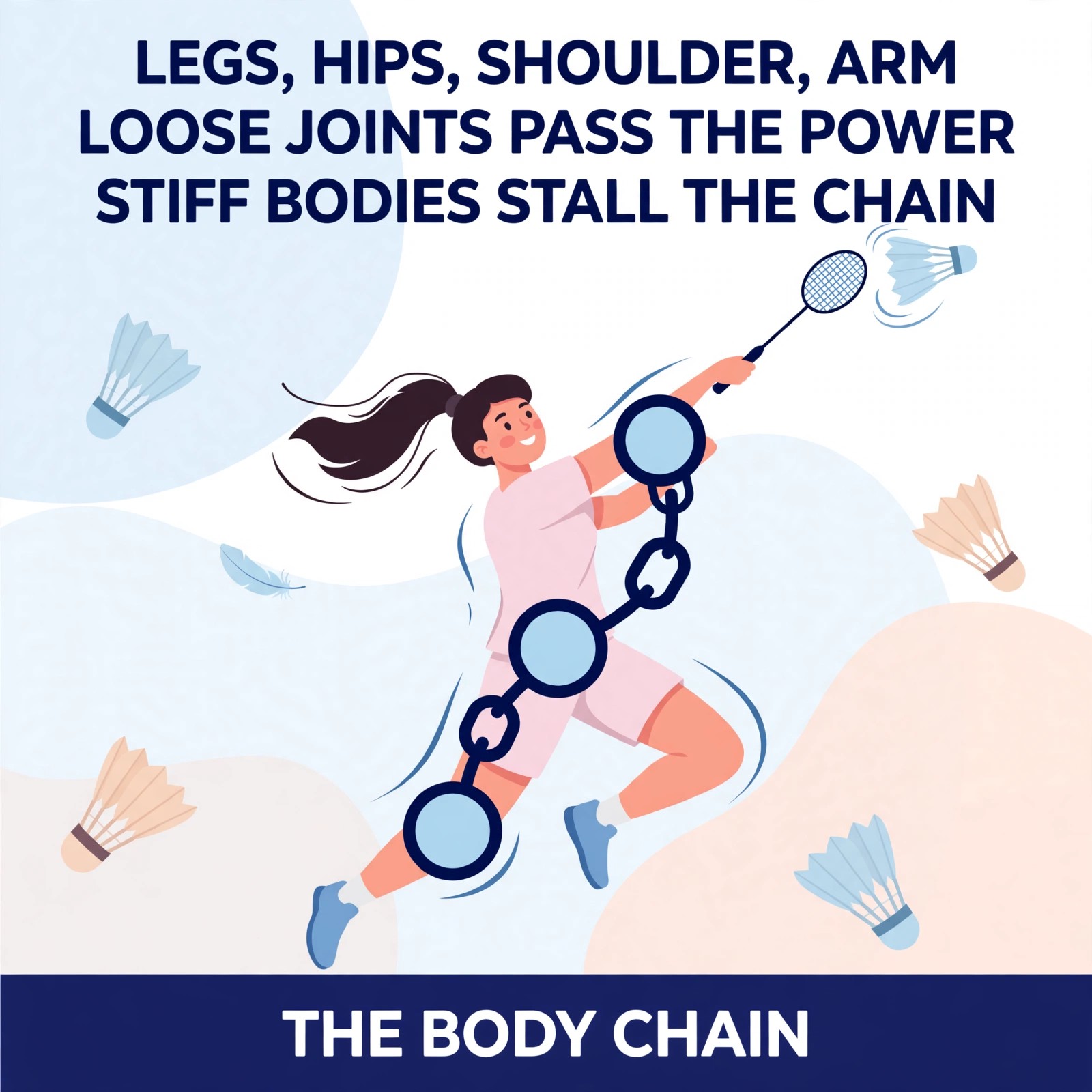
Relaxed does not mean careless. The body still works hard, but the work is done by the big muscles in the right order: legs drive, hips turn, the trunk follows, the shoulder comes through, and the arm and fingers finish the job. Each link adds speed to the next, so the racket arrives far faster than your arm could ever throw it alone. Players who try to smash with the arm only are asking the smallest link to do the whole chain’s work. The result is a sore shoulder and a smash your opponents read early. Learn to feel the chain, starting from the floor, and the power feels almost unfairly easy.
Power Check #2
Timing and Rotation: The Body Chain Behind the Smash
Timing is where the chain cashes in. A smash is only powerful when the racket meets the shuttlecock at the right moment: high, in front of your body, while the chain is still turning. Contact behind you wastes the legs. Contact too far to the side wastes the shoulder turn. Contact after the shuttle has started dropping wastes height, and height is what lets you hit down steeply. This is why coaches fuss over such small things: where your feet stand at contact, whether your non racket arm is up for balance, whether your chest has turned through. Each detail lines the chain up so all its speed arrives in the same split second.
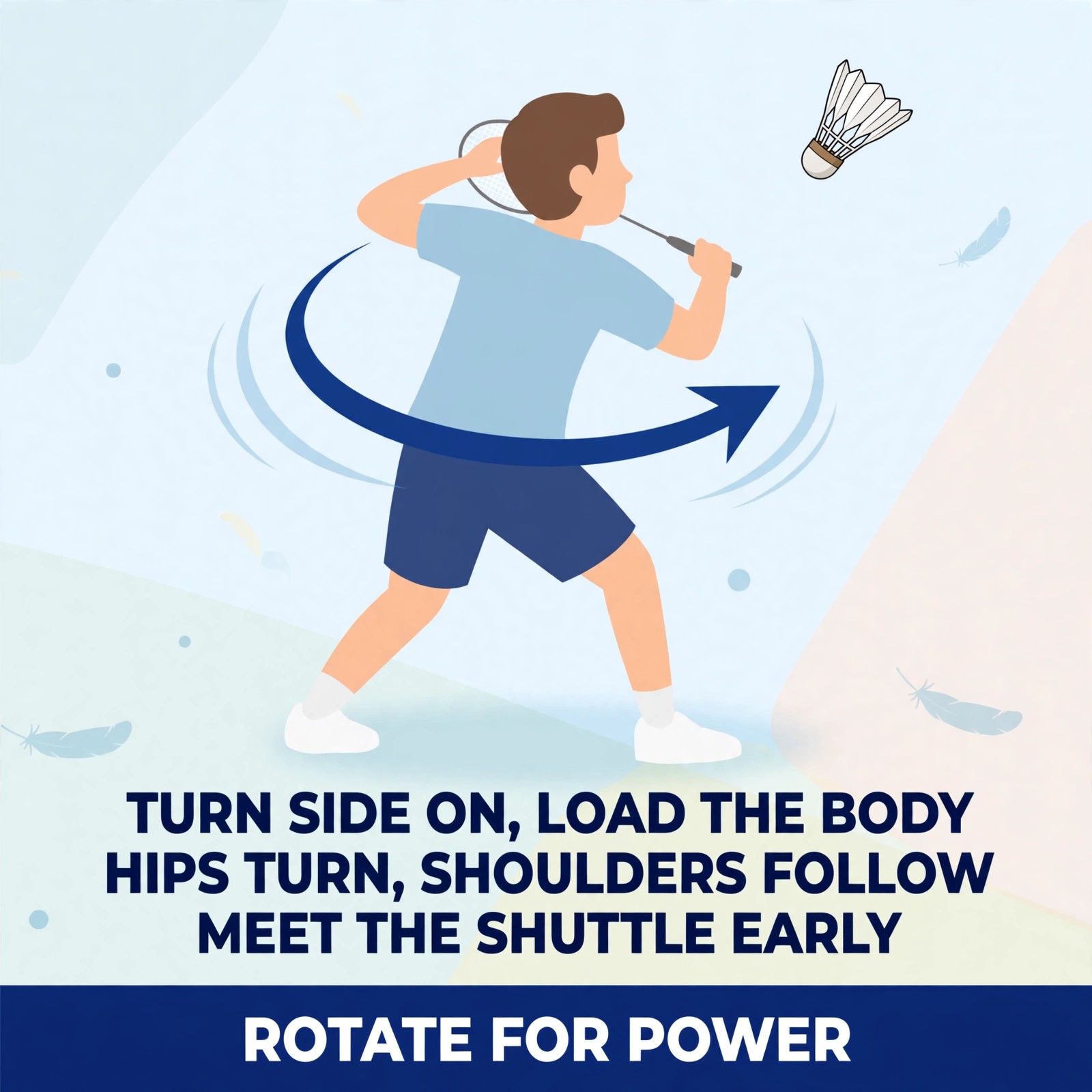
Rotation deserves its own word, because it is the link players skip. Stand square to the net and your smash is an arm shot. Turn your side to the net, racket shoulder back, and your whole trunk becomes part of the swing as it unwinds. The turn also sets up the recovery: as you strike, your feet swap in a scissor kick, the racket leg landing behind, so your body is already travelling back toward the middle as the shuttle leaves. Practise the turn without a shuttle first. Shadow the full shape slowly: side on, turn, strike at an imaginary high point, land balanced. When the shape is smooth, the power shows up almost by itself.
None of this works if the shuttle is not in the right place to be hit, and that is footwork, not luck. To smash from the back court you must arrive behind the shuttle, early enough to turn and set. Players who are late end up reaching up and backwards, and no chain can fire from that position. This is the first place power and quickness meet: quick feet buy you the position, and the position buys you the power. If your smashes feel weak in matches but strong in feeding drills, your feet are the difference. In drills the shuttle comes to you. In matches you must go to it, early, every single time.
Power Check #3
Grip for Power: Loose Fingers, Late Squeeze
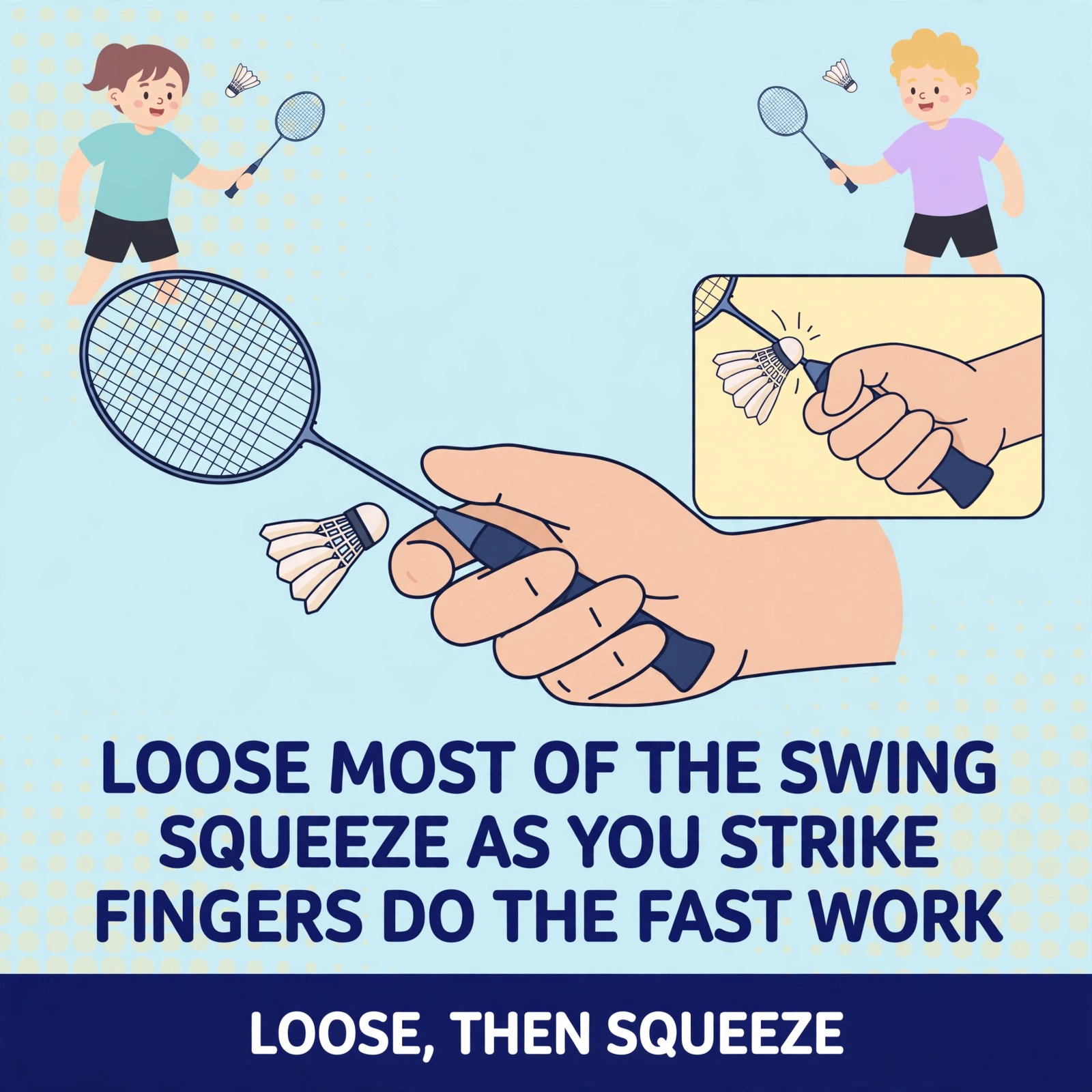
The grip finishes what the chain starts. Hold the racket loosely, with the handle resting mainly in your fingers rather than buried in your palm. A finger grip lets the racket pivot and snap through the last part of the swing. A palm grip locks the wrist and shortens the whip. The basic shape is the forehand grip: hand as if shaking hands with the handle, thumb and index finger forming a loose V along the top. Keep that V soft through the swing, and let the fingers close firmly only at the moment the strings meet the shuttle. That late squeeze is real power, the final snap that players feel as the shuttle jumping off the strings.
Test your grip pressure honestly. If your forearm aches during rallies, if your fingers are white on the handle, or if your smashes sound dull, you are probably holding on too tight, too early. Coaches often give a simple picture: the handle is a small bird. Hold it firmly enough that it cannot escape, gently enough that you do not crush it. Between shots, let the racket almost dangle. Shake your hand out. The players with the fastest racket heads are constantly letting go and taking hold again, and that rhythm of loose, snap, loose is exactly what makes the snap so sharp.
Grip also decides whether power stays accurate. A squeezed grip at contact points the racket face where your hand aims it. A grip that tightens too early twists the face as the arm tires, and late in a match those twists send smashes into the net or wide of the side line. This is one reason tired players lose their length and their angles at the same time. Keep the squeeze late and brief, and your power shots will keep landing where you sent them in the first game. Power you cannot place is just noise. Power that lands on the line, again and again, is what actually wins matches.
Power Check #4
Hit Hard, Recover Fast: Steps After the Big Shot
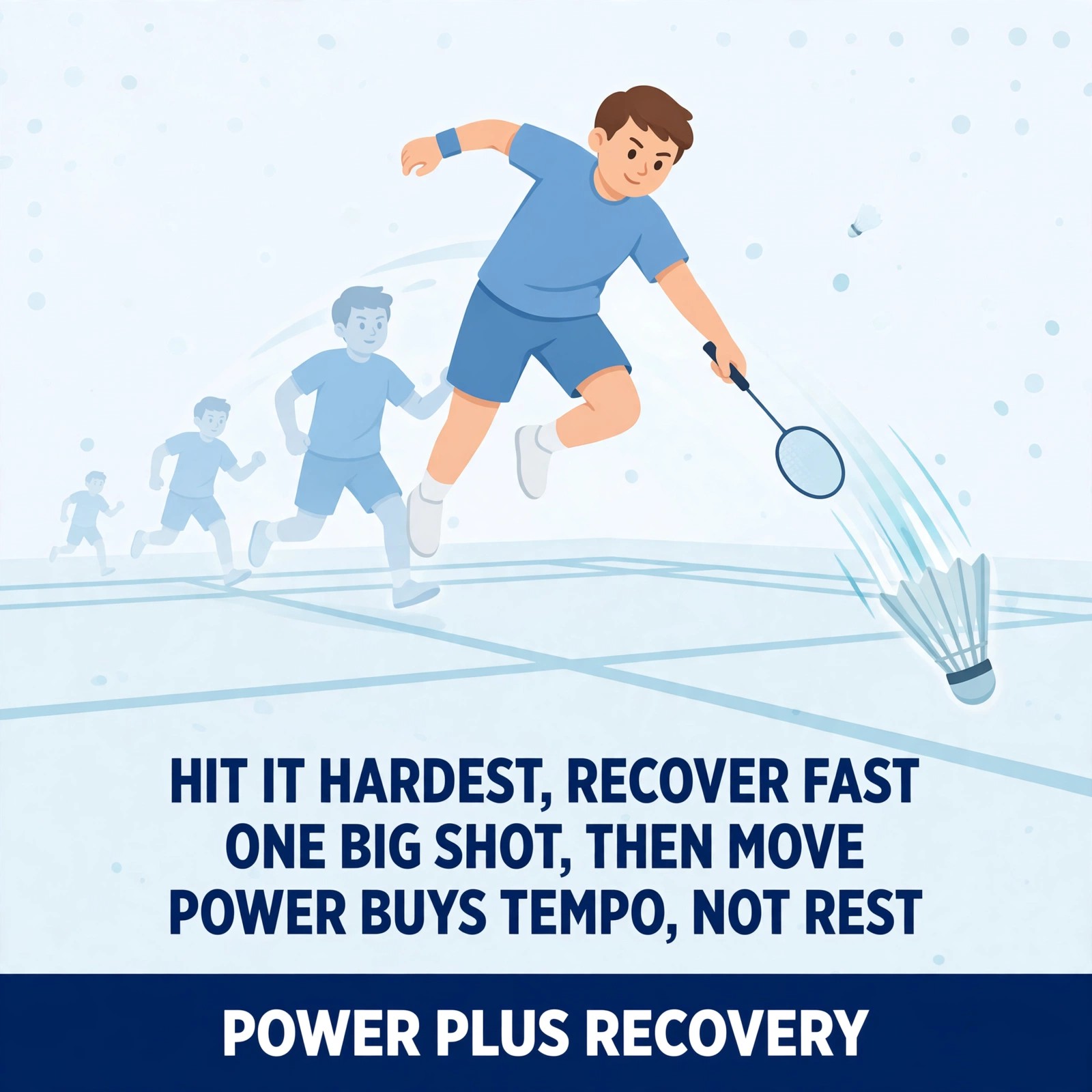
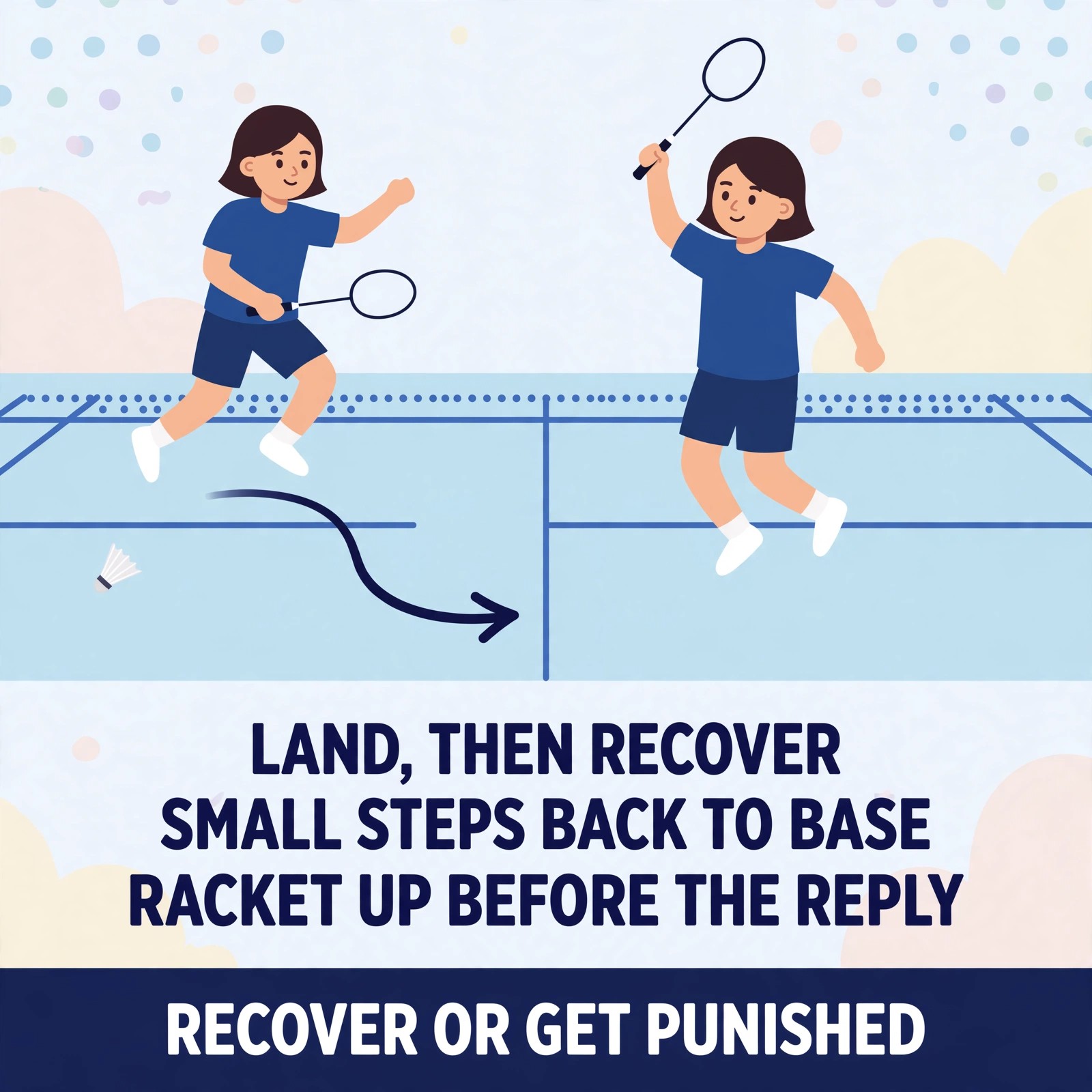
Now the half of power that players forget: the rally continues. A good defender expects your smash and has a block ready, so the shuttle can be coming back before your feet have landed. If you stand and admire your shot, the block lands at your feet and the point is theirs. Recovery is built into the smash itself. Land facing the net, not twisted away from it. Let the scissor kick carry you forward, and take your first step back toward base before you know where the reply is going. Racket up, eyes on their strings. The players who smash twice and three times in one rally are not fitter than you. They just start recovering earlier.
Base position after a back court smash is not the centre of the court, it is a step in front of where you hit from, ready to move forward for the block or back for the clear. Watch strong players and you will see the pattern repeat: deep shot, two quick steps home, split step, then explode again. Quickness here is mostly habit and timing, not raw speed. The split step lands as your opponent strikes, so your legs are loaded at the one moment you need them. Players who feel slow after smashing usually have no split step at all. They land flat, watch, and then start moving, which is giving the rally away one delay at a time.
Drives are the other face of power with quickness. A drive is a flat, fast shot hit at the body from mid court, and it uses the same chain in miniature: small turn, short swing, late finger squeeze, instant recovery. Because the swings are small, drives can be repeated at a pace smashes cannot, which is why drive exchanges feel so frantic. Practise them as power training, not just as a game. Stand at the service lines with a partner, trade drives at a pace you can hold, and focus on the racket returning to the front after every shot. When your drives stay flat and your racket stays ready, your power has quickness built into it.
Power Check #5
Power Drills: Building Explosive Hitting Safely
Power is built in layers, and the order matters. Layer one is shadow swings: the full smash shape with no shuttle, turned, balanced and landed properly, until the shape feels ordinary. Layer two is feeding: a partner lifts shuttlecocks to the back court and you smash at a target, with a full recovery between every shot. Layer three is pressure: feeds that arrive faster, smashes that must be followed by playing the block, rallies where the second and third hits count as much as the first. Skipping layers is how players end up with a big practice swing that vanishes in matches, because the match lives at layer three and they never trained there.
Conditioning supports the layers, but it does not replace them. Jump rope work and short sprints build the legs and lungs that repeated power needs, and simple bodyweight strength keeps the shoulder and trunk able to handle the chain. Single leg balance work, reaching out and returning without wobbling, teaches the control you need when landing from shots at full stretch. Keep conditioning short and honest, and keep it after the skill work, not before. A tired player practising smashes is practising bad smashes. Skill first while you are fresh, fitness after, and enough rest between sessions for the body to actually adapt to the load.
One safety rule sits above all of this. Power training loads the shoulder, the elbow and the back, and sharp pain is a stop sign, not a challenge. A tired ache in the muscles after a good session is normal. Pain inside the shoulder joint, pain that changes how you swing, or pain that is still there the next morning is information, and the right response is to rest it and, if it keeps returning, get it checked by a doctor or physiotherapist. Players lose months by smashing through joint pain for one extra week. Build power slowly, and it stays built. Rush it, and you will spend your training time recovering instead.

Myth vs Reality
Myths About Power and Quickness
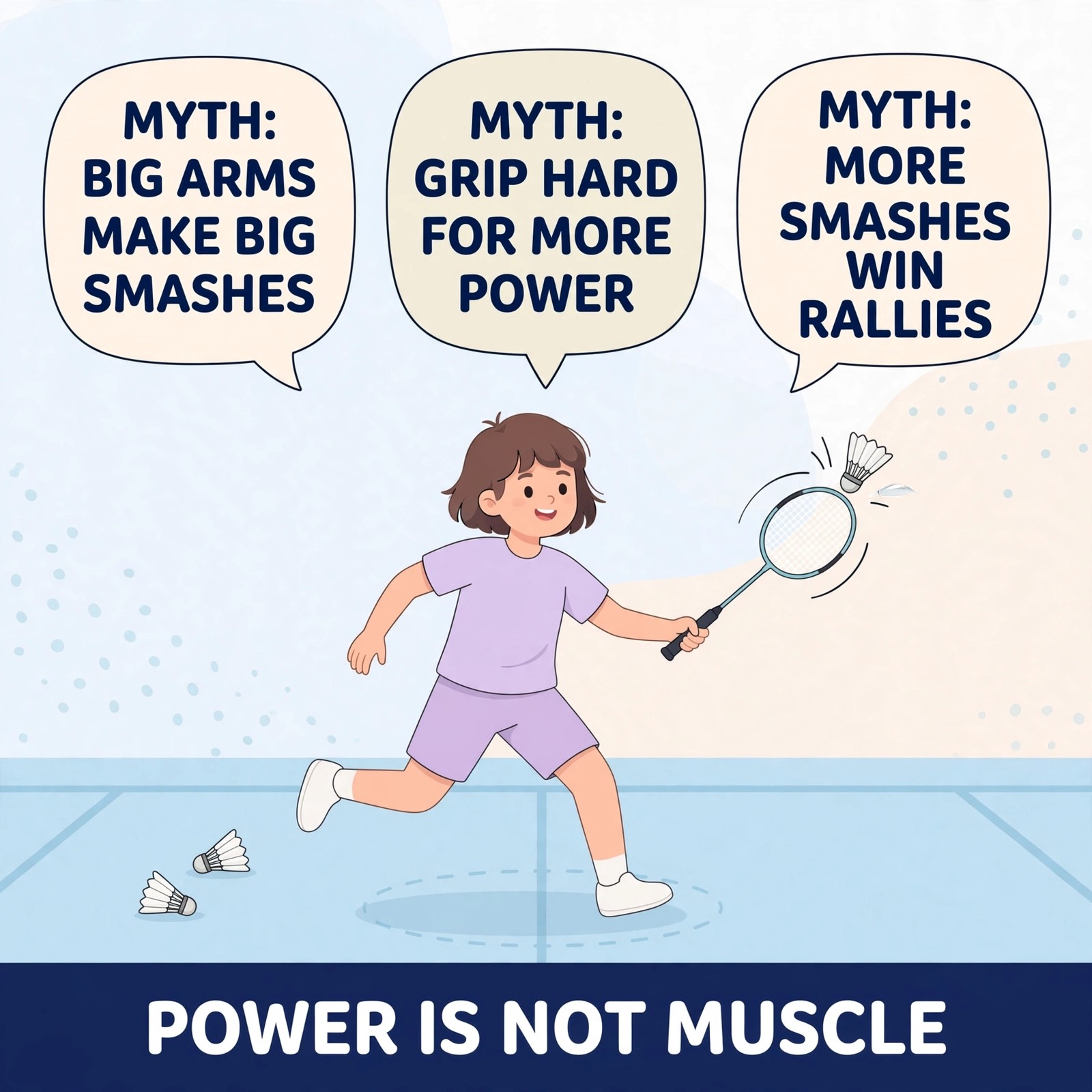
The biggest myth says power is all in the arm, so players curl and press their way toward a smash that never arrives. Arm strength helps a little, at the end of the chain. But watch any powerful hitter in slow motion and the arm is the last and laziest part of the movement. The legs drive, the body turns, and the arm is nearly just carried along for the ride, adding its snap at the end. A slim junior with a good chain will out smash a muscular adult swinging with the arm alone, and courts everywhere prove it every week. Train the chain, and let the arm be the messenger, not the engine.
The second myth says you must grip tight for power, squeezing the handle from the start of the rally to the end of the shot. It feels logical and it works backwards. A grip held tight slows the swing, tires the forearm and twists the racket face as the hand fatigues. The power grip is loose, loose, then squeeze, all inside the last fraction of the swing. If your hand cannot relax between shots, your smash has a ceiling it will never pass, no matter how strong you get. Shake the hand out between rallies. Waggle the fingers. The snap you are trying to build lives in the contrast between the loose swing and the firm finish.
The third myth warns that power makes you slow, as if a player must choose between hitting hard and moving fast. The truth runs the other way. Power played with a full chain lands you balanced and already moving home, while weak, stretched shots leave players tangled at the back of the court. What actually makes players slow is hitting hard from bad positions: off balance, late, reaching. Those shots are powerful at the racket and costly everywhere else. Learn the chain and the recovery together, and power becomes the thing that gives you time, because opponents are pinned deep and their replies come back slower and weaker.
Why Choose Us
Why Players Choose ST Badminton Academy
At ST Badminton Academy, power is coached as technique first and effort second. Classes are capped at a maximum of 4 students, so a coach can watch your chain link by link: the turn you skip, the grip you squeeze too early, the recovery step that never happens. Feeding is set to your level, so smashes are practised from positions you can actually reach in matches, not from a standing start that flatters everyone. Junior players learn the relaxed chain early, before bad habits set in. Adult players get their old habits unpicked one link at a time, with drills they can repeat in their own practice.
Our promise here is a steady one. We will not tell you that a few sessions will give you a professional smash, because they will not. We will tell you that a relaxed grip, a real body turn and an early recovery step are learnable at any age, and that most club players are leaving easy power on the table by swinging with the arm alone. Progress shows up in honest places: smashes that land deeper and steeper, second and third shots in a rally that you now reach, and a shoulder that feels worked rather than wrecked after training. That is what good power coaching looks like.
You will find us in Kuala Lumpur, where ST Badminton Academy began at our original base in Setapak and now coaches players from across the Klang Valley. Power and quickness work suits most levels, from the beginner whose smash will not clear the net to the league player whose power fades in the third game. A trial session is the easiest way to start: the coach watches your current smash, finds the weakest link in the chain, and gives you one or two things to build first. Bring your racket, court shoes and a water bottle, and expect plain feedback you can act on straight away.
FAQs: Badminton Power, Quickness and Smash Training in Malaysia (KL)
Below are the questions players ask us most about power, quickness and smash training at ST Badminton Academy. If your question is not answered here, bring it to a trial session and ask the coach on court.
Does power come from the arm, or from the whole body in Setapak or Gombak?
From the whole body working in order: legs driving, hips and trunk turning, the shoulder following, and the arm and fingers adding the final snap. The arm alone is the smallest part of it. Players who feel weak usually have a link missing, most often a body that stays square to the net and never turns into the shot.
How do I time a smash so the power lands in KL?
Set your feet behind the shuttlecock early, side turned to the net, then strike the shuttle at the highest point you can reach in front of your body, while your trunk is turning through. If contact happens behind you or after the shuttle drops, the power drains away. Footwork first, turn second, contact point third: that order fixes weak smashes.
Can smaller players hit hard at a beginner level?
Courts prove it weekly. A smaller player with a relaxed arm, a full body turn and a late grip squeeze will out hit a bigger player swinging with the arm alone. Size adds a little at the end of a good chain; it cannot replace the chain. Beginners start with shadow swings and gentle feeds, then build pace gradually.
Is a head heavy racket better for power, or does technique matter more?
Technique matters more. A head heavy racket adds a little momentum to overhead shots and suits some strong players, but it can also slow your defence and tire your arm. Most players gain far more power from fixing their turn and contact point than from changing rackets. Try before you buy, and let your coach watch you hit with it.
Do strength exercises help junior and adult players in classes?
Yes, in age appropriate ways. Juniors build the strength for power mainly through bodyweight work, games and good technique, not heavy weights. Adults add simple strength and conditioning to support the shoulder, trunk and legs. In our classes the strength work always supports the skill work; nobody is turned into a weightlifter who happens to own a racket.
Do I need a special racket for power training near Wangsa Maju?
No. Your racket is fine for power training, as long as it suits your hand and your strings are in decent condition. Coaches may suggest a different weight or balance later, once your technique is steady, but buying a power racket first rarely fixes a weak smash. The chain in your body is the equipment that matters most here.
Where does ST Badminton Academy run power focused training in Malaysia?
Power work is part of our regular badminton coaching in Kuala Lumpur, based in Setapak, where ST Badminton Academy first started. Smash technique, drive practice and recovery footwork are built into group and private sessions, with the load set to each player’s level. You do not need a separate power class; the work is inside the coaching sessions themselves.
How do I book a trial session to test my power?
Book a trial session through our website or WhatsApp and tell us you want your smash looked at. The coach will watch you hit from the back court, check your turn, grip and contact point, and show you the first link of the chain to fix. Bring your usual racket and court shoes; everything else is provided at the session.
What should I bring to my first power session for badminton?
Bring your normal playing kit: your racket, court shoes with non marking soles, a water bottle and a towel, plus a spare shirt if you sweat a lot during hard sessions. If your shoulder has been sore, tell the coach before the session starts, so the feeding load can be set sensibly for your first power session with us.
Power and Quickness Training in Action


One Standard for Every Session and Every Player
Every power session at ST Badminton Academy follows the same coaching standards. Technique is corrected before pace is added, and feeding stops the moment a player’s shape breaks down, rather than piling tired swings on top of tired swings. Loads rise gradually, week by week, and any joint pain is treated as a stop sign, never something to push through for the sake of looking committed. Coaches explain which link of the chain each drill is building, in plain words, so players can repeat the work in their own time. These standards keep power training productive and shoulders healthy.
| Factor | Arm Only Hitting | Whole Body Power POWER |
|---|---|---|
| Frequency | 1 or 2 times a week. Mostly for fun and sweat. | Legs, hips and shoulder turn together, so the racket head arrives fast without forcing. |
| Drills Focus | Basic static feeding. Minimal footwork pressure. | Grip stays loose, then the fingers squeeze late, adding snap at the moment of contact. |
| Physical Conditioning | Rarely included. Just playing games on court. | Core, agility, and speed training included in every session to prevent injury and build stamina. |
| Tactical Awareness | "Just hit it over." No real game plan. | Video analysis, point construction, and learning to read the opponent's game. |
| Coach Ratio | Large groups (8-10 kids). Coach barely watches you. | Max 4 students. Mr Eric Chuar personally corrects every stroke and movement detail. |
| Goal Setting | Fun and exercise. | Recovery steps start before the shuttle lands, so the next shot is played balanced. |
| Long Term Result | Good recreational player. | A player who smashes with timing, defends the reply and stays quick for the whole rally. |
Badminton Power Coaching in Kuala Lumpur
Your smash does not need a bigger arm. It needs a better chain and a quicker way home. Come to ST Badminton Academy in Kuala Lumpur and build your power in small classes, link by link, with a coach watching every step. Hit hard, land ready, and make your opponents deal with the next shot too.






