Edit Translation
 All languages
 Tionghoa (Sederhana)
 Tionghoa (Tradisional)
 Inggris
 Indonesia
 Jepang
 Korea
 Malay
 Thai
 Vietnam


How to Choose a Badminton Coach in Gombak
Gombak families are named as a served corridor on the ST Badminton Academy site, and the academy’s own homepage says its main base is at Gombak in Setapak, so a venue post for Gombak would only repeat what the site already says. The distinct angle is the chooser guide: how Gombak families compare the coaches and halls near them, and decide who to train with. This guide gives you a chooser checklist that works for any coach in Gombak: ten checks in detail, plus three final checks before you commit. Head coach Mr Eric Chuar explains what to look for, what to ask, and the red flags that mean you should look for another coach.

Start Here
How to Choose a Badminton Coach in Gombak: What to Know First
Gombak sits just north of Setapak, along the MRR2 and Jalan Genting Klang corridor, and ST Badminton Academy already dominates Gombak-named searches, because its homepage says the main base is at Gombak in Setapak and its Taman Melati and Lavana pages name Gombak families as a served corridor. The halls near Gombak include the Pusat Komuniti Gombak hall with two to three courts near M3 Mall, the Gombak Community Badminton Centre, and the halls of nearby Setapak and Batu Caves. This post does not add another venue page. It defends the corridor with a decision post: how to choose a coach when the halls are close and the names blur together.
The basis of this guide is the way ST Badminton Academy teaches in Setapak. Head coach Mr Eric Chuar has coached for more than 15 years in Singapore and Malaysia, and he teaches small groups himself, with a maximum of four students per coach. The checks in this guide work for any coach you meet in Gombak, and they also work for the Setapak base itself, which is the closest structured option for most Gombak families. The rest of this guide walks through them one by one, starting with the credential that matters most.

Check the License
Check the License First, Not the Fame
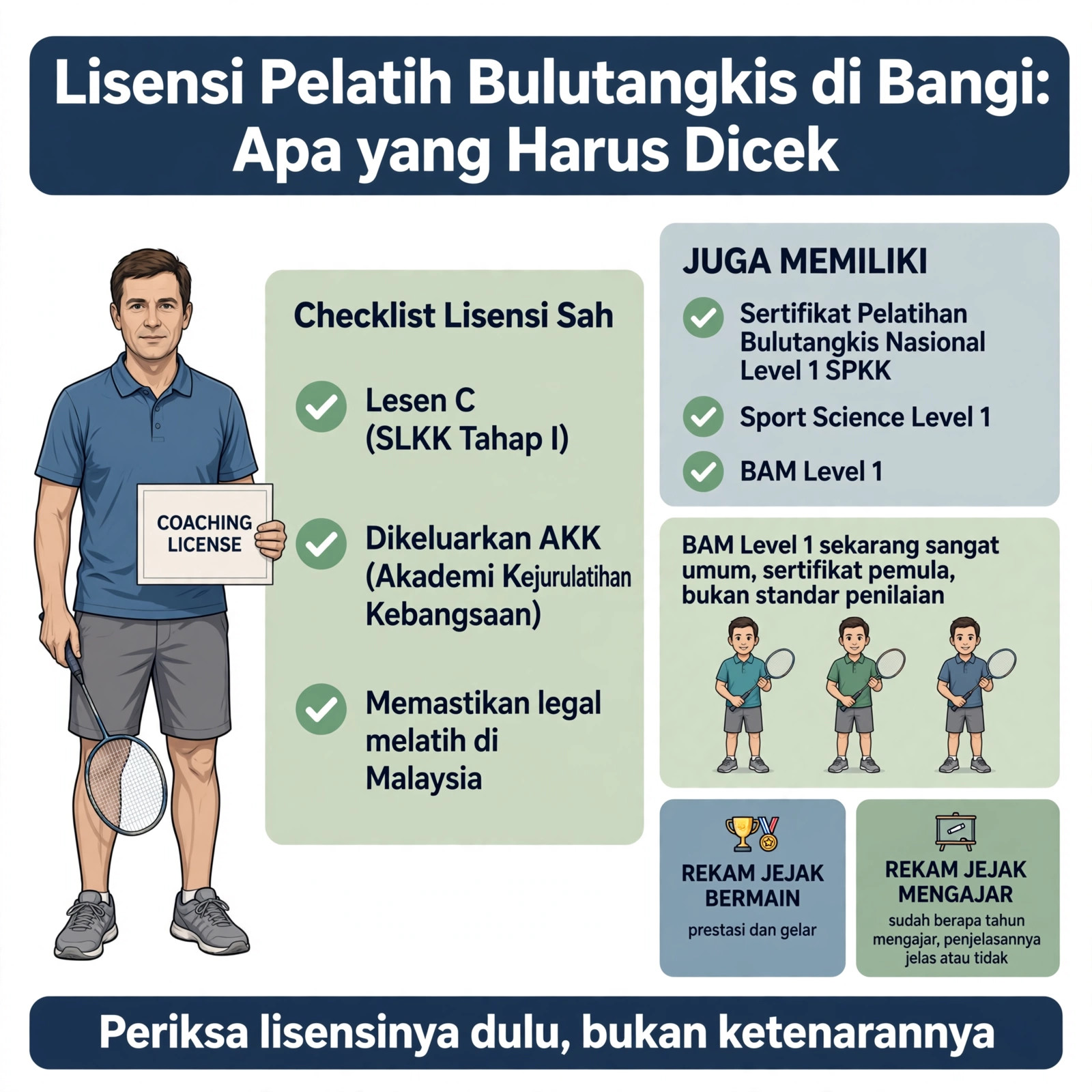
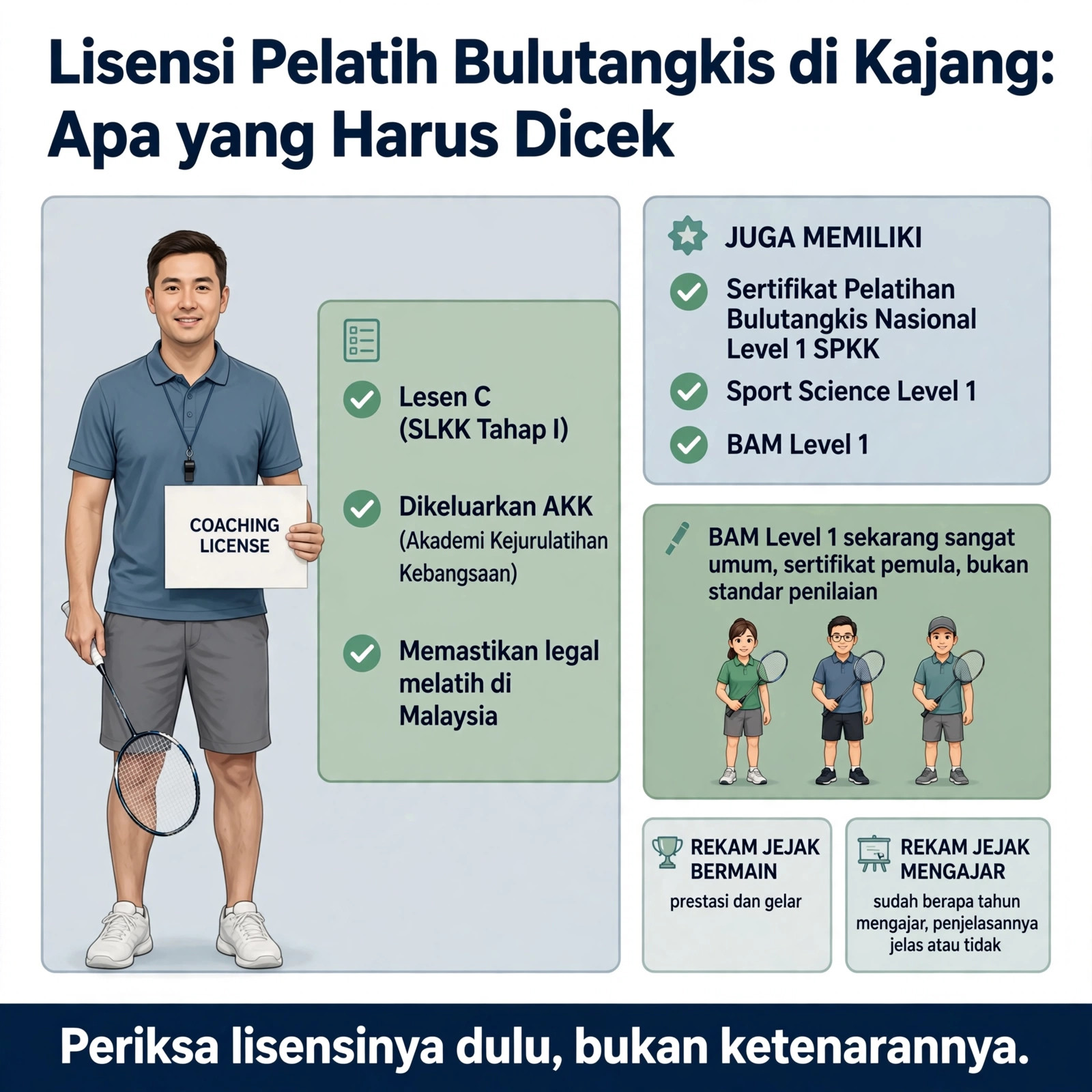
The first credential to ask any coach to show is a valid National Coaching License, Lesen C (SLKK Tahap I), issued by the National Coaching Academy (AKK). The license confirms the coach is legally allowed to coach in Malaysia, and you can check it on the MSCR platform. A BAM Level 1 certificate is the entry certificate for coaching, and it is now common, so it does not tell you much on its own. Fame, trophies, and a large following do not replace a license.
Ask to see the license in person, and check that the name on it matches the coach who will actually teach your child. Some academies show the license of the head coach while an assistant runs the class. That is not the same thing. Ask who teaches each session, and whether the coach you meet on the first visit is the coach who will teach every week. A good academy answers this directly, because it has nothing to hide.
The full credential line of head coach Mr Eric Chuar is a useful example of what a strong record looks like. He holds a valid National Coaching License, Lesen C (SLKK Tahap I), issued by the National Coaching Academy (AKK), plus a National Level 1 Badminton Coaching Certificate under SPKK, a Sport Science Level 1 qualification, and a BAM Level 1 coaching qualification. The license is the lead check, because it confirms legal coaching status in Malaysia, and the rest of the line shows depth of training. Never accept a credential written as only BAM Level 1 plus Sports Science Level 1 without the license, because that leaves out the one check that actually confirms the coach may coach.

Watch a Lesson
What to Watch in a Real Lesson
Credentials get you through the door, but the lesson is where you see the truth. Visit once and watch one session from start to finish. A good lesson has a shape you can follow: movement and games to warm up, one clear skill like the grip or a small footwork pattern, then rallies or a game at the end. The right grip, a handshake hold for forehand and the thumb behind the handle for backhand, is the basis of every shot, and the coach should check the grip of each student, one by one.
Watch how the coach explains. Good explaining uses plain words, one idea at a time, and one short example you can copy. If a coach talks for ten minutes while students stand still, the lesson is a lecture, not training. A good coach also fixes small mistakes right away. One small correction shown in a minute, with a result you can feel yourself, tells you more about the quality of the coach than any brochure. Students should move for most of the lesson, not stand in a line waiting for a turn that rarely comes.
Watch the order of skills as well. Once grip and footwork start to settle, the class should move to the clear, a high shot to the back of the court that teaches timing, height, and court coverage in one shot. The smash is not taught in the first week, because that shot needs strong basics first. If a Gombak class starts with the smash in the first lesson, ask the coach why. The answer will tell you a lot about how the class is planned.

Group Size
Why a Maximum Group of Four Matters
Group size decides how much coaching you actually receive, and in Gombak the range is wide, from a community hall session to a small academy group. In a group of ten, the coach can only watch each student for a few seconds in each drill. In a group of four, the coach can watch every shot, fix the grip, adjust the feet, and check the result. The difference shows within a few weeks, not years. Children in small groups learn clean habits from the start. Children in large groups often repeat the same mistake for months before anyone notices.
Ask the academy for the real maximum number, not the usual size. Some academies say small group but run classes of eight or ten when the class is full. At ST Badminton Academy, the maximum is four students per coach, and that number does not change when classes are busy. Head coach Mr Eric Chuar teaches these small groups himself, so the corrections come from the coach you meet, not from an assistant who happens to be free that day. Use that number as your comparison point when you ask Gombak coaches the same question, and be careful with a hall that counts players per session rather than students per coach.
A small group also changes the feel of the lesson. Students get more turns, more rallies, and more chances to ask questions. They learn to watch each other and wait for their turn without losing focus. Parents can see the difference in one visit: in a small group, the coach knows the name of every student and the weak shot of every student. In a large group, the coach only knows the loudest student.

Assessment and Progress
Initial Assessment and How Your Progress Is Tracked
Do not sign up for a long programme before you have seen one session. The Initial Assessment is an honest way to check whether the coach fits. In a good assessment, the coach watches how you move, how you hold the racket, and how you follow simple instructions. Then the coach tells you clearly what needs work and what the next steps are. You should leave the session knowing more about your game than when you arrived. At ST Badminton Academy, there is no free trial class. New students start with a paid Initial Assessment, because an assessment is real coaching time, not a sales visit. Other Gombak options do offer trial sessions, so ask first what the trial actually includes before you book it.
Progress in badminton is easy to feel but hard to measure without a record. A good coach keeps a record. It can be short notes after each block of sessions: grip fixed, footwork steadier, clear reaching the back line, rallies longer than five shots growing to ten shots. These small notes add up to a picture you can trust. Without a record, every week feels the same, and parents have no way to know whether their time and effort are paying off.
Feedback should be regular, specific, and honest. Saying good job every week is not feedback. A useful comment names one thing that has improved and one thing to work on next. Video feedback also helps, when it stays private. A short clip of a student’s clear, watched together with the coach, shows a mistake faster than ten minutes of talking. At ST Badminton Academy, video feedback is used this way, and videos of children are never posted in public. Ask how often you will hear from the coach, and in what form. A short update after one block of sessions is enough for most families.

Location and Schedule
Location and Schedule: Gombak and the Trip to Setapak
Gombak families have a short trip to the Setapak base, which is the main reason the corridor works so well for coaching. The trip runs along the MRR2 and Jalan Genting Klang, and the Lavana Sports Centre base sits on Jalan Genting Klang itself. Before signing up, check the travel time at your class hour, not at a quiet midday hour. A trip that takes twenty minutes on a Sunday can take twice as long on a weekday evening. A class nearby that you attend every week is better than a great class far away that you keep missing.
The community halls near Gombak are also worth a look for casual play, including the Pusat Komuniti Gombak hall with two to three courts near M3 Mall and the Gombak Community Badminton Centre. These halls suit social sessions and sparring, but they are not structured coaching, so do not confuse a good hall with a good coach. When you want a coach, judge the coach with the checks in this guide, not the hall with a courts count.
The schedule also needs to fit your life. Afternoon classes suit children after school, while evening or weekend classes usually suit working adults. Ask how often classes run each week, and how long each session runs. Beginners usually train two to three times a week, with rest days between sessions. Ask what happens when a class falls on a holiday, and how replacement sessions are handled. Ask who teaches when the main coach is away. Clear answers about schedule, holidays, and replacements show an academy that is well run.

Red Flags
Red Flags: When to Look for Another Coach
The first red flag is a promise of fast results. No coach can promise a tournament win, a place on a state team, or a fixed timeline for progress. Badminton rewards steady effort over months, and any coach who guarantees results within a few weeks is selling hope, not training. A good coach talks about the work to be done, the plan to be followed, and the signs of progress you can see, and lets the results be decided by the player.
The second red flag is pressure to pay for a long term before you have seen one session. A fair academy lets you assess first, then decide. Watch out for contracts that lock you in for months, extra charges that only appear after you sign, and answers that dodge direct questions about terms and conditions. Clear terms, given in writing before you commit, are a sign of a serious academy. If you feel pushed, trust that feeling and keep looking.
The third red flag is a coach who cannot explain, cannot correct, or will not answer questions. If a coach talks over you, blames the student for every mistake, or runs a group so large that nobody gets attention, look for another coach. There are many good coaches in Kuala Lumpur. The right coach will welcome your questions, show you the plan, and let the coaching speak for itself. Choose a coach who wants you to understand, not a coach who wants you to simply obey.
Why Eric Chuar Stands Out
A coach can sound good on paper and still teach badly. The difference shows in the details: how a lesson is planned, how mistakes get corrected, and whether a student actually improves week after week. Eric Chuar has spent over 17 years coaching in Malaysia and Singapore, and his teaching is built on proper training, not guesswork. His certificates are listed below, and parents can ask to see them before signing up.
Coaching licences: National Coaching License Lesen C, SLKK Tahap I, issued by Akademi Kejurulatihan Kebangsaan (AKK). This is the licence that confirms legal coaching status in Malaysia, and it can be checked on the Malaysia Sports Coach Registry (MSCR). He is also a Certified National Level 1 Badminton Coach under SPKK, issued by AKK and Institut Sukan Negara, and a Certified Badminton Coach under BAM Level 1.
Sport science: Sport Science Course Level 1 (AKK), covering basic anatomy and physiology, youth training principles, injury prevention, fitness components, training planning, testing and monitoring, and sport psychology basics.
Data and analytics: Sports Performance Analysis, Sports Performance Analytics Specialization, Prediction Models with Sports Data, Data Collection and Processing with Python, Wearable Technologies and Sports Analytics, Machine Learning in Sports Analytics, and a Test on Moneyball and Beyond.
Athlete development and safety: The Science of Training Young Athletes, Motivating Gen Z Learners, Safe Sport Core, Safe Sport (Coach), and Doping in Sports.
He codes, too. The Python and machine learning certificates are real, and he uses them. He builds his own systems for tracking students and planning lessons, so decisions come from records and data, not just feel. A coach who can read the numbers and read the court is hard to find.
Small groups, close attention. Classes stay at a maximum of four students, so every grip, every footwork step and every swing gets corrected properly. With over 17 years of coaching behind him, he has seen the same beginner mistakes hundreds of times, and he knows how to fix them before they become habits.
Sixteen certificates in total, plus registration on the Malaysia Sports Coach Registry. That is the part other coaches cannot match by talking about it.
FAQs: How to Choose a Badminton Coach in Gombak for Parents and Adults
Here are the answers to the questions parents and adult beginners in Gombak ask most often about choosing a badminton coach.
What is the first thing to check when choosing a coach in Gombak?
The first credential to ask any coach to show is a valid National Coaching License, Lesen C (SLKK Tahap I), issued by the National Coaching Academy (AKK). The license confirms the coach is legally allowed to coach in Malaysia, and you can check it on the MSCR platform. A BAM Level 1 certificate is the entry certificate for coaching, and it is now common, so it does not tell you much on its own. Fame, trophies, and a large following do not replace a license.
Where do Gombak families train for badminton?
Gombak families train at the community halls near Gombak, including the Pusat Komuniti Gombak hall with two to three courts near M3 Mall and the Gombak Community Badminton Centre, and at the ST Badminton Academy base in Setapak, which the academy’s own homepage describes as at Gombak in Setapak. The base sits at the Lavana Sports Centre on Jalan Genting Klang, reached from Gombak along the MRR2 and Jalan Genting Klang. A hall suits social play, but when you want a coach, judge the coach with the checks in this guide, not the hall with a courts count.
When can a child start badminton?
Children can start badminton while they are still young. At this stage, a class should be built around basic movement, holding the racket, and simple games that are fun. More serious structured training usually comes later, once the child is used to the court and can follow instructions in a group. The readiness signs that matter more than any number are whether the child can listen to instructions, wait for a turn, and enjoy moving. If your child shows these signs, an Initial Assessment will show whether a class suits them.
How often should a beginner train?
Beginners usually train two to three times a week. That schedule gives enough time to repeat what was learned, and rest days between sessions give the body time to recover. One session a week can still help, but progress is slower because too much time passes between sessions. Daily training with no rest is not advised for a beginner. Steady training over several weeks works better than a packed few days followed by a stop.
How long before I see progress?
Most beginners see small changes within a few weeks when they train steadily. The grip starts to look neater, the feet return to the middle of the court after every shot, and the clear reaches the back line more often. Rallies grow longer. Bigger progress, like steady footwork and shots you can rely on in a game, usually takes a few months. A good coach can tell you what has changed and what comes next, without vague praise.
Does ST Badminton Academy offer a trial class?
ST Badminton Academy does not offer a free trial class. New students start with a paid Initial Assessment. In the assessment, the coach watches how you move, how you hold the racket, and how you follow simple instructions, then tells you clearly what needs work and what the next steps are. The assessment is real coaching time, not a sales visit. Other academies do offer free trial classes. Ask first what the trial actually includes before you book it.
Group class or private lesson, which fits?
It depends on your goal. A group class gives training partners, games, and a social setting. A private lesson gives full attention to one stubborn problem, like a grip that will not change or a backhand that keeps failing. Many families combine both: a weekly group class for rallies and games, plus a private session when one shot needs fixing. At ST Badminton Academy, group classes are limited to four students, which sits between a large group and a private lesson.
What racket and shoes suit a beginner?
A beginner should pick a light racket that is easy to control, with a flexible or medium shaft. A racket that is too heavy or too stiff will make it hard to learn the right swing. Real badminton shoes also matter, because they are built for side to side movement and sudden stops on court. Ordinary running shoes do not give the same support. Bring your racket and shoes to the Initial Assessment, and the coach will tell you whether your gear suits you, or whether anything should change before you buy new gear.
What makes Mr Eric Chuar a good coach for beginners?
Mr Eric Chuar has coached for more than 15 years in Singapore and Malaysia, and he still teaches small groups himself at ST Badminton Academy in Setapak. He holds a valid National Coaching License, Lesen C (SLKK Tahap I), issued by the National Coaching Academy (AKK), plus a National Level 1 Badminton Coaching Certificate under SPKK, a Sport Science Level 1 qualification, and a BAM Level 1 coaching qualification. His groups are limited to four students, so every student gets individual corrections. He teaches the basics first, grip, footwork, then clear, and he tracks progress with regular feedback. Parents can watch one session and judge his coaching for themselves.
Good Badminton Coaching in Action


What Good Coaching Looks Like at ST Badminton Academy
Picking a coach gets easier when you know what good coaching looks like. These are the standards we hold ourselves to in every session at ST Badminton Academy in Setapak, serving families from Gombak and nearby areas.
| Factor | Casual Coach | Structured Coach STBA |
|---|---|---|
| Coach Background | Whoever is free that day. No clear credential or plan. | A qualified coach with a clear teaching record and more than 15 years of experience in Singapore and Malaysia. |
| First Lesson Plan | Turn up and start playing. No assessment, no plan. | Initial Assessment first, then grip, footwork, and clear in a fixed order. |
| Group Size | Large groups. The coach hardly sees each student. | Maximum 4 students. Mr Eric Chuar himself corrects every shot and movement. |
| Progress Tracking | No record. You are told you are good every week. | Regular feedback and a clear record of what has improved and what to work on next. |
| Communication | Short answers. Parents rarely hear about their child's progress. | Clear explanations after sessions, and video feedback that stays private. |
| Training Plan | The same drills every week for everyone, whatever their goal. | A plan matched to your goal: fun games, school team, or competition training. |
| Long Term Results | Players who play the same way year after year. | Players with clean basics, clear next steps, and steady progress over time. |
Choose Well, Then Train with Confidence
Before you commit, run three final checks. Check 8: does the location and schedule fit your week without a long trip or late night sessions? Check 9: can the coach explain things in words you and your child understand? Check 10: are the terms and conditions clear, with no pressure to pay for a long term before you have seen one session? If a coach passes all ten checks, you have found a coach worth training with. ST Badminton Academy in Setapak welcomes parents and adult beginners from Gombak who want to see good coaching before they commit.