All languages
 Tionghoa (Sederhana)
 Tionghoa (Tradisional)
 Inggris
 Indonesia
 Jepang
 Korea
 Malay
 Thai
 Vietnam


Badminton Coach Red Flags: Warning Signs Before You Enrol
Every badminton coach in Malaysia will tell you they are good, and most of them will show you something to prove it. The problem is that the warning signs are easy to miss when you are new, hopeful, or in a hurry. A coach who cannot show a license, who plays with the best player while the rest wait, who teaches with no plan, or who pressures you to pay for a long term before you have seen one session is showing you red flags. This guide lists the flags in plain words, explains why each one matters, and tells you what to do when you spot one. One flag is a warning. Two flags are a pattern. Head coach Mr Eric Chuar explains the checks that matter, and the red flags that mean you should walk away and find a coach who shows the license, teaches the base in the right order, and corrects every player by name.

Start Here
The Red Flag Test: One Flag Is a Warning, Two Flags Are a Pattern
A red flag is a warning sign, and the test is simple. One red flag is a warning: ask about it, watch one more session, and see if the coach fixes it. Two red flags are a pattern, and a pattern is the system, not a bad day. Walk away when you see two, and do not let a friendly coach, a low price, or a famous name talk you out of it. The flags in this guide are the ones that matter most: no license, no correction, no plan, oversized groups, unsafe halls, and pressure to pay. Learn them before you enrol, and you will never waste months with a coach who does not teach.
Trust what you see more than what you are told. A flyer can promise anything, but a session shows what the coach actually does. Watch one session, count the group size, count how many times the coach speaks to each player by name, and ask what the plan is for the first month. The answers are the evidence, and they do not lie. This guide walks through each flag in turn, explains why it matters, and tells you what to do when you spot it.

No License
No License, No Proof: The Flag That Ends the Conversation
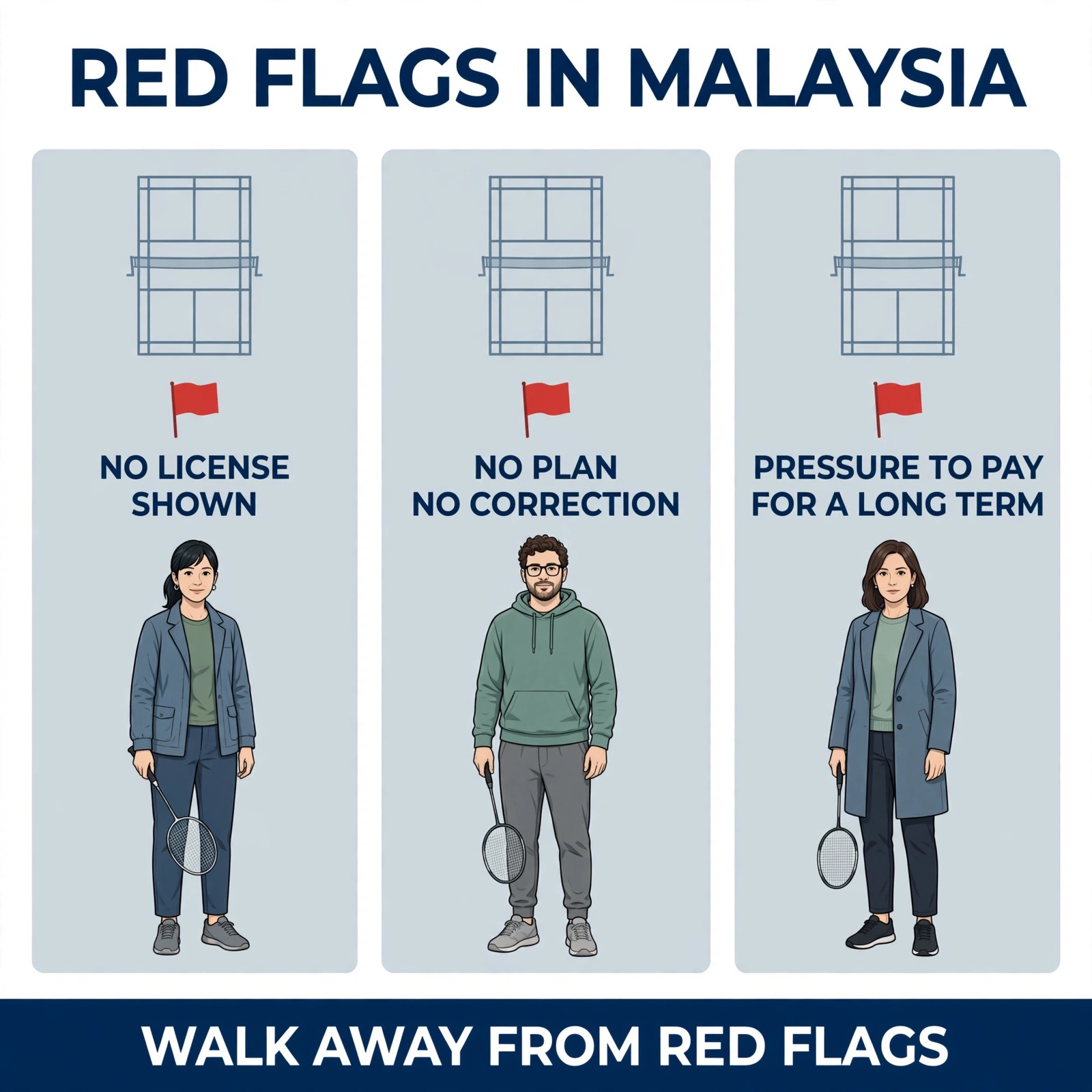
The clearest red flag is a coach who cannot show a valid National Coaching License, Lesen C (SLKK Tahap I), issued by the National Coaching Academy (AKK) and verifiable on the MSCR platform. The license is the check that matters, because it shows the coach is legally allowed to coach and trained to teach. A coach who shows only a playing record, or who gets angry when asked about a license, is asking you to trust a reputation instead of a credential, and that is a poor trade. Playing well and teaching well are different skills, and a trophy proves the first, not the second.
A second flag in the same family is a coach who presents only BAM Level 1 as proof. BAM Level 1 is the entry certificate and it is now common, so on its own it proves little. A coach who says BAM certified without saying which level, or who shows a BAM certificate and nothing else, is asking you to accept the first step as the whole proof. Ask for the license, ask for the SPKK certificate, and ask for the Sport Science course. A coach who holds the full line shows it proudly. A coach who holds only the first rung changes the subject.
A third flag is a coach who hides the credential. A coach who shows a photo of a license on a phone but will not let you read it, who shows a certificate with a different name on it, or who says the license is at home and never brings it, is hiding something. A license is a public proof, not a secret. A coach who treats it as a secret is a coach to avoid. Malaysia has enough licensed coaches that you do not need to settle for one who cannot show a license. Walk away early, and put your time into a coach who shows the license first.
No Correction
No Correction, No Teaching: When the Coach Only Plays
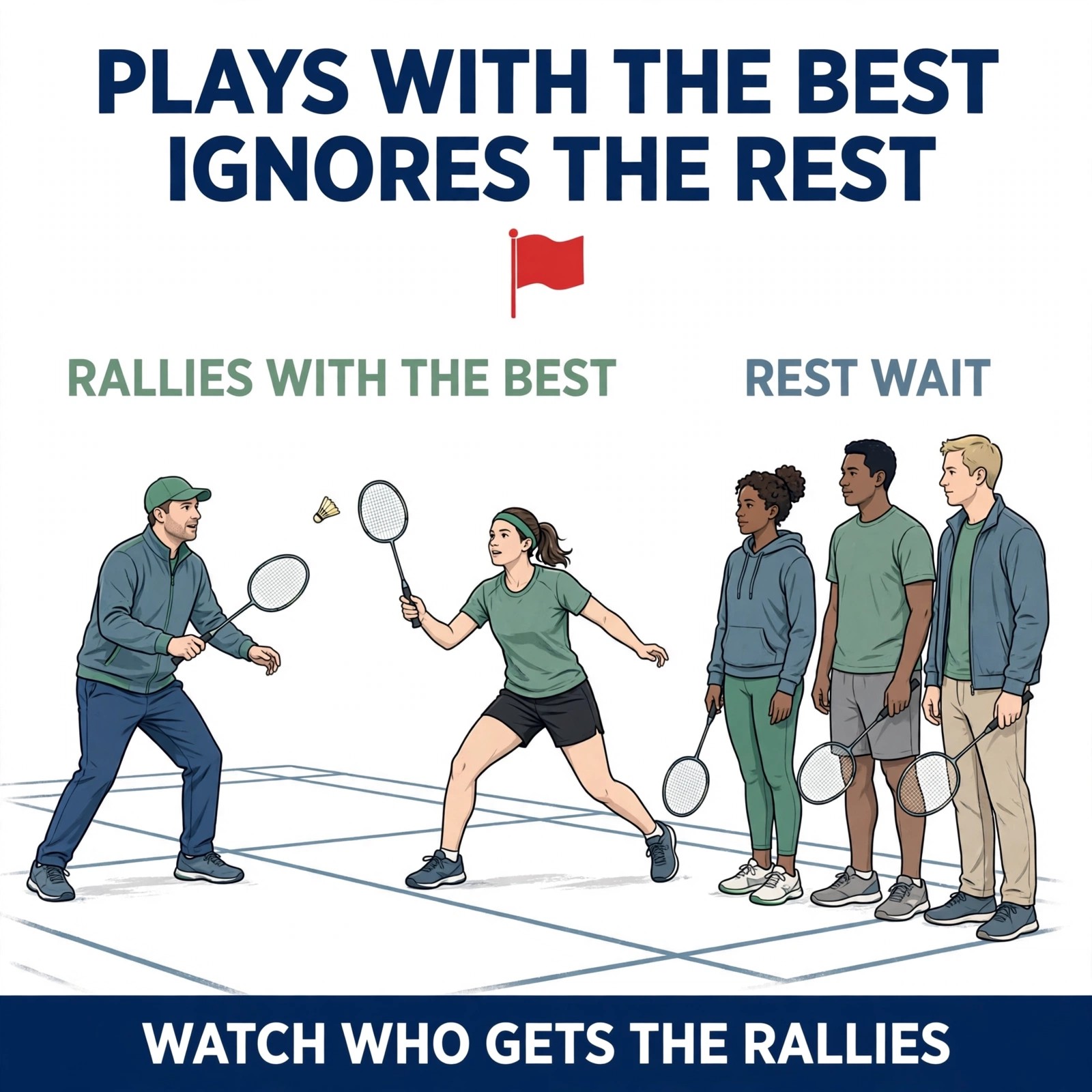
The heart of coaching is correction, and the flag is easy to spot: no player is corrected by name in the whole session. A good coach corrects by name, points at one clear change, and lets the player try again right away, with patience and a smile. A poor coach says good job to everyone, or corrects only the strongest player while the rest wait. Listen for names. In a small group, every player should hear their name and get at least one useful correction in every session. If the coach corrects no one, the session is a social hit around, not a lesson.
Watch whether the coach plays with the group or watches the group. A coach who plays all the time is not coaching, and the strongest player gets the rallies while the rest watch. If the coach only rallies with the best player, the rest are paying to watch, and you should look for another coach. A good coach watches, corrects, and only steps in to show a skill. The coach’s eyes tell you who the session is for. If the eyes are on every player, the session is for everyone. If the eyes are on one player, the session is for one player.
Watch the shy players as well. In a large group, the shy player disappears, and the coach never notices. In a good class, the coach brings the shy player in, gives the player turns, and corrects the player by name. If the same two players get every turn, the coach is coaching two players and charging twelve. If every player gets turns, the coach is coaching the group. The turns are the evidence, and they are easy to count.
No Plan
No Plan, No Progress: Random Drills and No Theme
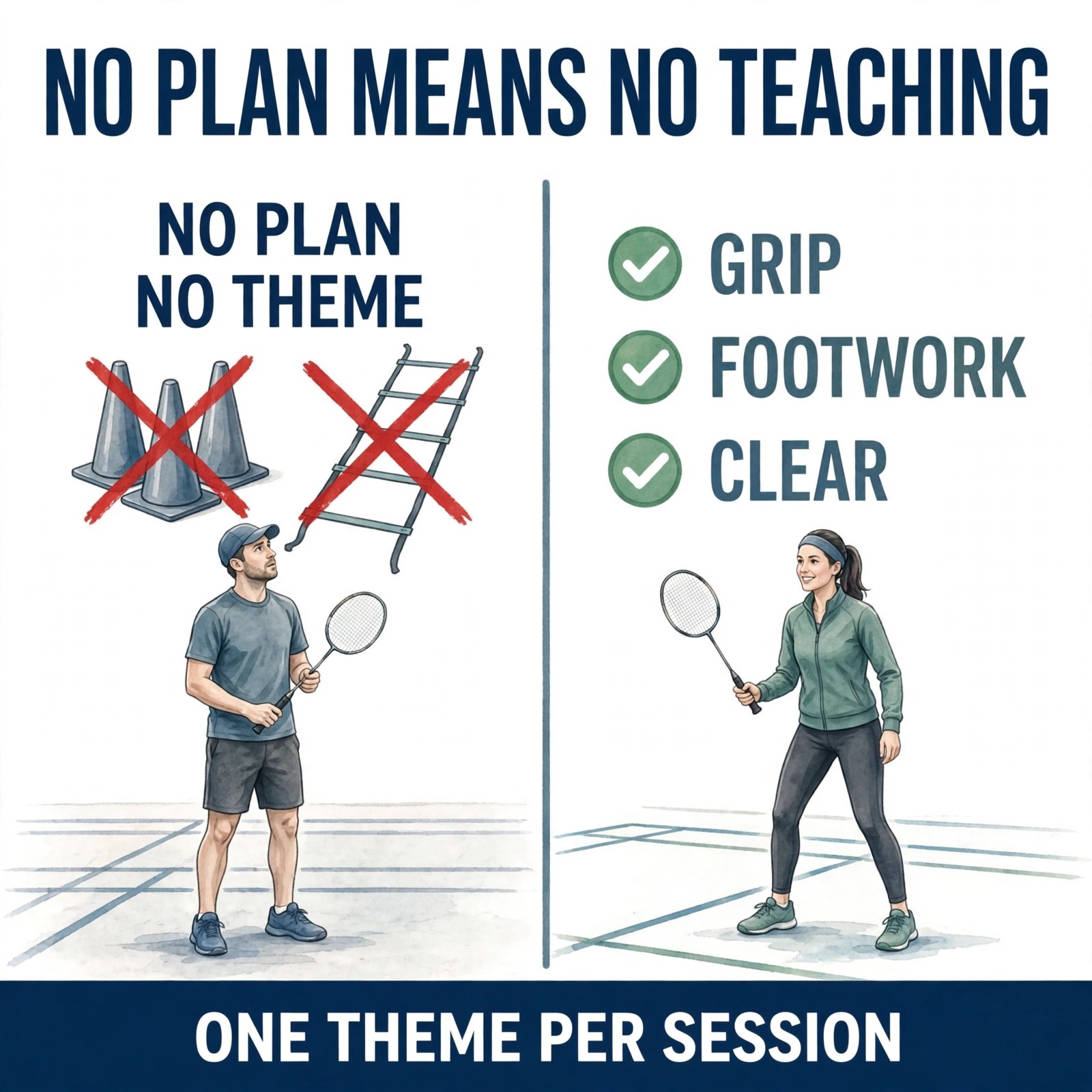
A good session has one clear theme. It starts with a warm up, then one clear skill such as the handshake grip, the split step, or the high clear. The coach shows it, the players practise it in short turns, and the coach corrects what he sees. Rallies and easy games come after the skill work. A coach with no plan runs a different drill every five minutes, and no player learns anything well. The difference is easy to see in one session: a planned session feels calm and purposeful, and a random session feels busy and loud. Busy is not the same as learning.
The order of skills matters more than the speed of progress. Grip comes first, because a wrong grip limits every shot that follows. Footwork comes next, because a player who cannot reach the shuttle in balance cannot hit it well. The clear comes after, because it teaches height, depth, and timing in one shot. A coach who teaches the smash in the first session is skipping the base, and the players will pay for it later with a weak clear and poor balance. Ask the coach after the session what the theme was. A clear answer shows a real plan, and a vague answer shows there is no plan at all.
A class with no plan also has no progress tracking. A good coach keeps a simple record of what has improved and what to work on next, and shares it with parents and players in plain words. A weak class tells you that your child or you are doing well every week, with no record and no next step. Progress in badminton is easy to see when it is tracked: the clear goes deeper, the footwork gets quicker to base, the serve stops going into the net. If no one can name what changed since the first week, the class is not tracking anything, and that is a flag.
Oversized Groups
Oversized Groups and Unsafe Halls: When the Numbers and the Floor Warn You
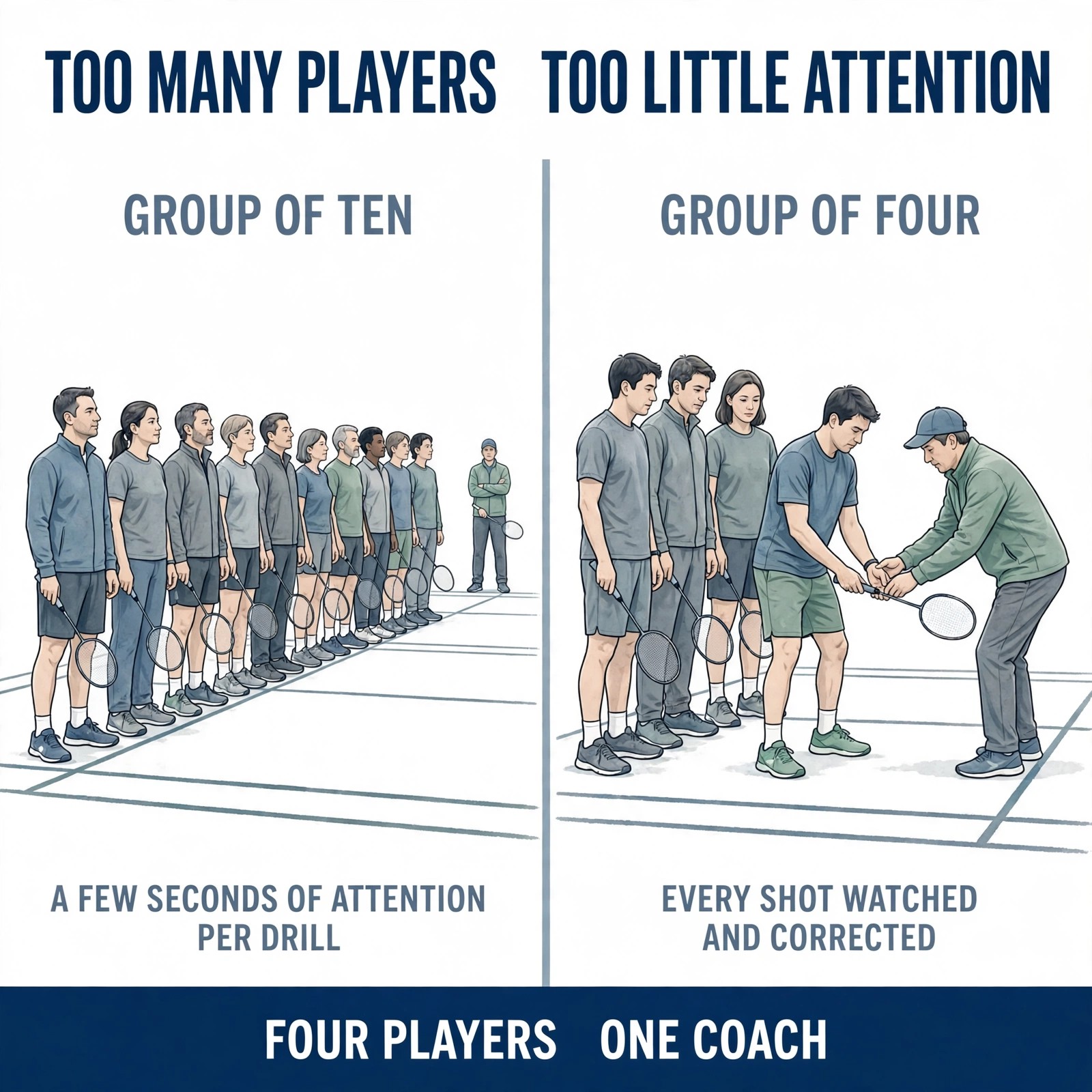
Group size is the simplest check you can run, and it is the one most classes fail. In a group of four, the coach can watch every player, correct every shot that matters, and give each player many turns in every drill. In a group of ten or more, the coach can only watch the front of the line, and most players spend most of the session standing and waiting. The hall may look busy, but busy is not the same as learning. When you visit a class, count the players on one court with one coach. That number tells you more than any flyer.
ST Badminton Academy limits its classes to a maximum of four students per coach, and head coach Mr Eric Chuar teaches those small groups himself. That limit exists because coaching is watching and correcting, and one pair of eyes cannot watch twelve players at once. A class that keeps its groups small is making a choice that costs money, because fewer students means less income per court. When a class accepts that cost, it is putting teaching first. When a class packs the court, it is putting income first, whatever its flyer says.
Check the hall as well as the group. A slippery floor or a dark hall makes good coaching hard, because players hold back when they do not trust the floor. Check the lighting, the space around the court, and whether the hall is safe for every player in the group. A good coach checks the floor and the space before the session starts, and keeps every player moving without long waits in the sun or on a slippery floor. A coach who ignores a dangerous floor is a coach who does not care about safety, and that is a flag.
Pressure to Pay
Pressure to Pay and Promises: The Sales Flags Before You Enrol
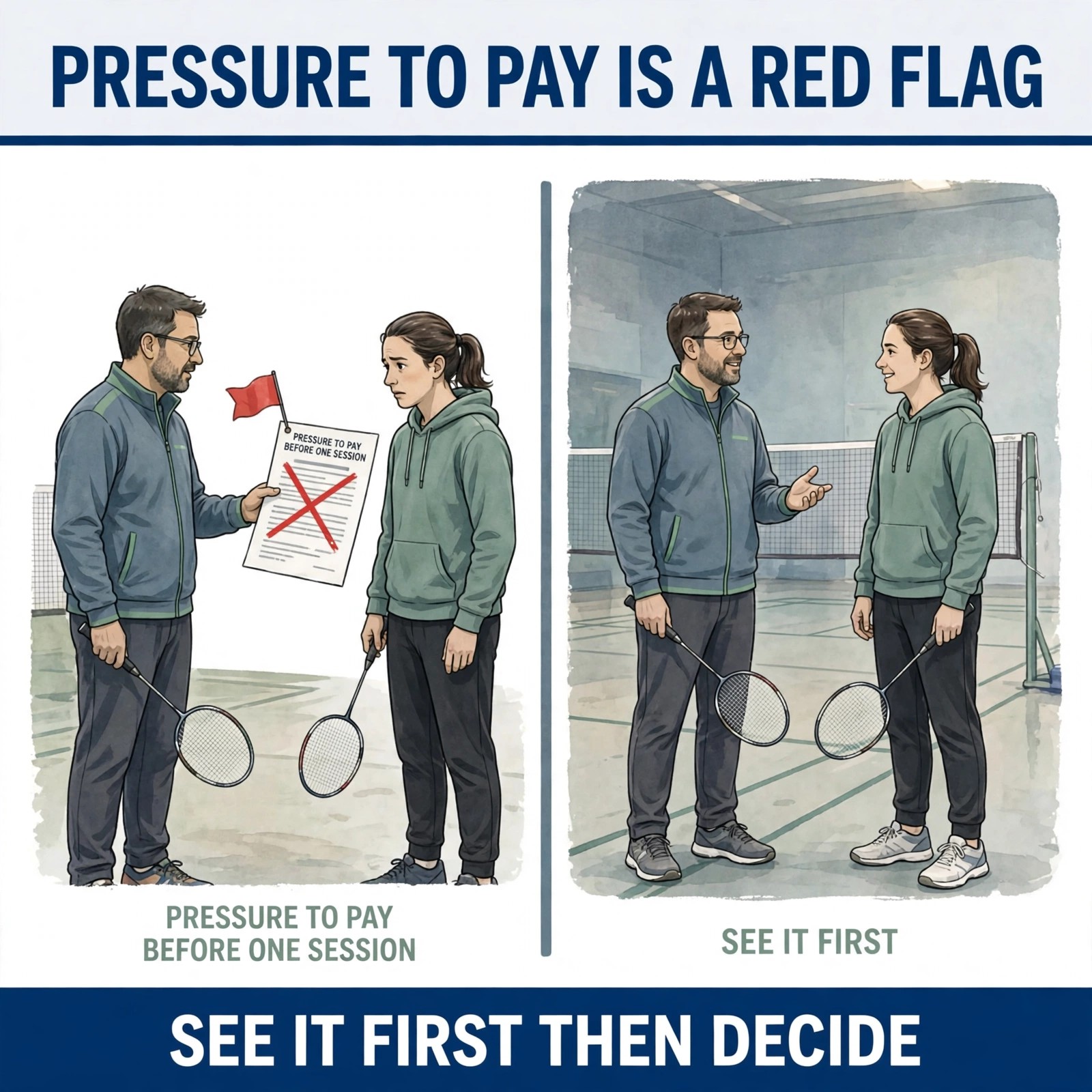
A good class lets you see the coaching first, through an assessment or a first session, and explains its terms in plain words. A class that pushes a long package on the first visit, and warns that the price will rise if you wait, is selling a contract, not coaching. Pressure to pay before you have seen one session is a red flag, and it is the flag that most often traps new players, because the deal sounds good and the clock sounds urgent. Walk away from the pressure, and look for a class that shows its work first.
The same applies to promises of fast results. No coach can promise a school team place or a tournament win in a set number of weeks, because progress depends on the player, the practice, and the time available. A coach who guarantees results is either lying or does not understand coaching, and either way the promise is a flag. A good coach promises a plan, a small group, and honest feedback, and lets the results speak for themselves. Judge the coach on the plan, not on the promise.
Read the terms before you sign anything. Ask what happens when you miss a session, whether the coach will help you catch up, and what happens if the coach leaves. A good class answers in plain words, and the terms are fair. A class with hidden terms, or a coach who will not put the terms in writing, is a class with something to hide. The terms are part of the coaching, and a class that hides them is a class that does not respect its players.
What to Do
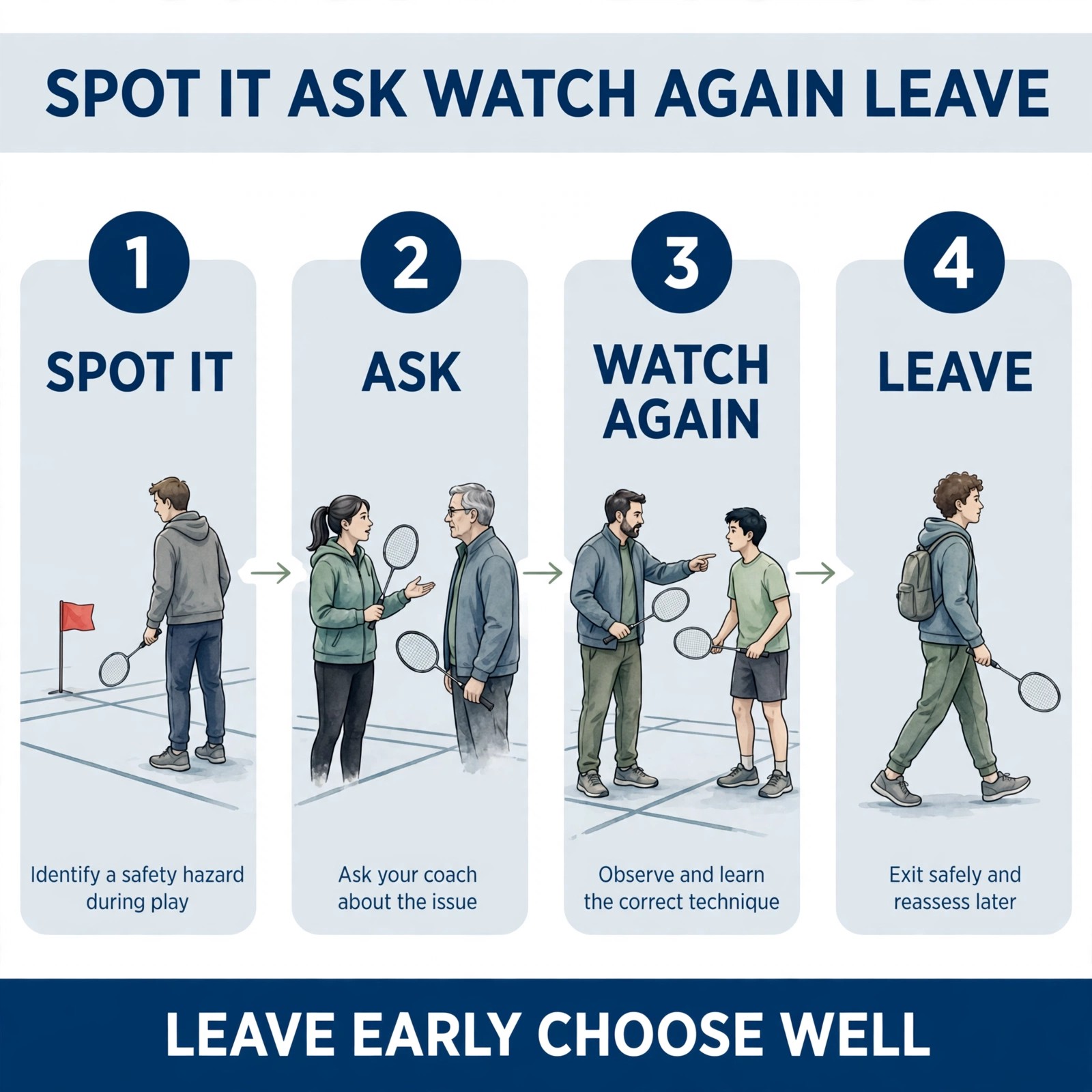
What to Do When You Spot a Flag: Ask, Watch Again, and Walk Away
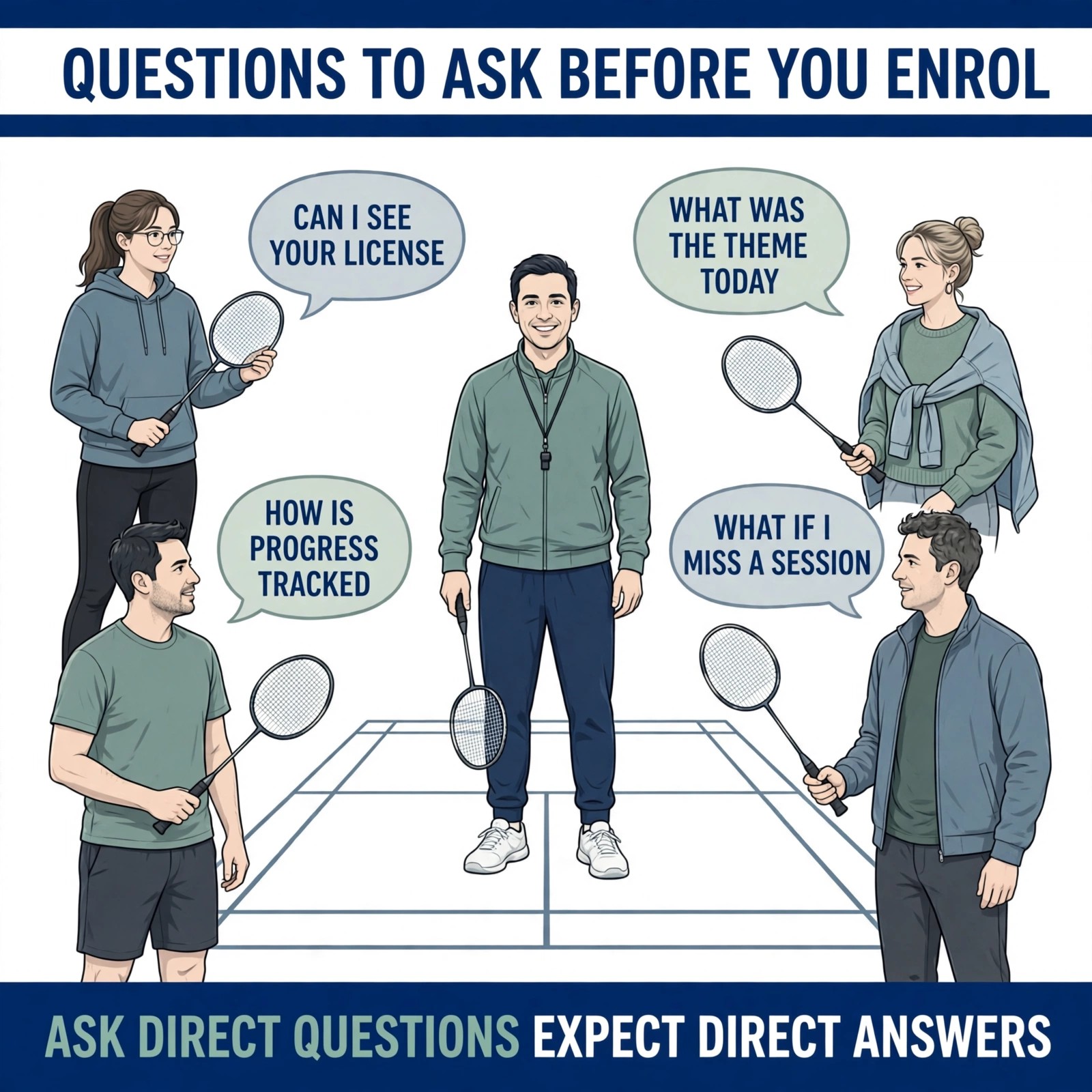
When you spot one flag, ask about it. Ask the coach to show the license, ask what the theme of the day was, ask how progress is tracked, and ask what the plan is for the first month. A good coach answers directly, and a poor coach changes the subject. The answer tells you whether the flag is a misunderstanding or a habit. A coach who fixes the flag after you ask is a coach who listens. A coach who argues, or who gets angry when asked, is a coach who has confirmed the flag.
When you are unsure, watch one more session. One poor session may be an off day, so give the coach a second chance to show the coaching. Watch the second session with the same checks: the license, the group size, the theme, the correction, and the questions after the session. Two poor sessions in a row is the system, not a bad day, and the decision is made. Do not pay for a long term to give the coach time, because time does not fix a system that has no plan.
When you see two flags, walk away. Leave politely, thank the coach for the session, and do not explain the flags in detail, because a coach who argues will waste your time. Then find a coach who passes the checks: a valid license shown without hesitation, a small group, a clear plan, correction by name, and progress shared in plain words. Malaysia has enough licensed coaches that you do not need to settle for one with red flags. The coach who passes the checks is the coach who will still be teaching well in a year, and that is the coach worth your time and your money.
Why Eric Chuar Stands Out
A coach can sound good on paper and still teach badly. The difference shows in the details: how a lesson is planned, how mistakes get corrected, and whether a student actually improves week after week. Eric Chuar has spent over 17 years coaching in Malaysia and Singapore, and his teaching is built on proper training, not guesswork. His certificates are listed below, and parents can ask to see them before signing up.
Coaching licences: National Coaching License Lesen C, SLKK Tahap I, issued by Akademi Kejurulatihan Kebangsaan (AKK). This is the licence that confirms legal coaching status in Malaysia, and it can be checked on the Malaysia Sports Coach Registry (MSCR). He is also a Certified National Level 1 Badminton Coach under SPKK, issued by AKK and Institut Sukan Negara, and a Certified Badminton Coach under BAM Level 1.
Sport science: Sport Science Course Level 1 (AKK), covering basic anatomy and physiology, youth training principles, injury prevention, fitness components, training planning, testing and monitoring, and sport psychology basics.
Data and analytics: Sports Performance Analysis, Sports Performance Analytics Specialization, Prediction Models with Sports Data, Data Collection and Processing with Python, Wearable Technologies and Sports Analytics, Machine Learning in Sports Analytics, and a Test on Moneyball and Beyond.
Athlete development and safety: The Science of Training Young Athletes, Motivating Gen Z Learners, Safe Sport Core, Safe Sport (Coach), and Doping in Sports.
He codes, too. The Python and machine learning certificates are real, and he uses them. He builds his own systems for tracking students and planning lessons, so decisions come from records and data, not just feel. A coach who can read the numbers and read the court is hard to find.
Small groups, close attention. Classes stay at a maximum of four students, so every grip, every footwork step and every swing gets corrected properly. With over 17 years of coaching behind him, he has seen the same beginner mistakes hundreds of times, and he knows how to fix them before they become habits.
Sixteen certificates in total, plus registration on the Malaysia Sports Coach Registry. That is the part other coaches cannot match by talking about it.
FAQs: Badminton Coach Red Flags in Malaysia Explained
These are the questions parents and players ask most often about badminton coach red flags in Malaysia, answered in plain words.
What is the biggest red flag in a badminton coach?
A coach who cannot show a valid National Coaching License, Lesen C (SLKK Tahap I), issued by the National Coaching Academy (AKK). The license is the check that matters, because it shows the coach is legally allowed to coach and trained to teach. Everything else in this guide is useful, but a missing license is the flag that ends the conversation.
Is one red flag enough to leave a coach?
One red flag is a warning, not a verdict. Ask about it, and watch one more session to see if the coach fixes it. Two red flags are a pattern, and a pattern is the system, not a bad day. Walk away when you see two, and do not let a friendly coach or a low price talk you out of it.
What if the coach is very popular?
Popularity proves nothing. A coach can be popular and still teach badly, because a full hall can mean good marketing, not good coaching. Judge the coach on the checks in this guide: the license, the group size, the plan, the correction, and the progress tracking. A popular coach who fails those checks is still a poor coach.
What if the coach was a very good player?
A good player is not automatically a good coach. Playing well and teaching well are different skills. A coach must explain in short, simple words, show the skill instead of only talking about it, correct by name, and keep every player moving. Watch one session: does the coach teach, or only play? The answer tells you more than any trophy.
How do I check a coach’s license?
Ask the coach to show the valid National Coaching License, Lesen C (SLKK Tahap I), then check it on the MSCR platform, the Malaysian Sports Coaches Registry, where the license can be verified. A coach who shows the license without hesitation is a coach who has nothing to hide. A coach who refuses, delays, or gets angry when asked is a red flag.
What if the class is very cheap?
A low price does not excuse a missing license, a packed court, or no plan. A cheap class that does not teach costs more in wasted months than an honest class that does. Judge the coach on the checks in this guide, not on the price. A good coach is worth the fee, and a poor coach is not worth any fee.
What if my child likes the coach?
A child can like a coach who does not teach, because a friendly coach who plays games all session is fun. Fun matters, but it is not teaching. Watch whether your child improves: the grip feels natural, the clear reaches further back, and the coach can name what improved. If your child likes the coach but learns nothing, the class is a game, not a lesson, and you should find a coach who teaches and is kind.
What should the first session include?
A good first session starts with a warm up, then one clear theme such as the handshake grip, the split step, or the high clear. The coach shows it, the players practise it in short turns, and the coach corrects what he sees. Rallies and easy games come after the skill work. Every player should hear their name and get at least one useful correction. If the first session is games only, with no teaching, it is a social session wearing a class label.
What does ST Badminton Academy do differently?
ST Badminton Academy shows the license first, limits classes to a maximum of four students per coach, starts with an assessment, teaches grip, footwork, and clear in that order, corrects every player by name, and shares progress with parents and players in plain words. Parents are welcome to watch a session and check the license before they commit. Head coach Mr Eric Chuar holds the valid National Coaching License, Lesen C (SLKK Tahap I), plus the SPKK National Level 1 certificate, Sport Science Level 1, and BAM Level 1.
Badminton Coach Red Flags in Action

What Good Coaching Looks Like at ST Badminton Academy
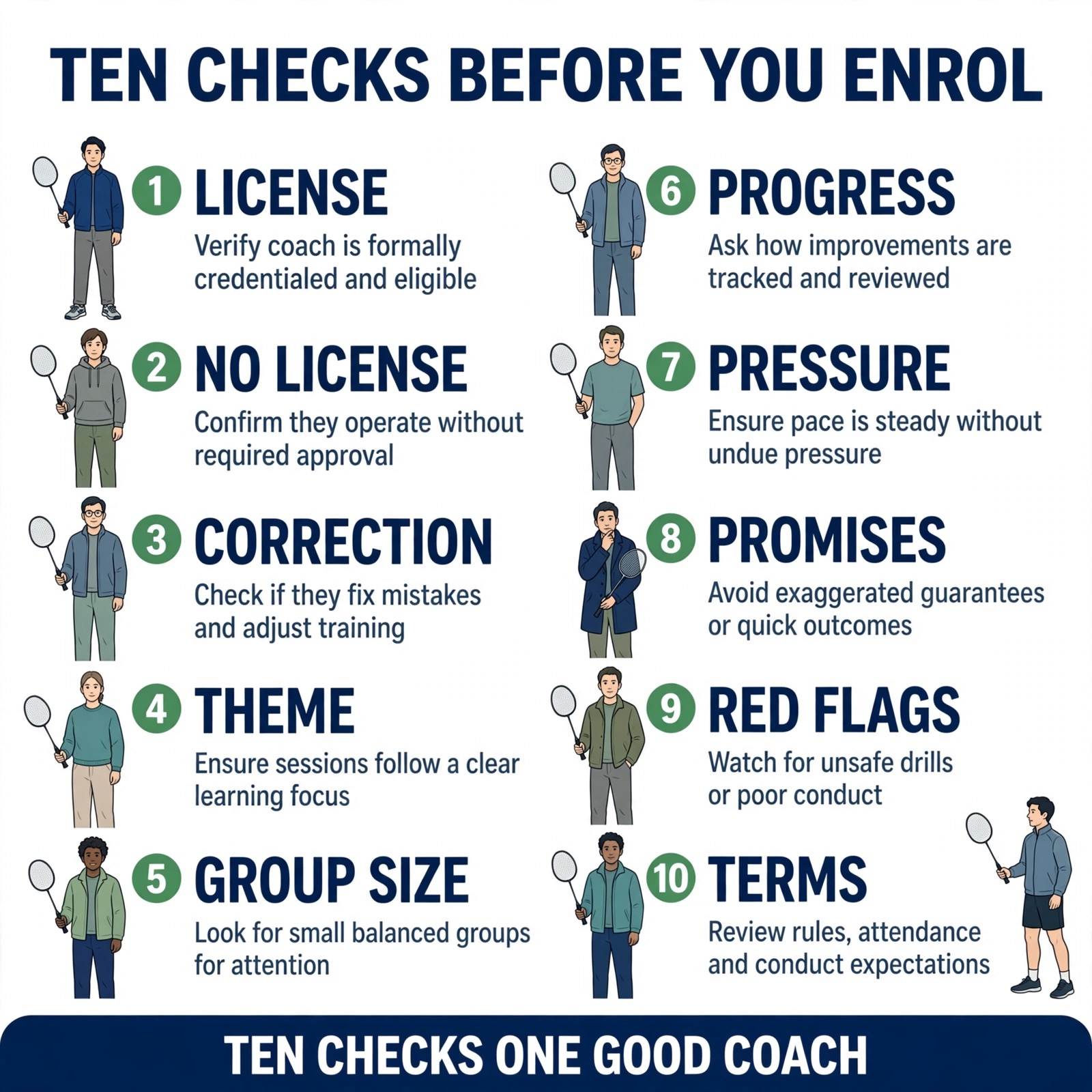
Spotting red flags gets easier when you know what good coaching looks like. These are the standards we hold ourselves to in every session at ST Badminton Academy.
| Factor | A Coach With Red Flags | A Coach Worth Training With STBA |
|---|---|---|
| Coach Background | No license shown. Only a playing record or a BAM Level 1 certificate. | A licensed coach with a clear teaching record and many years of experience in Singapore and Malaysia. |
| Session Plan | No theme, random drills, no assessment. | Assessment first, then one clear theme per session, in a fixed order. |
| Group Size | Large groups. The coach hardly sees each player. | Maximum 4 students. The coach corrects every shot that matters. |
| Progress Tracking | No record. Players are told they are good every week. | A simple record of what improved and what to work on next, shared in plain words. |
| Communication | Short answers. Players rarely hear about their own progress. | Clear explanations after sessions, and video feedback that stays private. |
| Who Gets Attention | The coach rallies with the best player while the rest wait. | Every player gets turns, hears their name, and gets one clear correction. |
| Terms | Pressure to pay for a long term before one session. | Terms explained in plain words, and a first session to see the coaching before you commit. |
Spot the Flags Early, Walk Away Cleanly
Before you enrol with any badminton coach in Malaysia, run the checks in this guide. One red flag is a warning: ask about it, watch one more session, and see if the coach fixes it. Two red flags are a pattern: walk away and find a coach who shows the license, teaches the base in the right order, corrects by name, and tracks progress. A coach who hides the license, plays with the best player, teaches with no plan, packs the court, or pressures you to pay for a long term is not a coach worth your time or your money. Malaysia has enough licensed coaches that you do not need to settle for one with red flags. ST Badminton Academy welcomes parents and players who want to watch a session, check the license, and judge the coaching before they commit.