The Importance Of Good Footwear In Badminton: Choosing The Right Shoes (Footwear Guide)
Ask a room of badminton players what gear matters and most will talk about rackets. Ask their ankles and the answer is shoes. Badminton is a sideways sport played in lunges, jumps, sudden stops and sharp turns, and the shoe is the only piece of equipment that touches the floor through all of it. This guide explains how to choose court shoes properly: why running shoes are the wrong tool, what the sole, cushioning and support actually do, how a shoe should fit, and how to care for a pair so it lasts. It is the advice we give every new student at ST Badminton Academy in Setapak, Kuala Lumpur.

Shoe Check #1
Court Shoes Are Not Running Shoes
Start with the movement. A runner travels in a straight line, heel to toe, over and over. A badminton player travels in every direction except a straight line: lunging forward and sideways, braking hard, turning on the front of the foot, jumping and landing on one leg. Running shoes are built for the first job. They sit tall on thick, soft heels designed to roll forward, and that height becomes a lever when you lunge sideways: the shoe tips, and the ankle goes with it.
A court shoe is built for the second job. It sits low to the floor, so the foot is stable when it lands off balance. Its sole is flat and wide, so braking and turning happen on a platform instead of a perch. Players who switch from running shoes usually feel the difference in the first session: stops feel planted, turns feel deliberate, and the small wobble at the end of a deep lunge mostly disappears. No shoe can promise you will never roll an ankle, but the right shape lowers the risk and the wrong shape raises it.

Shoe Check #2
The Sole: Gum Rubber, Grip and Turning
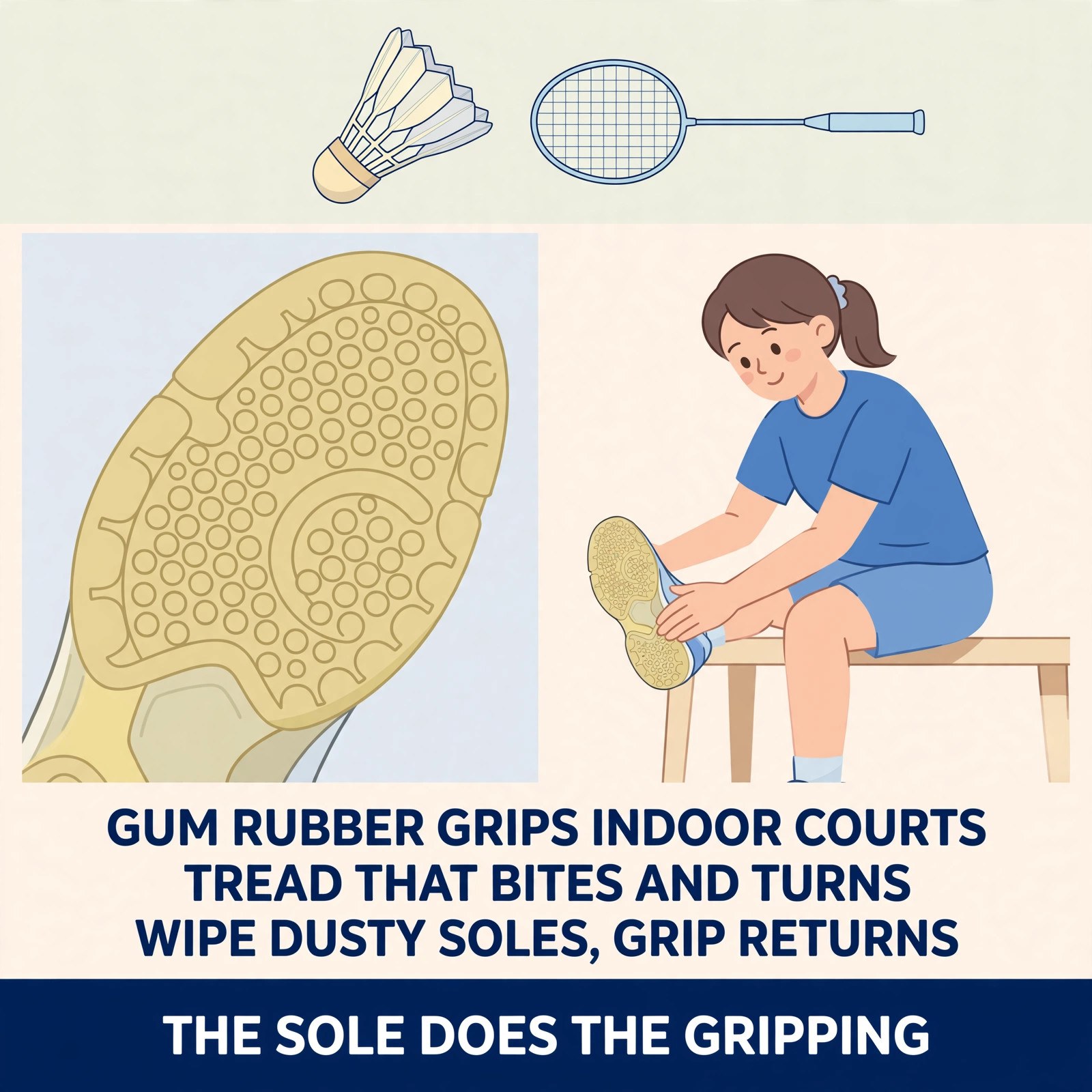
Grip on an indoor court comes from gum rubber, the pale, soft rubber used on proper court shoe soles. It bites into smooth hall floors in a way that hard black running soles cannot. Look at the tread as well: court soles use rounded patterns that run in several directions, often with a round pivot area under the front of the foot, because badminton turns happen on the spot as much as in a line. Grip should hold you when you brake and still let you turn; a sole that sticks in every direction would twist knees instead of saving them.
Two honest notes on grip. First, the best sole in the world cannot grip a dusty court: wipe the soles with your palm, or on a damp towel at the side of the court, whenever you feel the first slide. Second, grip is a wearing part. As the tread smooths out over months of play, the bite fades quietly, long before the shoe looks finished. That fading is the main signal in the replacement section later in this guide.
Court shoes are made for indoor courts and should live there. The same gum rubber that grips a hall floor wears quickly on concrete and tarmac, and grit from outdoor surfaces grinds the tread away. Wear your normal shoes to the hall and change at the bench. It feels fussy for a week and then becomes habit, and it can stretch the useful gripping life of a pair a long way.
Shoe Check #3
Cushioning and Support Where Lunges Land
Cushioning in a court shoe has a specific job: soften the repeated landings under the heel and the front of the foot without turning the shoe into a mattress. Too little and your heels and knees feel every jump. Too much soft foam and the foot rolls inside the shoe before the shoe itself moves, which makes lunges feel vague and late. The middle ground is firm cushioning: present when you land, quiet when you move.
Support is the other half. The side walls of a court shoe are reinforced because the lunge lands on the side of the foot, not the middle. A firm cup around the heel holds the back of the foot still so it does not slide inside the shoe on hard stops. A shoe that resists twisting when you wring it gently in your hands helps the whole platform stay under you during quick changes of direction.
Be clear about what support cannot do. A shoe supports the foot; it does not strengthen the ankle. Players whose ankles roll often still need balance and calf work in training, and this guide will not pretend a purchase replaces it. What the right shoe honestly offers is a stable, grippy, cushioned platform that lets your own strength do its job, instead of a tall, soft one that fights it.

Shoe Check #4
Fit: The Part Most Players Get Wrong
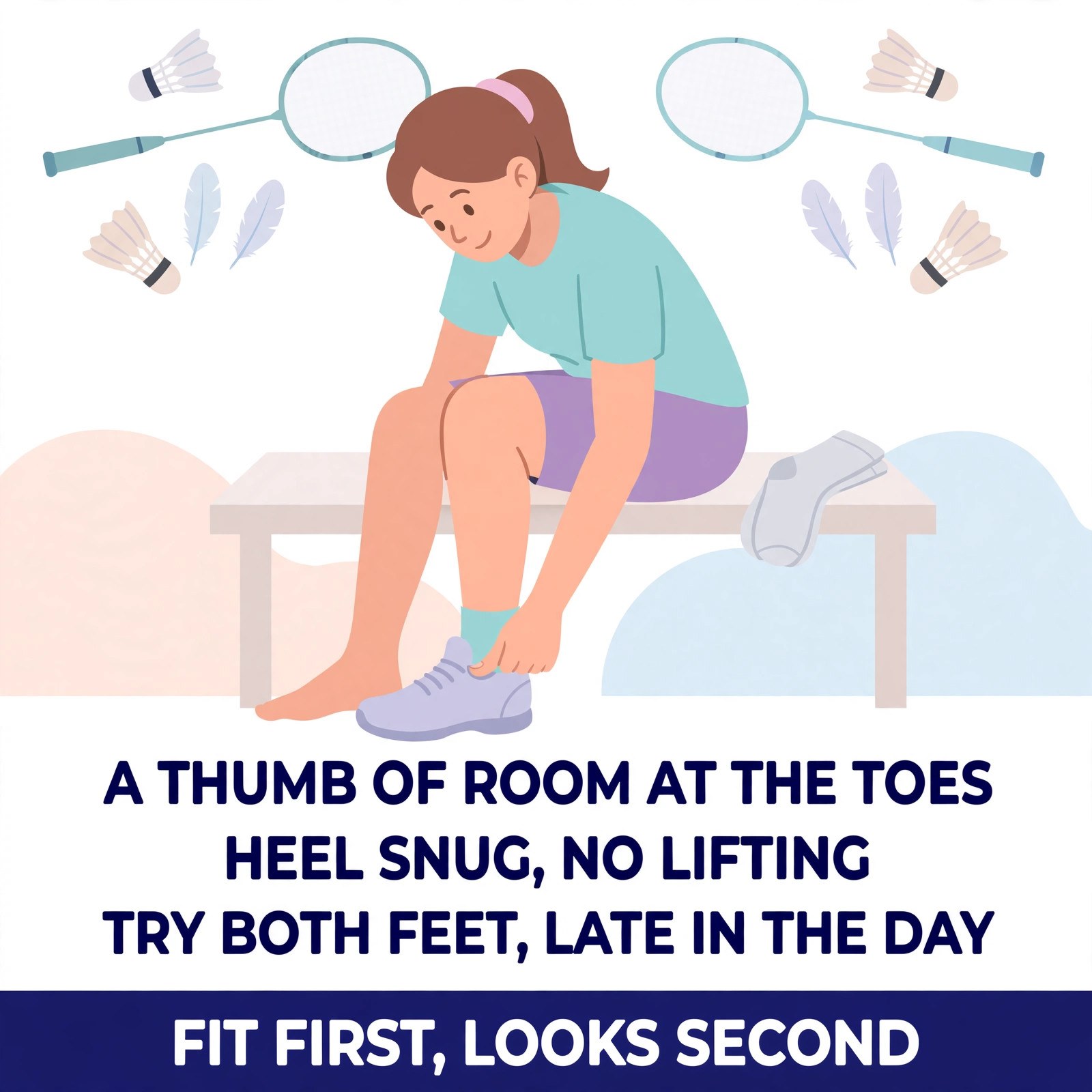
Fit is where most shoe buying goes wrong, usually because players buy the size on the chart instead of the feel on the foot. Your feet swell during a day and during play, so try shoes late in the day, wearing your court socks. Stand up in them; there should be about a thumb of room between your longest toe, which is not always the big toe, and the front of the shoe. Too little and your toes will pay for every lunge by the third game.
The heel matters just as much. It should sit snug at the back with no lifting as you walk, while the middle of the foot feels held, not squeezed. Width counts too: a foot that spreads over the side wall on a lunge is a foot the shoe cannot support, however good the sole is. Try both feet, because most people have one foot slightly larger; fit the larger one. Then test the pair the way you will use them: walk, lunge both ways, and hop on the spot in the shop.
A word on men’s and women’s models: the difference is mostly the last, the shape the shoe is built around, with women’s versions often narrower at the heel. It is a starting point, not a rule. Plenty of women play well in men’s models and plenty of men in women’s. The fit checks in this section outrank the label on the box every time, and any shop that will not let you lunge in the shoes is a shop to leave.
Shoe Check #5
Care, Wear and Knowing When to Replace
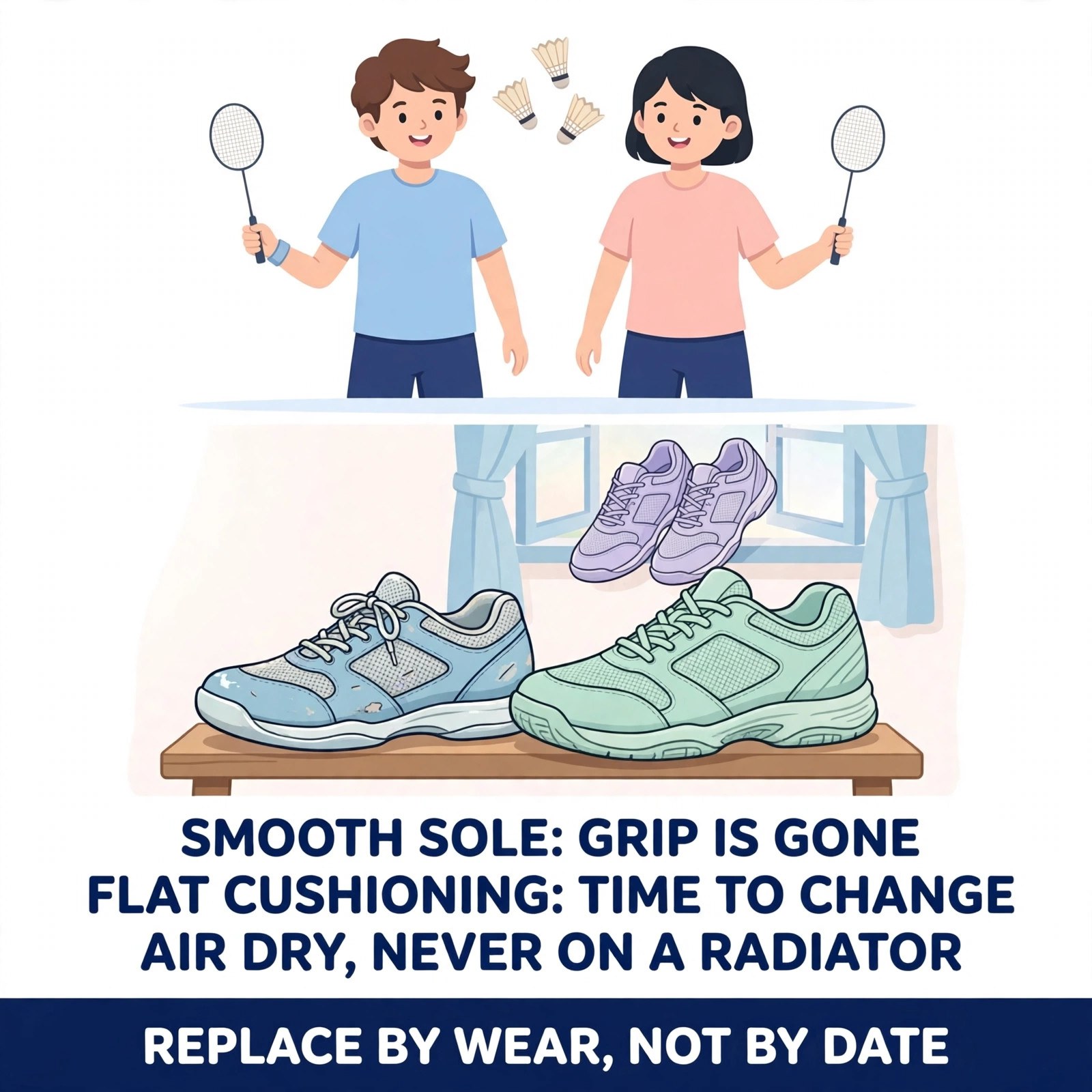
Court shoes fade from the inside and the bottom, not from looking old. The three honest wear signals are: a sole that has gone smooth and shiny, so the grip you trusted is no longer there; cushioning that feels flat and dead under the heel, so landings jar more than they used to; and an upper that has stretched or split at the sides, so the foot moves inside the shoe on lunges. Any one of the three is a reason to replace the pair.
How long that takes depends on how much you play, not on the calendar. A player training several times a week on hard hall floors might wear through the grip in well under a year. A once a week social player might get several seasons. This is why we teach the weekly check instead of a replacement date: run a finger over the tread, press the heel cushion, look at the side walls. Two minutes, honest answers.
Care in between is simple and mostly free. Loosen the laces and air the shoes out after every session instead of leaving them sealed in a bag. Brush dust and grit off the soles. Keep them away from radiators and direct hot sun, which harden and crack the materials, and never put court shoes in a washing machine. Players who play almost daily sometimes keep two pairs in rotation, which lets each pair dry fully and stretches the life of both.
Myth vs Reality
Myths About Badminton Shoes
Myth one: any trainer will do for badminton. Trainers are a family, not a shoe. Running shoes are tall and built to roll forward, fashion trainers are often heavy with flat fashion soles, and gym shoes vary a lot. Badminton needs its own shape: low, flat, grippy, supported at the sides. Playing a sideways sport in a straight line shoe is the cheapest false economy in the game, paid for in slips and rolled ankles.
Myth two: more cushioning is always better. On a court, excess softness is a cost, not a comfort. The foot sinks and rolls before it can push, landings feel late, and quick direction changes lose their edge. Court cushioning should be firm and placed, under the heel and forefoot, inside a stable shoe. Comfort in badminton comes from fit and support working together, not from the thickest foam in the shop.
The reality is plain: fit and sole come first, and everything else is decoration. A modest court shoe that fits your foot and grips your hall will serve you better than a flagship model in the wrong size. There are no brands named in this guide on purpose. Learn the checks, run them on any pair in front of you, and let your feet, not the marketing, make the decision.

Why Choose Us
Why Players Choose ST Badminton Academy
At ST Badminton Academy, shoes are the first gear check we make, before rackets, in small groups with a maximum of four students per coach. New students are asked to arrive in proper court shoes or to talk to us before buying. It is a short conversation that saves money: the checks in this guide take five minutes in a shop and prevent the most common wrong purchase in the sport.
We are strict about one hall rule: court shoes are worn only indoors and changed into at the bench. It keeps grit off our courts for everyone’s grip, and it keeps each student’s soles alive longer. Students also learn the weekly self check, sole, cushioning and side walls, so a worn out pair is spotted in the changing room and not discovered mid lunge in a match.
If a student’s feet keep hurting, or an ankle keeps rolling, we say the same thing we say about any pain in this guide: shoes are part of the picture, not the whole answer. Get the feet checked by a doctor or physiotherapist, and bring their advice back to us. We will happily match footwear and training to it. Honest limits keep players playing longer.
FAQs: Badminton Shoes and Footwear in Malaysia (KL)
These are the questions students and parents ask us most about badminton shoes. The short answer running through all of them: low and grippy beats tall and soft, fit beats size charts, and wear beats the calendar every time.
What shoes should I wear for badminton if I play in Setapak or Gombak?
Proper indoor court shoes: low to the floor, flat gum rubber soles, firm cushioning and reinforced sides. At our Setapak base we ask students to change into them at the bench, never to wear them outside. If you are buying your first pair, run the fit checks in this guide before you look at anything else.
Why are running shoes a poor choice for badminton in KL?
Because they are built for a different job. Running shoes sit tall on thick, soft heels made to roll forward in a straight line. Badminton moves sideways, and on a lunge that tall heel acts like a lever, tipping the foot and taking the ankle with it. Court shoes sit low and flat for exactly those moves.
How should badminton shoes fit when I try them on in level?
Try them late in the day, in your court socks, standing up. Leave about a thumb of room in front of your longest toe, keep the heel snug with no lifting, and make sure the midfoot feels held rather than squeezed. Fit the larger foot if one is bigger, then walk, lunge and hop before you decide.
How long do badminton shoes last before the grip and cushioning fade?
There is no honest fixed number, because it depends on how often you play and on what floors. A player training several times a week may wear the grip out in well under a year; a weekly social player may get several seasons. Check weekly instead: smooth sole, flat cushioning or stretched sides mean replace.
What should I check on the sole before buying court shoes for classes?
Three things. The material should be gum rubber, pale and slightly soft, made for indoor courts. The tread should run in several directions with a round pivot area under the front of the foot, because badminton turns on the spot. And the sole should be flat and wide, so braking and lunging happen on a stable platform.
Do you give footwear advice to students near Wangsa Maju?
Yes. Our base is in Setapak, a short drive from Wangsa Maju, and footwear is the first gear topic we cover with new students. Bring the pair you are thinking of buying, or the pair you already own, and we will run the sole, cushioning and fit checks with you before your first full session.
What should my child wear on the feet for a first badminton class in Malaysia?
Proper court shoes if you have them, sized by the fit checks in this guide: thumb of room, snug heel, court socks. If your child is trying a first class before you buy, tell us when you book and we will advise honestly on what they have, rather than send you shopping in a panic.
Where does ST Badminton Academy coach badminton in Setapak?
Our home base is Setapak in Kuala Lumpur, and the full programme runs there, including the footwear checks in this guide. Players join us from Wangsa Maju, Gombak and across the city. Tell us your area when you book a trial and we will confirm the session times that suit you best.
What makes Mr Eric Chuar check student shoes before class in badminton?
Mr Eric Chuar has coached in Singapore and Malaysia for over fifteen years, and shoes are the first thing he looks at because they are the only gear touching the floor on every lunge and landing. A two minute check at the door has prevented more slips in his sessions than any speech about technique.
Badminton Footwear and Class Standards in Action


One Standard for Every Player and Every Session
One standard runs through every check in this guide: the shoe must serve the movement, not the mirror. At ST Badminton Academy we look at soles before logos and fit before fashion, and we teach students to run the same checks themselves. A pair that grips, supports and fits will never trend on social media, and it will quietly do its job for season after season, which is the only review that matters on court.
| Factor | Any Trainers | Proper Court Shoes SHOES |
|---|---|---|
| Frequency | 1 or 2 times a week. Mostly for fun and sweat. | Low gum rubber soles that grip indoor courts and let the foot turn safely. |
| Drills Focus | Basic static feeding. Minimal footwork pressure. | Flat support built for lunges and side steps, not straight line running. |
| Physical Conditioning | Rarely included. Just playing games on court. | Core, agility, and speed training included in every session to prevent injury and build stamina. |
| Tactical Awareness | "Just hit it over." No real game plan. | Video analysis, point construction, and learning to read the opponent's game. |
| Coach Ratio | Large groups (8-10 kids). Coach barely watches you. | Max 4 students. Mr Eric Chuar personally corrects every stroke and movement detail. |
| Goal Setting | Fun and exercise. | Fit checked with a thumb of room at the toes and a heel that stays put. |
| Long Term Result | Good recreational player. | A player who moves fast, stops safely, and trusts every landing. |
Badminton Classes With the Right Shoes in Kuala Lumpur
This guide gives you the full picture: court shoes, not running shoes; gum rubber and a turning tread; firm cushioning and honest support; a thumb of room and a snug heel; replaced by wear, not by date. Run those checks on any pair, at any price, and your feet will tell you the truth. If you want the checks done with you before you buy, come and try a session with us in Setapak, Kuala Lumpur, and bring your shoes.






