Stay Safe With Badminton Injury Prevention Tips (Injury Safety Guide)
Badminton is a kind sport to learn and a hard sport on the body. The lunges load your knees and ankles, the overhead shots load your shoulder, and a season of sudden stops asks a lot of calves and Achilles tendons. Staying safe is not about wrapping yourself in cotton wool. It is about habits: how you warm up is part of it, but this page covers the rest of the safety picture we teach at ST Badminton Academy in Setapak, Kuala Lumpur: sensible training load, footwear that fits the job, a court checked before you play, honest technique, and knowing when to stop and when to rest. None of it can promise you will never get hurt. All of it lowers the risk.
Safety Check #1
What Actually Hurts Badminton Players?
It helps to know what actually goes wrong. The common badminton injuries are ankle sprains from rolling on a lunge or landing, muscle strains in the calf, thigh and groin from sudden pushes, knee pain built up over weeks of hard landings, shoulder and elbow soreness from overhead volume, and wrist strains from tense, forced shots. Notice the pattern: very few of these are bad luck. Most are load meeting a body part that was cold, tired, badly shod or asked for too much too soon.
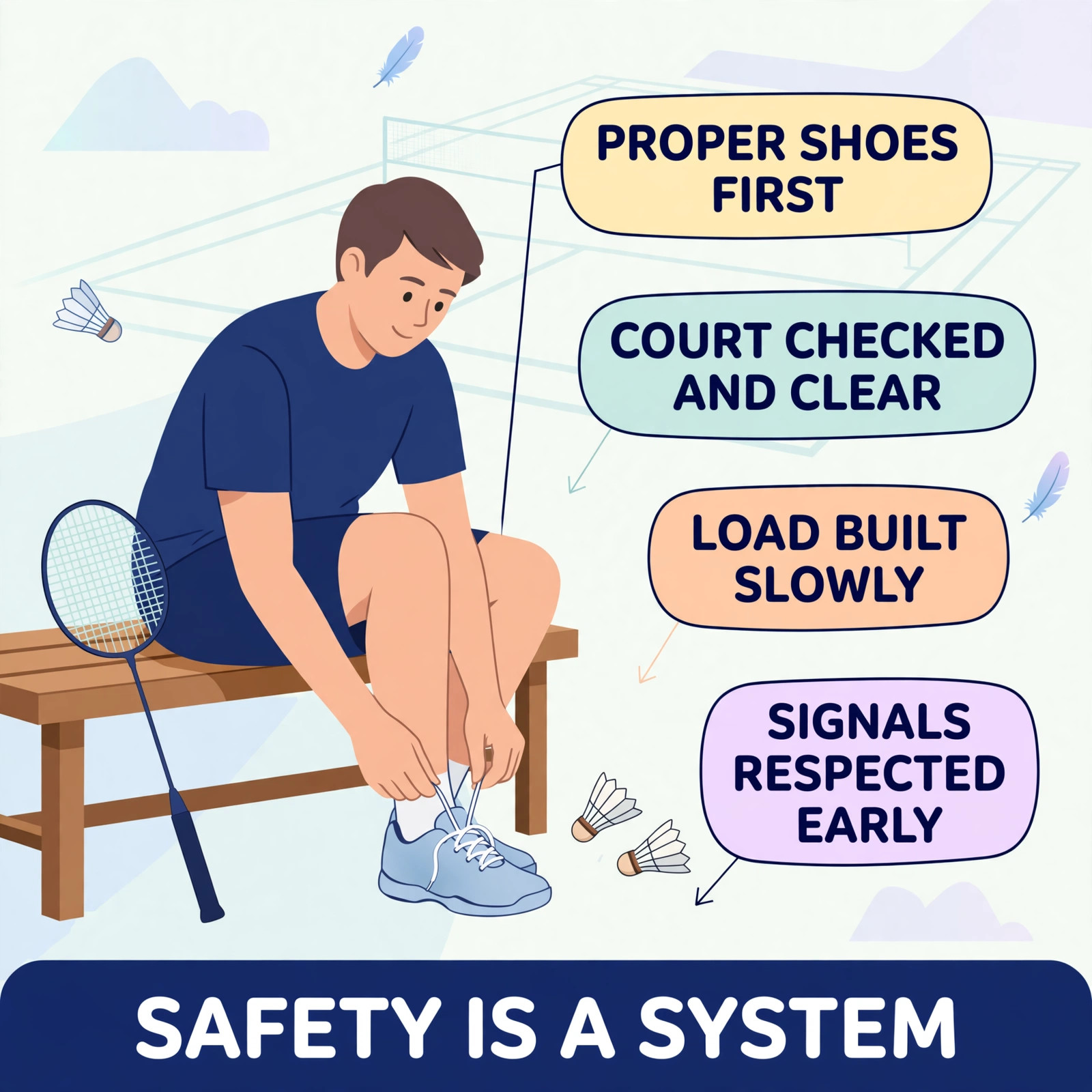
That pattern is good news, because load and readiness are things you control. Safety in badminton is mostly load management wearing different clothes: warm the tissue before you load it, build the load gradually, wear the shoe that holds your foot, land on a surface that is clean and grippy, and stop when a small pain starts sending bigger signals. The sections below take those habits one at a time, in the order you would meet them on a normal playing week.

Safety Check #2
Start at the Floor: Shoes and Court Checks
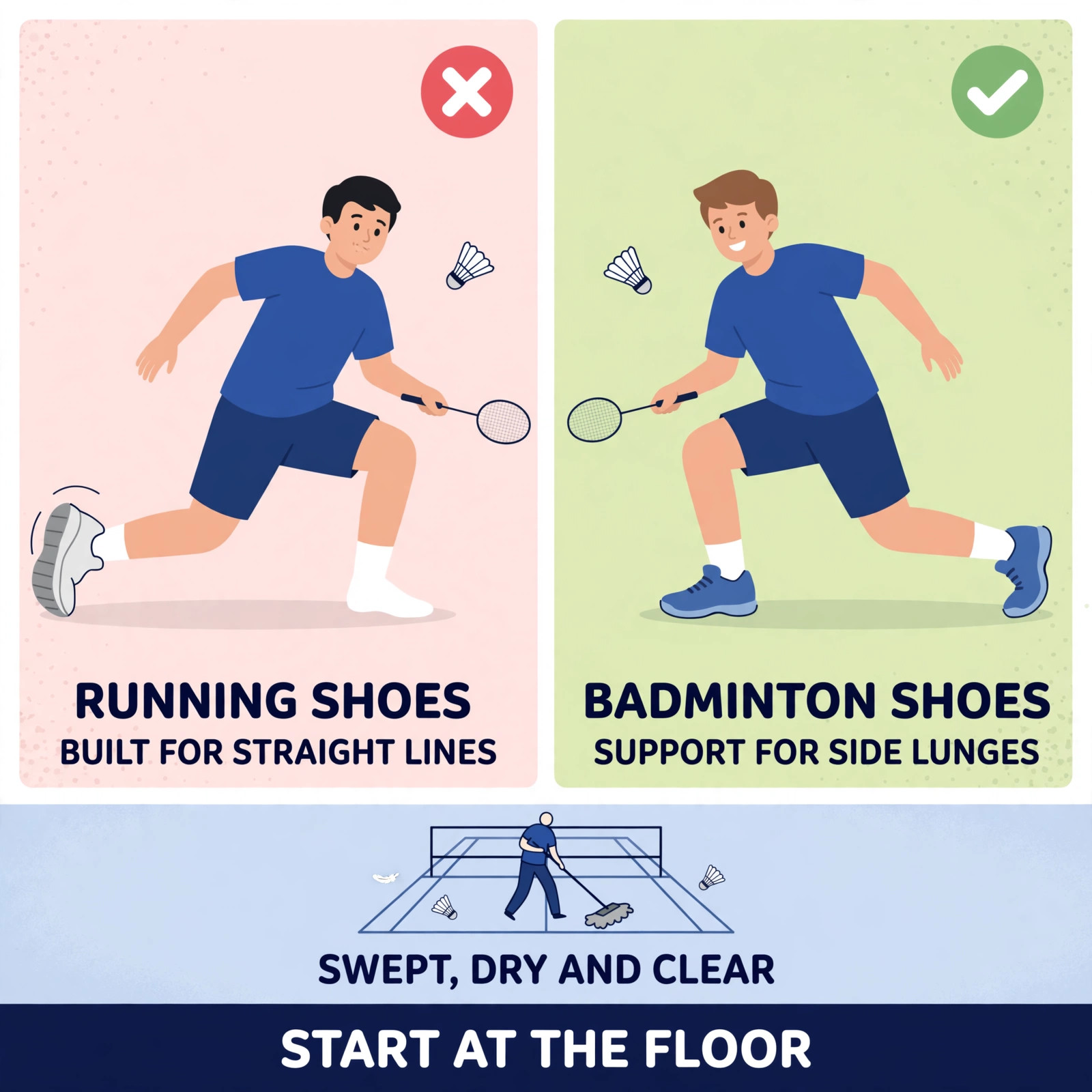
Your feet are where safety starts. Badminton shoes are built for this game: a low, stable sole that resists rolling during side lunges, gum rubber that grips court mats, and cushioning placed for repeated small jumps and hard stops. Running shoes are built for straight lines and are tall and soft at the heel, which is exactly what tips an ankle over in a side lunge. If you change one piece of equipment for safety, change the shoes.
Fit matters as much as the model. Your toes need room to spread on the lunge without sliding forward and jamming, and the heel should sit locked so the foot and shoe move as one. Replace shoes when the grip pattern wears smooth or the midsole feels dead and flat; a worn shoe quietly stops doing the job you bought it for. Socks are a small thing with a real effect: proper sports socks reduce blisters and the skin tears that end sessions early. None of this is fashion. It is the contact patch between you and every movement you make.
Then check the court before the first rally. A swept, dry court is a safe court; dust, water spots and spilled drinks are slipping hazards that turn a normal lunge into a split you did not plan. Wipe wet patches, clear bags and bottles from the run-off areas, and leave space behind the back line for landings after deep clears. This takes two minutes, and most halls are happy to sweep if you ask. Players skip it because it feels fussy, right up until somebody does the splits at the back tramline.
Safety Check #3
Load Sense: How Much Is Too Much?
More injuries are scheduled than accidental. They come from the training load jumping faster than the body can follow: the player who adds a third hard session in one week, the holiday tournament played on no base, the smash marathon that keeps going because it feels good. Bodies adapt to load, but they adapt on their own calendar, days and weeks, not on your enthusiasm’s calendar. Build gradually. One extra session or one extra drill at a time, held for a couple of weeks, lets muscles, tendons and joints keep up with your ambitions.
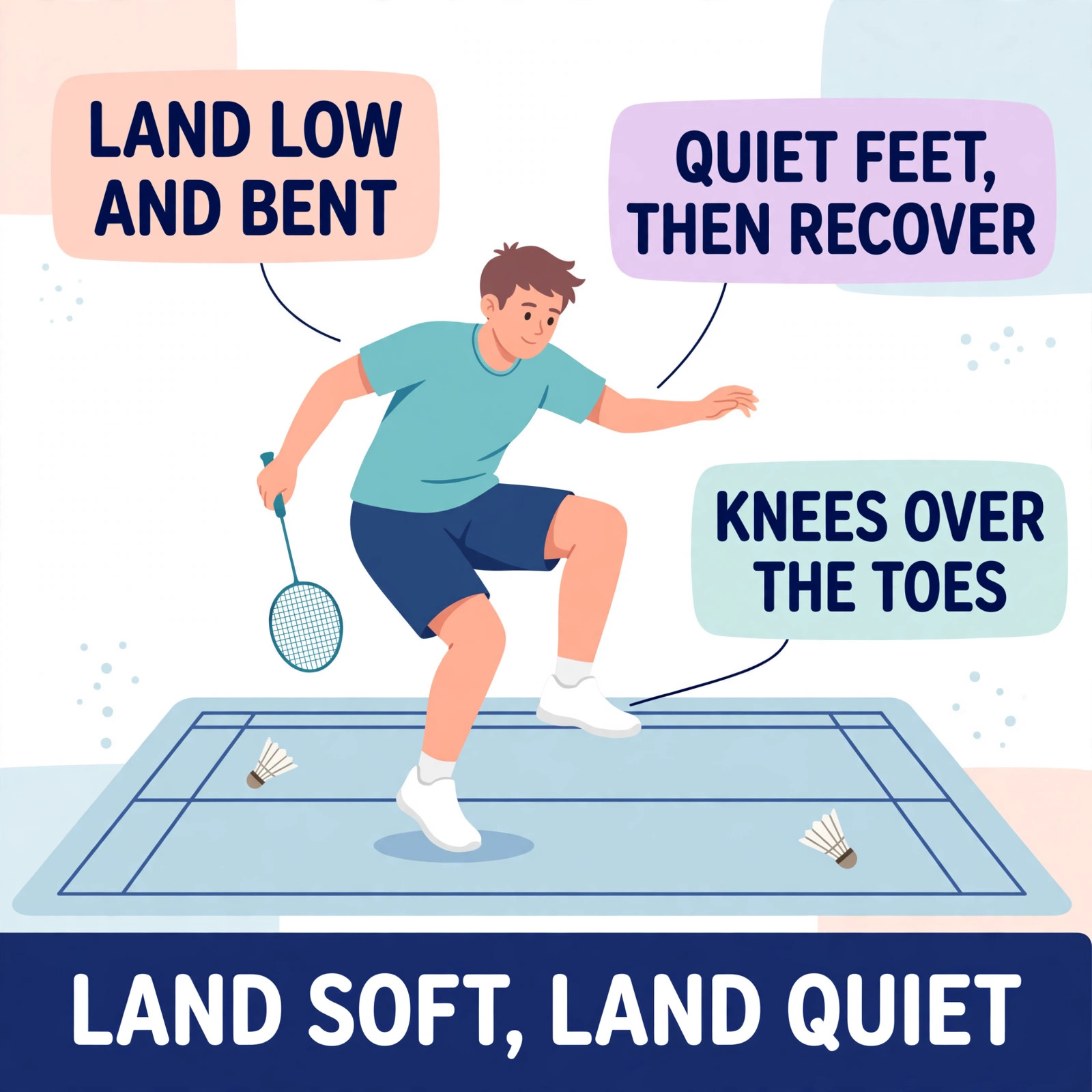
Fatigue is the other quiet scheduler. Technique falls apart when you are tired: lunges get longer and lower, landings get louder and straighter, the shoulder starts doing the work the legs stopped doing. Most strains happen late in sessions for exactly this reason. Coaches watch for it, and you should too. When your footwork turns into reaching and your landings stop bending, the useful part of the session is over, whatever the clock says. Ending ten minutes early is cheaper than three weeks off with a strained calf.
Warm muscles are only half of readiness. Strength is the other half, built slowly in the background: calves and ankles that can hold a lunge, thighs that can lower you and lift you, a core that keeps your trunk steady while your limbs move fast. Simple bodyweight work done regularly, squats, lunges, calf raises and planks, lowers the risk that an ordinary court movement becomes an overload. It does not need a gym membership or an hour a day. It needs consistency, which is the unglamorous ingredient in almost every safety habit on this page.

Safety Check #4
Technique That Protects You
Technique is a safety feature. A lunge that lands heel first with the knee tracking over the toes shares load through the leg the way the leg is built to take it. A lunge that collapses inward at the knee or lands on a straight leg sends the same load through the wrong structures. Overhead shots work the same way: a smash produced by the whole body chain shares effort between legs, trunk and arm, while an arm-only smash bills the whole shot to one shoulder.
Grip and tension habits play their part quietly. A hand that clamps the handle all rally keeps the forearm loaded without rest, and forced shots played with a locked wrist ask the wrist and elbow to absorb angles they dislike. Loose until contact, squeeze at contact, loose again: the rhythm that improves your shots is also the rhythm that rests your arm between them. None of this turns technique into a guarantee. It simply stops your own habits from adding risk the game did not ask for.
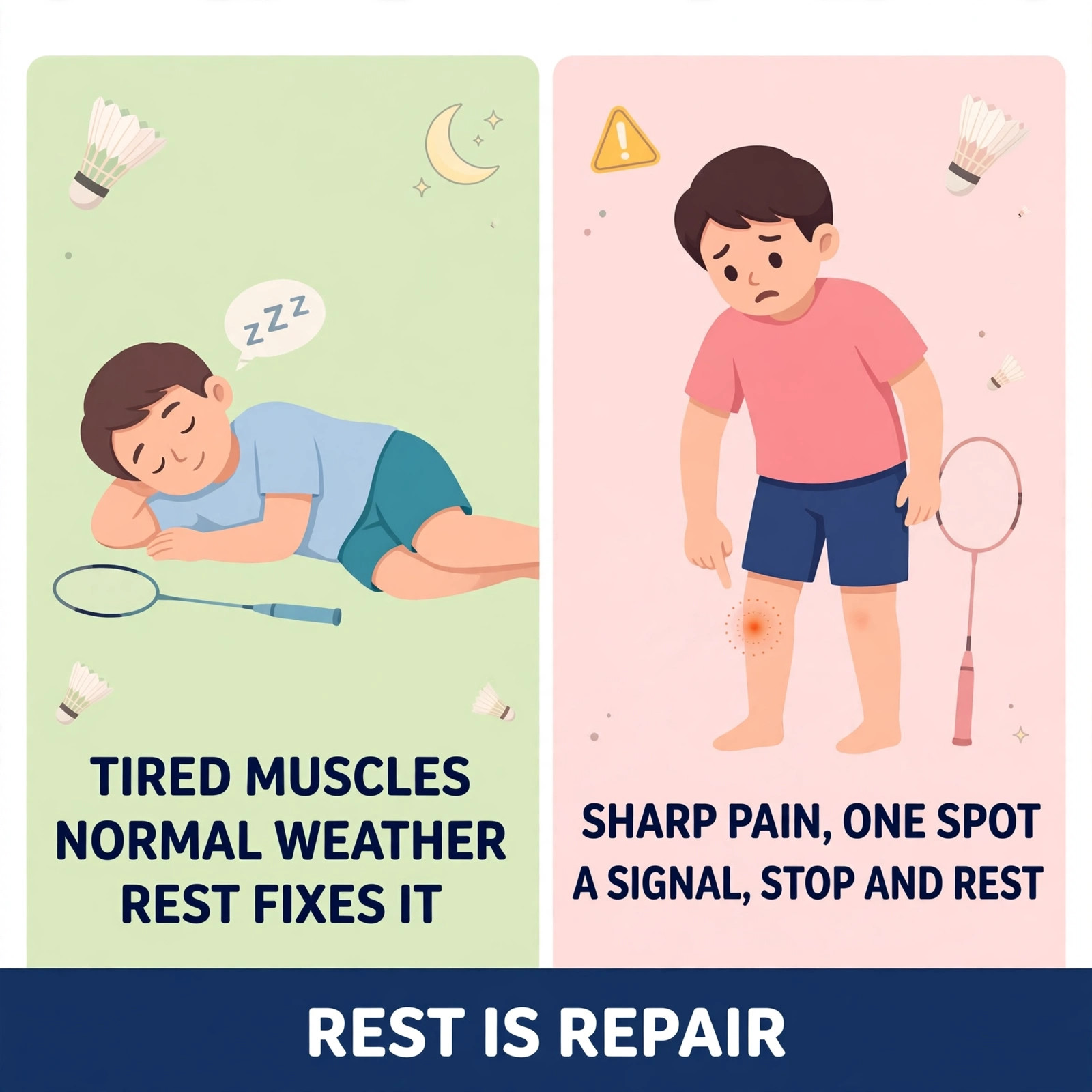
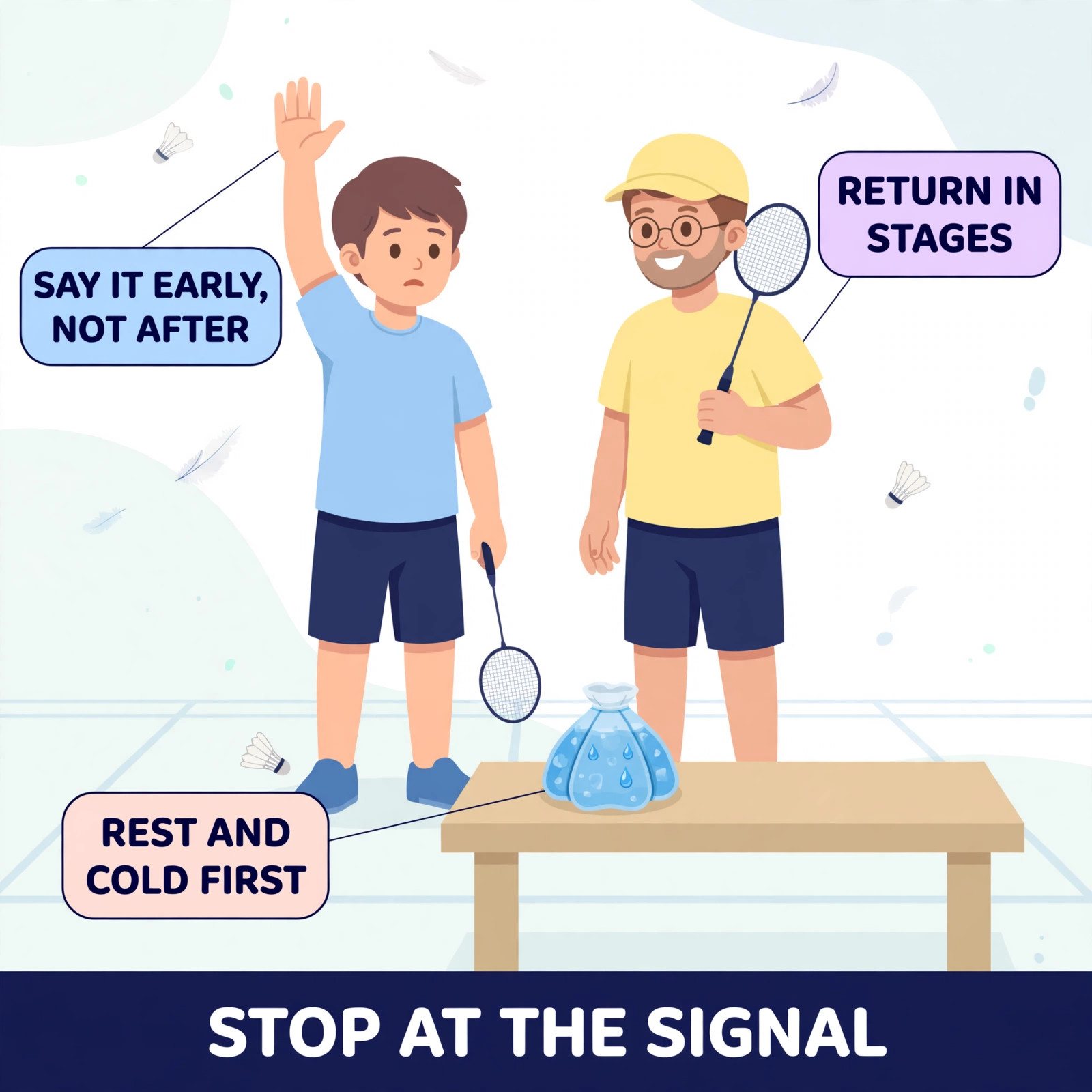
Learn the difference between tired and warning. Muscle burn during a hard drill, general tiredness in the legs, and next-day stiffness after a new session are normal training weather. Sharp pain, pain in one exact spot, pain that changes how you move, swelling, or the same niggle returning session after session are signals, not weather. Play through weather if you like. Signals mean stop, rest, and watch it. A small problem rested early is usually days; the same problem played through for a month can become the season.

The Recovery
Rest, Signals and Coming Back Safely
Rest is not the absence of training; it is where training lands. Muscles and tendons repair between sessions, not during them, so sleep and easy days are part of the safety system. Most recreational players do well alternating harder and easier days rather than stacking hard days together, and growing players need that spacing even more. If your legs feel heavy and your jumps feel low two days running, that is information, not weakness. Take the easy day before your body takes a hard one for you.
Food and drink carry safety too. A player who arrives dehydrated in our Malaysian heat cramps earlier, concentrates worse, and makes the tired technique mistakes that cause strains. Drink water through the day, sip during play, and eat a proper meal a few hours before rather than playing on empty. After hard sessions, protein and carbohydrates plus water help the repair work your rest days are doing. Nothing exotic is needed; the basics, done on time, do the job.
If something does go wrong, the first response is simple: stop playing on it, protect the area, and give it rest and cold in the first day or two rather than testing it with one more rally. Return in stages: easy movement first, then light drills, then full sessions, backing off if the pain answers back. And know the line for professional help: pain that is not settling after several days, swelling that stays, an ankle that keeps giving way, or anything that stops normal daily movement deserves a doctor or physiotherapist, not another week of hoping. Getting checked early protects the rest of your season.
Myth vs Reality
Myths About Injury Safety
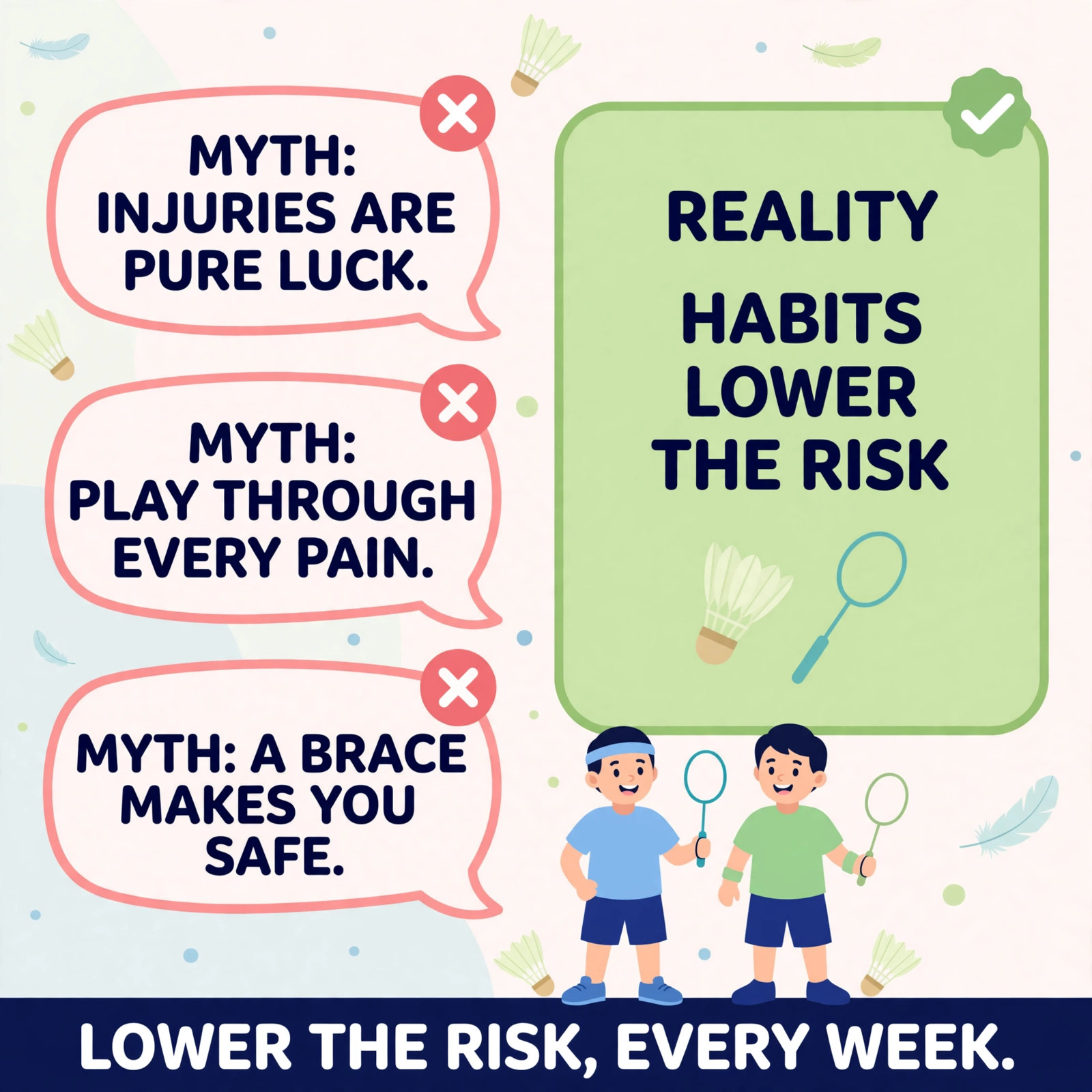
Myth: “Injuries are just bad luck in a fast game.” Reality: some are, most are not. The typical badminton injury is load meeting a cold, tired, badly shod or overloaded body part. You cannot remove risk from sport, and nobody honest promises that. You can lower it a long way with shoes, load sense and honest signals.
Myth: “Good players never get injured, so injuries mean you are doing everything wrong.” Reality: even professionals with full support teams get injured; the game is that demanding. Myth: “Playing through pain toughens you up.” Reality: playing through warning pain usually trades a few days of rest for weeks of it. Toughness is knowing which pain is weather and which is a signal.
Myth: “Protective gear makes you injury proof.” Reality: an ankle brace or knee support can help a previously injured joint and has its place, but it does not replace shoes, strength or load sense. Myth: “Stretching alone before a game is the whole answer.” Reality: a warm-up matters, and it is one habit among several. Safety is a system, not a single stretch.
Why Choose Us
Safe Training, Coached Every Session
At ST Badminton Academy KL, safety habits are coached inside small group classes capped at max 4 students. Four students means the coach sees your landings, your lunge shape and the moment your tired technique starts reaching, and can end your hard reps there instead of three lunges after the strain. Load is set per player, and returning players are rebuilt in stages, not thrown back at full speed because the calendar says so.
Mr Eric Chuar has over 15 years of coaching experience in Singapore and Malaysia. His safety rule is plain: respect the signal, graduate the load. He checks footwear at the door, teaches landings before he teaches jump smashes, and treats a player’s niggle report as useful information rather than a complaint. Seasons are long; his job is to keep players in all of them.
Our academy is based in Setapak, Kuala Lumpur, convenient for players from Wangsa Maju, Melati Utama, Danau Kota and Gombak. If you keep collecting niggles that never quite become injuries, or you are coming back after time off and want a sensible rebuild, start with a session. We will look at your shoes, your landings and your weekly load before we look at your smash.
FAQs: Badminton Injury Prevention in Malaysia (KL)
These are the questions players ask us most about staying safe on court in Malaysia. If your question is not here, message us, describe what keeps hurting or twinging, and we will give you a straight answer about which habit to look at first. For pain that is not settling, we will also tell you plainly to see a medical professional.
How can I lower my injury risk if I live in Setapak or Gombak?
Start where your feet meet the floor: proper badminton shoes, then a sensible weekly load. In our Setapak sessions, inside small groups of max 4 students, we check your landings and lunge shape early and build your court load in stages, so safety is trained as a habit, not recited as a warning.
What causes most badminton injuries in KL?
The load meeting the wrong body at the wrong time: a cold muscle asked to sprint, a tired leg asked to land, a sudden jump in sessions, worn shoes on a dusty court. Technique, footwear, gradual load and rest each lower the risk. Together, they are the difference between a long playing life and a string of interrupted ones.
Are warm-up and cool-down still important, or is that the whole level?
Warm-up and cool-down matter. A ten to fifteen minute warm-up before play and a few minutes easing down after are part of the system, covered in our warm-up guidance. But they are one part. Shoes, load, technique and rest carry as much of the risk, which is why this page treats safety as the whole week, not the ten minutes.
My knee or ankle twinges during play. Should I stop, or play through?
It sends a signal, and signals deserve respect rather than a verdict from the internet. Rest it, watch whether it settles over a few days, and return in stages. If the same spot keeps complaining, swells, or starts changing how you move or walk, see a doctor or physiotherapist. Early checks protect seasons; guessing rarely does.
Is an ankle brace or knee support worth wearing for badminton?
For a joint you have injured before, a brace or support can be sensible during the return, and many players find it reassuring. It supports; it does not strengthen or correct. Pair it with the rebuild work, strength, landings and gradual load, and treat the brace as a bridge, not a permanent resident, unless a professional advises otherwise.
Do you coach safe training habits in classes near Wangsa Maju?
Yes. Safe training habits are part of regular group classes at our Setapak base, a short trip from Wangsa Maju. Footwear checks, landing technique and sensible session loads are built into normal training, and players returning from time off are staged back in rather than dropped into the hardest group.
How do you keep junior players safe when they train in Malaysia?
Young players are still growing, and growth plates and coordination change month to month, so load needs more patience: shorter hard blocks, more variety, and zero tolerance for playing through joint pain. In our classes, junior loads are set conservatively and parents hear the same signal rules, because a child often hides a niggle to stay in the game.
Where is ST Badminton Academy KL located for safe badminton training?
We are based in Setapak, Kuala Lumpur, close to Wangsa Maju, Melati Utama, Danau Kota and Gombak. Sessions run in small groups of max 4 students. Message us for the current class schedule and we will place you in a group at your level, with your load set sensibly from the first week.
What makes Mr Eric Chuar a suitable coach for safe training and badminton?
Fifteen years of coaching in Singapore and Malaysia, and a safety-first reading of the game. Eric checks shoes, landings and loads before he chases performance, teaches the difference between tired and warning, and stages returning players back in with patience. Players stay in the game longer because their seasons stop being interrupted.
Badminton Injury Prevention in Action


What It Takes to Stay in the Game
A player meets our safety standard when five habits hold: proper badminton shoes in good condition, a court checked and clear before play, a weekly load that grows in small steps, landings and lunges that keep their shape when tired, and signals reported early instead of played through. When those five hold, risk is as low as an honest coach can help you make it.
| Factor | Risky Habits | Safe Habits SAFE |
|---|---|---|
| Frequency | 1 or 2 times a week. Mostly for fun and sweat. | Before play, shoes are proper badminton shoes in good condition and the court is swept, dry and clear of bags and bottles. |
| Drills Focus | Basic static feeding. Minimal footwork pressure. | During play, load grows in small steps, technique keeps its shape, and landings stay low, bent and quiet. |
| Physical Conditioning | Rarely included. Just playing games on court. | Core, agility, and speed training included in every session to prevent injury and build stamina. |
| Tactical Awareness | "Just hit it over." No real game plan. | Video analysis, point construction, and learning to read the opponent's game. |
| Coach Ratio | Large groups (8-10 kids). Coach barely watches you. | Max 4 students. Mr Eric Chuar personally corrects every stroke and movement detail. |
| Goal Setting | Fun and exercise. | When something twinges, weather pain is managed and signal pain stops the session early, while it is still small. |
| Long Term Result | Good recreational player. | A long playing life with fewer interruptions, because risk was lowered every single week. |
Badminton Injury Prevention Training in Kuala Lumpur
This page covered staying safe on the badminton court beyond the warm-up: the injuries that actually happen and why, footwear and court checks, training load and fatigue, technique as a safety feature, rest, food and drink, and what to do when something hurts anyway. Safety is a system of small habits. Bring your game to Setapak and let us build yours with you.






