How to Play Badminton With Precision and Accuracy: Techniques and Tips (Precision Guide)
Ask players what accuracy is and most will describe a feeling: the shuttle just goes where they want. Watch an accurate player closely and the feeling turns into something much plainer. Their swing looks the same on every shot, their body is balanced when they hit, and they chose the target before the rally forced their hand. Precision in badminton is not a talent some players are given. It is what happens when a repeatable technique meets a clear target, thousands of times. This guide breaks accuracy down into the parts you can actually practise: the swing, the targets, the soft shots, the deep shots, and the drills that tie them together.
Precision Check #1
Accuracy Is a Repeatable Swing: Why Technique Comes First
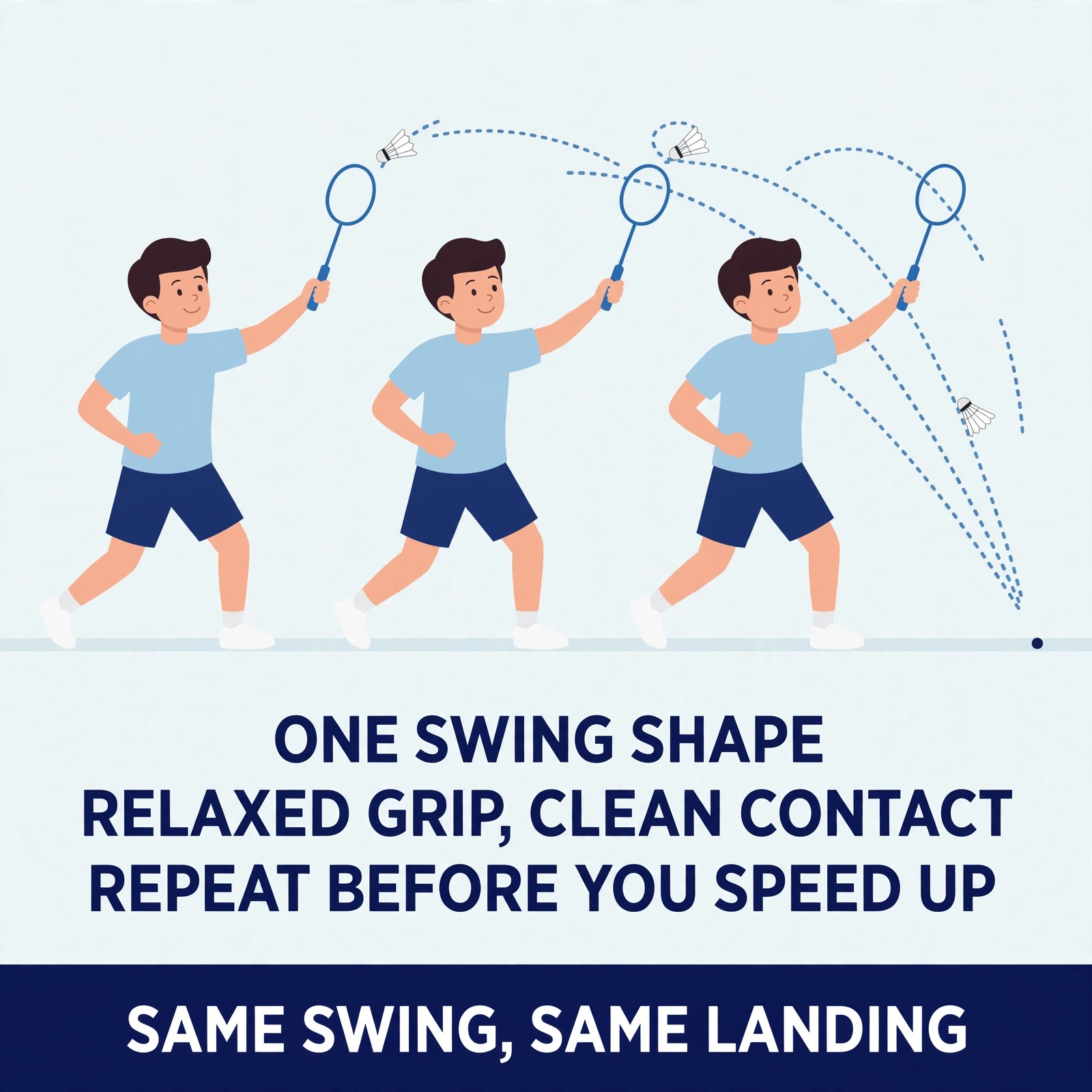
Accuracy starts with a swing your body can copy. A shot lands where you aim when the grip, the swing path and the contact point stay the same from one rally to the next. Most inaccuracy is not bad aiming. It is a swing that changes every time: the grip squeezed a little harder, the elbow a little higher, the contact a little later. Your brain cannot aim a moving target with a tool that keeps changing shape. This is why coaches slow players down when accuracy work begins. A slow swing is a swing you can feel, correct and repeat. Speed is added later, on top of a shape that already lands the shuttle where you send it.
Three habits hold the repeatable swing together. First, keep the grip relaxed until the moment of contact, so the racket face stays where your hand points it instead of twisting under tension. Second, make contact in front of your body, where your eyes can judge the shuttle and your arm is in its strongest, steadiest position. Third, finish the swing the same way every time, because a wild follow through usually means the contact before it was wild too. None of this needs special talent. It needs a player willing to hit fifty gentle shots with full attention instead of fifty smashes with none.
Precision Check #2
Know Your Targets: Lines, Corners and the Tape
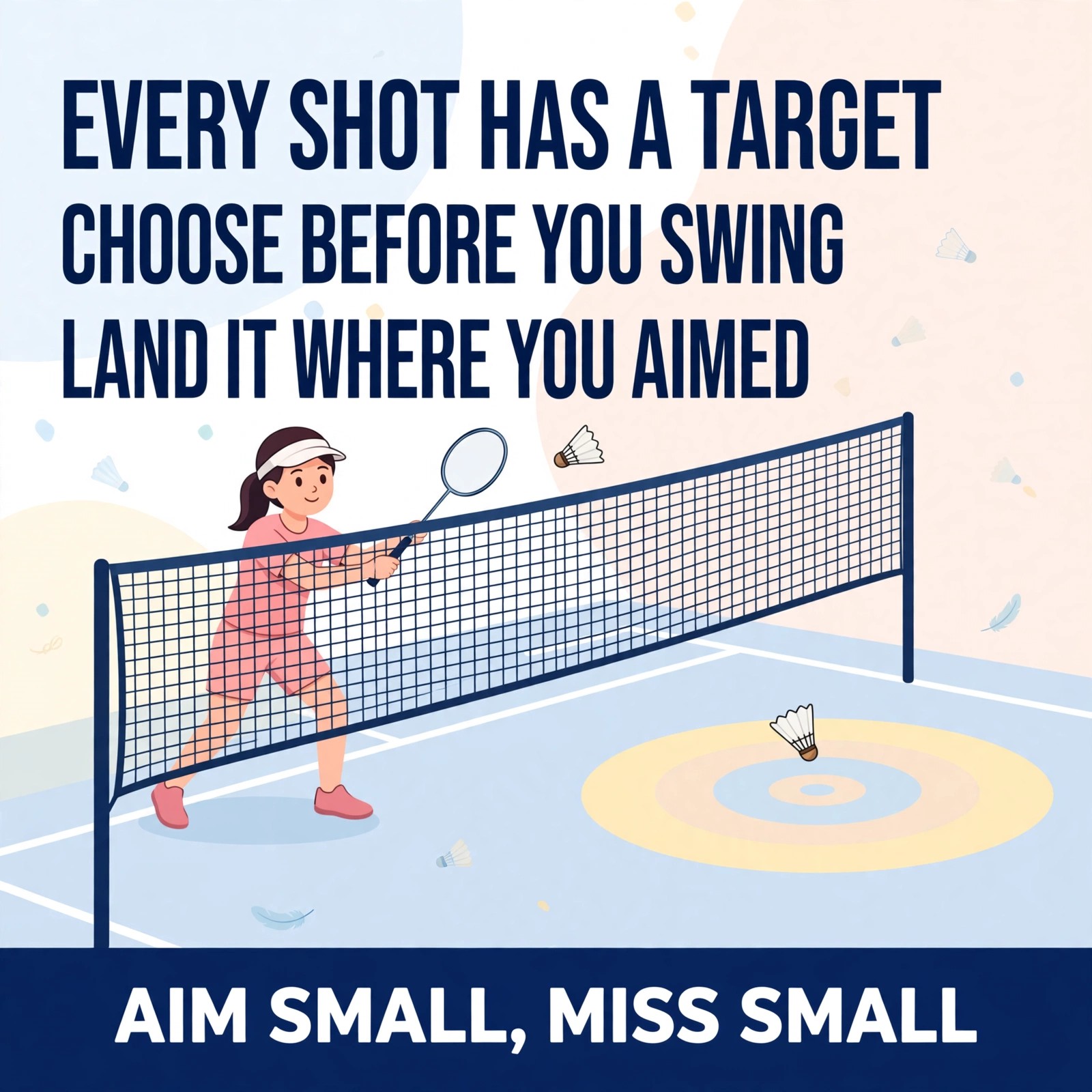
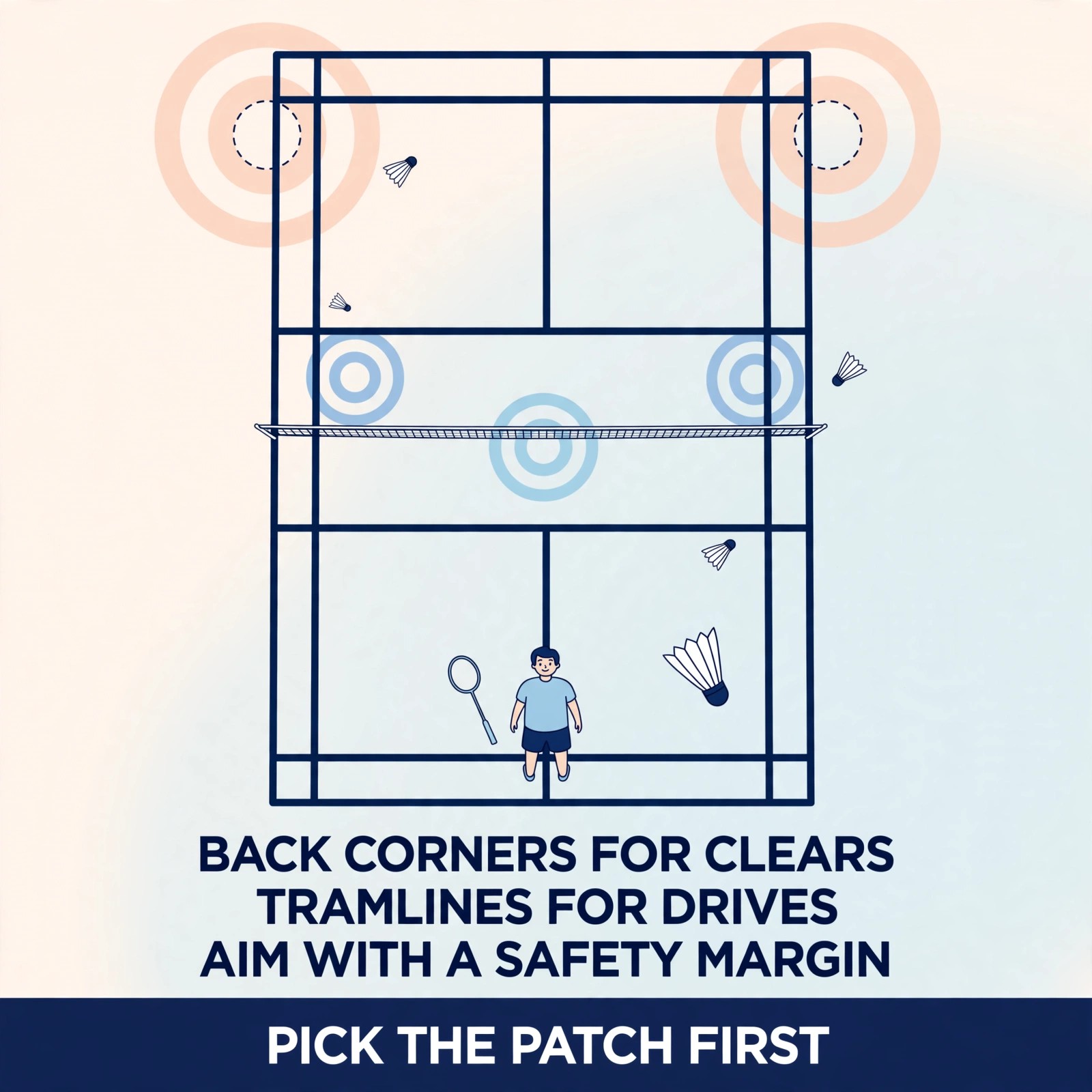
Once the swing can be repeated, it needs somewhere to go. Accurate players think in targets, not in shots. The back corners are the target for clears that must push an opponent deep. The tramlines are the target for drives that must pass a waiting racket. The small patch just behind the tape is the target for net shots that must not be lifted. Choosing the target before you swing changes everything about the swing itself: your feet set earlier, your body turns toward the target, and your arm stops guessing at the last moment. Players who aim at nothing in particular hit exactly that, rally after rally.
Aim with a margin. Beginners aim at the line itself, which means half their good shots land out by a feather width. Better players aim at a patch inside the line, close enough to pressure the opponent, safe enough to stay in when the swing is slightly off. The patch grows smaller as your control grows, but it never disappears. Even professionals miss the line they wanted; they just miss by less, and their misses still land in court. Think of accuracy as shrinking your misses rather than never missing. A player whose errors land two feet inside the court beats a braver player whose errors land two inches outside it.
Targets also change with the rally. A clear aimed at the back corner is right when you need time, wrong when your opponent is already stranded there and the front court is empty. Reading the opponent, which the old guides on this site talk about for strategy, feeds straight into accuracy: you cannot place shots well if you have not noticed where the space is. Start each rally with a simple picture. Where is my opponent standing, and which patch of court is farthest from their racket? Hit that patch. As your control improves, the patches you can use get smaller and closer to the lines, and your opponents start running much further for the same shuttle.
Precision Check #3
Tight Net Shots and Soft Control: Accuracy at the Front
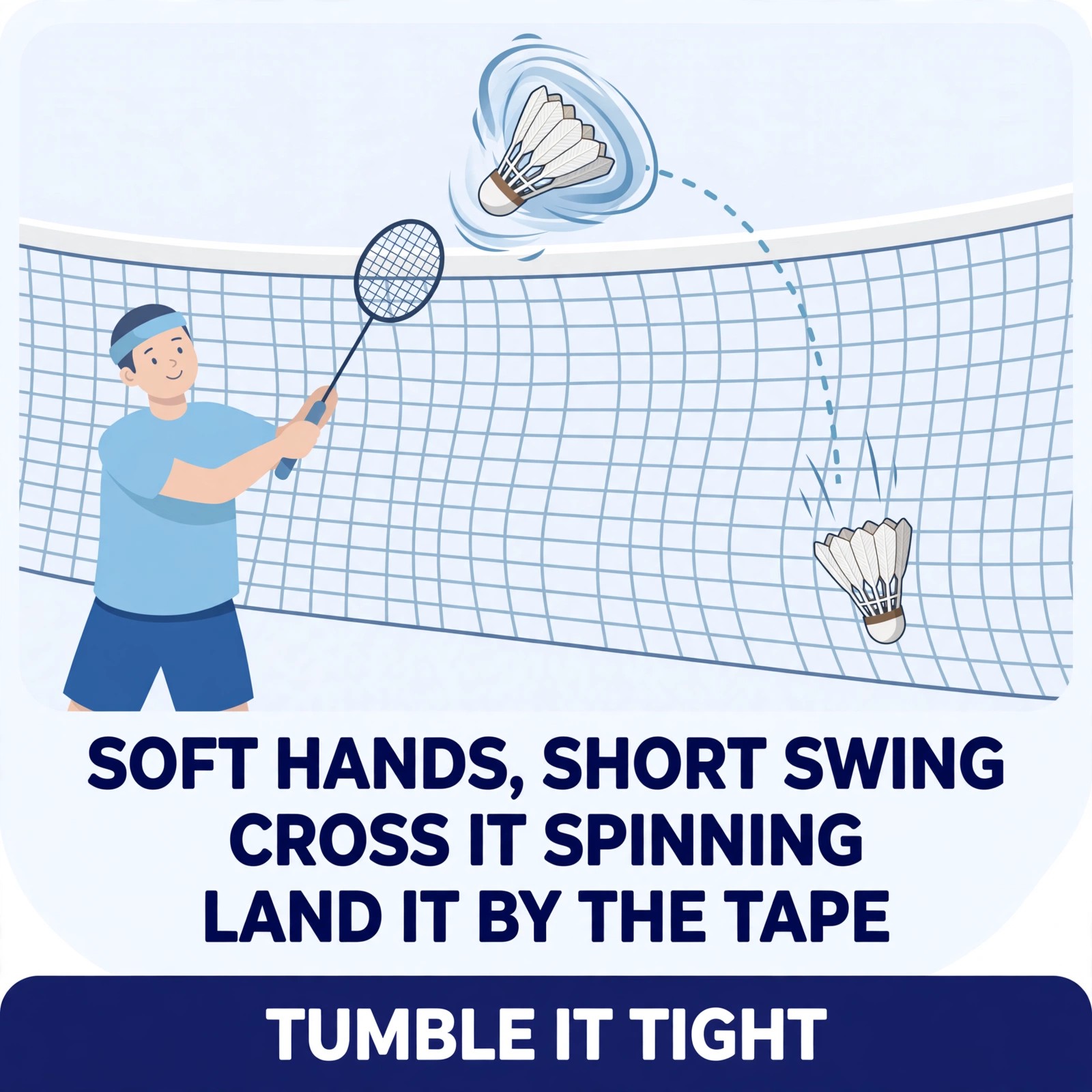
The net shot is where accuracy is easiest to see. A good one crosses just above the tape, tumbles as it falls, and lands so close to the net that your opponent must lift or lose the point. A poor one floats high, sits up, and gets killed. The difference is mostly softness. Take the shuttle early, while it is still near tape height, with a relaxed hand and almost no swing. Let the racket face guide the shuttle rather than push it. If you jab at the shuttle, it bounces off the strings and climbs. If you cradle it for a fraction longer, it rolls over the tape and drops on the other side like it has forgotten how to fly.
Spin is the net player’s quiet weapon. A shuttlecock that tumbles end over end as it crosses is hard to return cleanly, because it will not sit still on the opponent’s strings. You create the tumble by cutting slightly under and across the shuttle at contact, a small slicing action of the racket face, learned slowly at the net with a partner feeding. Do not chase spin before your plain net shot is steady. A spinning shot that lands in the net helps nobody. First the shuttle must cross low and land close, every time. Then the tumble is added, a little at a time, until it becomes part of the same relaxed movement.
Cross court net shots ask for even more control, because the shuttle must travel further while staying just as low. The common error is helping it with a flick of the wrist, which lifts the shuttle into killing range. Keep the same soft action as the straight net shot and simply angle the racket face toward the far corner. The shuttle should still feel like it is rolling off your strings, not being thrown. Practise cross court net shots in pairs, one direction at a time, and count how many land within a racket length of the side line without touching the net. That count is your accuracy score, and it is more honest than how the shots felt.
Precision Check #4
Deep Accuracy: Clears and Drops That Land on the Line
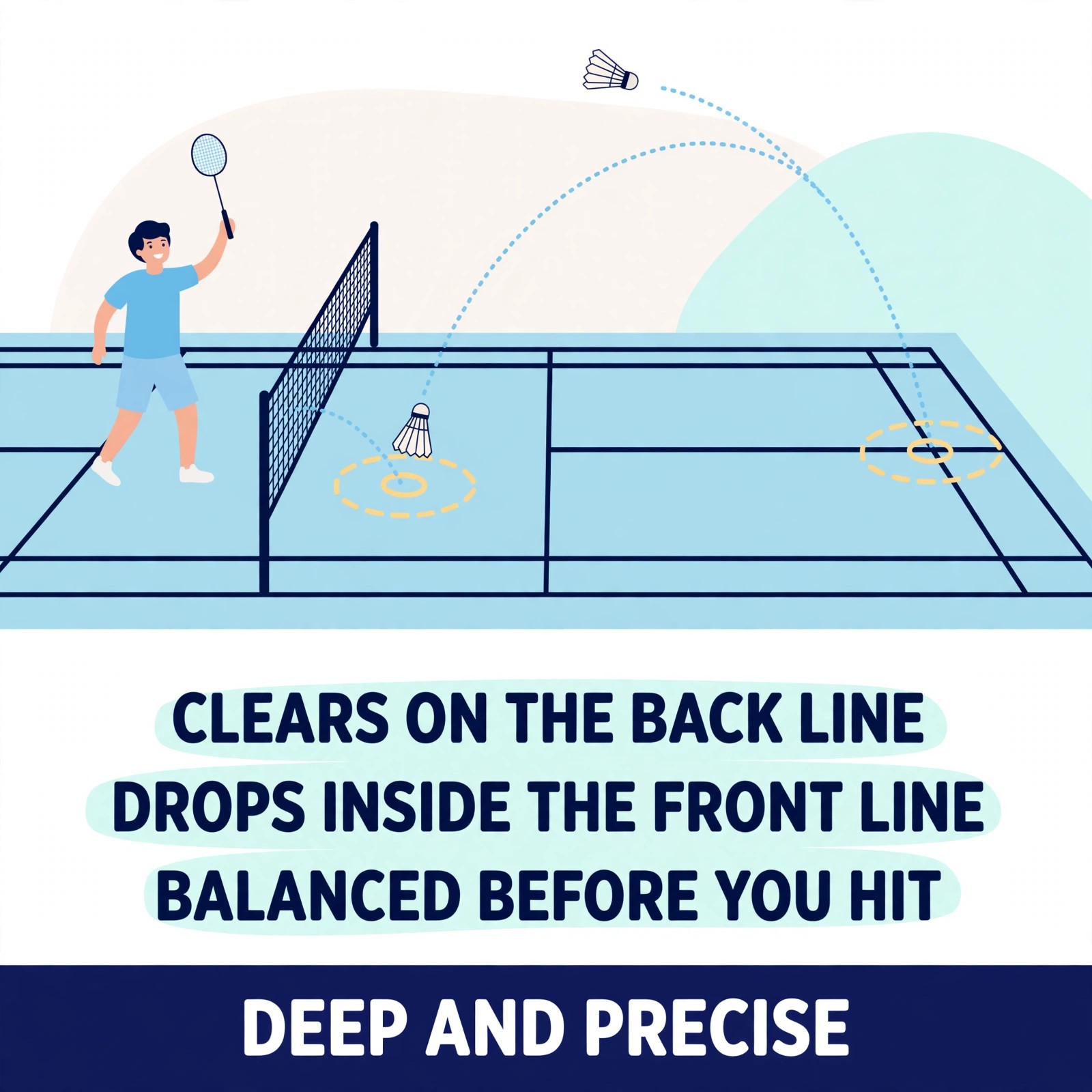
Deep shots test a different kind of accuracy. A clear is only doing its job when it lands close to the back line, forcing your opponent to hit from the deep corner with their back almost to the wall. A clear that lands a metre short is a gift: an easy smash with time to spare. Judge your clears by where they land, not by how high they fly. The back tramline area, the last strip of court, is the target zone. When your clears start landing in that strip from both corners of your own court, your defence gains whole seconds, because opponents must respect the depth before they can attack you.
Drop shots live at the other end of the same skill. A good drop from the back court lands inside the front service line, close enough to the net to drag your opponent forward, soft enough that they cannot drive it back. Drops that land deep give away the front court; drops that land in the net give away the point. The shape of the swing matters here. Your clear and your drop should look identical until the last moment, with the drop played by slowing the racket and softening the contact rather than by changing the whole action. Accuracy and disguise are cousins: the same repeatable swing produces a shot your opponent cannot read, landing in a patch they cannot reach.
Balance is the hidden half of deep accuracy. You cannot place a clear on the back line while falling backwards, or drop the shuttle softly while lunging at full stretch. Arriving early and hitting from a steady base is what lets the repeatable swing do its work, which is why accurate players always look unhurried. Their footwork bought them the stillness their accuracy needs. If your deep shots spray around when you are rushed but land well when you have time, your problem is probably not your arm. It is your arrival. Fix the footwork pattern to the corner first, and the shots from that corner will tighten up behind it.
Precision Check #5
Target Practice: Drills That Make Accuracy Stick
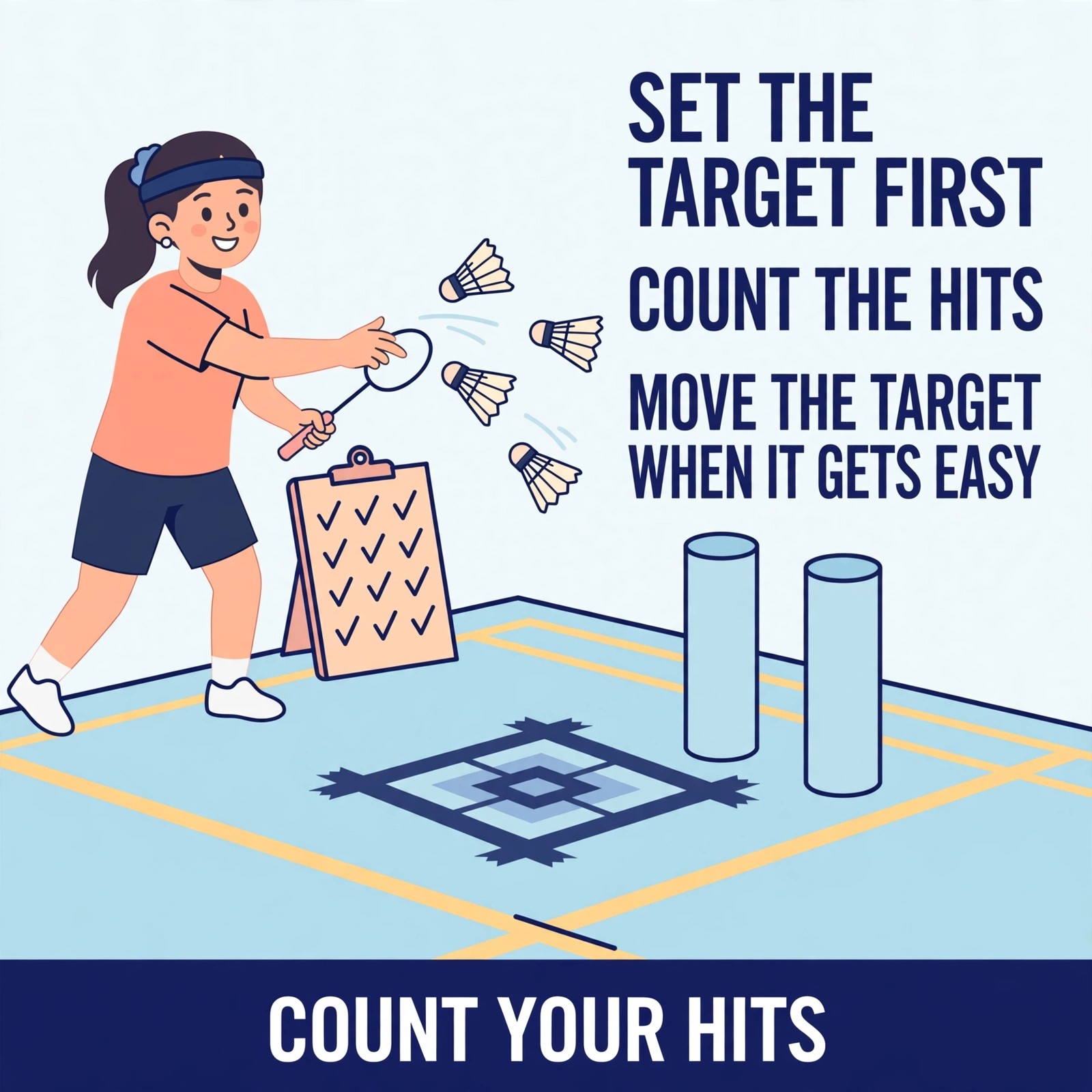
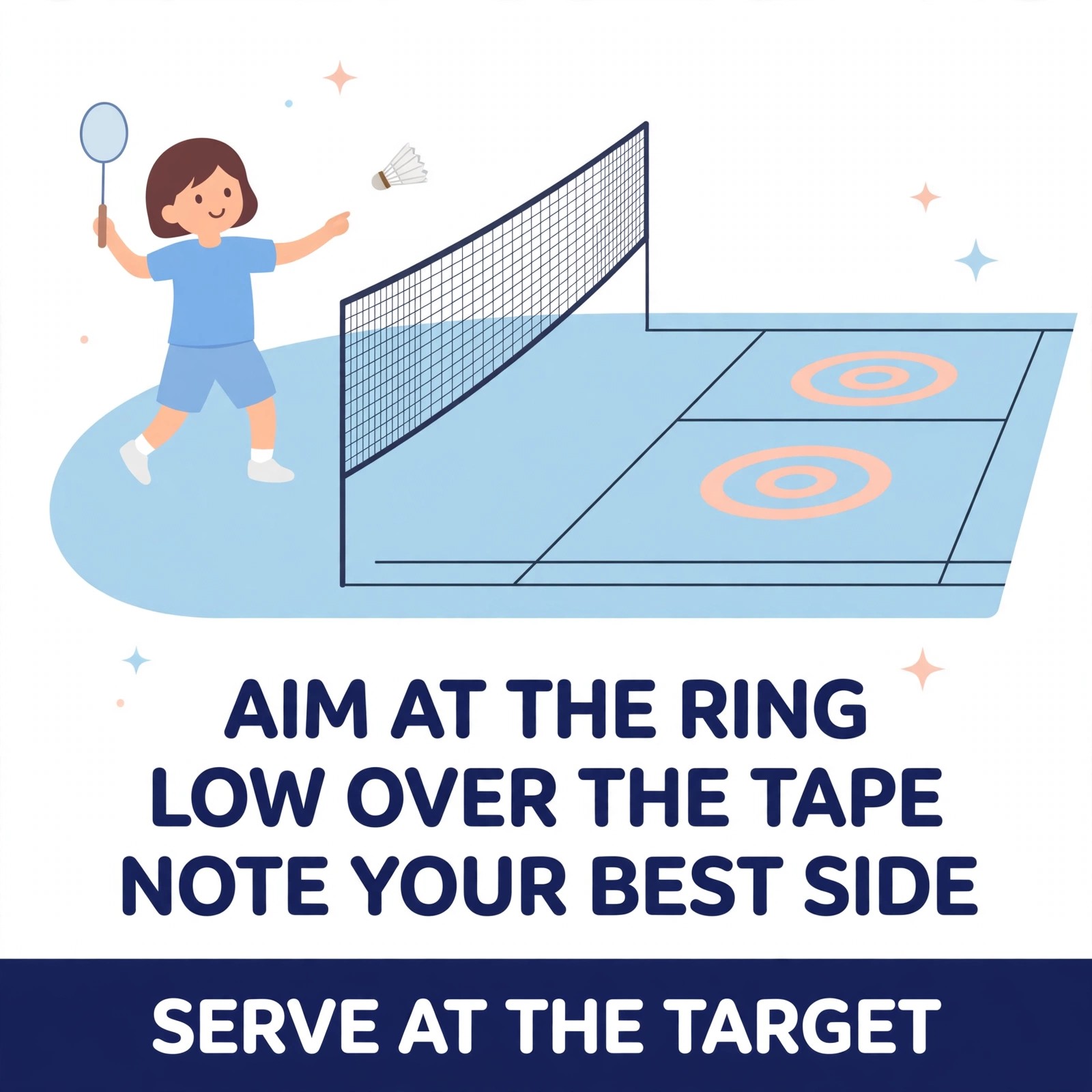
Accuracy grows fastest when practice has something to aim at and a way to keep score. Tape a square in the back corner and feed clears at it. Stand two shuttle tubes upright in the service box and serve at them. Place a target ring behind the net and play fifty net shots, counting how many land inside. The targets do two jobs. They give your eyes a clear picture before every shot, and they give you a number afterwards, so you know whether this week is better than last week. Feelings lie about accuracy. Counts do not.
Build target practice in layers. Start with one target and one shot from a gentle feed, and stay there until your count is respectable. Then move the target, then feed from a different corner, then ask for the same shot in a rally. The common mistake is jumping straight to match speed targets, missing everything, and deciding accuracy is boring. Accuracy is only boring when the target is impossible. Set it where you succeed about half the time, and the drill stays honest and hard in the right measure. When a target gets easy, shrink it or move it closer to the line, and begin the count again.
Coaches at good academies weave this into normal sessions rather than making it a separate subject. A feeding drill becomes accuracy work the moment a target is named. A shadow footwork pattern becomes accuracy work when the shot at the end must land in a marked patch. You can do the same in your own games. Pick one shot per match, say the backhand corner clear, and quietly judge every one by its landing spot. One shot, honestly measured, improves faster than a whole game vaguely played. Over a season, shot by shot, this is how ordinary club players turn into the accurate ones everyone hates playing.
Myth vs Reality
Myths About Precision and Accuracy
The first myth says accurate players are born, not made, usually said by someone watching a smooth player and seeing only the smoothness. What they do not see is the years of counted targets behind it. Accuracy is one of the most trainable parts of badminton, because it depends on repetition, and repetition is available to anyone willing to do it. Nobody is born knowing where the back line is from the far corner. They learned it the way you will, one measured drill at a time. Talent might decide how fast you improve. It does not decide whether you improve.
The second myth says accuracy means playing safe and soft, tapping the shuttle around and hoping. Tell that to the player whose smash lands on the side line ten times a match. Accuracy is about placement, not pace. A smash aimed at the line is an accuracy shot. A clear floated to the middle of the court because you were afraid of the line is not a safe shot at all, it is just an easy one for your opponent. Playing accurately often means playing bravely, sending the shuttle close to lines and corners while accepting the odd miss. The players who fear missing never learn where the lines truly are.
The third myth blames the equipment: my racket is why my shots spray. A racket that suits you helps, and strings at a sensible tension give a cleaner feel, but no racket aims itself. The same player with a borrowed racket will place shots almost as well, because the accuracy lives in the swing, not the frame. Chasing a new racket every month is an expensive way to avoid fifty counted net shots. Buy gear that fits, keep it restrung when the strings go dead, and spend the difference in time on targets. Your landing spots will tell you the truth about where your accuracy problem lives.

Why Choose Us
Why Players Choose ST Badminton Academy
At ST Badminton Academy, accuracy is coached as a habit, not a gift. Classes run with a maximum of 4 students, so a coach can stand behind your shots and see what you cannot: where your clears actually land, how far your net shots float, which corner leaks points in every match. Feeding drills come with named targets. Landing spots get pointed out honestly, good and bad, because a player cannot fix a miss they never noticed. Junior players learn counting games early, so measuring their shots feels normal. Adults get the same direct feedback, set at a pace their current technique can handle.
We are careful with promises in this area too. Accuracy coaching will not turn a club player into a professional in a month, and we will not pretend otherwise. What it does, reliably, is shrink your misses. Clears land deeper, so you defend less desperately. Net shots land tighter, so you get lifted shuttles to attack. Serves land where the receiver least wants them. These are small edges, and matches at club level are usually decided by exactly these small edges, repeated over three games. Players feel the change first as calmness: the court looks bigger when you trust your own landing spots.
Our academy is based in Kuala Lumpur, starting from our original base in Setapak, and accuracy work fits every level we teach. Beginners start with big targets and gentle feeds, building the repeatable swing before anything else. Intermediate players work the corners, the tape and the front service line with counted drills. Advanced players measure misses in matches and bring the worst corner back to training. If you want to know where your accuracy really stands, a trial session will show you quickly. Bring your racket and court shoes, and expect to leave with one clear thing to practise, not ten vague ones.
FAQs: Badminton Precision, Accuracy and Shot Control in Malaysia (KL)
Below are the questions players ask us most about precision, accuracy and shot control at ST Badminton Academy. If your question is not answered here, bring it to a trial session and ask the coach on court.
Can accuracy be learned, or is it a talent you are born with in Setapak or Gombak?
It can be learned. Accuracy is built from a repeatable swing, a clear target and counted practice, and none of those need talent. Some players improve faster than others, but every player who does honest target work sees their landing spots tighten. Start slow, measure your misses, and give it a few months of practice before judging your progress.
What target practice can I do alone with a basket of shuttlecocks in KL?
Use targets and a count. Tape a square in a back corner and feed clears at it, twenty at a time. Stand shuttle tubes in the service box and aim serves and net shots at them. Work alone with a basket of shuttlecocks if you have one, feeding yourself from one corner and placing shots to the other side.
How tight should a net shot be at a beginner level?
Tight enough to make your opponent lift, loose enough to cross every time. At beginner level, aim for the shuttle to cross a racket head above the tape and land within a step of the net. That is a good, safe net shot. As your control grows, bring the crossing lower and the landing closer, in small steps.
Does a lighter racket or a heavier one give more control?
Neither, by itself. Control comes from your swing and your grip, not from the weight class of the racket. A racket that is too heavy for your arm will tire your wrist and harm control in long rallies, and one that is too light can feel unstable. Choose a weight your arm handles comfortably, then build control with practice.
Do children and adults learn accuracy at the same speed in classes?
At the same speed in drills, often differently in habits. Children copy movements quickly and love counting games, so their accuracy grows fast. Adults understand targets and margins sooner, but must unlearn old habits first. In our classes both improve steadily, because the method is the same: a repeatable swing, a clear target and honest counts.
Do I need feather shuttlecocks for accuracy practice near Wangsa Maju?
Feather shuttles fly truer and are what matches are played with, so serious accuracy work is best done with them. For basic target games, good nylon shuttles are fine and cheaper to replace. What matters most is that the shuttles are in decent condition. Bent, broken feathers make every shot inaccurate, whatever your technique is doing that day.
Where does ST Badminton Academy run precision focused training in Malaysia?
Precision work is woven into our regular badminton coaching in Kuala Lumpur, based in Setapak, where ST Badminton Academy first started. Target drills, counted net practice and landing spot feedback are part of group and private sessions at every level. There is no separate accuracy class to join; the work is inside the coaching you already get with us.
How do I book a trial session to check my accuracy?
Book a trial session through our website or WhatsApp and mention that you want your shot control checked. The coach will set a few simple targets, watch your clears, net shots and serves, and tell you which part of your accuracy to build first. You only need your usual racket, court shoes and a water bottle for the session.
What should I bring to my first precision session for badminton?
Bring your normal kit: your own racket if you have one, court shoes with non marking soles, a water bottle and a spare shirt if you sweat heavily. Targets, shuttlecocks and feeding are provided at the session. If you have been keeping any notes on your matches or misses, bring those too; they help the coach see your patterns faster.
Precision and Accuracy Training in Action


One Standard for Every Session and Every Player
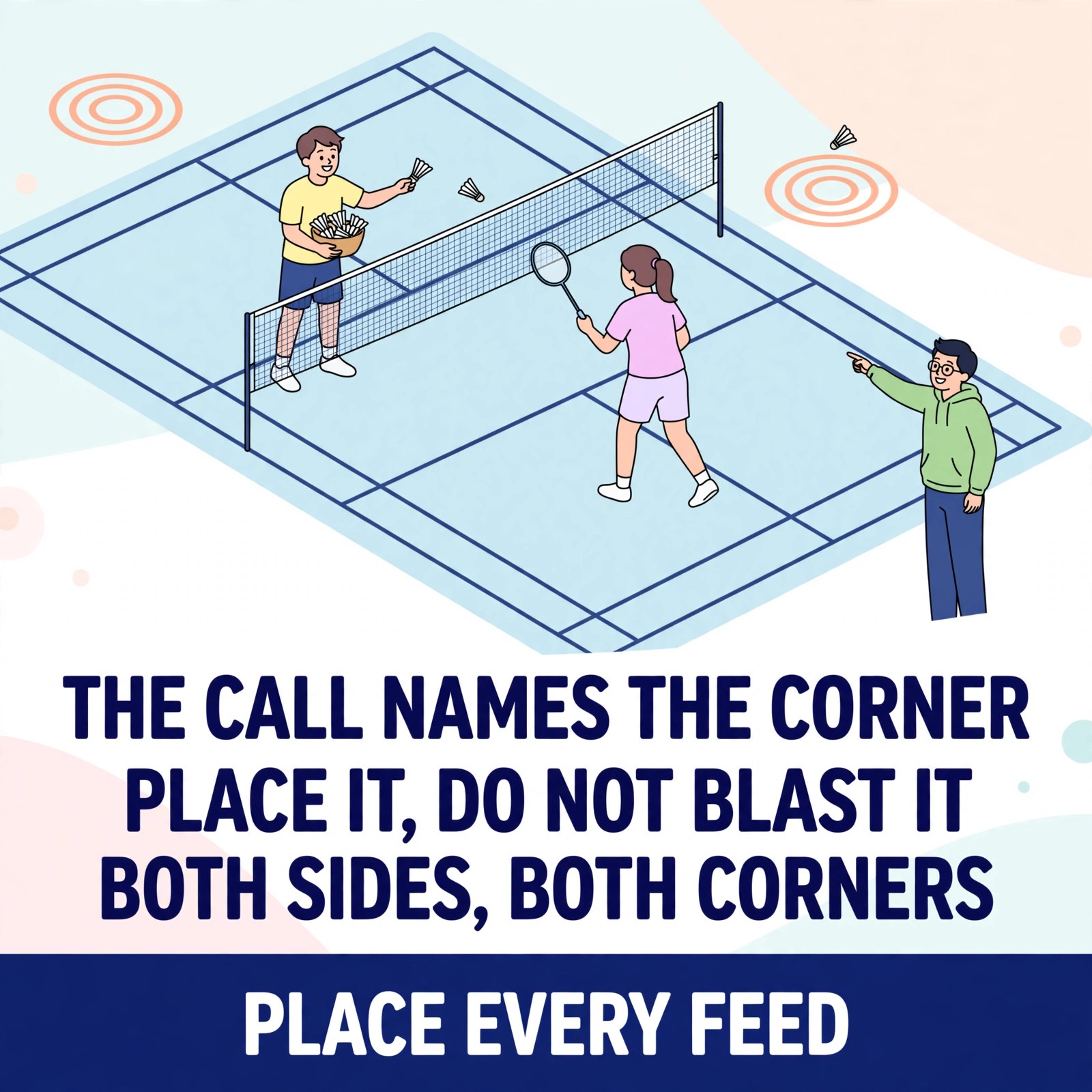
Every accuracy session at ST Badminton Academy follows the same coaching standards. Targets are set at a size the player can honestly reach about half the time, never so hard that the drill becomes guessing. Counts are kept truthfully, by the player or the coach, and landing spots are pointed out as they happen. When a player’s technique breaks down, we slow the drill down rather than letting wild swings pile up. Standards like these sound plain, but they are why our players’ misses shrink month after month instead of staying the same size forever.
| Factor | Hopeful Hitting | Targeted Shots TARGET |
|---|---|---|
| Frequency | 1 or 2 times a week. Mostly for fun and sweat. | Every practice shot has a target: a line, a corner or a patch of court chosen before the swing. |
| Drills Focus | Basic static feeding. Minimal footwork pressure. | Slow, repeatable swings first, with speed added only when the landing spot stays steady. |
| Physical Conditioning | Rarely included. Just playing games on court. | Core, agility, and speed training included in every session to prevent injury and build stamina. |
| Tactical Awareness | "Just hit it over." No real game plan. | Video analysis, point construction, and learning to read the opponent's game. |
| Coach Ratio | Large groups (8-10 kids). Coach barely watches you. | Max 4 students. Mr Eric Chuar personally corrects every stroke and movement detail. |
| Goal Setting | Fun and exercise. | Misses are measured and noted, so practice fixes the corner that actually leaks points. |
| Long Term Result | Good recreational player. | A player whose clears land deep, whose net shots tumble tight and who wastes few free points. |
Badminton Precision Coaching in Kuala Lumpur
Your shots do not need more luck. They need a target and a swing that repeats. Come to ST Badminton Academy in Kuala Lumpur and build your accuracy in small classes, one corner at a time. The lines are not moving. With the right practice, your shuttles will start landing where you send them.






