How To Develop Strong And Accurate Badminton Serves (Serve Guide)
Every rally starts with a serve, and yet the serve is the shot most club players practise least. That is a pity, because in badminton a strong serve does not mean a hard serve. It means a serve that is legal every time, accurate enough to land where you aimed, and awkward enough that the receiver cannot attack it. This guide builds that kind of serve in order: the legal shape first, then the low serve as your trusted base, then the flick serve as the change up, then disguise, and finally the target practice that makes accuracy stick.

Serve Check #1
The Legal Serve: Low, Legal and Hard to Attack
Badminton serving starts with the laws of the game, and the laws are strict for a reason. At the moment of contact, the whole shuttle must be below 1.15 metres from the court surface. The shaft and the head of the racket must point downwards, so the shuttle is struck from below, never hit down at the receiver. Your feet stay still, on the floor and inside the service box, until the serve is delivered.
The serve must also travel in one continuous forward motion once the swing has started. No stopping halfway, no faking a swing to freeze the receiver, and no double hits. You hold the shuttle by its feathers, cork pointing toward the racket, and release it into the swing. Get this legal shape grooved first, because a serve that gets faulted in a tight match costs far more than a point. It costs trust in your own action.

Serve Check #2
The Low Serve: Your Trusted Base Serve
The low serve is the base serve in singles and doubles alike. It leaves the racket flat, skims just above the tape, and drops into the front of the service box, close to the short service line. Because it stays low the whole way, the receiver has to hit up or play a careful reply, and you get the first say in the rally instead of defending a smash.
Accuracy beats bravery here. Aim for a small area of the front box and learn to land the shuttle there on demand. The action is a short, gentle push with the forearm, the racket face almost flat, and the shuttle held still until the swing starts. A calm routine before each serve, the same breath and the same settle, is what makes the tenth serve of a match look like the first.
Expect the net to catch your early attempts. A low serve that clips the tape usually left the racket too flat or too soft, so check the height of the contact and the angle of the face before adding pace. Small changes, measured over a basket of shuttles, are how the low serve becomes boring in the best way: same shape, same spot, every single time.

Serve Check #3
The Flick Serve: The Attacking Change
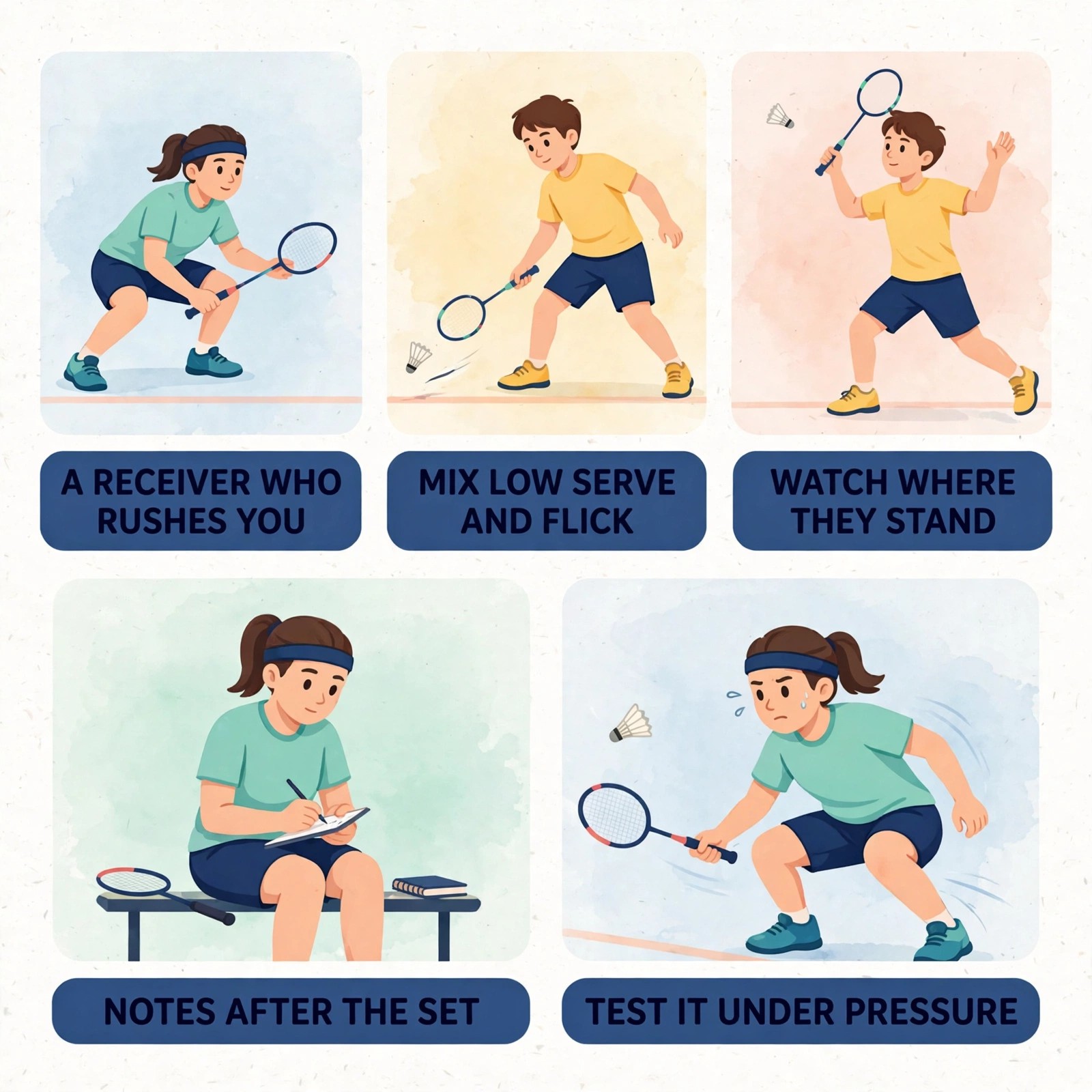
The flick serve is the low serve with one late change. The start looks identical: same stance, same hold, same slow backswing. Then, at the last moment, the wrist flicks and the shuttle climbs steeply to the back tramlines. Used well, it punishes receivers who creep forward to rush your low serve, and it buys you space and respect for the rest of the match.
The flick only works because the disguise is honest. If your flick start looks bigger or faster than your low serve start, receivers read it early and the shuttle sits up to be smashed. Practise the two serves in pairs from one frozen start position, so the only difference lives in the final wrist action. The receiver should have to guess, and guessing wrong should cost them.
Choose your moments. Flick more when a receiver crowds the short service line, leans in, or starts nailing your low serve. Flick less against a tall receiver with a strong backhand overhead, and never flick three times in a row just because the first one worked. The flick is a spice, not the meal: its value comes from the doubt it plants in the receiver.

Serve Check #4
Same Start, Two Serves: Disguise and Routine
Disguise is really one idea repeated: the same start must be able to produce both serves. Your routine is the camouflage. Bounce or settle the shuttle the same way, look up at the same moment, breathe at the same pace, and keep your face calm whether the shuttle is staying low or climbing deep. Receivers read shoulders, speed and eyes long before they read the racket.
Your stance helps too. Stand at the same distance from the short service line for both serves, and keep the racket head at the same height in the ready position. Little tells, like standing closer for the flick or gripping tighter, are free information for a sharp receiver. In practice, have a partner call out which serve they think is coming before contact. If they keep guessing right, your start is leaking.
None of this needs tricks that bend the laws. The serve stays one continuous forward motion, the shuttle stays below the limit, and the racket points down at contact. Disguise built inside the rules lasts your whole playing life. Disguise built on fakes and delays gets faulted once, and after that the umpire and every opponent watches you for the rest of the match.

Serve Check #5
Build Accuracy: Targets, Counting and Practice
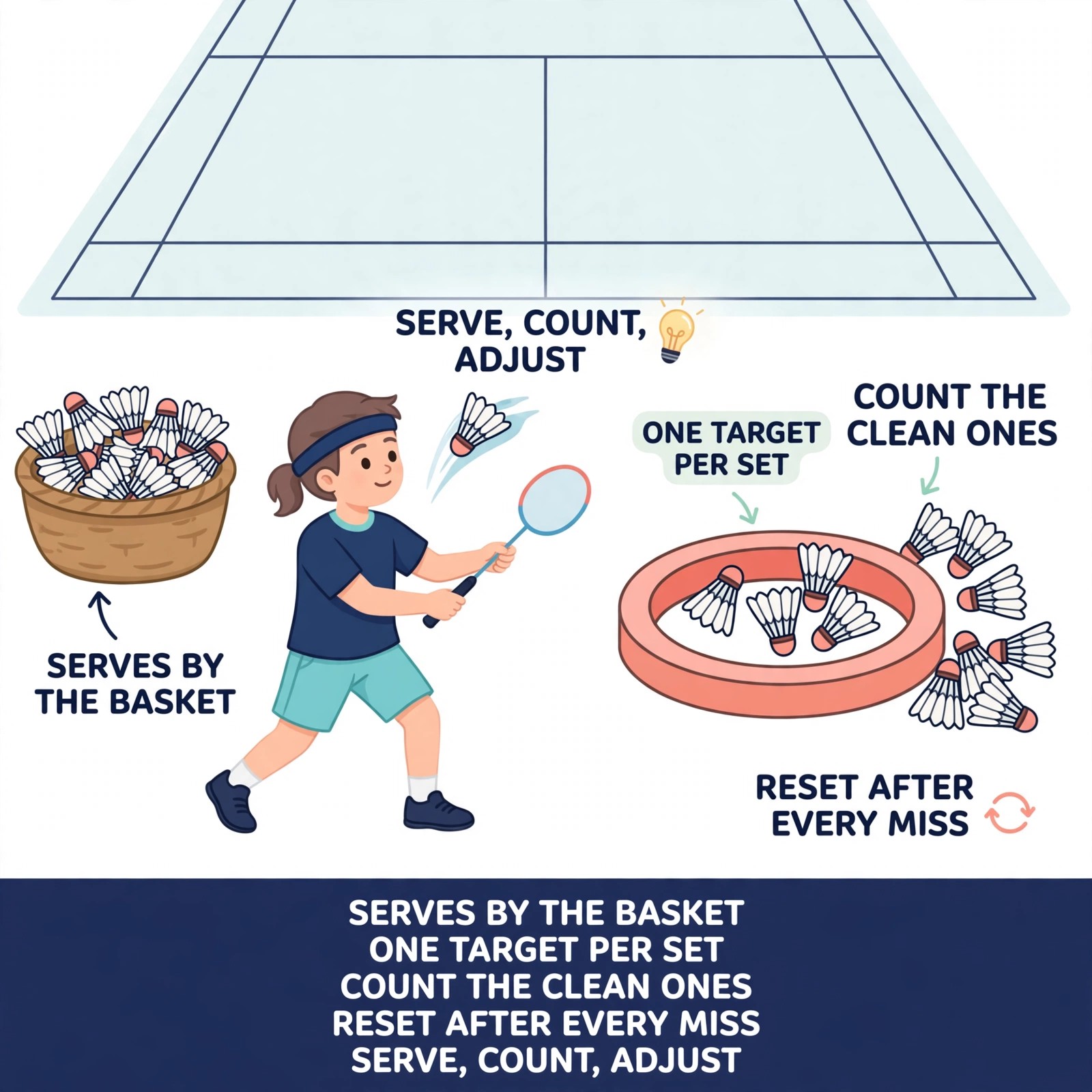
Accuracy is a practice habit, not a match day wish. Put flat targets in the front service box: rings, towels or the corners of a sheet of paper. Serve a basket of shuttles at one target, count how many land inside, and write the count down. When the count rises, shrink the target. Small targets make average serves look sloppy, and that honest pressure is what sharpens them.
Keep the routine identical during practice. It is tempting to fire serves quickly to finish the basket, but rushed reps groove a rushed action. Serve, reset, breathe, look up, serve again. Stop a set while the shape is still good, because tired serving practises the fault you are trying to remove. Two focused sets with full routine teach more than a hundred serves hit on autopilot.
Finish by testing the serve under pressure. Play conditioned games where your serve has to land in the target zone to count, or where a partner receives with instructions to rush everything. Pressure testing shows which part breaks first: the height, the spot, or your nerve. Train the part that breaks, and the serve you own in practice becomes the serve you trust at match point down.

Myth vs Reality
Myths About Developing Serves
Myth: serve hard like tennis to win free points. Reality: badminton laws make the power serve impossible. The shuttle must be struck below the limit with the racket pointing down, so there is no overhead blast available. Strength in a badminton serve means accuracy and control, the two things that actually win the first exchange.
Myth: spinning the shuttle makes a serve deadly. Reality: you hold the shuttle by the feathers and strike the cork cleanly in one forward motion. There is no legal way to load a serve with spin the way a sliced tennis serve works. Chasing spin just adds wobble and faults to a shot that wins by being tidy.
Myth: toss the shuttle up and hit it like a smash serve. Reality: there is no toss in badminton serving. The shuttle is held, released and struck below the limit in one motion. Anyone grooving a toss is practising a fault. The low serve and the flick, both from the same quiet hold, are the serves that win points.

Why Choose Us
Why Players Choose ST Badminton Academy
We do not just feed shuttles; we build players. ST Badminton Academy Malaysia is different because our head coach, Mr Eric Chuar, has over 15 years of coaching experience in Singapore and Malaysia, and he corrects technique personally in small groups. A serve fault hides easily in a big class. In a group of four, the contact height, the hold and the routine are seen on every rep.
Our small group policy, with a maximum of 4 students, means your serve is checked in every session. Players working on serving follow a clear order: legal shape, low serve accuracy, flick disguise, then pressure testing. The coach stands where he can see the contact point, because that is where most serve faults are born and where they are fixed.
We focus on long term player development. A serve you can trust changes whole matches: receivers stop rushing you, your third shot gets respect, and tight games stop feeling like coin flips. That is built with honest assessment, counted practice and steady correction, rather than a handful of tips shouted across a crowded court.
FAQs: Developing Strong and Accurate Badminton Serves in Malaysia (KL)
Here are answers to common questions from players in Kuala Lumpur about building a strong and accurate badminton serve, serve practice, and how coaching at ST Badminton Academy works.
Can a beginner learn a legal, accurate serve in Setapak or Gombak?
Yes. Beginners often build the best serves, because the legal shape and the routine are learned correctly from the very first week. Start with the hold and the low serve, aim at big targets, and add the flick only when the low serve lands where you aim it most of the time.
What makes a badminton serve strong if power is not the point in KL?
Accuracy and control. A strong badminton serve stays below the 1.15 metre limit, skims the tape and lands on the spot you chose, so the receiver cannot attack it. Power smashes are not available under the serving laws. The serve that wins is the one that starts every rally on your terms.
Why do my low serves keep hitting the net or floating high at club level?
Usually the contact is too low, too rushed or made with a dropping racket face, so the shuttle floats up or clips the tape. Slow the routine down, hold the shuttle still, and check that the racket points down at contact. Then count ten serves at a target and adjust one thing at a time.
My flick serve gets smashed every time. Should I stop flicking or fix the disguise first?
Fix the disguise before you abandon the flick. If the receiver reads it, your start is leaking: a bigger backswing, a faster routine or a different stance. Practise low serve and flick in pairs from one frozen start, and flick less often for a while so the doubt comes back.
How can I practise serving alone with a basket of shuttles during training?
Serve at targets with a basket of shuttles and full routine on every rep. Count how many land in the target zone and log low serve and flick counts separately. Add shadow serving to groove the routine with no shuttle, and finish one set with a partner rushing you to test it.
Do you coach serve technique near Wangsa Maju?
Yes. ST Badminton Academy is based in Setapak, a short drive from Wangsa Maju, Melati Utama and Danau Kota. Serve work is coached in small groups of no more than four students, so your hold, contact height and accuracy are watched and corrected personally by the coach in every session.
Where does ST Badminton Academy coach serving skills in Malaysia?
We coach in Setapak, Kuala Lumpur, and our serve work travels well: legal shape first, low serve accuracy, then disguise and pressure testing. Players from Gombak, Sentul, Ampang and nearby areas train with us each week in small, focused groups where serving is practised properly, not squeezed in at the end.
How do I book a trial session to work on my serve before training?
Message us on WhatsApp and tell us your serve is the project. We will place you in a small group session where the coach can watch your low serve and flick, check the legal shape, and show you the practice plan we would follow. One session is enough to leave with clear targets to train.
What makes Mr Eric Chuar a suitable coach for serve coaching in badminton?
Mr Eric Chuar has coached in Singapore and Malaysia for over 15 years and teaches serving the way it actually holds up in matches: legal shape first, accuracy counted, disguise checked by receivers. Because he coaches small groups personally, your contact point and routine are corrected in the session, not weeks later.
Badminton Serve Training in Action


One Standard for Every Session and Every Player
Developing a serve at ST Badminton Academy KL follows one standard: legal shape, counted accuracy and honest disguise. Every serving session works at the step you are actually on, with a maximum of 4 students per group, so technique is corrected while it is being built, not after bad habits settle.
| Factor | Toss and Hope | Low and Legal SERVE |
|---|---|---|
| Frequency | 1 or 2 times a week. Mostly for fun and sweat. | The legal shape is grooved first: shuttle held by the feathers, struck below the limit with the racket pointing down. |
| Drills Focus | Basic static feeding. Minimal footwork pressure. | The low serve is the trusted base, skimming the tape to a counted target in the front service box. |
| Physical Conditioning | Rarely included. Just playing games on court. | Core, agility, and speed training included in every session to prevent injury and build stamina. |
| Tactical Awareness | "Just hit it over." No real game plan. | Video analysis, point construction, and learning to read the opponent's game. |
| Coach Ratio | Large groups (8-10 kids). Coach barely watches you. | Max 4 students. Mr Eric Chuar personally corrects every stroke and movement detail. |
| Goal Setting | Fun and exercise. | The flick serve hides behind the same start, so receivers cannot creep in and rush the low serve. |
| Long Term Result | Good recreational player. | A server with an accurate plan: calm routine, legal contact, and a first rally that starts on their terms. |
Badminton Serve Coaching in Kuala Lumpur
This guide gives you the full route: lock the legal shape, make the low serve your base, add the flick as the change up, hide both behind one routine, and count your accuracy until it holds under pressure. If your serve needs that building, ST Badminton Academy in Setapak can coach you through it in a small group. Message us to book a trial session.






