Enhance Your Badminton Footwork And Agility (Footwork Guide)
Watch two players of the same standard and the difference is rarely the shots, it is the feet. One arrives balanced and early, hits with time to spare, and recovers before the reply comes. The other reaches, stretches and scrambles, and even good strokes fall apart. Footwork is the skill underneath every other skill in badminton.
This guide explains how to enhance your badminton footwork and agility: why feet decide rallies, the patterns that cover the six corners, the agility work that sharpens them, the strength behind fast movement, and how to train it all in a normal week, the way we coach it at ST Badminton Academy in Setapak, Kuala Lumpur.

Footwork Check #1
Why Do Feet Decide Rallies Before Shots Do?
Every rally is a race you run in two-second bursts. The shuttle reaches a corner in under a second, and your shot quality is decided before your racket moves, by whether your feet got you there balanced, behind the shuttle, with time to choose. Players blame their strokes for errors their feet caused: the clear that falls short because the lunge was late, the smash that nets because the body was still travelling.
Agility is the second half of the same skill: not just moving fast, but changing direction fast without losing balance. Badminton movement is a loop, push out from base, strike, recover, repeated hundreds of times a match. Train the loop and rallies feel slower, because you arrive earlier. Ignore it and every match feels rushed, however fit you are.

Footwork Check #2
Split Step and Six Corners: How Do the Patterns Work?
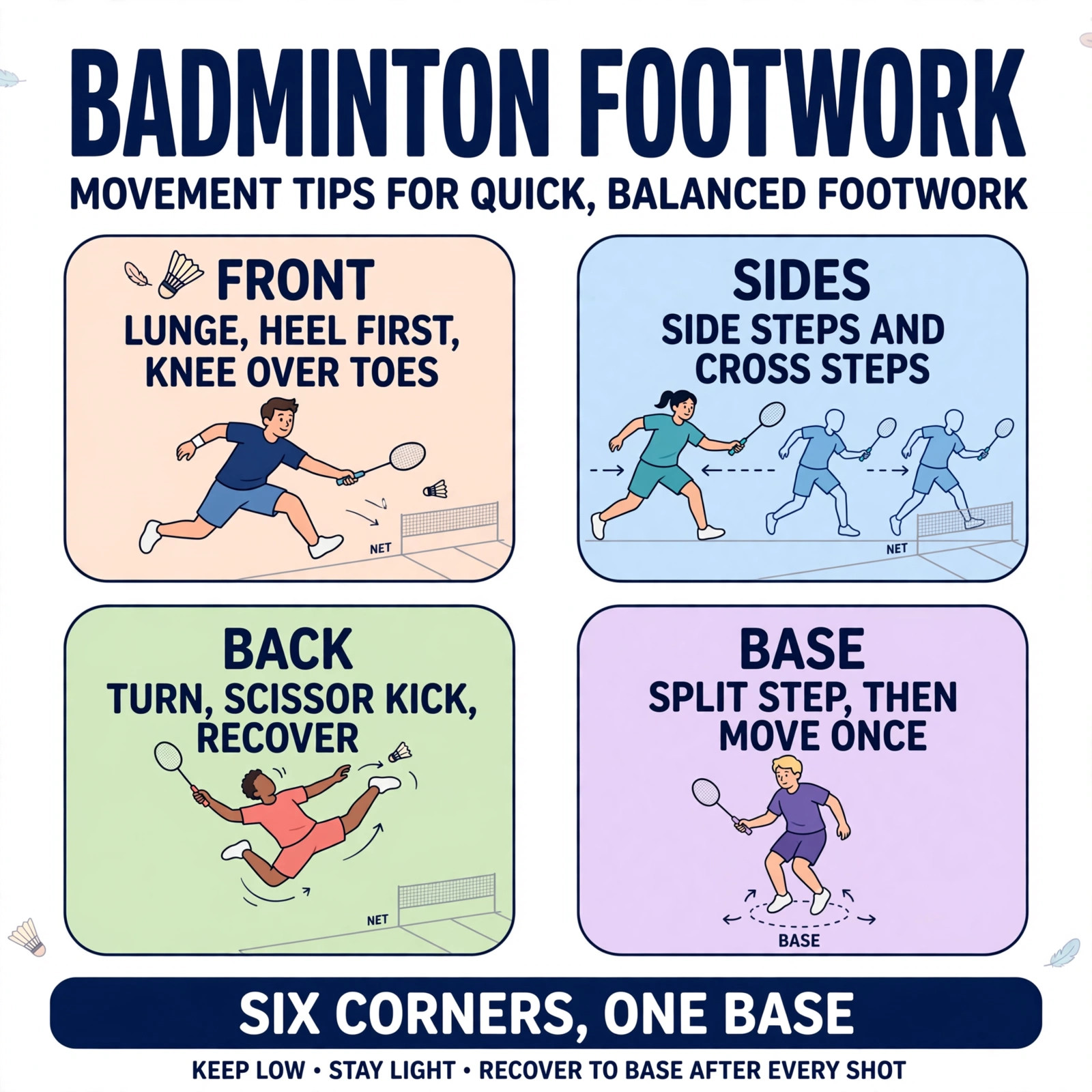
Everything starts from the base position and the split step. Stand near the centre of the court, knees soft, weight on the front of your feet, racket up. As your opponent strikes the shuttle, make a small hop, the split step, landing with feet apart and legs loaded. That tiny bounce is what turns standing into moving: it lets you push off in any direction the instant you read the shot.
From the split step, each corner has its own pattern. The net corners are reached with a lunge, a long last step, heel first, knee tracking over the toes. The side courts use running steps and cross steps that keep you facing the net. The back corners combine a turn, a scissor kick through the overhead shot, and a fast recovery. Six corners, a handful of patterns, one rule: always recover towards base.
Good patterns are economical. Two or three steps, taken early, beat five panicked ones. The most common fault we coach is moving before reading, a player guesses, commits, and gets wrong-footed. The split step fixes that too: it buys a fraction of a second to read the shuttle first, then move once, correctly. Fast feet are calm feet.
Footwork Check #3
How Do You Train Agility and Reaction?
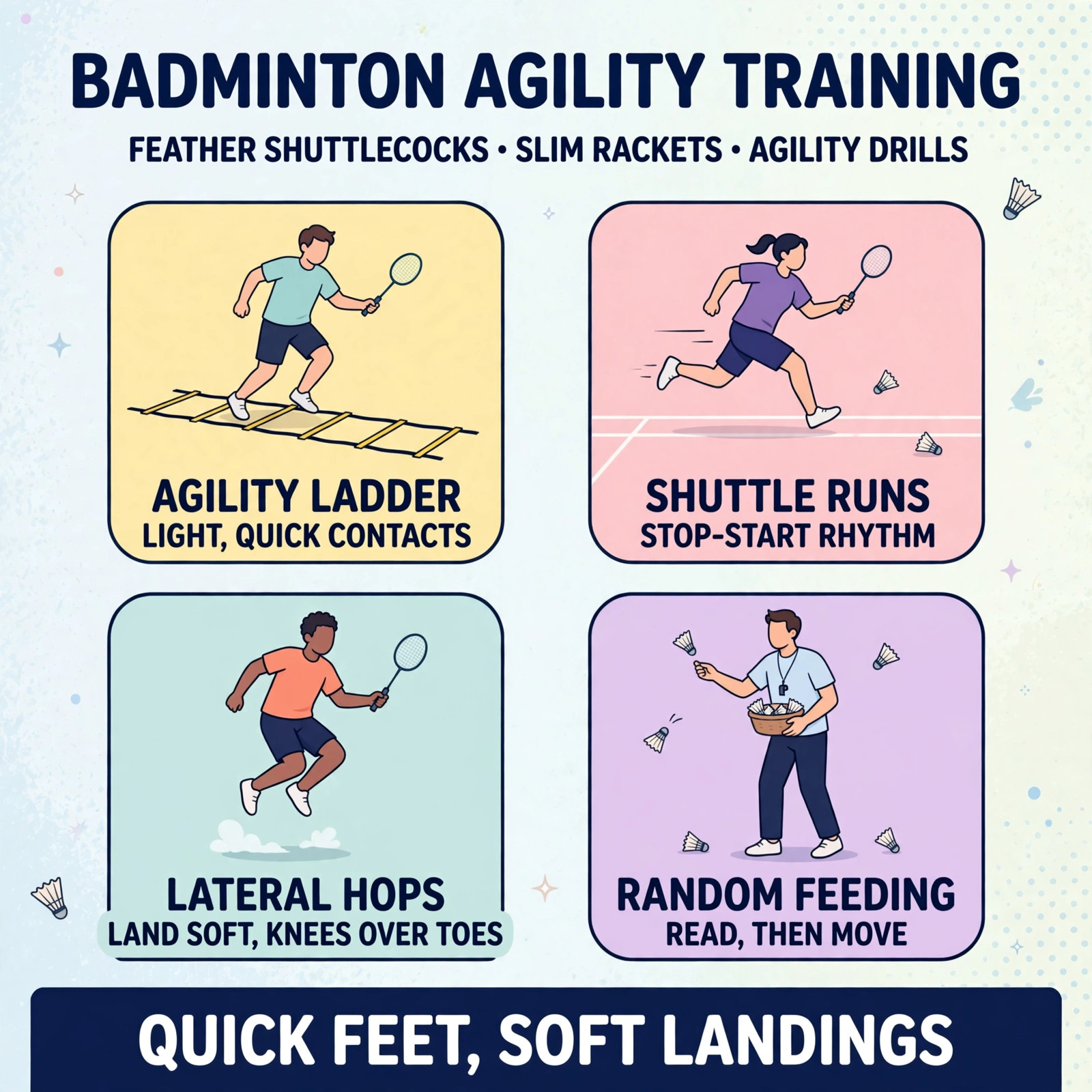
Agility training sharpens the raw materials: reaction, first-step speed and change of direction. Ladder drills teach quick, light contacts with the floor. Shuttle runs between lines build the stop-start rhythm of a rally. Lateral hops and skater jumps load the legs the way defensive movement does. None of this needs a gym, a court, some lines and a few cones are enough.
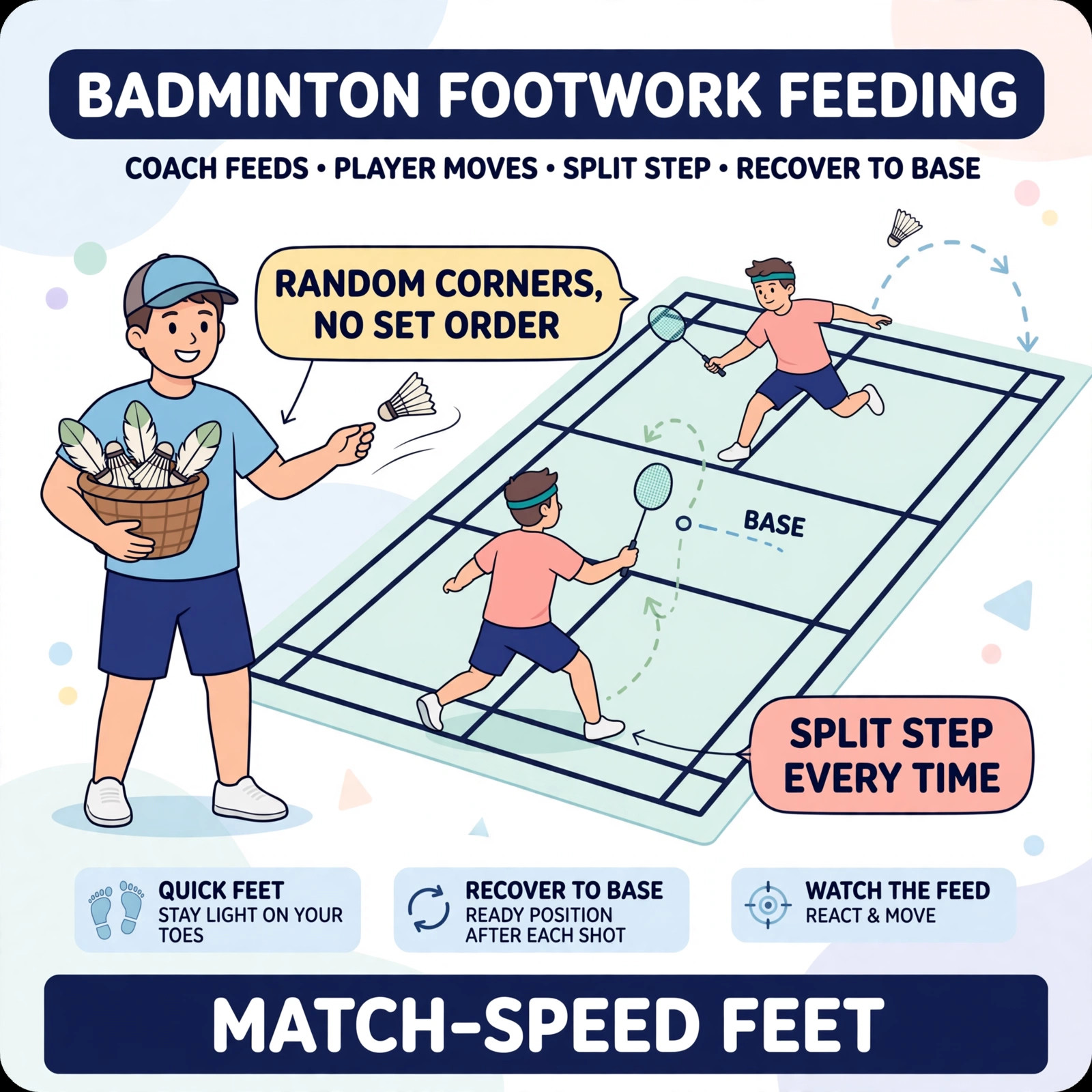
Reaction is trainable, not a gift. Random feeding, where the coach sends shuttles to corners in no set order, forces you to read, split step and move under real uncertainty, which is exactly what a match demands. Start at a pace you can handle with clean technique, then let the feed speed grow. Sloppy speed teaches sloppy feet; controlled speed becomes match speed.
Keep agility work short and sharp. Footwork quality drops the moment legs tire, steps get heavy, lunges get sloppy, landings get loud. Sets of a few seconds at full quality, with proper rest between them, build the kind of speed badminton uses. Long, grinding conditioning has its place in fitness training, but it is a different session from agility work.
Footwork Check #4
What Strength Makes Feet Faster?
Fast movement is built on strong legs. Squats and lunges strengthen the exact positions badminton uses; calf raises power the push-off and help the ankles handle repeated landings; single-leg balance work steadies the wobble that slows a recovery. Two short strength blocks a week, done consistently, change how light your feet feel on court.
The core links it together. Your trunk transfers force from legs to racket and keeps you upright while you change direction. Planks, dead bugs and glute bridges are enough for most players, no equipment, a few minutes at a time. A player whose core tires mid-match starts leaning into shots, and leaning is just another word for arriving late.
And look after the machinery. Land softly, knees tracking over toes, weight absorbed through the leg, because ankles and knees take every landing you make. Warm up before footwork work, stretch calves, quads and hips afterwards, and treat sharp pain as a stop sign, not a challenge. Good warm-ups lower the risk of the strains that interrupt training; they are part of footwork training, not a delay to it.

The Training Week
How Do You Train Footwork in a Normal Week?
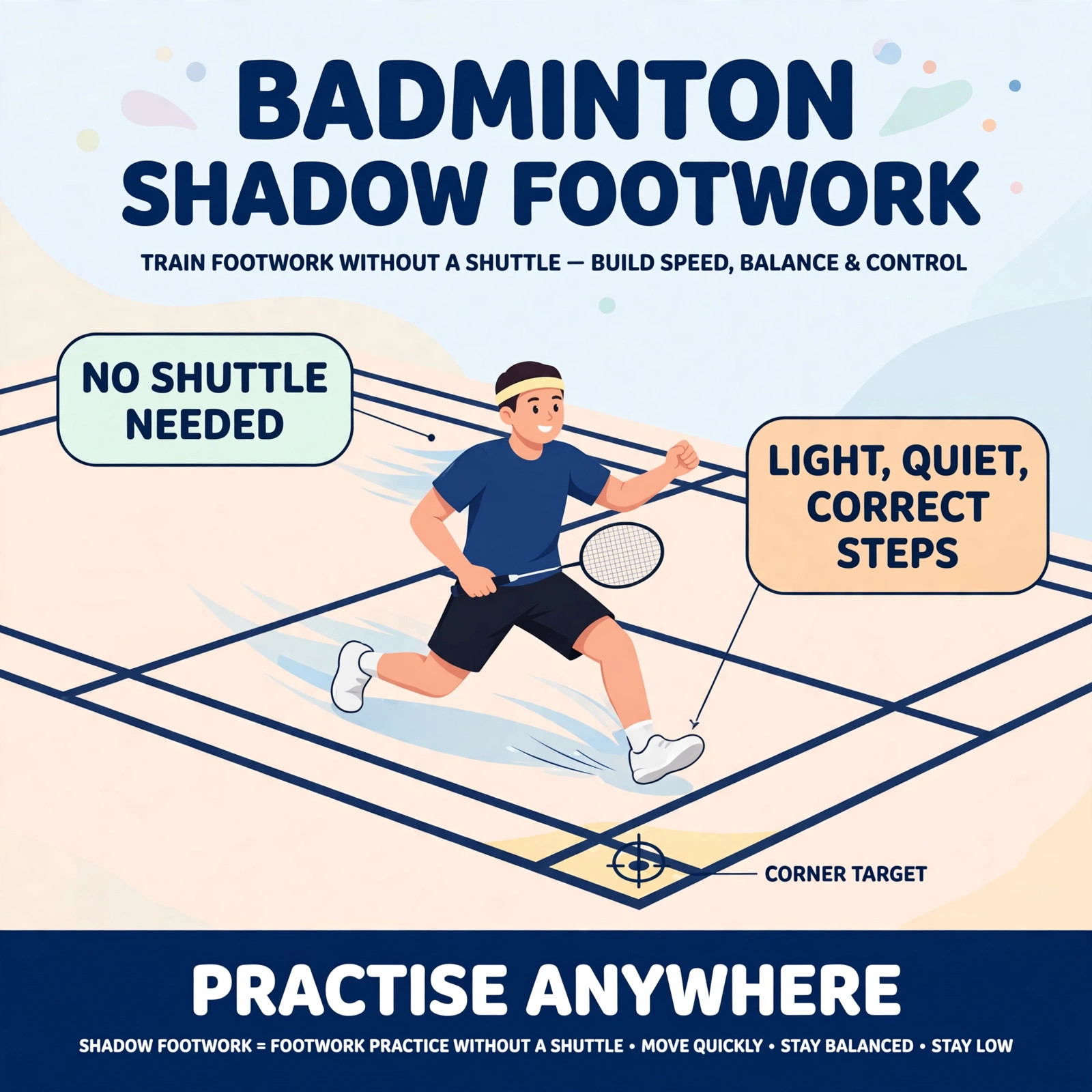
A footwork week does not need to be complicated. One class session where a coach corrects your patterns, one short home or hall session of shadow footwork and ladder work, and games where you test it all under pressure. Shadow footwork, moving through the corners without a shuttle, is the most underrated practice in the sport: a few quiet minutes at a time, a few times a week, grooves the patterns until they are automatic.
Inside a class, footwork training follows a simple build: warm-up and split steps, pattern blocks at walking then full pace, random feeding for reaction, then conditioned games where points reward good recovery. The coach watches your feet, not your shots, the late split step, the extra adjustment step, the recovery that stops halfway.
Progress shows in ordinary moments: you stop lunging desperately at net shots you used to miss; back-court clears stop feeling rushed; third games stop falling apart. Time yourself over a set pattern, or film a rally and count how often you are balanced at contact. When the feet improve, the whole game feels easier, because it is.

Myth vs Reality
Myths About Badminton Speed
Myth: “Some players are just born fast.” Reality: top speed varies, but badminton speed is mostly pattern and timing, the split step, the right steps, an early read. Players who train patterns look fast even against quicker athletes, because they waste no movement. The player who looks slow in your hall is usually not slow; their feet are untrained.
Myth: “Running more miles will fix my footwork.” Reality: long slow runs build general stamina, not the two-second bursts and direction changes badminton needs. Myth: “Footwork drills are only for beginners.” Reality: advanced players drill footwork constantly, it is the first thing that fades when training gets lazy, and the first thing opponents notice.
Myth: “If I train footwork hard, my legs should be sore for days.” Reality: good footwork training leaves you worked, not wrecked. Constant soreness usually means volume jumped too fast or landings are heavy and sloppy. Build gradually, land softly, rest between hard days, speed grows from fresh, high-quality repetitions, not from grinding tired legs.

Why Choose Us
Footwork, Coached Rep by Rep
At ST Badminton Academy KL, footwork is coached in every class, in groups capped at max 4 students. That size matters for feet more than for anything else: a coach can watch one player’s split step and recovery on every rep, and correct the small fault, the late hop, the wrong first step, that videos of your own games never show you.
Mr Eric Chuar has over 15 years of coaching experience in Singapore and Malaysia, and footwork is where he starts with almost every new student. His rule is simple: we fix the feet before we touch the shots, because a corrected stroke on late feet still fails. Students often find their existing shots improve within weeks, nothing about the swing changed, only the arrival.
Our academy is based in Setapak, Kuala Lumpur, convenient for players from Wangsa Maju, Melati Utama, Danau Kota and Gombak. If you feel rushed in rallies despite knowing the shots, bring your game to a session, a coach will watch your feet for ten minutes and show you exactly where your time is leaking.
FAQs: Badminton Footwork and Agility in Malaysia (KL)
These are the questions players ask us most about badminton footwork and agility in Malaysia. If your question is not here, message us, tell us your level and where rallies feel rushed, and we will give you a straight answer about what your feet need first.
How do I improve my footwork if I play in Setapak or Gombak?
Start with patterns, not fitness. Learn the split step and the six corner patterns slowly, with a coach checking your steps, then add speed. In our Setapak classes, footwork is corrected in groups of max 4 students, so your patterns are watched on every rep from the first session, that is how habits form quickly and correctly.
What is a split step and why does it matter in KL?
The split step is a small hop made as your opponent strikes the shuttle. You land with feet apart, knees soft and legs loaded, ready to push off in any direction. It looks like nothing, and it changes everything: it removes the flat-footed delay that makes players feel slow, and it starts every corner pattern in this guide.
How often should I train footwork to improve at a steady level?
Two or three short blocks a week beat one long session. A few minutes of shadow footwork, a ladder set and some shuttle runs, done with full quality and proper rest, is enough for most club players. In class, your coach builds footwork into every session, so home practice only needs to keep the patterns warm between lessons.
Should a school player train footwork while still in school?
Yes, school players benefit from footwork training early, because patterns learned young become the habits they keep. Coaches teach it as movement games and short, fun challenges at that stage, with sensible volume while bodies are growing. Good feet at school level quietly become a big advantage when rallies get faster in later years.
What should I check about my footwork before a match I enter?
Look at your feet, not your shots. Film one rally and watch your arrival: are you balanced at contact, or still travelling? Do you split step on every opponent shot? Do you recover to base, or admire the shot? Three honest answers from one video will name the fault your next month of practice should fix.
Do you coach footwork in classes near Wangsa Maju?
Yes, footwork is coached inside our classes at the Setapak academy, a short drive from Wangsa Maju, Melati Utama and Danau Kota. With max 4 students per group, coaches watch your split step, patterns and recovery closely and correct them rep by rep, which is exactly how footwork faults get fixed for good.
Does your academy teach agility and reaction training in Malaysia?
Yes, agility is part of how ST Badminton Academy teaches in Malaysia: reaction feeding, ladder work, shuttle runs and shadow patterns sit inside regular classes alongside stroke work. Students learn why each drill exists, so the same short routines can be repeated at home or in any hall between coached sessions.
Where is ST Badminton Academy KL located for footwork training?
ST Badminton Academy KL is based in Setapak, Kuala Lumpur, where our classes run in small groups of max 4 students. The academy is convenient for players from Wangsa Maju, Melati Utama, Danau Kota and Gombak. Message us before your first session and we will confirm the venue details and what to bring.
What makes Mr Eric Chuar a suitable coach for footwork and badminton?
Mr Eric Chuar has over 15 years of coaching experience in Singapore and Malaysia, and footwork is the first thing he checks in a new student. He watches how you arrive, not just how you swing, and fixes the split step, first step or recovery that is costing you time, one fault at a time.
Badminton Footwork Training in Action
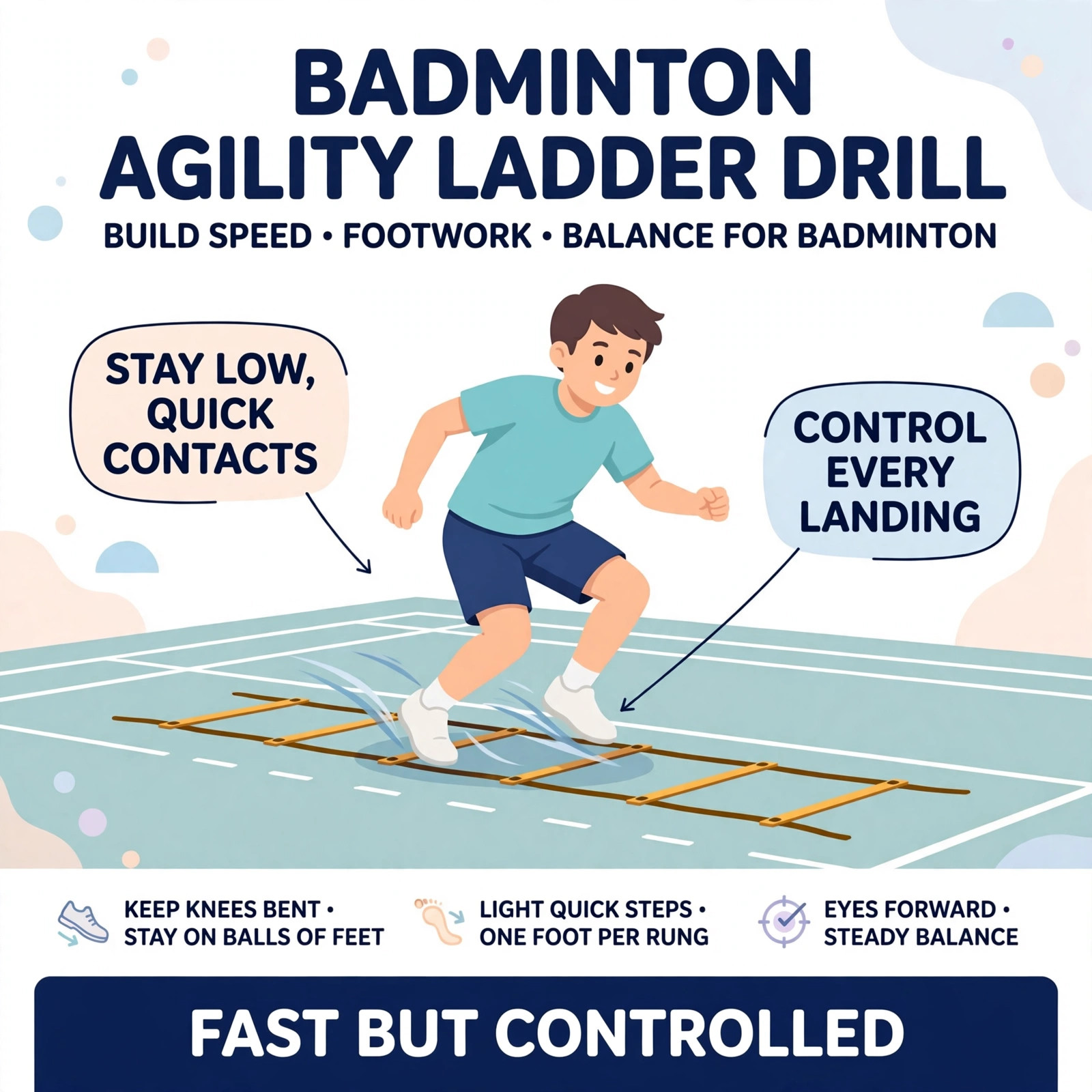

What It Takes to Move Like a Player
A player meets our footwork standard when five habits hold: the split step comes on every opponent shot, each corner is reached with its proper pattern, the recovery returns to base without being told, landings stay soft and quiet, and the feet stay just as clean in the third game as the first. Our footwork standards below are the checkpoints our coaches use.
| Factor | Running More | Training the Patterns PATTERNS |
|---|---|---|
| Frequency | 1 or 2 times a week. Mostly for fun and sweat. | Split step on every shot, six corner patterns grooved until they are automatic. |
| Drills Focus | Basic static feeding. Minimal footwork pressure. | Agility work in short sharp sets: ladders, shuttle runs and random feeding. |
| Physical Conditioning | Rarely included. Just playing games on court. | Core, agility, and speed training included in every session to prevent injury and build stamina. |
| Tactical Awareness | "Just hit it over." No real game plan. | Video analysis, point construction, and learning to read the opponent's game. |
| Coach Ratio | Large groups (8-10 kids). Coach barely watches you. | Max 4 students. Mr Eric Chuar personally corrects every stroke and movement detail. |
| Goal Setting | Fun and exercise. | Strength for the positions badminton uses: lunges, calves, single-leg balance. |
| Long Term Result | Good recreational player. | A player who arrives early and balanced, so rallies feel slower than they are. |
Badminton Footwork Coaching in Kuala Lumpur
This page covered badminton footwork and agility: why feet decide rallies, the split step and six corner patterns, agility and reaction work, the strength behind fast movement, and how to train it in a normal week. ST Badminton Academy KL coaches footwork inside small group classes of max 4 students in Setapak. If you are in Wangsa Maju, Gombak, Cheras or nearby, contact us today.






