Strengthen Your Mental Game In Badminton With Expert Tips (Mental Game Guide)
Two players of the same standard can play the same match and remember two different games. One remembers the rallies. The other remembers the score, the mistake at 14 all, and the game that slipped away while they were still thinking about it. The mental game is the half of badminton that decides which player you are. It is not a personality trait and it is not a mystery. It is a set of trainable habits: how you read an opponent, how you reset between rallies, how you picture the match before it starts, and how you answer when the score turns against you. This guide covers the mental game the way we coach it at ST Badminton Academy in Setapak, Kuala Lumpur.

Mind Check #1
Why Good Players Lose Matches in Their Head
Watch a club match closely and you will see where games are really lost. A player misses a simple net shot, and the next three rallies are played in a rush: a serve into the net, a clear attempted from a bad position, a smash at a shuttle that was never there. The first error cost one point. The reaction to it cost four. Points in badminton are rarely lost one at a time. They are lost in clusters, and the cluster always starts in the head, in the seconds between the error and the next serve.
The other leak is attention spent on the wrong scoreboard. Players carry the last rally into the next one, replay the game they should have won, or start protecting a lead at 15 all and stop playing the shots that built it. None of that changes a single shuttle. The only rally you can still play is the next one, and it deserves your whole attention. A trained head is not empty of feelings. It is a head that notices the feeling, parks it, and gets back to the job: where is my base, what is my serve, what did they just show me?

Mind Check #2
Read the Opponent, Read the Moment
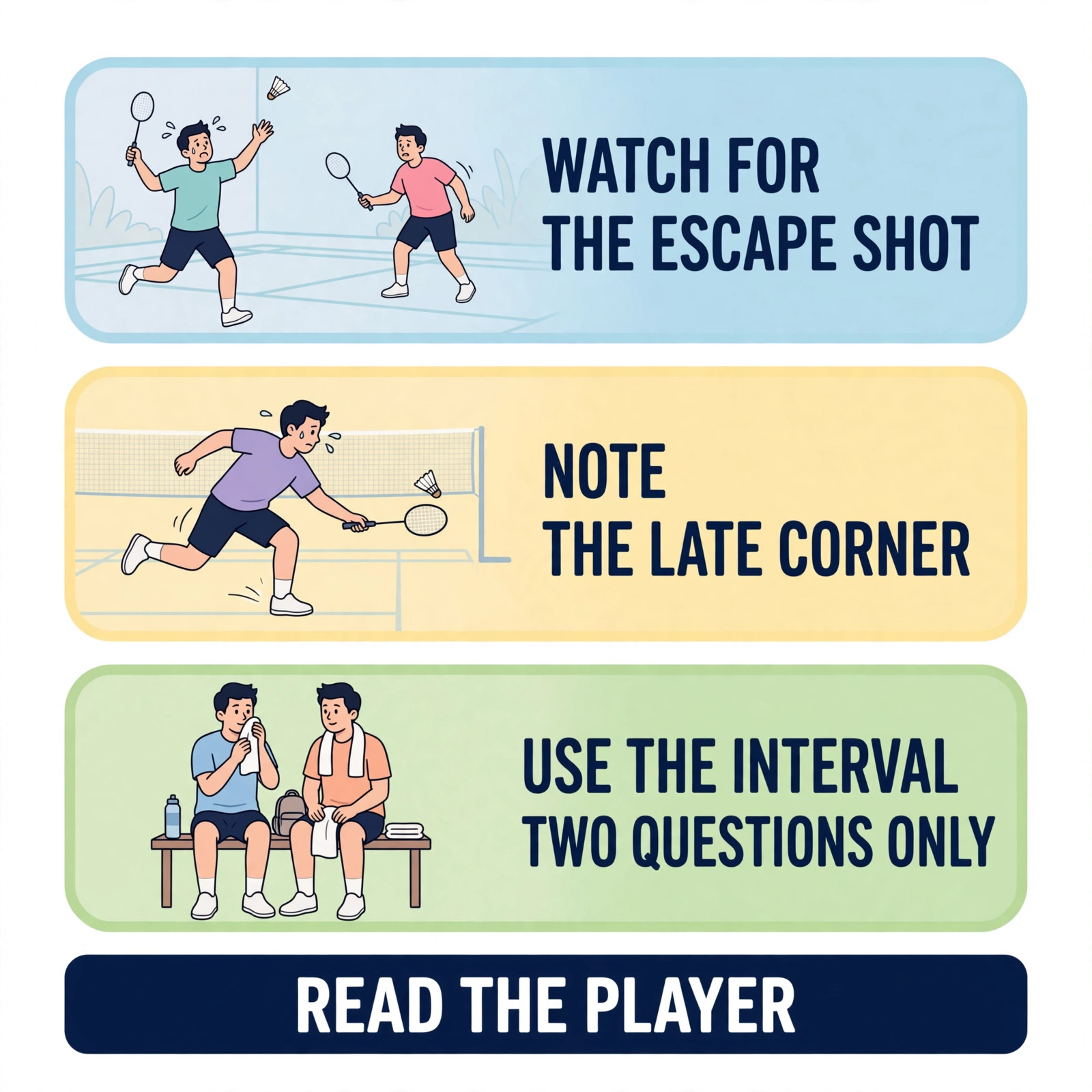
Your opponent is giving you information in every rally, and most of it is free. Watch where they go when they are tired: most players have a favourite escape shot, often a lift to the same corner, and a corner they defend a half step late. Watch their body between rallies too. Shoulders dropping after errors, serves getting faster and riskier when they trail, a flick serve that only appears under pressure. None of this needs a notebook. It needs your eyes up during the sixty seconds most players spend staring at their strings.
Reading the moment matters as much as reading the player. The rally after a long one is not the time to gamble on your lowest percentage shot. The points right after an interval are where plans get tested, because both players have had time to think, and the one who acts on the thought first usually takes the small run of points that follows. Learn to spot the turning points: 11 all at the interval, the first game slipping away, your opponent’s best shot starting to miss. Those are the moments where one calm decision is worth more than one hard smash.
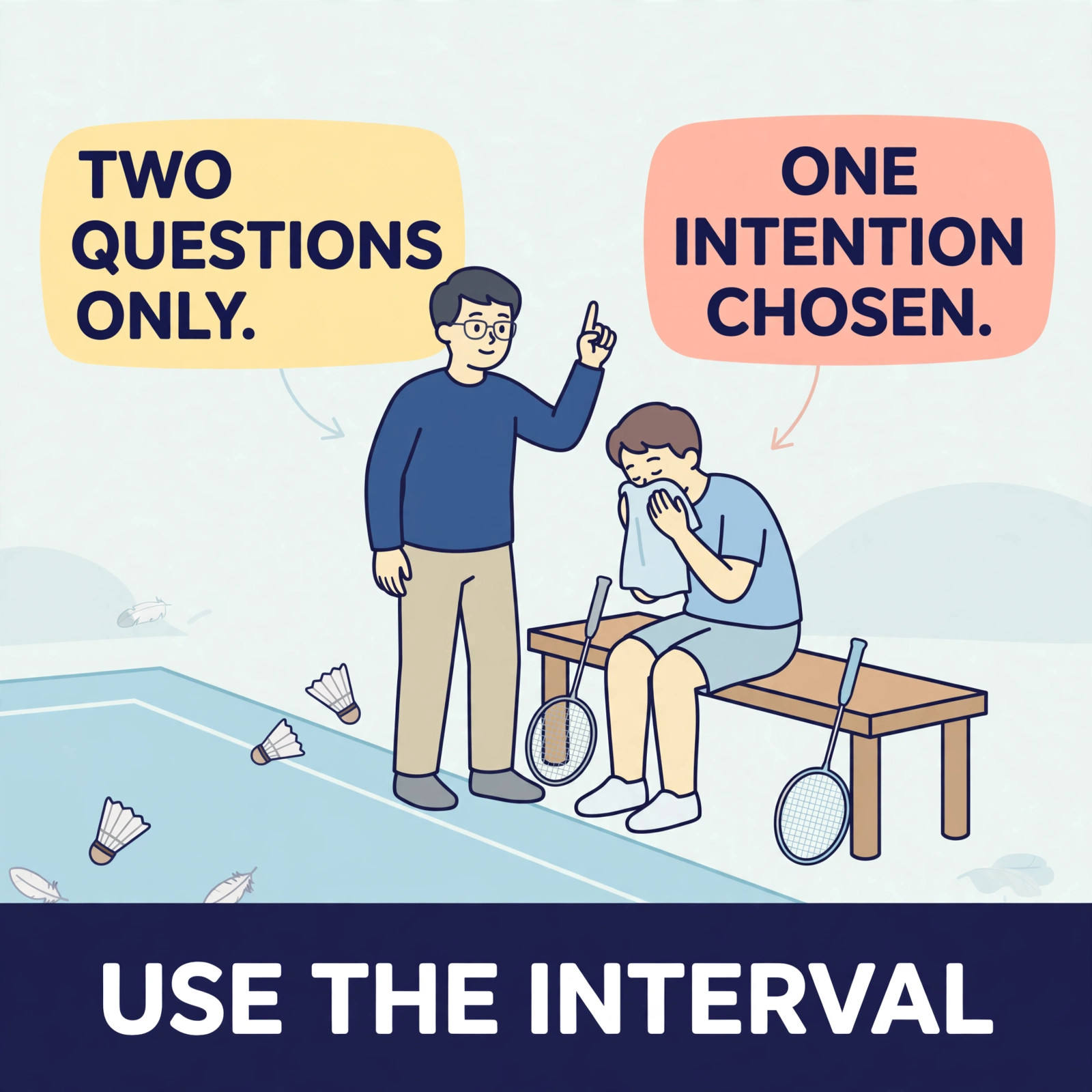
Use the breaks the game gives you. The interval at 11 points and the pause between games are coaching time you give yourself. Towel down, breathe, and ask two questions only: what is working, and what is their escape? Then pick one intention for the next stretch, not five. Players who try to fix everything at the interval fix nothing. Players who choose one thing, like taking the net earlier or serving to the backhand corner, come back out with rallies that have a shape again.
Mind Check #3
Train Your Focus Between Rallies
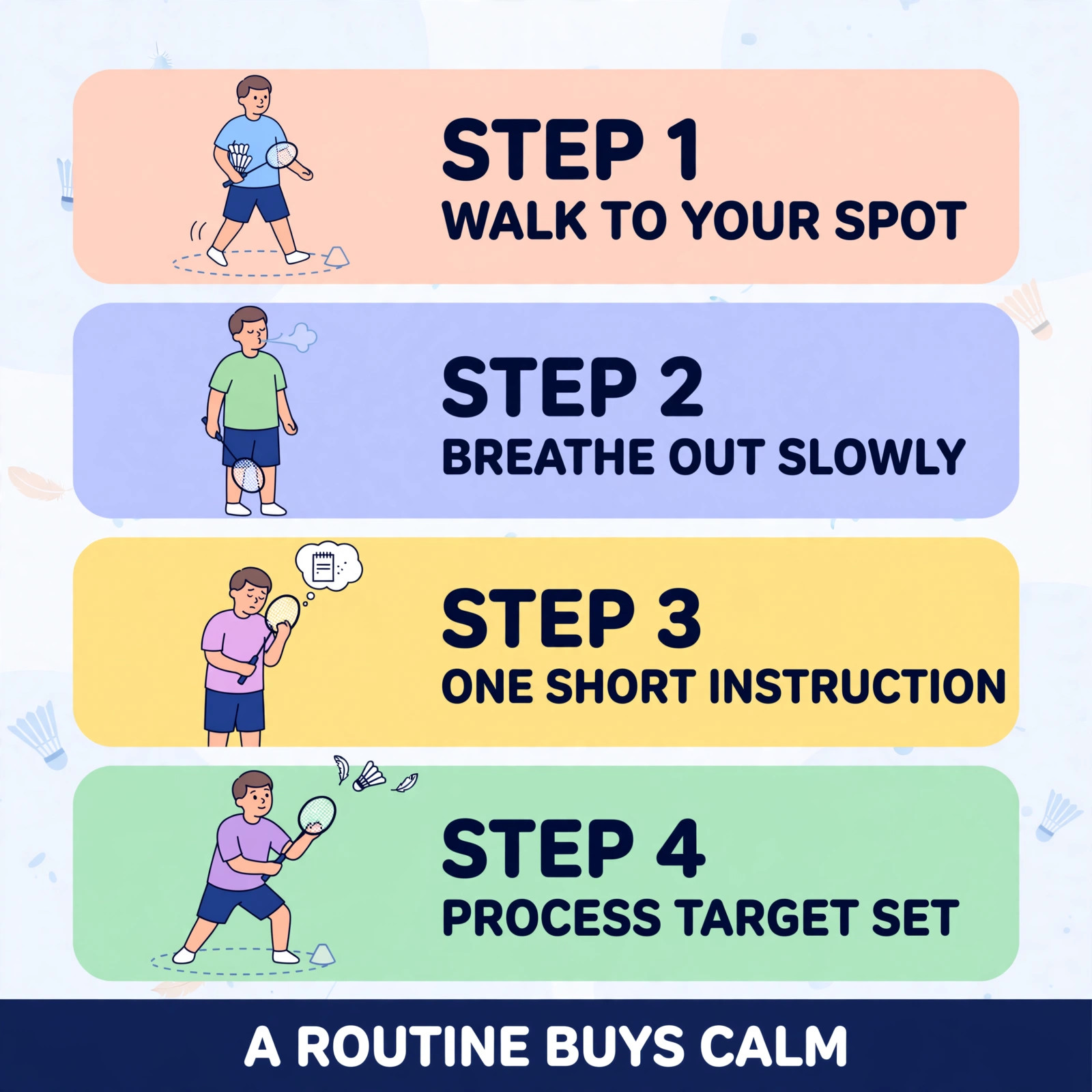
Focus is not a stare you hold for an hour. It is a routine you repeat for ten seconds at a time. Build a between rally routine and use it after every point, won or lost: walk to your spot, towel down or bounce the shuttle, breathe out slowly once, and say one short instruction to yourself, like feet first, or watch the face. The routine does three jobs. It slows your heart, it closes the last rally, and it opens the next one with a plan instead of a mood.
Breathing is the physical switch under the routine. Under pressure, breathing goes shallow and fast, the shoulders rise, and the hands start squeezing the grip long before the shuttle arrives, which is where tight, late shots come from. One long breath out between rallies reverses most of it. The shoulders drop, the grip loosens, and your eyes settle. It sounds too small to matter, until you watch one player at 19 all take the breath while another rushes the serve. Only one of them is playing the rally. The other is playing the score.
Small targets keep a long match simple. Instead of win this game, which you cannot directly control, set targets you can act on in the very next rally: recover to base after every shot, take the shuttle in front at the net, serve to the corner you chose. Process targets give your mind a job with a clear yes or no, and they stack up. Ten rallies of hitting your process targets usually produce the scoreboard result you wanted anyway, without you having to carry it. When your head drifts to the result, the next process target is the way back.
Mind Check #4
Picture It First: Visualisation and Self-Talk
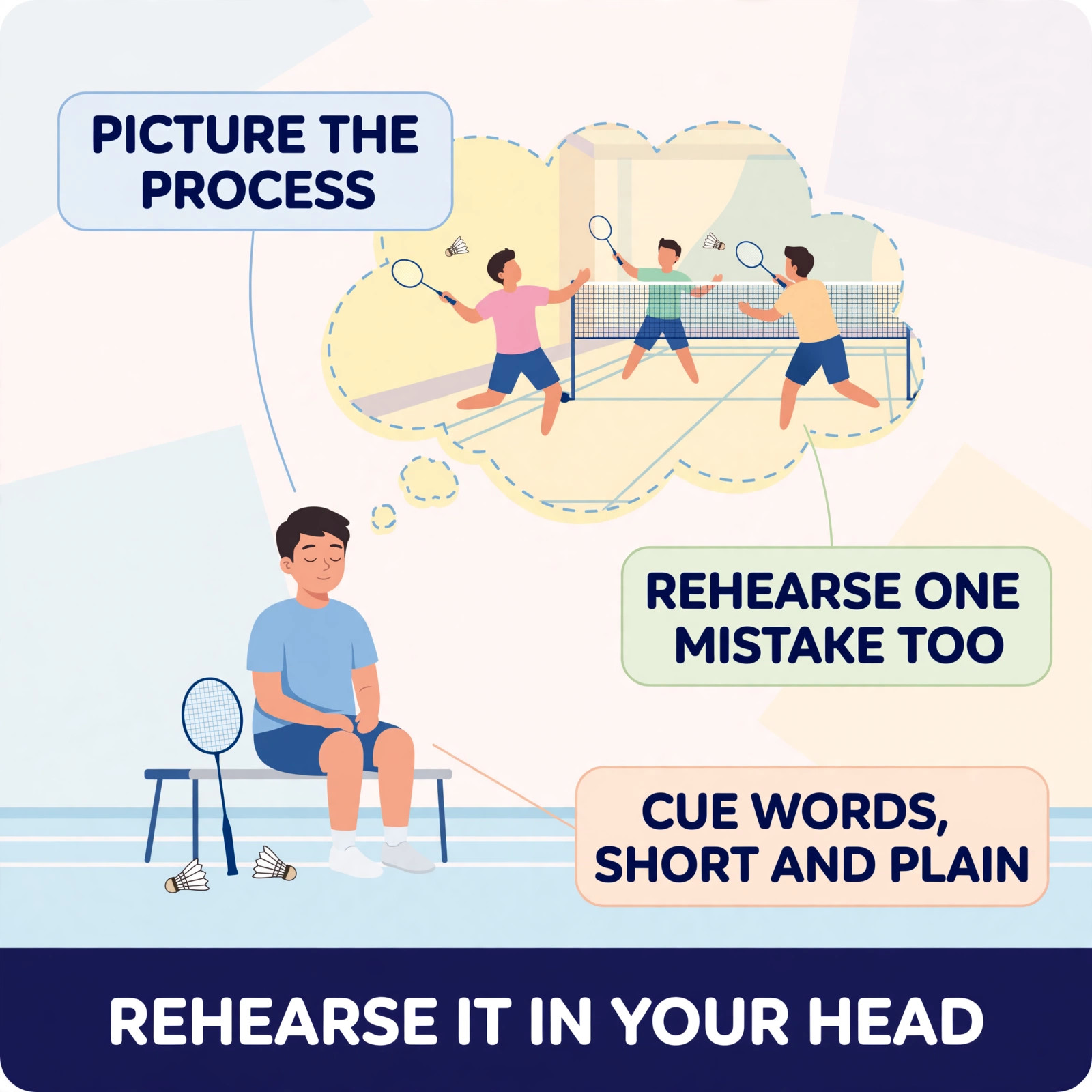
Visualisation is rehearsal with the picture turned on. Sit somewhere quiet before a match, close your eyes, and play the match you want in real time: the hall, the sounds, your serve routine, your feet moving to the corners, your reply to their best shot, yourself calm at 18 all. Picture the process, not the podium. Your mind treats a well rehearsed picture a lot like a memory, so when the moment arrives on court it feels familiar instead of new, and familiar is calm.
Keep the picture honest. Include a mistake in your rehearsal: you hit one into the net at 12 all, and you watch yourself walk back, breathe, and play the next rally well. Players who only picture perfect matches are ambushed by the first error, because the real match has left their script. Players who rehearsed the recovery own a script for the hard moments too. Five quiet minutes of this, a few times a week, is enough. It is a skill, and like every skill on this page, it improves with practice.
Self-talk is the other half of the inside game, and it should be short, plain and about actions. Next one. Feet. Up early. Watch it in. Long speeches do not survive contact with a rally, and negative talk aims your mind at the thing you fear, because the mind hears the picture and skips the do not. Say what you want, in the present, in a few words. Many players keep a cue word on the grip or look at the strings between rallies, so the reminder is there every time they reset.
The Comeback
Confidence, Errors and Bouncing Back
Confidence is not the absence of doubt. It is the memory of problems you have already solved. That is why confidence built only on winning is fragile: the first strong opponent takes it away. Confidence built on preparation is sturdier. You know your routine, you have rehearsed the tight scores, and your training week was honest. When a match turns, that kind of confidence does not argue with the scoreboard. It goes back to work, one rally at a time, because it has something to stand on besides the score.
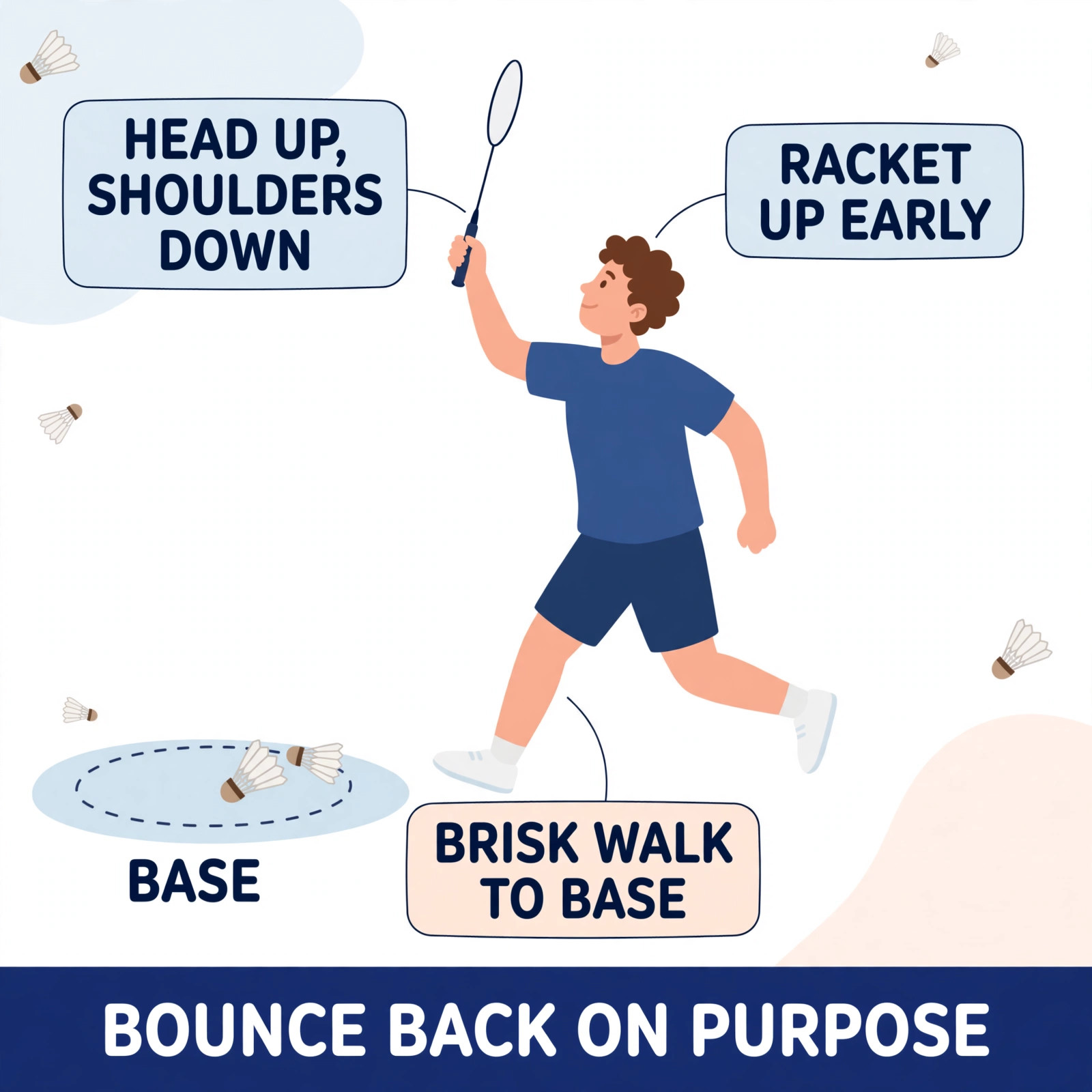
Bouncing back is a behaviour before it is a feeling. After an error, the body goes first: shoulders up, head down, steps slowing, and your opponent can read all of it from across the net. Train the opposite body on purpose. Head up, shoulders down, a brisk walk back to base, racket up early. You are not faking anything. You are giving your mind the posture of the next rally instead of the last one. Opponents notice too. A player who looks unchanged after three errors is a hard sight, because the cluster of points they were counting on never starts.
Fitness quietly supports all of this. A tired mind makes the same decisions as a scared one: it rushes, it gambles, it stops reading. The third game is a mental test mostly because it is a physical one first. Players who hold their footwork and their length in the third game usually hold their heads too, because clear thinking is much easier in a body that is not shouting for air. Train fitness and focus together, with conditioned games and tight score practice, and match day becomes a place you have already been.
Myth vs Reality
Myths About the Mental Game
Myth: “Nerves mean you are not cut out for competition.” Reality: nerves mean you care, and every experienced player feels them. The skill is not removing nerves. It is what you do in the ten seconds after they arrive. A routine, a breath and one clear intention turn nerves into readiness. Untrained players wait to feel calm before they play well. Trained players run their routine, and calm follows.
Myth: “You should never think about the score.” Reality: the score is information, and good players use it: when to take a risk, when to play the safest pattern, when an opponent is protecting a lead. Myth: “Confidence comes from winning.” Reality: winning helps, but confidence that lasts comes from preparation you can point to. Build it in training and it travels to any hall.
Myth: “Mental training is soft extra work for after the real training.” Reality: the mental game decides real points in every close match, and it is trained the same way as a shot, with practice under pressure. Myth: “Positive thinking means ignoring your faults.” Reality: honest review is part of the system. You note the fault, train it, and leave it in the training hall, not in your head at 19 all.

Why Choose Us
Mental Game Coaching, Trained Like a Shot
At ST Badminton Academy KL, the mental game is coached inside small group classes capped at max 4 students. Four students means your coach sees your head as well as your shots: how you respond to errors in a practice game, whether your routine survives at 17-19 down, and which rally makes you rush. We train tight scores on purpose, so match day pressure is a situation you have already practised, not a surprise.
Mr Eric Chuar has over 15 years of coaching experience in Singapore and Malaysia. His rule for the mental game is simple: routine first, feelings second. He teaches players a between rally routine, rehearses tight score situations in class, and reads a player’s head the way he reads a grip, small causes first. Calm, in his classes, is not a talk. It is a drill.
Our academy is based in Setapak, Kuala Lumpur, convenient for players from Wangsa Maju, Melati Utama, Danau Kota and Gombak. If your game keeps disappearing for five points at a time, or your best badminton only shows up in friendly games, bring it to a session. We will look at your routine, your tight score habits and your recovery after errors before we change a single shot.
FAQs: Badminton Mental Game in Malaysia (KL)
These are the questions players ask us most about the mental game in Malaysia. If your question is not here, message us, tell us the moment matches usually turn against you, and we will give you a straight answer about which habit to train first.
How can I calm my nerves before a match if I live in Setapak or Gombak?
Start with a routine, not with willpower. In our Setapak sessions, inside small groups of max 4 students, we build you a between rally routine and rehearse it at tight scores in practice games. Nerves do not disappear, but they stop running your rallies, and that is the change that matters on match day.
What matters most in the mental game of badminton in KL?
The next rally. Everything else, the last error, the score, the crowd, is either finished or not yours to control. In training we build one routine and one process target per player, so attention always has a job. Players who run that system look focused because their focus is a habit, not an effort.
How often should I practise routines and visualisation to play my level?
A few minutes a day is enough, as long as it is regular. Picture your serve routine and your recovery after an error on training days, and rehearse one tight score situation each week. In our classes, visualisation is built into practice games, so the picture and the pressure arrive together and the skill transfers to matches.
When I make two errors in a row my head drops. How do I stop one mistake becoming a bad run?
With a routine that starts the moment the rally ends. Walk back, breathe out, one short instruction, then eyes on the next serve. We rehearse exactly this in class: errors are fed into practice games on purpose, and you practise the ten seconds after them until the slide stops starting.
What should parents say to a junior player before and after a match?
Keep it short, kind and about process. Before the match, one line about their routine is worth more than a speech about winning. After it, ask what they learned before you mention the score. In our junior groups, parents hear the same routine language the players use, so home and court tell the same story.
Do you coach the mental game in classes near Wangsa Maju?
Yes. The mental game is part of regular group classes at our Setapak base, a short trip from Wangsa Maju. Routines, tight score practice and recovery habits are trained inside normal sessions, in small groups of max 4 students, against real opponents at your level, so the skills are tested under honest pressure.
How long does it take to build a calmer match head in Malaysia?
Weeks, not days, and it shows in pieces. First the slide after errors gets shorter. Then tight scores stop feeling new. Then whole matches run on your routine instead of your mood. In our experience, players who practise the routine every session feel the change inside a school term of steady training.
Where is ST Badminton Academy KL located for mental game training?
We are based in Setapak, Kuala Lumpur, close to Wangsa Maju, Melati Utama, Danau Kota and Gombak. Sessions run in small groups of max 4 students. Message us for the current class schedule and we will place you in a group at your level, with mental game work built into the training from the first week.
What makes Mr Eric Chuar a suitable coach for the mental side of badminton?
Fifteen years of coaching in Singapore and Malaysia, and a simple order of work: routine first, feelings second. Eric reads a player’s head the way he reads a grip, small causes first, and trains calm as a drill inside small groups where every response to pressure is actually seen and corrected.
Badminton Mental Game in Action



What It Takes to Stay Calm at 19 All
A player meets our mental game standard when five habits hold: a between rally routine that runs after every point, one process target per match, breathing that settles the shoulders before the serve, errors answered with the reset body instead of the slump, and tight scores played from a rehearsed script. When those five hold, the head stops costing points.
| Factor | Scattered Head | Trained Head MIND |
|---|---|---|
| Frequency | 1 or 2 times a week. Mostly for fun and sweat. | Before the match, nerves are expected and planned for: a rehearsed routine, a warm-up that finishes at match speed, and two clear intentions for the first rallies. |
| Drills Focus | Basic static feeding. Minimal footwork pressure. | During the match, attention stays on the next rally: a breath, a towel, a walk back, and the same routine after every point, won or lost. |
| Physical Conditioning | Rarely included. Just playing games on court. | Core, agility, and speed training included in every session to prevent injury and build stamina. |
| Tactical Awareness | "Just hit it over." No real game plan. | Video analysis, point construction, and learning to read the opponent's game. |
| Coach Ratio | Large groups (8-10 kids). Coach barely watches you. | Max 4 students. Mr Eric Chuar personally corrects every stroke and movement detail. |
| Goal Setting | Fun and exercise. | At tight scores, the player follows the rehearsed script instead of the panic: serve routine, best pattern, and no new inventions at 19 all. |
| Long Term Result | Good recreational player. | A player who spends the match on the rally in front of them, and gives their real level a fair chance to show. |
Badminton Mental Game Training in Kuala Lumpur
This page covered the mental game of badminton: why points are lost in clusters, how to read an opponent and the moment, the between rally routine and the breathing under it, process targets, visualisation and self-talk, and how confidence and fitness carry the whole system. Calm is a skill. Bring your match head to Setapak and let us train it with you.






