Connect With Fellow Badminton Enthusiasts At Community Events (Community Guide)
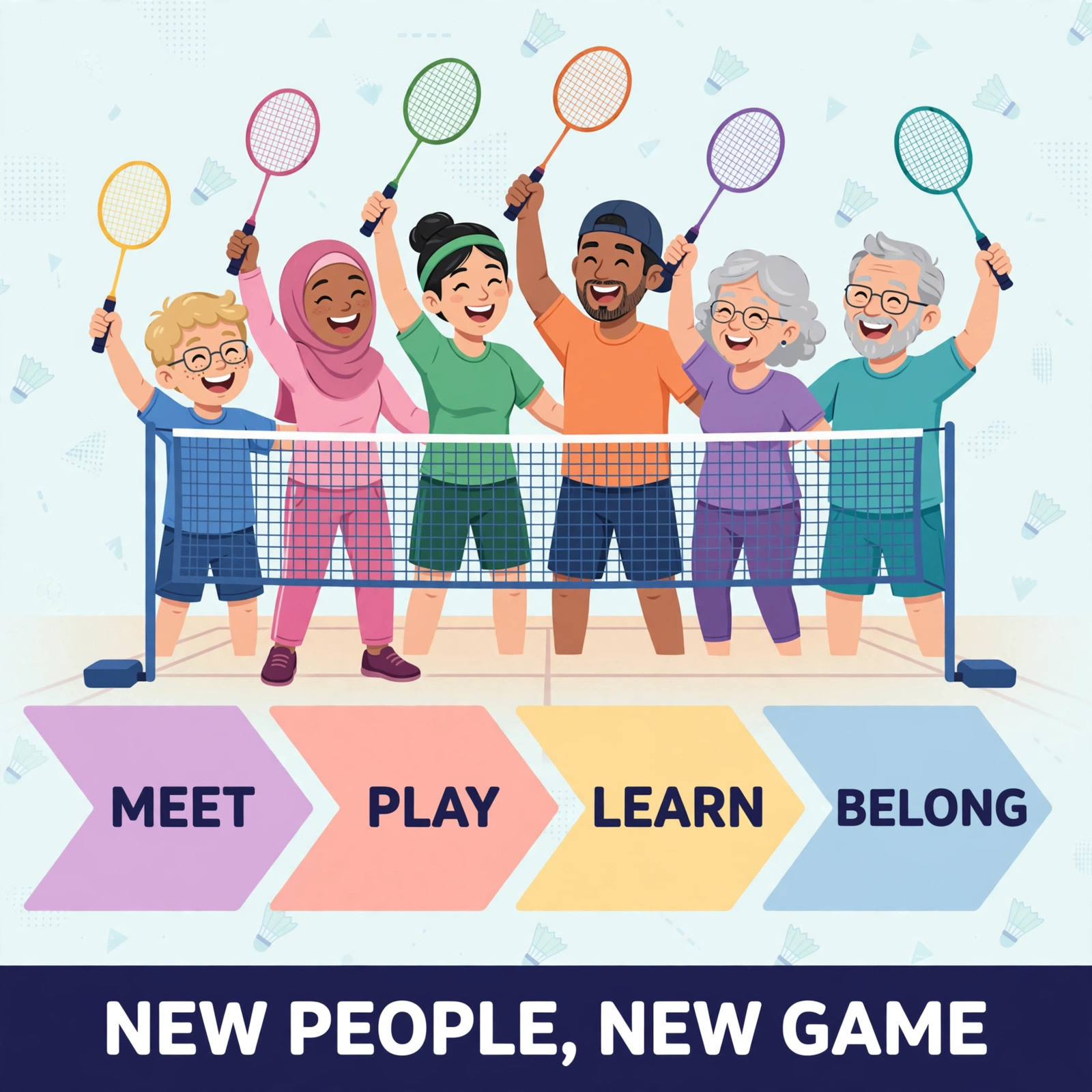
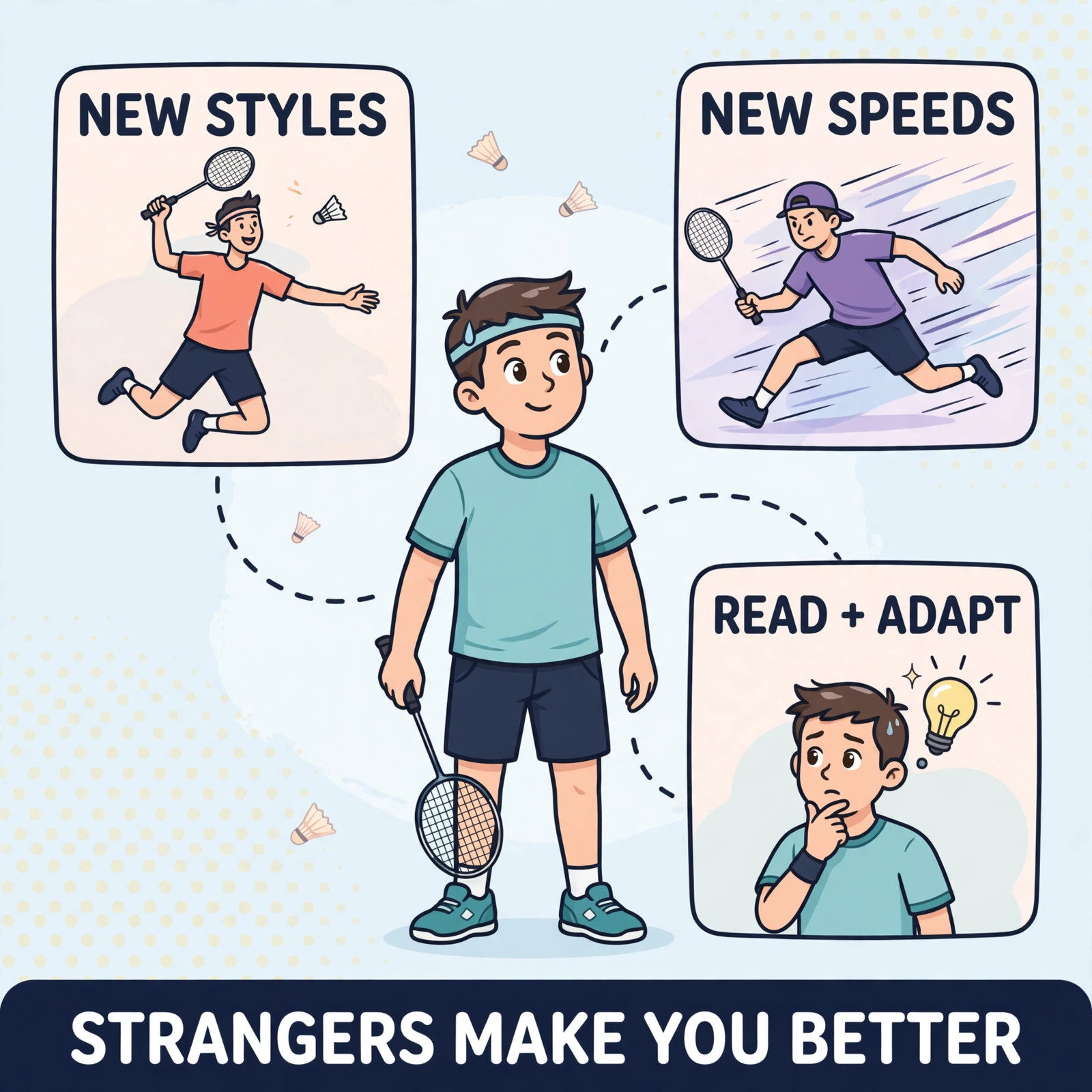
Badminton is easy to start alone and hard to grow alone. A player who only hits with the same partner every week plateaus quietly; a player who walks into community events meets new styles, new speeds and new friends, and improves without noticing it happen.
This guide explains how to connect with fellow badminton enthusiasts at community events in Singapore: why events grow your game, what kinds you can join, how to find sessions at your level, what to bring, how to behave, and how a first visit turns into a regular group, written by the team behind ST Badminton Academy’s classes in Singapore and Kuala Lumpur.
Community Check #1
Why Do Community Events Grow Your Game?
The playing benefit comes first. Every new opponent is a new problem: a left-hander’s angles, a defender who never lifts, a junior with fast hands and no patience. Solving strangers teaches reading and adapting, the two skills that decide real matches, far faster than drilling against a partner whose shots you already know by heart.
The social benefit is just as real. Community events put you in a hall with people who chose to spend their evening the same way you did, which makes conversation easy: rackets, strings, where the good courts are, who is forming a team. Players who join a community stick with the sport for years, because the game becomes an appointment with friends instead of a chore on a calendar.
Community Check #2
What Kinds of Events Can You Join?
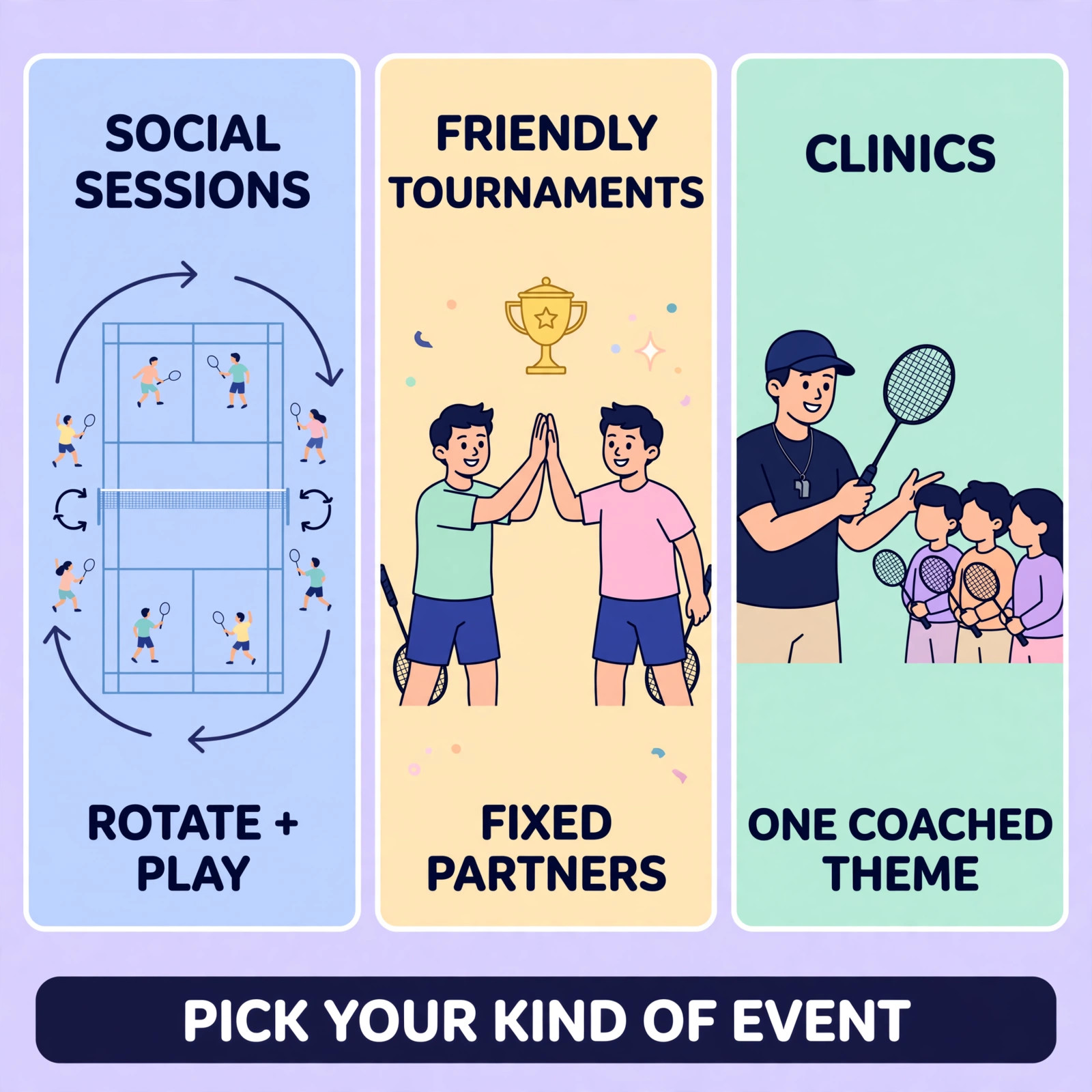
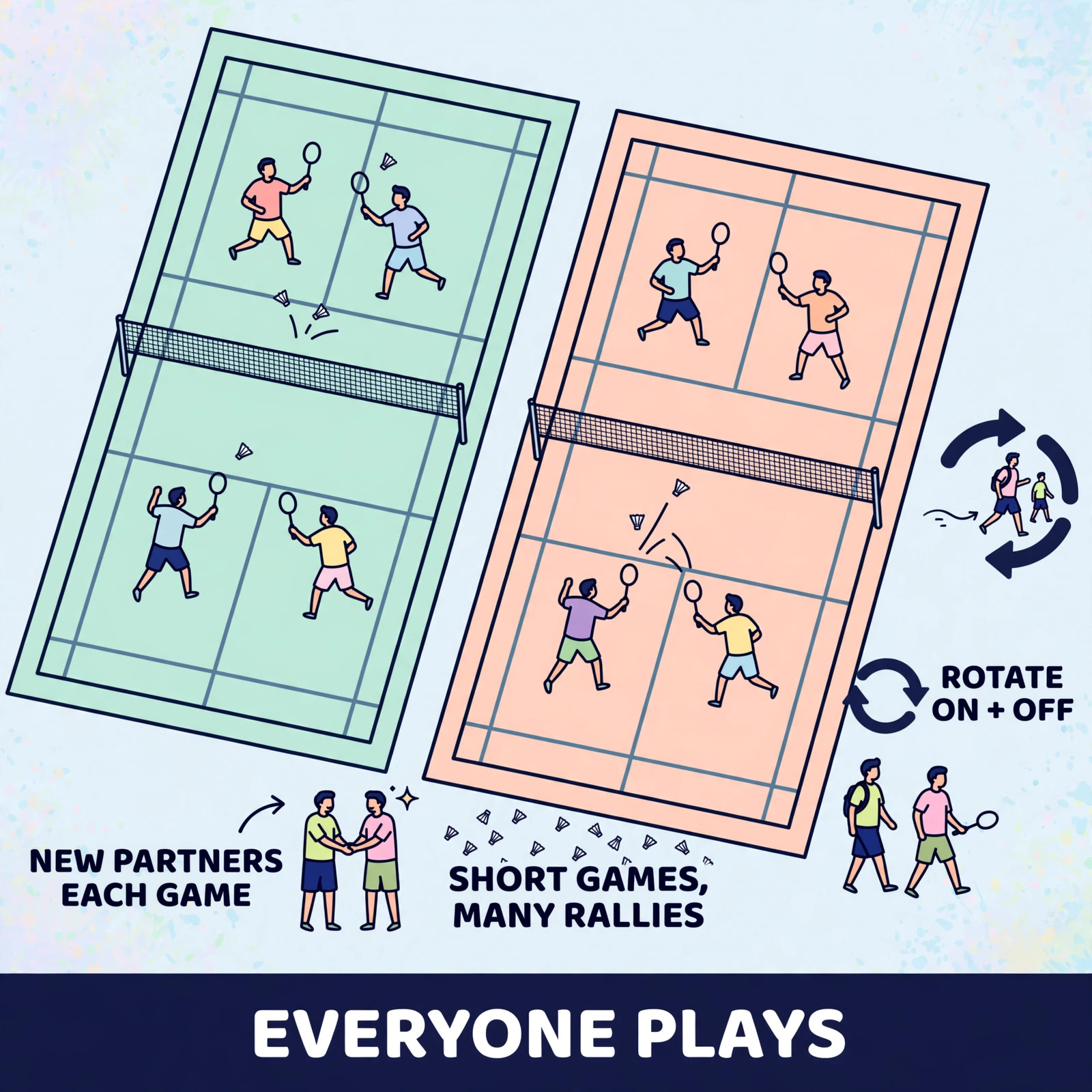
Social sessions are the front door. A hall books several courts, players rotate on and off, and games form by whoever is waiting, usually doubles, mixed levels, short games to keep the rotation moving. Nobody is picked last and nobody owns a court. For a new player, this is the lowest-pressure way to play real games against real strangers.
Friendly tournaments and social leagues sit one step up: fixed partners or small teams, a schedule of matches, sometimes a simple ladder that shuffles winners upward. The standard is still social, nobody’s ranking depends on it, but the games have shape and stakes, which makes them the perfect first taste of competition for club players.
Clinics and group lessons complete the menu. A coach runs a theme, footwork, doubles rotation, net play, and players drill and play with whoever shows up. Events like these mix learning with meeting people, and the group chat that forms afterwards often becomes the player’s regular session. Many of our own Singapore students first met each other at exactly this kind of event.
Community Check #3
How Do You Find Events at Your Level?
Start where community badminton already lives: community clubs, public sports halls, school halls opened to the public, condo and company groups, and the social groups that organise sessions online. In Singapore the scene is active most evenings and weekends, the honest problem is not finding a session, it is finding the right one for your level.
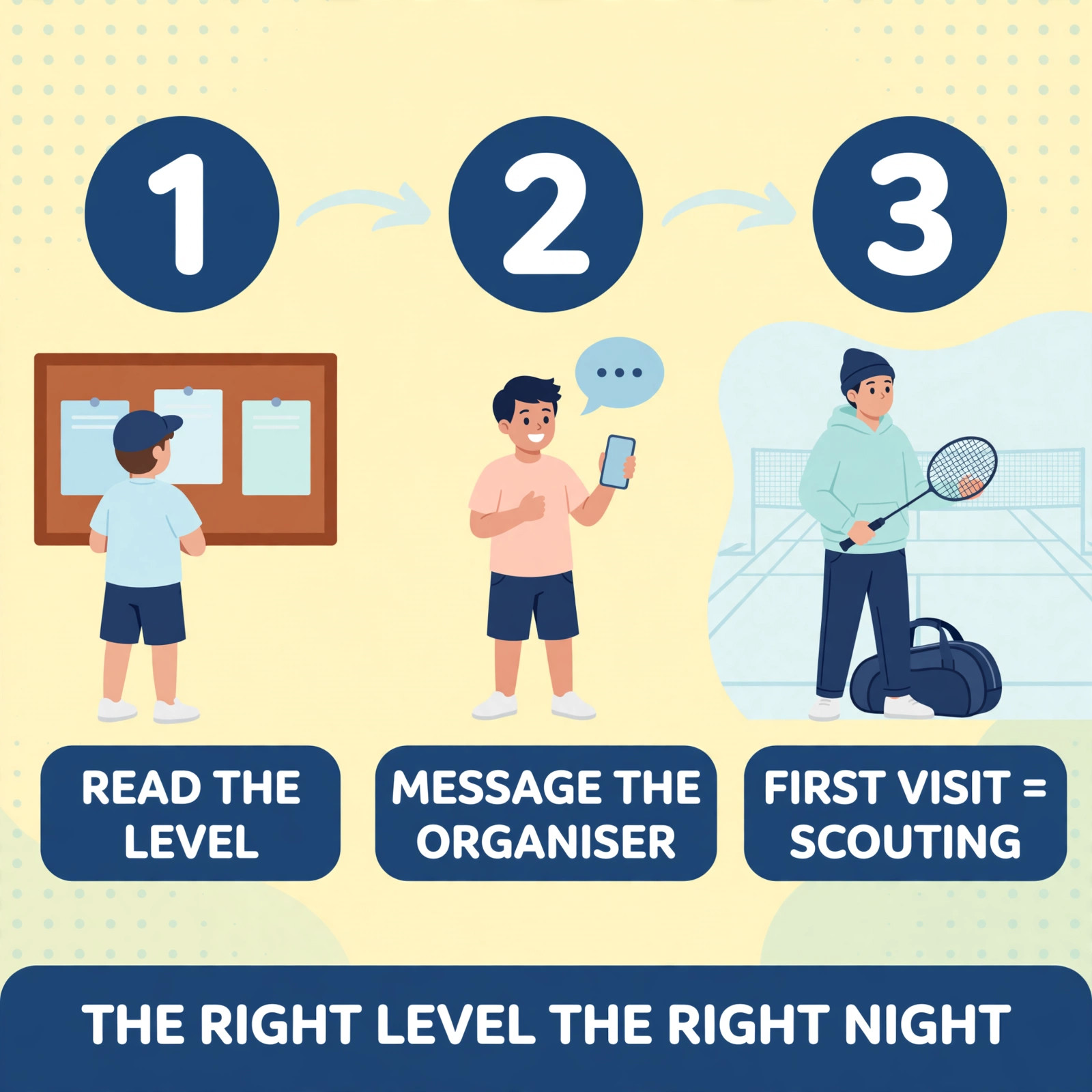
Read the session description before you go. Organisers usually say who the session suits, social, intermediate, advanced, and they mean it kindly: a beginner dropped into an advanced session gets few rallies and a sore evening, while a strong player in a social session must hold back. If the level is not stated, message the organiser and describe your game honestly; they would rather place you well than watch a mismatch.
Your first visit is a scouting trip. Arrive a little early, introduce yourself to the organiser, watch how rotation works, and join the games you are offered. Every group has small customs, how winners stay on, how courts are shared, how shuttles are provided, and one evening of watching teaches them faster than any rule list. Players who fit in are the ones who match the group’s rhythm, not just its standard.
Community Check #4
What Should You Bring and How Should You Behave?
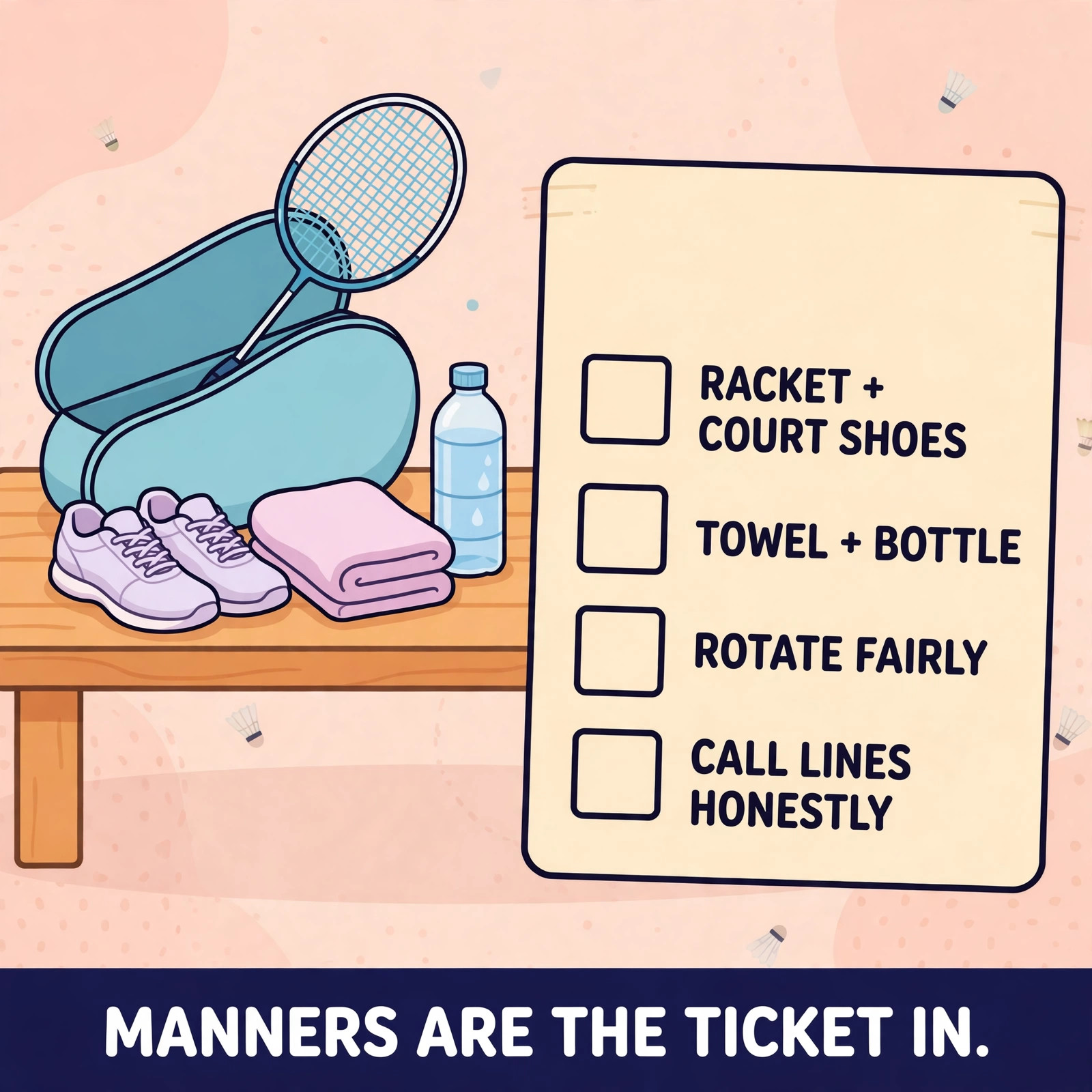
Bring your own racket, proper non-marking court shoes and a change of shirt, Singapore halls are warm work. Most social sessions provide shuttlecocks as part of the session, but check beforehand rather than assuming; some groups rotate the cost of a tube among players. A towel and a water bottle finish the kit. You do not need expensive gear to belong at a community event, an honest mid-range racket and clean court shoes pass everywhere.
Event etiquette is simple and strict at the same time. Rotate fairly: when your game ends, come off if others are waiting, however good the game was. Call lines honestly, keep score out loud, and never coach strangers mid-rally unless they ask. Between games, the winners-stay-on rule belongs to the group, not to you, follow the organiser’s system and nobody will need to remind you twice.
Be the player organisers remember kindly. Help collect shuttles at the end, thank the organiser, and pay session fees promptly and without being chased. Community badminton runs on volunteers and small margins; the player who makes an organiser’s evening easier gets invited to everything, including the sessions that never get advertised.
From Guest to Regular
How Do Events Turn Into a Regular Badminton Habit?
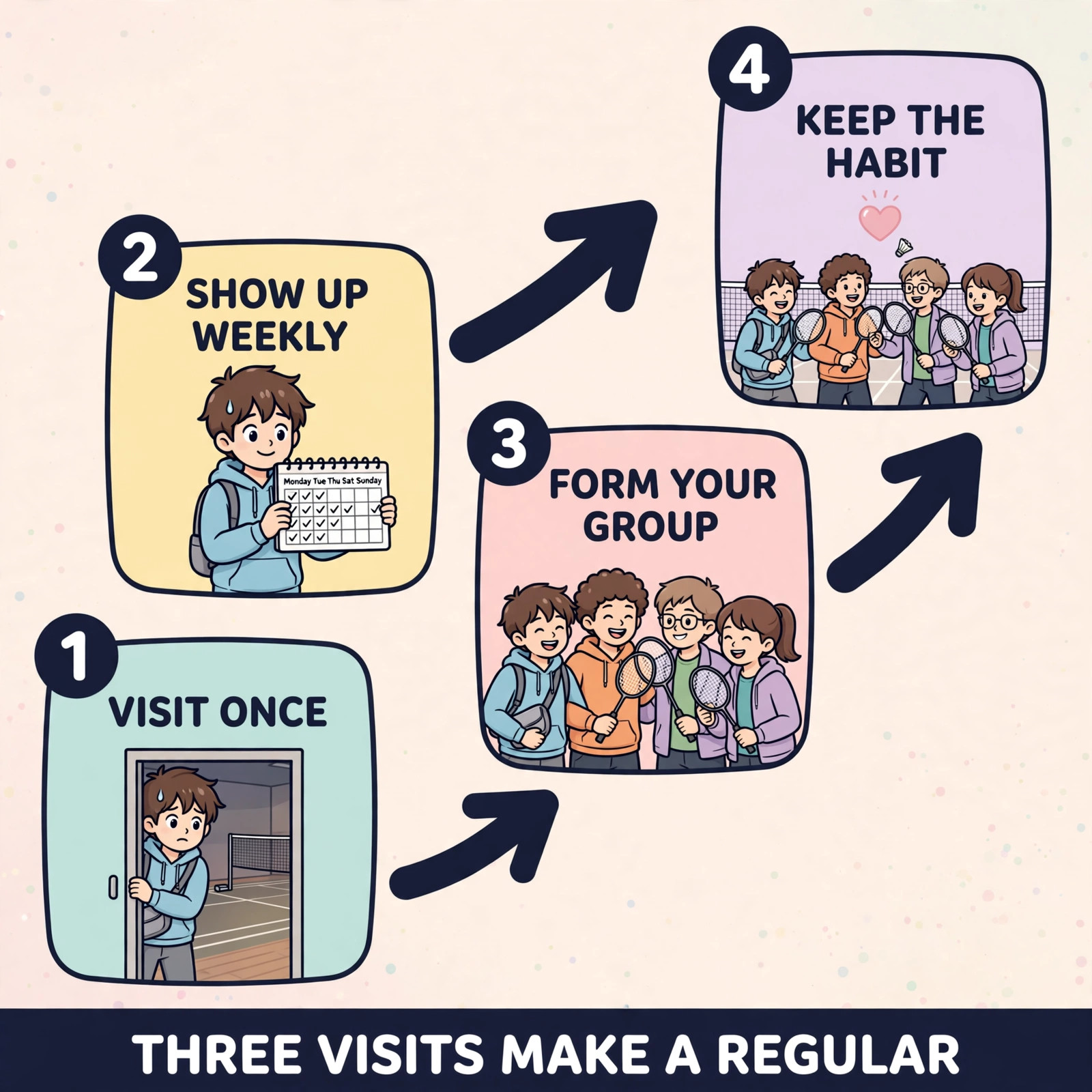
One visit makes you a guest; three visits make you a regular. Regulars get the real rewards: a standing group that knows their game, partners who call them for weekend sessions, a team when the social league opens. The path is dull and reliable, show up at the same session, at the same time, play honestly, and let people learn your name.
Warm up like it matters, because community players get hurt the same way athletes do: cold muscles, hard lunges, one ambitious smash in the first game. Five minutes of jogging, side steps, lunges and shadow swings before your first rally is the cheapest insurance in the sport. And pace the evening, social sessions run for hours, and the player who sprints through game one often spends game five watching from the bench with an ice pack.
From there, groups form naturally. Exchange contacts with the players at your level, agree a regular day, book the court between you, and suddenly the community event has done its real job: it has given you a badminton life that runs itself. That is also how many players find their way to structured coaching, a regular group shows you exactly which parts of your game need a coach’s eye.
Myth vs Reality
Myths About Community Badminton
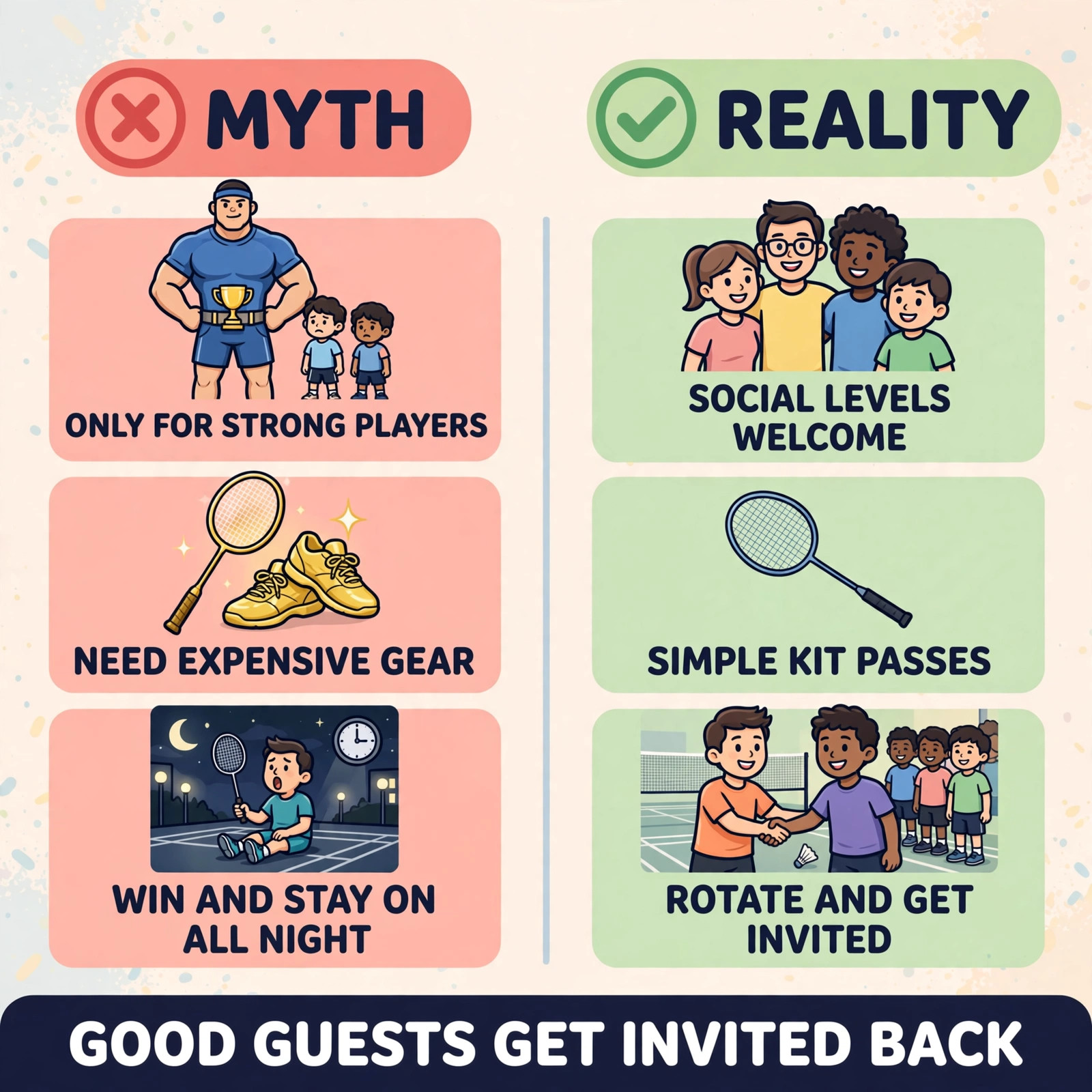
Myth: “Community events are only for strong players.” Reality: most sessions exist for social and intermediate players, and organisers grade them honestly. The strong-player sessions are the minority, a beginner who picks the right session gets more rallies, not fewer.
Myth: “You need expensive gear before you can show up.” Reality: a sound mid-range racket, non-marking court shoes and a towel pass at any community session in Singapore. Myth: “Events are just games, coaching is where improvement happens.” Reality: new opponents teach reading and adapting, which drills alone cannot; the smartest players use both.
Myth: “The best move is to win every game and stay on court all night.” Reality: hogging courts and crushing weaker players is the fastest way to stop being invited. Community badminton rewards the player who rotates fairly, mixes levels gracefully and leaves partners glad they shared a court.
Why Choose Us
Community Is Part of Our Coaching
At ST Badminton Academy, community is not a marketing word, our classes in Singapore and Kuala Lumpur are deliberately small, capped at max 4 students, so players actually know each other. Students meet training partners in class, form their own social groups, and carry the academy’s habits, honest calls, fair rotation, warm up first, into every community hall they visit.
Mr Eric Chuar has over 15 years of coaching experience in Singapore and Malaysia, and he pushes his students into community play on purpose: class builds technique, but strangers test it. His advice to new students is always the same, join one social session a week alongside your lessons, and watch how fast the lessons start to make sense.
If you are looking for classes in Singapore where the group is small enough to become a community of its own, message us with your level and the days you are free. And if you already play in a community group and want a coach’s eye on your game, bring a friend from your session, half our Singapore students arrived exactly that way.
FAQs: Badminton Community Events in Singapore (SG)
These are the questions players ask us most about badminton community events in Singapore. If your question is not here, message us, tell us your level and which part of Singapore you play in, and we will give you a straight answer about where to start.
How do I find badminton community events near me in Singapore?
Look where community badminton already lives: community clubs, public sports halls and the social groups that book courts weekly across Singapore. Tell the organiser your honest level before your first visit and they will place you in the right session, a good first evening is worth more than ten advertisements.
What kinds of community badminton events run in Singapore?
In Singapore you will find open social sessions with rotating doubles, friendly tournaments and social leagues with fixed partners, coached clinics built around one theme, and regular private groups that welcome guests. Each suits a different goal, games, gentle competition, learning, or a standing weekly group of your own.
How often should I join community games if I play at a social level?
Weekly suits most players: one standing session, same day, same hall, so the group learns your game and you learn theirs. Add a second session when fitness and appetite grow. At any level, one regular session you never miss builds more skill and more friendships than three sessions you attend once.
Can a teenager join community badminton sessions at 13 or 14?
Yes, community sessions welcome teenagers at thirteen or fourteen when the session level fits and a parent or organiser knows they are there. Social sessions with mixed adults are usually fine for juniors who can hold a rally; the organiser’s word on placement is final, and our coaches can advise which sessions suit.
What should I bring to a community badminton event I enter?
Bring a racket you swing comfortably, non-marking court shoes, a towel, a water bottle and a change of shirt for the trip home. Check whether the session provides shuttlecocks or shares the cost of a tube. Then warm up properly, rotate fairly and introduce yourself, preparation is mostly manners.
Does ST Badminton Academy run classes and community play sessions in Singapore?
Yes, ST Badminton Academy runs small group classes in Singapore, capped at max 4 students, alongside our Kuala Lumpur base in Setapak. Many students join us after meeting our players at community sessions. Message us with your level and free days and we will confirm class details and the nearest suitable group.
Does your academy help new players connect with community groups in Singapore?
Yes, connecting players is part of how ST Badminton Academy works in Singapore: small classes where students know each other, coaches who point students toward suitable social sessions, and regulars who form their own groups. Tell us what you are looking for, games, partners or coaching, and we will point you the right way.
Where does ST Badminton Academy run classes and community play?
ST Badminton Academy runs classes in Singapore in small groups of max 4 students, and our original base is in Setapak, Kuala Lumpur. Message us before your first session, tell us your level and which area suits you, and we will confirm the venue details, what to bring and which group fits you best.
What makes Mr Eric Chuar a suitable coach for community badminton?
Mr Eric Chuar has over 15 years of coaching experience in Singapore and Malaysia, and community badminton is where he started: social sessions taught him the game before coaching became his work. He still tells students that a coach builds your shots, but a community builds your badminton life, you need both.
Badminton Community Events in Action


What It Takes to Be a Good Community Player
A player meets our community standard when five habits hold at any event: they warm up before the first rally, rotate fairly without being asked, call lines honestly, match the group's level honestly, and leave the organiser's evening easier than they found it. Our community standards below are the checkpoints our coaches teach before a student's first event.
| Factor | Playing Alone | Joining a Community TOGETHER |
|---|---|---|
| Frequency | 1 or 2 times a week. Mostly for fun and sweat. | New opponents every week: new styles, new speeds and new problems to solve on court. |
| Drills Focus | Basic static feeding. Minimal footwork pressure. | Partners and groups at your level, found by showing up instead of searching alone. |
| Physical Conditioning | Rarely included. Just playing games on court. | Core, agility, and speed training included in every session to prevent injury and build stamina. |
| Tactical Awareness | "Just hit it over." No real game plan. | Video analysis, point construction, and learning to read the opponent's game. |
| Coach Ratio | Large groups (8-10 kids). Coach barely watches you. | Max 4 students. Mr Eric Chuar personally corrects every stroke and movement detail. |
| Goal Setting | Fun and exercise. | Honest calls, fair rotation and warm-ups, community habits that protect every game. |
| Long Term Result | Good recreational player. | A player with a standing group, real match craft and a badminton life that runs itself. |
Badminton Community Events in Singapore
This page covered connecting with badminton enthusiasts at community events in Singapore: why events grow your game, the kinds you can join, finding your level, what to bring, event manners, and becoming a regular. ST Badminton Academy runs small group classes of max 4 students in Singapore and Setapak, KL. Message us and come meet your people.






