Strengthen Your Badminton Defensive Play With Expert Tips (Defensive Play Guide)
Every rally you survive is a point your opponent has to win twice. Defence is not the absence of attack; it is the skill of staying in the point until the attack runs out of ideas, then taking the point yourself. Players who defend well look calm while faster players burn out around them. This guide covers defensive play the way we coach it at ST Badminton Academy in Setapak, Kuala Lumpur: the ready base, the footwork that buys you time, the block and the lift, forehand and backhand defence, cutting off the attack, and the reading that makes it all feel slow.
Defence Check #1
Where Does Defence Really Start?
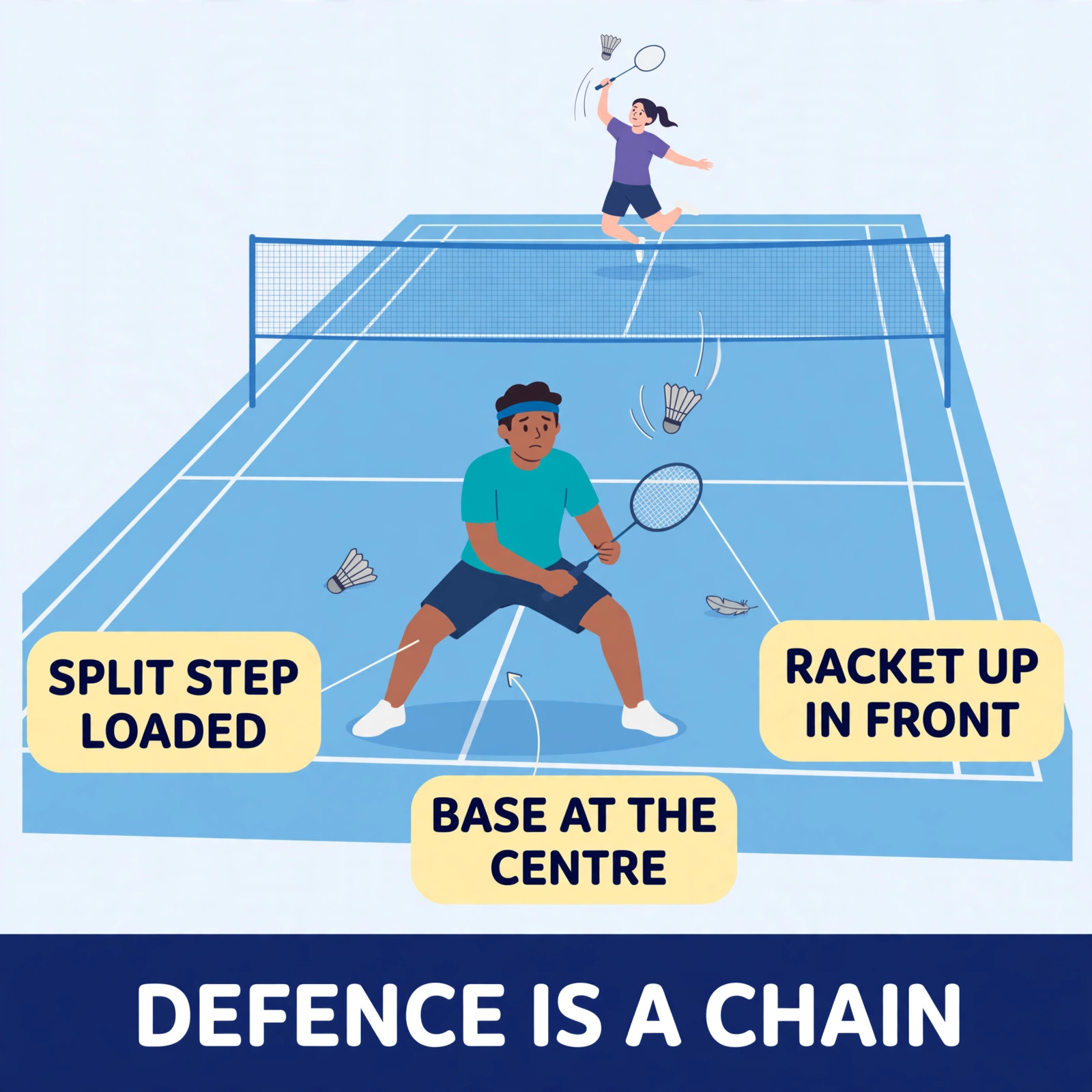
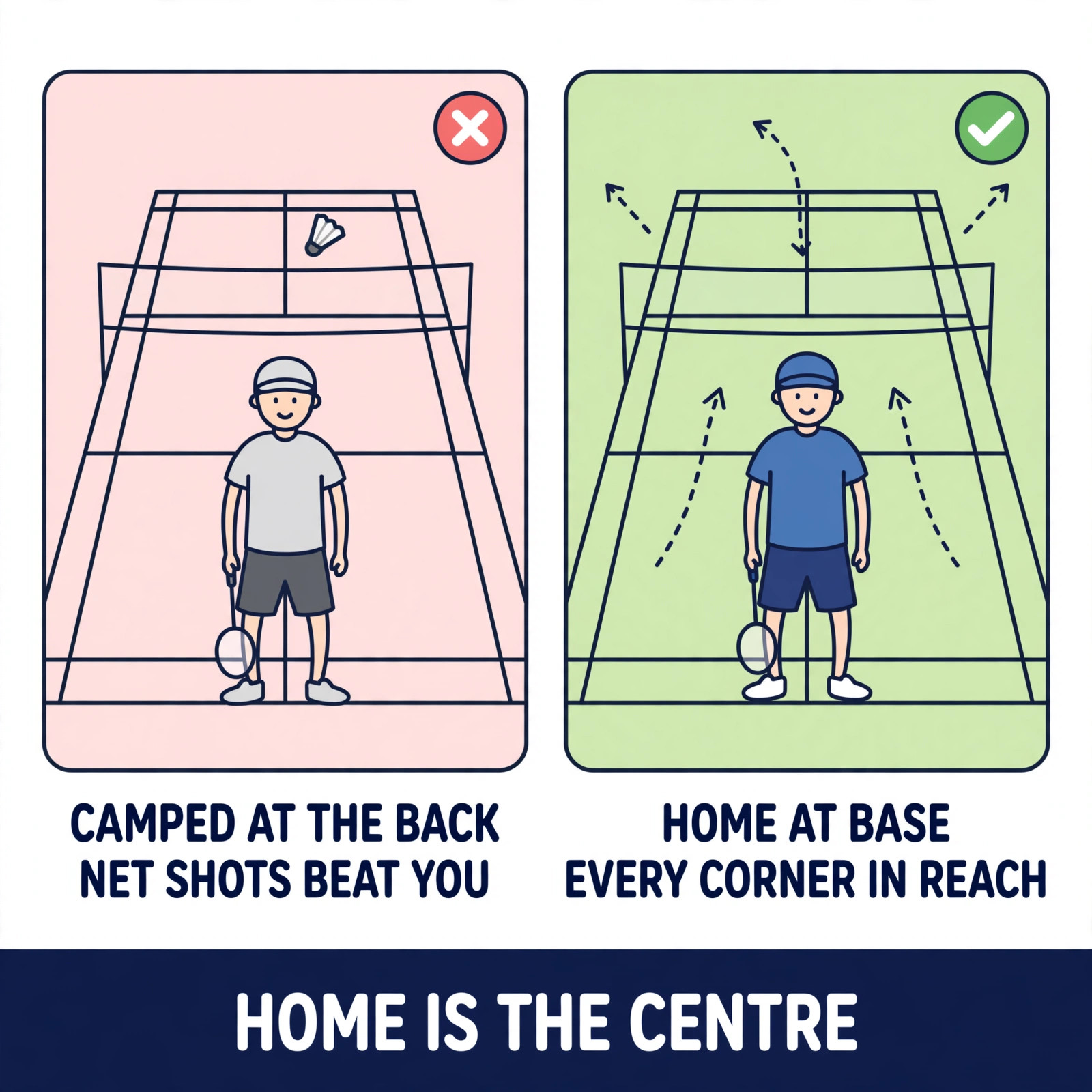
Defence starts from a base, and the base is not the back of the court. In singles, your home is around the centre of the court, a step behind the middle at most, close enough to reach the net with one lunge and the rear corners with two steps. Stand too deep and every net shot becomes an emergency; stand too far forward and clears pass over your head. From base, the ready stance does the early work: feet a little wider than your shoulders, knees soft, weight forward on the balls of your feet, racket up in front of your body where it can move in any direction.
The split step ties it together. As your opponent strikes the shuttle, you land from a small hop, both feet together, legs loaded like springs. That landing is your launch pad; from it you move in whichever direction the shot demands, already moving instead of starting from stillness. Defenders who look slow are usually not slow; they are starting flat-footed while the shuttle is already travelling. The split step, timed to the opponent’s contact, is the cheapest speed in badminton, and it belongs to every single shot you defend.
Defence Check #2
Feet That Buy You Time
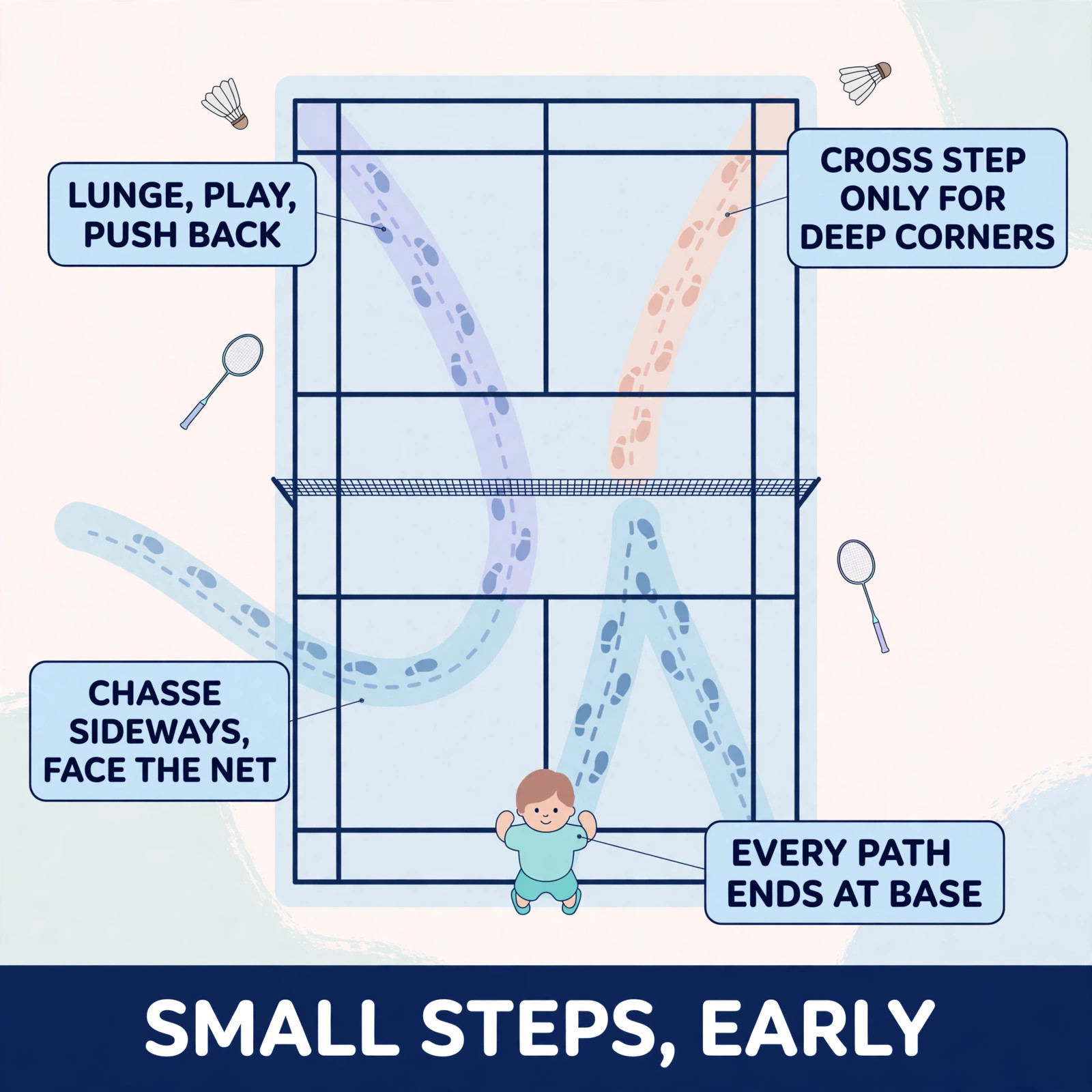
Defensive footwork is mostly small and quick rather than big and heroic. The chasse, a side-step shuffle, covers the mid-court and keeps your body facing the net, which is where defence lives. Quick steps and small adjustments keep you balanced so the racket can stay in front. Cross behind and turn only for the deep corners, where the distance forces it. The rule underneath all of it: move early in small steps, arrive balanced, and never let your feet plant you in a shape the next shot can punish.
The lunge is your front-court brake and your reach extender. Land heel first, knee tracking over the toes, non-racket arm back for balance, and the same leg pushes you back toward base. A good defensive lunge is a visit, not a move of house: you play the shot and you are already recovering. Practise the return trip as much as the arrival, because rallies are lost by players still admiring their save when the next shuttle comes.
Recovery is the habit that joins defence together. Every defensive shot ends with a route back to base, taken at the speed the situation allows: urgent when you are stretched, calm when you have bought time with a good lift. Players often count their defence in shots saved. Count it instead in positions recovered, because a brilliant dive followed by an empty court is a highlight in a lost rally. Defence is a chain: base, split, move, play, recover, and the chain is only as strong as the recovery link.
Defence Check #3
The Block, the Lift and the Return
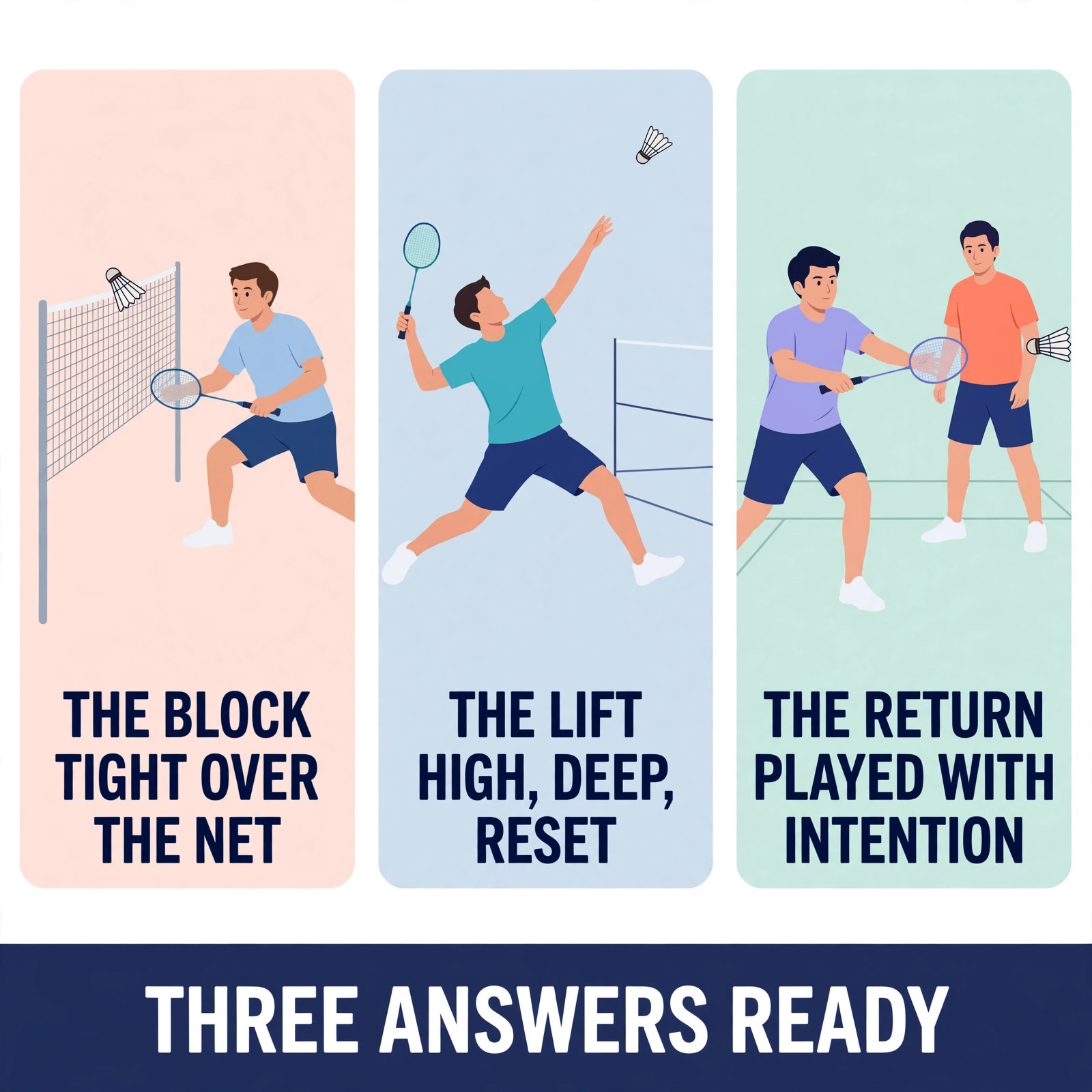
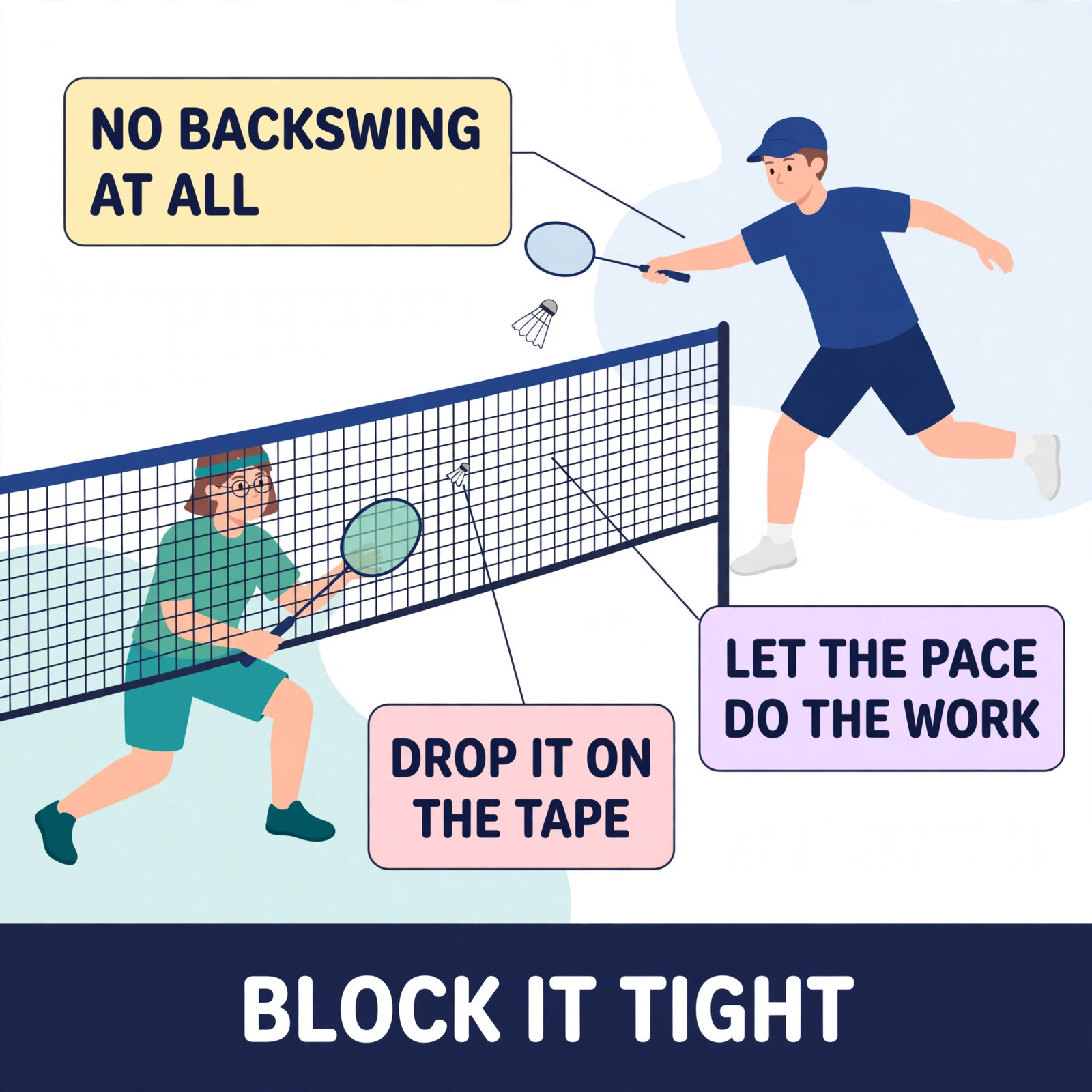
Your first defensive weapon is the block. Played from a short, still racket in front of your body, the block takes the pace out of a smash or drive and drops the shuttle just over the net, forcing the attacker to run forward and lift. No backswing, no drama: the shuttle’s own speed does the travelling. Angle the face slightly and the block slides cross court, into the space the attacker just left. A good block turns their best shot into their longest run.
The lift is the block’s partner, the shot that buys you the whole court back. When you are stretched, late or off balance, lift high and deep to the rear tramlines, ideally to the corner your opponent defends worst. A good lift is not surrender; it is a reset with interest, because it gives you time to recover to base while pushing the attacker to the very back, where their next smash starts from the hardest place on the court. The sin is the mid-height lift, neither tight nor deep, which is a smash invitation with your name on it.
Returning serve is defence that starts before the rally. Stand balanced and alert in your service box, racket up, and read the server’s habits from the first game: do they flick under pressure, which corner do they favour at tight scores? A return that is merely safe keeps you alive; a return with intention, driven flat past the server or dropped tight at the net, stops the attack before it forms. In doubles, your return decides which pair defends for the next ten shots, so it deserves the same respect as any smash you will play.
Defence Check #4
Forehand and Backhand Defence
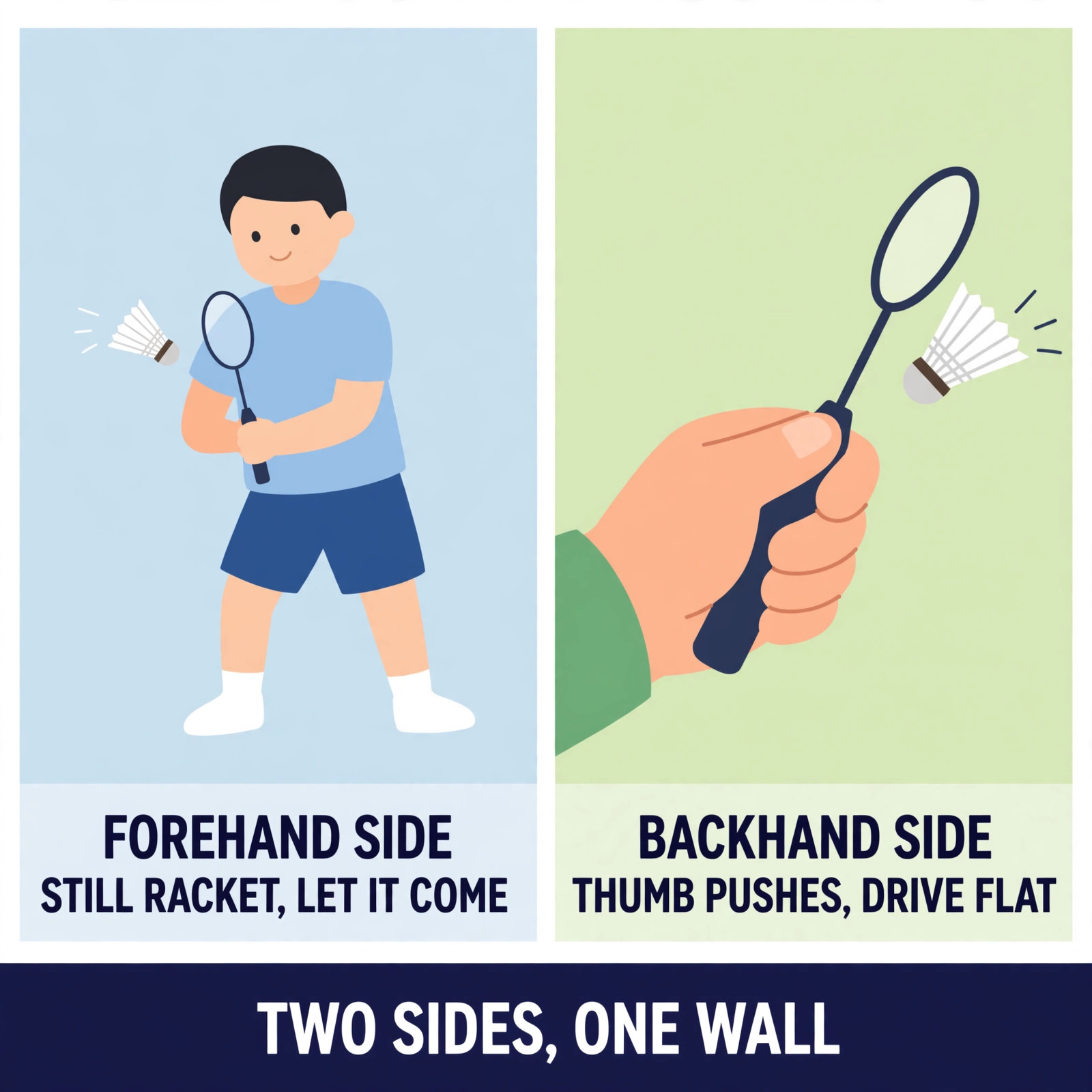
Forehand defence covers the wide side most players attack. Keep the racket in front with the forehand grip set early, and let the shuttle come to the racket rather than reaching and snatching at it. Against drives and smashes to your forehand, the answers are the block to the net, the drive back flat past the attacker, or the deep lift when you are stretched, chosen by how balanced you are, not by hope. The forehand side feels natural, which is its trap: players swing at it. Defence here is stillness and angles, not a smaller smash.
The backhand side is where attacks go to test you, so it must be a wall, not a door. The thumb grip does the work: thumb flat on the wide bevel, racket in front of the body, short push rather than a swing. Backhand blocks and drives played this way are firm and flat, and they surprise attackers who expected a weak lift. When you are truly late and the shuttle is behind you, take the honest option, a deep backhand lift or a clear played round the head if your feet allow, and rebuild. What you cannot do is freeze. A late, balanced lift keeps the rally; a panicked swing ends it.
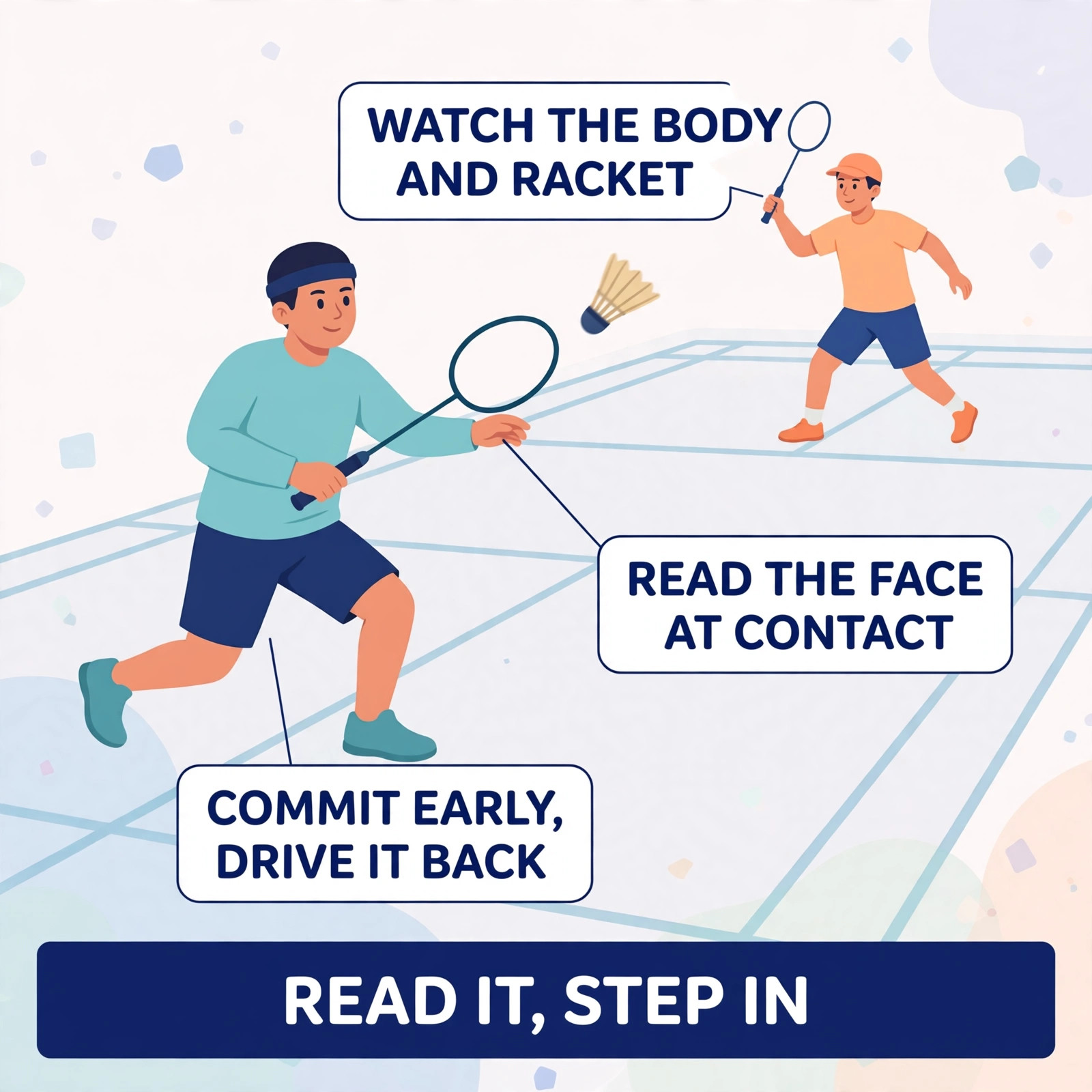
Cutting off the attack is defence growing teeth. As your reading improves, you start stepping in on shots that used to push you back: the loose drive intercepted at shoulder height, the predictable cross court met early and driven back down the line. Interception is a decision before it is a movement: you commit because you read the preparation, not because you guessed. Start with the obvious ones, the shots to your strong side from a player whose habits you know, and let success teach your feet how early they are allowed to leave.
The Read
Cutting Off the Attack and Reading Play
Anticipation is reading, and reading is a trainable skill. Watch the opponent’s body and racket, not the shuttle: the shape of their preparation tells you which shots are still possible, and the angle of the racket face at the last moment narrows it further. A player who telegraphs a smash has a different shoulder shape from one preparing a drop. None of this is guesswork; it is attention, pointed at the right things, trained in games where you call the shot aloud before it is played.
Deception cuts both ways, and defenders use it too. Hold your shape the same whether you plan to block, drive or lift, so the attacker cannot read your reply early and close in. Vary your answers to the same attack: block twice, then drive the third past them, and their smash starts arriving with doubt in it. Placement is the quiet weapon underneath: a defensive reply into the space they just vacated, or at the body of a player still recovering from their own smash, turns their power into their problem.
The defender’s head matters as much as the defender’s feet. Defence means long rallies on the opponent’s terms, and patience is a physical skill: staying low, staying ready, offering the same quality on the ninth shot as the first. Pressure makes players reach for a winner from a bad position; defenders win by refusing that trade. And in doubles, talk: a simple call of mine or yours, early and loud, prevents the two-player pause that loses more defensive points than any smash. Calm is not a personality trait at this level. It is a habit, trained one rally at a time.
Myth vs Reality
Myths About Defensive Play
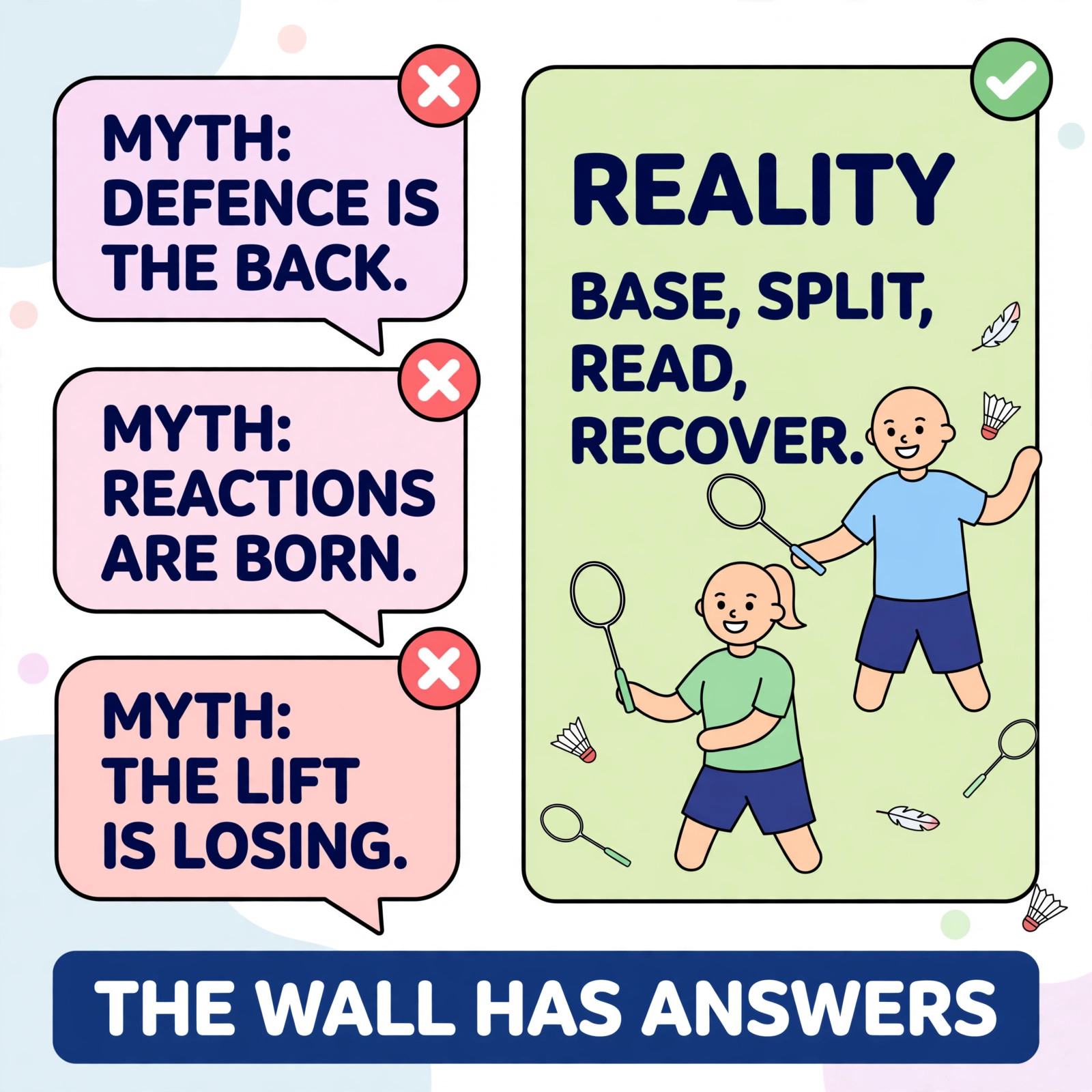
Myth: “Defence means standing at the back and getting everything back.” Reality: defence is played from base at the centre, and getting it back is only the start. Blocks that force lifts, drives that pass the attacker and replies placed into empty space are defence with a plan. A wall that only returns is eventually climbed; a wall that answers is respected.
Myth: “Fast reactions are something you are born with.” Reality: what looks like reaction is mostly the split step and reading. Players who split on the opponent’s contact and watch the racket face look gifted; they are just earlier. Myth: “The lift is a losing shot.” Reality: a deep lift to the right corner resets the rally on your terms. The losing shot is the mid-height lift, which is not a lift at all, just a setup.
Myth: “Backhand defence is a weakness to hide.” Reality: with the thumb set on the wide bevel and the racket in front, backhand blocks and drives are firm, flat and fast. Attackers test the backhand because most players never trained it. Train it, and the test stops coming, which is the finest compliment defence can earn.
Why Choose Us
Defensive Play, Coached Link by Link
At ST Badminton Academy KL, defensive play is coached inside small group classes capped at max 4 students. Defence faults hide in speed: the split step skipped under pressure, the racket dropped at the side, the recovery that takes a holiday. In a group of four, the coach sees them and feeds at the pace that exposes exactly one fault at a time, so your defence is rebuilt under honest pressure, not in slow motion.
Mr Eric Chuar has over 15 years of coaching experience in Singapore and Malaysia. His defence rule is simple: base, split, still racket, recover. When a student leaks points in defence, Eric reads the chain from base position outward before touching any shot, because most defensive failures are positioning wearing a disguise. Fixes come in order, and the wall goes up one honest brick at a time.
Our academy is based in Setapak, Kuala Lumpur, convenient for players from Wangsa Maju, Melati Utama, Danau Kota and Gombak. If attackers circle your backhand like it is marked on the map, or your defence ends one shot before the rally does, bring it to a session. Defensive faults are easy to spot from the side and satisfying to repair.
FAQs: Badminton Defensive Play in Malaysia (KL)
These are the questions players ask us most about defensive play in Malaysia. If your question is not here, message us, tell us where your defence breaks down, and we will give you a straight answer about which link in the chain to fix first.
How can I strengthen my defence if I live in Setapak or Gombak?
Start from base and the split step, not from the shots. In our Setapak sessions, inside small groups of max 4 students, your defensive chain is read link by link, base, split, move, play, recover, and feeding is set at the pace that tests the link you are rebuilding. Your wall goes up in the right order, against real attacks.
How do I improve my reaction time on court in KL?
The split step and your eyes. Split as the opponent contacts the shuttle and your feet are loaded to move either way; watch their body and racket face and the shot starts telling you where it is going. What looks like reflexes is mostly these two habits arriving early. Train them and the game visibly slows down.
Should I defend close to the net or farther back in level?
Neither, and that is the point. Base is around the centre, a step behind at most in singles, so the net is one lunge away and the rear corners are two steps. Too close to the net and clears beat you; camped at the back and net shots beat you. Defence is played from the middle, on the move.
My opponent has a huge smash. How do I defend against it?
Be patient and make them hit another shot. Block tight instead of swinging, lift deep when stretched, and reply where their feet are not. Power fades when it must be produced from the back tramline repeatedly, and attackers forced to win the point three times start donating it. If smashes keep coming from close, look earlier: mid-height lifts feed them.
Is defensive play a good thing for beginners to train, or only for advanced players?
It is one of the best parts of your game to train, because defence is habits, and habits respond to practice at any age. The chain is simple to learn: base, split step, move early, still racket, recover. Adult beginners often become annoying defenders quickly, because patience, which adults have practised in life, is most of the job.
Do you coach defensive play in classes near Wangsa Maju?
Yes. Defensive play is part of regular group classes at our Setapak base, a short trip from Wangsa Maju. You will train the chain against live attackers, including backhand defence and interception, because defence only counts when someone is genuinely trying to finish the rally against you.
Which defensive shot should a beginner learn first in Malaysia?
Start with the block, because it needs the least movement and teaches the still racket everything else depends on. Racket up in front, no backswing, let the shuttle’s pace do the work, and aim to drop it just over the tape. Once the block feels natural, add the deep lift for stretched moments and the drive for flat attacks.
Where is ST Badminton Academy KL located for defensive training?
We are based in Setapak, Kuala Lumpur, close to Wangsa Maju, Melati Utama, Danau Kota and Gombak. Sessions run in small groups of max 4 students. Message us for the current class schedule and we will place your defensive work in a group at your level.
What makes Mr Eric Chuar a suitable coach for defensive play and badminton?
Fifteen years of coaching in Singapore and Malaysia, and a defender’s patience for causes over symptoms. Eric reads your defensive chain from the base outward, fixes one link at a time in small groups where every rally is seen, and teaches calm as a habit. Players leave harder to beat than they arrived, which is the point of defence.
Badminton Defensive Play in Action


What It Takes to Build a Wall
A player meets our defensive standard when five habits hold: base is home around the centre and every recovery returns there, the split step lands on the opponent's contact every time, the racket stays up and in front, forehand and backhand replies stay flat, tight or deep by choice, and the player stays patient enough to make the attacker win the point three times. When those five hold, defence stops being survival and becomes a weapon.
| Factor | Scrambling Defence | Organised Defence WALL |
|---|---|---|
| Frequency | 1 or 2 times a week. Mostly for fun and sweat. | Before the shot, the player is home at base, split step loaded, racket up and in front, watching the opponent racket face. |
| Drills Focus | Basic static feeding. Minimal footwork pressure. | During the rally, replies are chosen by balance: block when set, drive when flat, lift deep when stretched, never the mid-height gift. |
| Physical Conditioning | Rarely included. Just playing games on court. | Core, agility, and speed training included in every session to prevent injury and build stamina. |
| Tactical Awareness | "Just hit it over." No real game plan. | Video analysis, point construction, and learning to read the opponent's game. |
| Coach Ratio | Large groups (8-10 kids). Coach barely watches you. | Max 4 students. Mr Eric Chuar personally corrects every stroke and movement detail. |
| Goal Setting | Fun and exercise. | Recovery is part of every shot, so the next attack meets a player who is already home and ready. |
| Long Term Result | Good recreational player. | An attacker forced to win the point three times, who eventually donates it once. |
Badminton Defensive Play Training in Kuala Lumpur
This page covered defensive play: the base and split step that start it, the footwork and recovery that sustain it, the block and lift that answer attacks, forehand and backhand defence, interception, reading and the patience that holds it together. Defence is a chain, and every link trains. Bring your wall to Setapak and let us build it with you.






