Improve Your Game With Online Badminton Coaching (Online Coaching Guide)
Here is the quiet problem with practising on your own: practice repeats whatever you do, right or wrong. Hit a thousand backhands with the thumb in the wrong place and you have not practised a backhand. You have installed a fault. The reason is simple. You cannot see your own game. You cannot watch your grip at contact, your feet at the far corner, or your racket face as the shuttle leaves it. Online badminton coaching exists to put a coach’s eye back into that loop, through your phone: you film your practice, a coach marks what actually happened, and you train the fix. This guide covers that loop the way we use it at ST Badminton Academy in Setapak, Kuala Lumpur.
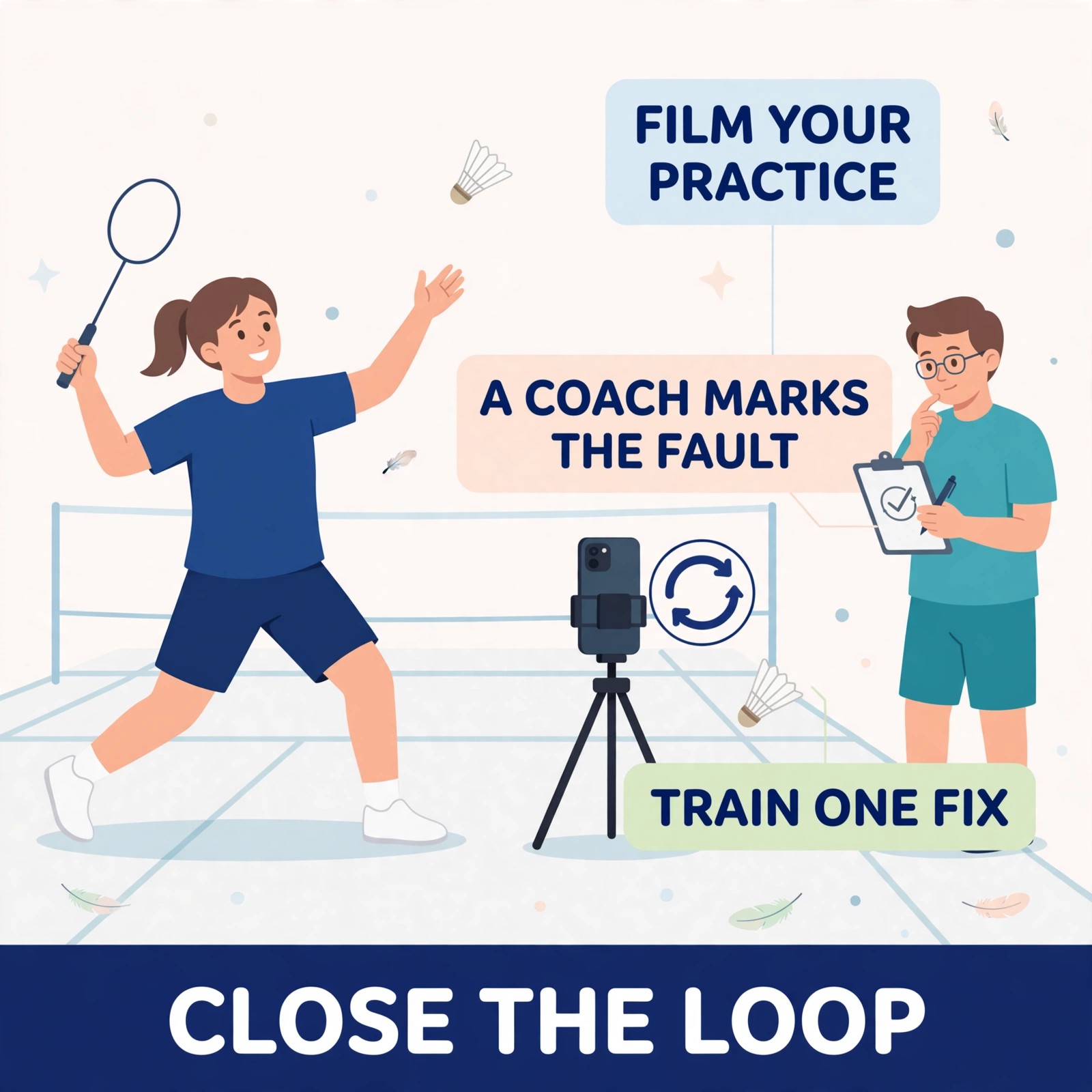
Feedback Check #1
Why Practice Alone Plateaus
Solo practice has a ceiling, and the ceiling is your own eyesight. From inside your body, a late lunge feels like a lunge, a rolling grip feels like a grip, and a clear that falls short feels like bad luck. Faults do not feel like faults. They feel like your technique, because they are, until somebody shows you otherwise. This is why hardworking players plateau: not from lack of effort, but from thousands of honest repetitions of a pattern nobody has ever corrected. Effort was never the missing piece. Observation was.
The internet has made information free and feedback rare. You can watch a thousand coaching videos tonight, and every one of them will show you someone else’s game, someone else’s faults, someone else’s fix. None of them will watch your clear fall short and tell you why. A coach’s value was never the information. It is the observation: a trained eye on your shots, naming the one fault that matters most, in the order it should be fixed. Online coaching does not change that job. It changes where the eye sits: on a clip you filmed this week, marked up and sent back to you.

Feedback Check #2
The Feedback Loop: Film, Fix, Film Again
The loop has four steps, and it only works if all four happen. First, you film a short clip of real practice or a real match: normal rallies, normal speed, faults included. Second, the coach reviews it properly, pausing at the moments that matter, and marks the fault where it happens. Third, you get one fix, with a drill to train it and a count to reach. Fourth, you train the fix for a week, film the same drill again, and the two clips are compared. Film, mark, fix, film again. Skip the last step and nobody knows whether anything changed.
The hardest part for players to accept is the one fix. A single honest clip can show ten faults: grip, feet, timing, position, all untidy at once. Chasing all ten changes none of them, because a body learns one pattern at a time. A good coach orders the faults like a queue. The one that causes the others goes first: very often the grip, because the grip sets the racket face for every shot, or the footwork, because late feet corrupt every swing built on top of them. Fix the cause, and half the list quietly disappears with it.
Good feedback has a shape, and you should learn to recognise it. It is specific: your thumb leaves the racket on the backhand, not ‘your backhand needs work’. It is timed: it points at the moment in the clip where the fault happens, so you can watch it yourself. And it comes with a drill and a measure: a target to hit, a count of clean repetitions to reach, so both you and the coach know what ‘fixed’ will look like. Praise without these three things feels kind and teaches nothing. It is not coaching. It is company.
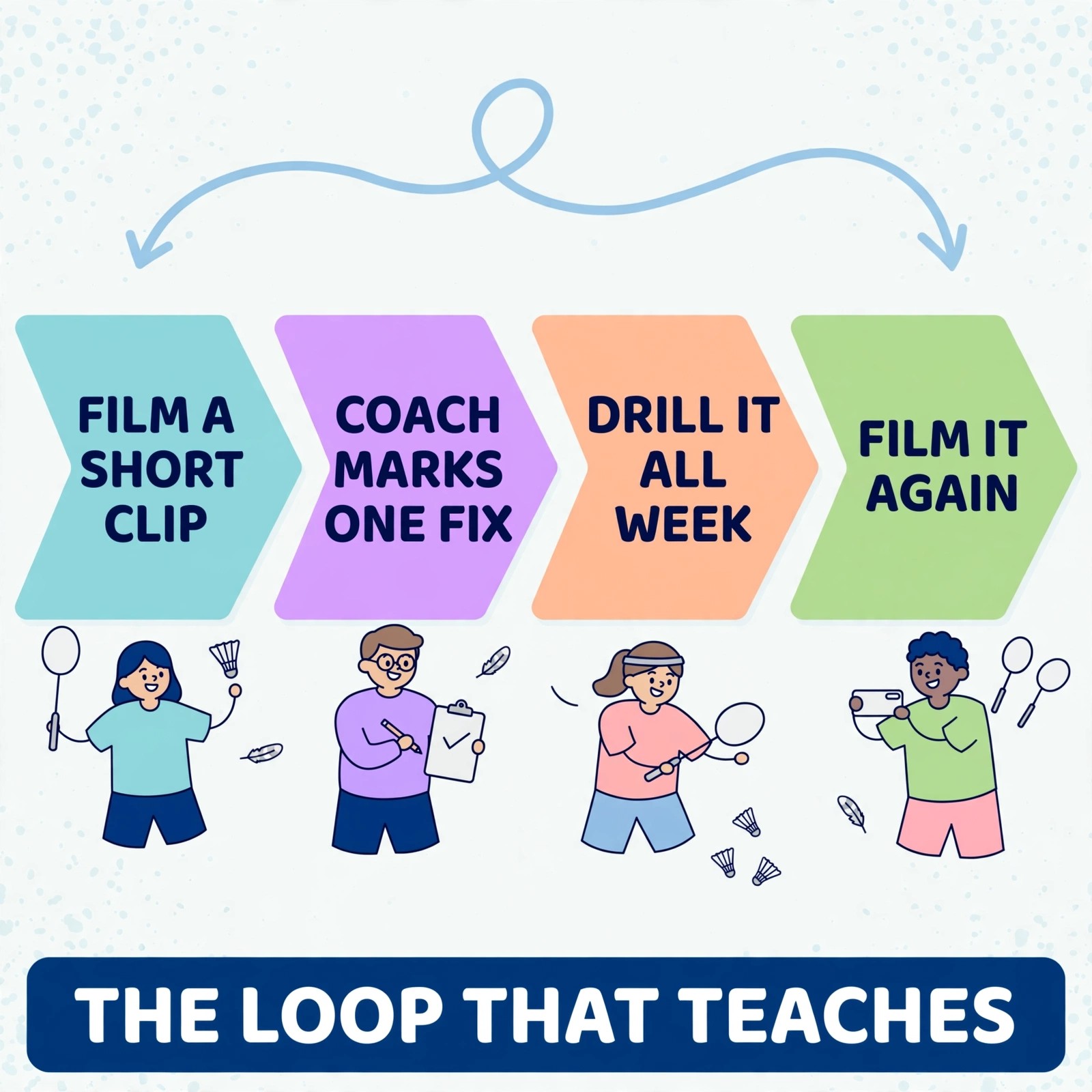
Feedback Check #3
Film It Properly: Camera, Clips and Honesty
Where you put the camera decides what the coach can see. For footwork and court position, place the phone behind your court, slightly above head height if you can, so the whole court and your recovery paths are in frame. For swing shape and contact point, a side view at net height shows what a back view hides. Either way, keep your whole body and the shuttle in frame for the whole clip, and steady the phone: on a tripod if you have one, on your kit bag if you do not. A wobbling clip of half a player is a puzzle, not evidence.
Film honest badminton. The clip that helps you is a normal rally at normal speed, including the shots that miss, the corners you reach late, and the serves that hit the tape. A showreel of your ten best shots tells a coach nothing except that you can edit. Label every clip before you send it: the date, the drill or the match, and the one thing you were working on. Labels turn a folder of videos into a record, and records are what progress is measured from, months later, when memory has started flattering you.
Short clips beat long ones. Thirty to ninety seconds of one drill is plenty for a coach to mark, and several short clips teach more than one full match video that nobody has time to study frame by frame. Send the originals, not compressed copies, when you can, so the coach can pause on a clear frame. Keep every clip you send, in order, in one folder. The comparison between this month’s clip and the one from three months ago is the most honest progress report in your badminton life.

Feedback Check #4
Between Check-Ins: Turning Notes Into Practice
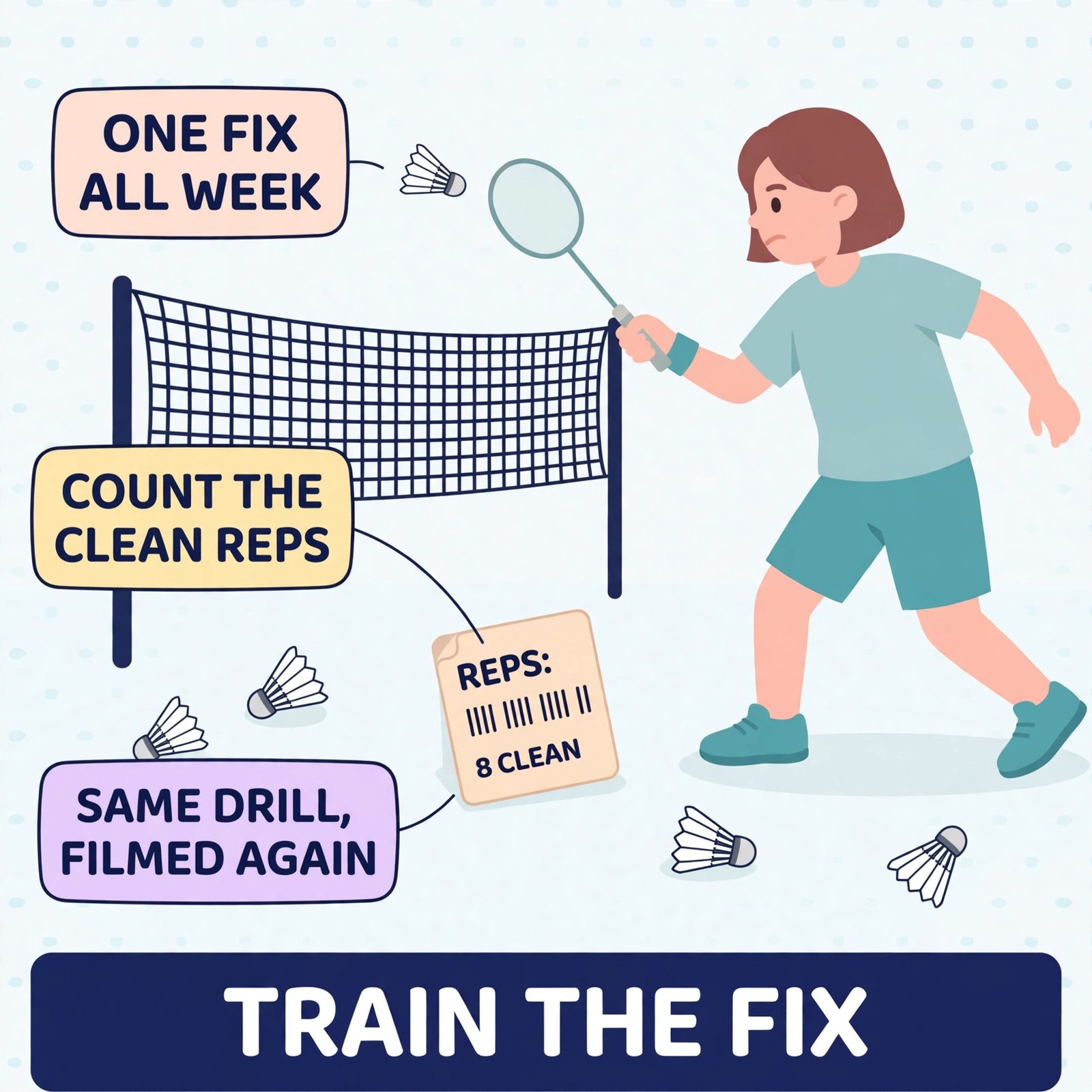
The week between check-ins is where online coaching is won or lost, and it runs on the fix, not on the video. Build the week around it: a short drill block on the fix at the start of every session, while you are fresh, then a conditioned game that tests it under a little pressure. Write down the counts: how many clean repetitions, out of how many attempts. Feelings about a session are weather. Counts are data, and data is what the next clip gets judged against.
Progress in the loop is measured, not felt. Once a month, film the same drill, from the same camera position, at the same target. Put the two clips side by side. Is the thumb still on the racket? Are the feet arriving earlier? Did the count of clean repetitions climb? Side by side clips end arguments that feelings start, and they protect motivation better than any speech, because a player who can watch their own fault shrinking rarely needs to be talked into the next week of work.
Ask better questions. A clip sent with ‘please check my game’ gets a general answer. A clip sent with one specific question, ‘why does my clear fall short when I am moving backwards’, points the coach at the problem you actually feel, and the answer comes back fitted to your game instead of generic. Players who learn to ask specific questions improve faster with the same coach, the same clips and the same hours. The question is part of the training. Treat it that way.
The Honest Limits
What a Screen Cannot Do
Now the honest limits, because a coach who hides them is selling something. Remote coaching cannot feed you shuttles at the pace that stretches you, and feeding is where many fixes are actually built. It cannot stand across the net as an opponent who reads you back. It cannot watch your partner play, your positioning in a live doubles rally from every angle, or correct you in the half second before a fault happens. One camera gives one angle. A court gives a coach all of them, plus a voice in real time.
So the strongest setup is a blend, and it is the one most of our players end up using. Online review supplies the eye and the plan: the fault named, the drill set, the week kept honest. Court time supplies the rest: feeding at your edge, real opponents, live correction, and pressure. The clip keeps your solo practice pointed at the right fault between sessions, so no week of training is spent polishing the wrong thing. Each half covers the other’s weakness, which is more than either can claim alone.
Choose an online coach the way you would choose one in person. Check that they coach real players at your level, not only audiences. Ask how feedback comes back: marked clips, written notes, a call, and how many of your clips they will actually watch. Agree the rhythm before you start: how often you send, how fast you hear back, and what one fix at a time means in practice. And be careful with anyone whose offer is only a library of videos with no eyes on your game at all. That is content. Content is fine, but it is not coaching, and it should not be priced as if it were.

Myth vs Reality
Myths About Online Coaching
Myth: “Watching professional videos is the same as being coached.” Reality: a video shows you the professional’s game, in the professional’s body, with the professional’s problems. Coaching starts when somebody watches your game and answers it. The two feel similar on a screen and do opposite things to your faults: one entertains them, the other names them.
Myth: “The more clips I send, the faster I improve.” Reality: improvement follows the fix you grooved, not the number of faults you collected. One fix trained for a week beats ten faults noted in a day. Myth: “I need an expensive camera setup.” Reality: you need a phone, a steady place to put it, and honest rallies. The camera you already own is good enough to be coached from.
Myth: “Online coaching can replace court coaching completely.” Reality: it sharpens the plan between sessions, but feeding, opponents and live pressure still live on a court. Myth: “A good coach praises everything.” Reality: a good coach is kind and specific, and the specific part sometimes says your grip is wrong. Praise that hides faults is not kindness. It is a delay.

Why Choose Us
Coaching With a Camera, Checked by a Coach
At ST Badminton Academy KL, video review is built into the way our small group classes work, capped at max 4 students. Coaches film short clips during sessions and go through them with the player on the spot: the grip at contact, the feet at the corner, shown frame by frame, then corrected live in the next drill. Players also send clips from their own practice between sessions, and the same loop runs: one fix, one drill, film it again.
Mr Eric Chuar has over 15 years of coaching experience in Singapore and Malaysia. His rule for video is simple: the fault you can see is the fault you can fix, so show it early and show it honestly. He marks clips the way he corrects on court, small causes first, one fix at a time, and he checks the next clip against the last one rather than against an opinion. Progress, in his reviews, is something you can watch.
Our academy is based in Setapak, Kuala Lumpur, convenient for players from Wangsa Maju, Melati Utama, Danau Kota and Gombak. If you practise often but improve slowly, bring a recent clip of your game to a session, the honest kind, faults included. We will show you what a coach sees in it, and which single fix your next month of practice should be built around.
FAQs: Online Badminton Coaching in Malaysia (KL)
These are the questions players ask us most about online coaching and video feedback in Malaysia. If your question is not here, message us, tell us how you practise now and what feels stuck, and we will give you a straight answer about where the loop should start.
How can online coaching help my game if I live in Setapak or Gombak?
By putting a coach’s eye on the practice you already do. You film short, honest clips, the coach marks the one fault that matters, and you train that fix between check-ins. Players near our Setapak base often blend it with court sessions, so the fix is also corrected live.
What matters most in online badminton coaching in KL?
The loop, not the library. Film, get one specific fix with a drill and a count, train it, film the same drill again. Coaching that only sends you more videos to watch is content, not coaching. The change happens when someone watches your shots and answers your game.
How often should I send training clips to my coach to keep raising my level?
A steady rhythm beats a flood: one or two short clips a week, each with one question, is plenty for most players. That gives you time to train the fix properly before the next review. In our classes the same rhythm runs inside the week between sessions.
I practise alone and keep repeating the same faults. How does video feedback actually change that?
Because you cannot see yourself, a fault feels like your normal technique. A marked clip shows you the exact frame: the grip at contact, the feet at the corner. Once you can see it, the drill makes sense, and the next clip proves whether the pattern actually changed.
What should I look for in an online coaching programme before I enter?
Check three things: the coach works with real players at your level, feedback is given on your clips rather than generic videos, and the rhythm is clear: how many clips, how often, one fix at a time. If a programme promises rankings or instant results, keep looking.
Do you use video review in classes near Wangsa Maju?
Yes. Video review is part of regular group classes at our Setapak base, a short trip from Wangsa Maju. Coaches film short clips during sessions and go through them with you on the spot, in small groups of max 4 students, then correct the same fault live on court.
Can online feedback fit around my regular court sessions in Malaysia?
That is exactly where it works best. Online feedback sets the plan and keeps the week honest; court sessions give you feeding, opponents and live correction. Many players send clips from their own practice between weekly classes, so no session starts from zero or repeats a hidden fault.
Where is ST Badminton Academy KL located for in-person training?
We are based in Setapak, Kuala Lumpur, close to Wangsa Maju, Melati Utama, Danau Kota and Gombak. Sessions run in small groups of max 4 students. Message us for the current class schedule, and bring a recent clip of your game if you would like it reviewed.
What makes Mr Eric Chuar a suitable coach for video based badminton?
Fifteen years of coaching in Singapore and Malaysia, and a simple order of work: the fault you can see first gets fixed first. Eric marks clips frame by frame, sets one drill with a count, and checks the next clip against the last, inside small groups and reviews alike.
Online Badminton Coaching in Action


What It Takes to Improve on Camera
A player meets our online coaching standard when five habits hold: clips are filmed honestly with the whole body in frame, one fix is trained at a time until it holds, repetitions are counted rather than felt, comparison clips are kept and reviewed monthly, and every clip arrives with one specific question. When those five hold, practice has an eye on it.
| Factor | Watching Videos | Being Coached LOOP |
|---|---|---|
| Frequency | 1 or 2 times a week. Mostly for fun and sweat. | Before the session, the player films honest clips of real practice and sends them with one specific question. |
| Drills Focus | Basic static feeding. Minimal footwork pressure. | During the review, the coach marks the exact frames, names the one fault that matters most, and sets a drill with a count to reach. |
| Physical Conditioning | Rarely included. Just playing games on court. | Core, agility, and speed training included in every session to prevent injury and build stamina. |
| Tactical Awareness | "Just hit it over." No real game plan. | Video analysis, point construction, and learning to read the opponent's game. |
| Coach Ratio | Large groups (8-10 kids). Coach barely watches you. | Max 4 students. Mr Eric Chuar personally corrects every stroke and movement detail. |
| Goal Setting | Fun and exercise. | Between check-ins, the player trains that one fix, counts clean repetitions, and films the same drill again for comparison. |
| Long Term Result | Good recreational player. | A player whose practice has an eye on it: faults named early, fixes measured, and progress you can watch side by side. |
Online Badminton Coaching in Kuala Lumpur
This page covered online badminton coaching as a feedback loop: why solo practice plateaus when nobody can see your faults, the four steps of film, mark, fix and film again, how to film clips a coach can actually use, how the week between check-ins should run, and the honest limits of a screen, with court time completing the picture. Send us an honest clip, and let us show you your next fix.






