Improve Your Badminton Drives And Pushes With Expert Tips (Drives and Pushes Guide)
Some rallies are won slowly, with clears and patience. Others are won in two seconds of flat, fast exchanges at the front and middle of the court. Drives and pushes are the shots that win those exchanges. A drive flies flat and fast, just over the tape. A push is its softer partner, sending the shuttle past the front player into open space. This guide covers badminton drives and pushes the way we coach them at ST Badminton Academy in Setapak, Kuala Lumpur: what each shot is, the grips behind them, how to be ready, the short swing that makes them quick, and how to use them in real rallies.

Flat Game Check #1
Two Flat Shots That Run the Mid-Court?
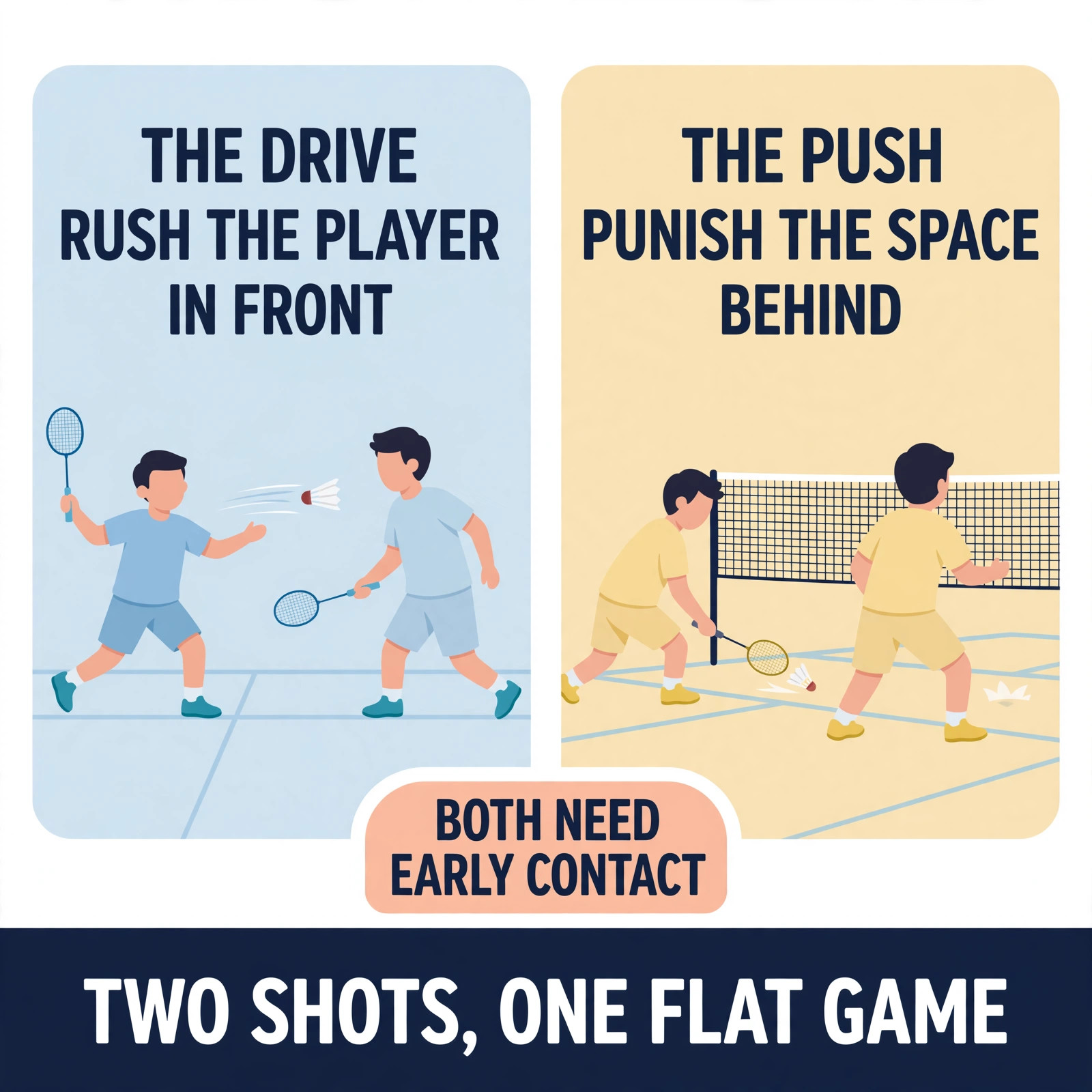
A drive is a flat attacking shot. It travels parallel to the floor, skims just over the net tape, and arrives before your opponent has finished recovering from their last shot. That is its whole job: to take time away. Drives live mostly in doubles, where the flat game decides who attacks, but they matter in singles too, whenever a loose shot sits up at mid court and begs to be driven flat at the body instead of lifted away.
A push looks similar and feels different. It is played from the front or mid court with a softer hand, pushing the shuttle flat past the front player or into the open mid court corners. Where the drive rushes the opponent in front of you, the push punishes the space behind them. Together, drives and pushes form the flat game, and the flat game is where fast rallies are controlled. Both shots share one demand: early contact, in front of the body, before the shuttle drops.
Flat Game Check #2
The Grip Behind Every Drive and Push
The forehand drive starts with a normal forehand grip, held properly. The base knuckle of your index finger sits on the wide bevel of the handle, your fingers wrap with a small gap between palm and grip, and the whole hand stays relaxed. That relaxed hand is not a detail. Finger power, the small squeeze at contact that snaps the racket head through, only exists when the fingers were loose a moment before. A grip held tight from the start has nothing left to give at contact.
The backhand drive and the backhand push use the other grip. Turn the racket so your thumb presses flat against the wide side of the handle, supporting the back of the racket as it faces the shuttle. That thumb support is what steers a backhand drive flat instead of letting it float, and it gives a backhand push its direction into the corners. If your backhand flat shots spray wide or climb into a smash invitation, check the thumb first. It is the most common fault we fix in this part of the game.
Between the two grips sits the real skill: changing. Fast exchanges do not give you time to look at your hand. The change has to happen inside the movement, fingers rolling the handle as you step, so the right grip is already set when the shuttle arrives. Keep the fingers loose enough to roll the grip and firm enough at contact to control the face. Practise the swap in shadow swings first, on a coach call, eyes up, until your hand changes grips the way your feet change direction: without being asked.

Flat Game Check #3
Be Ready Before the Shuttle Arrives
Flat shots are won before the swing, by where you stand. For drives, set up side-on to the net, feet about shoulder width apart, knees soft, weight slightly forward on the balls of your feet. From that stance you can step into a forehand drive or turn for a backhand without a wasted first movement. Players who stand square and flat-footed can still hit drives, but they hit them reaching, and a drive played while reaching loses its flat line and its sting.
The ready position matters just as much. In the flat game your racket lives up in front of your body between shots, head around net height, ready to meet the next shuttle early. Watch a player whose racket drops to their side after every shot: their next drive starts late, from below the shuttle, and floats. Racket up is a habit, not a technique. It feels like effort for two weeks, then it just becomes where your racket waits.
Contact position finishes the preparation. Meet the shuttle in front of your body, as high as the rally allows, stepping in with your racket leg as you strike. Contact in front keeps the shuttle flat, because the racket face can stay firm and level. Contact beside or behind your body forces the face open, and open faces send shuttles up. Most weak drives are not weak swings. They are good swings played from a contact point that was already beaten.

Flat Game Check #4
A Short Swing Beats a Wild One
Forget the big swing. A drive uses a short backswing, a rotation of the forearm, and that finger squeeze at contact. The stroke is compact because the flat game gives you no time for anything longer, and compact because power here comes from timing, not from arm size. A short swing played early beats a huge swing played late, every single rally. When coaches say a player has fast hands, this short, early, repeatable stroke is what they mean.
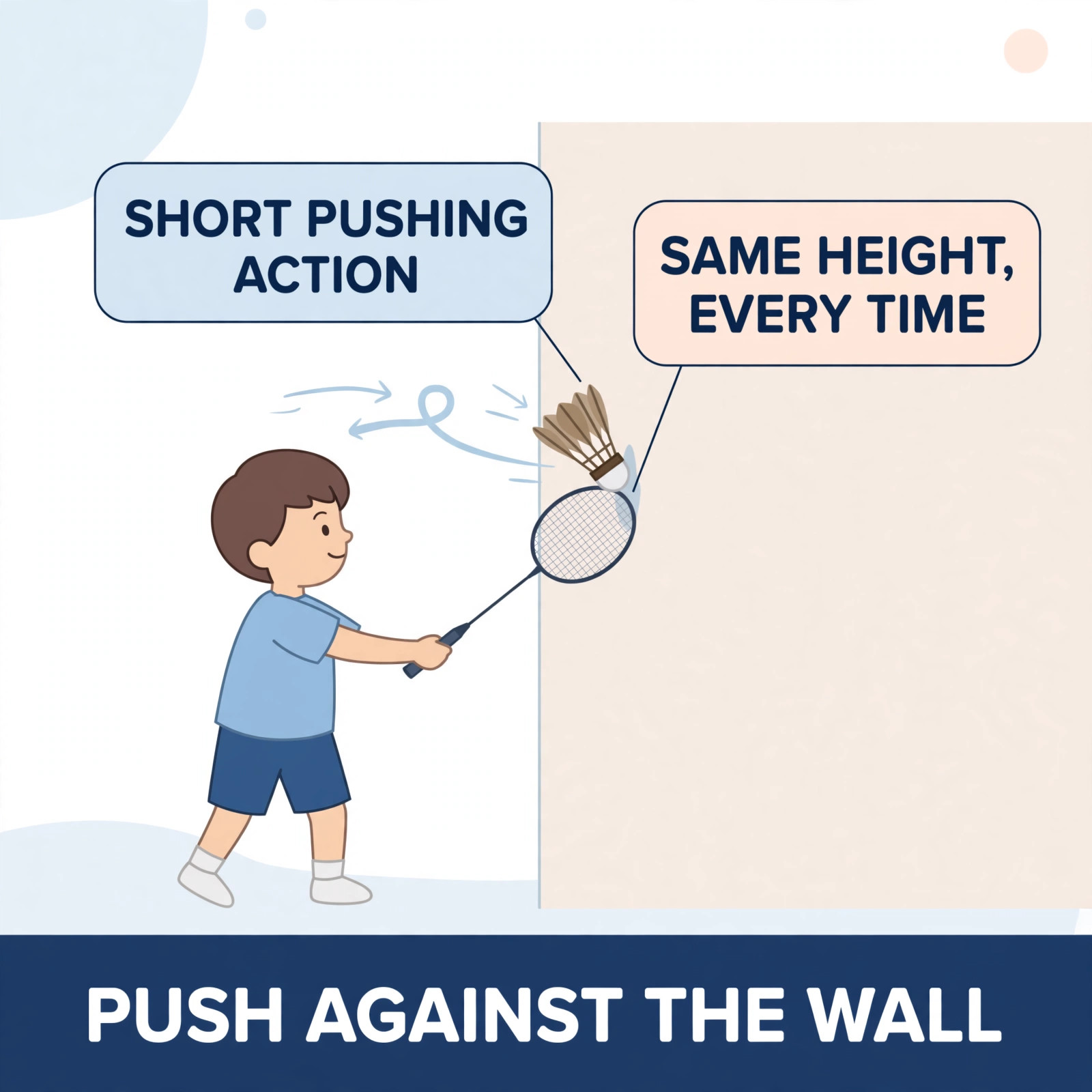
Follow-through follows the same logic. A drive needs a short follow-through that stops with the racket still in front of you, ready for the reply. A long follow-through across the body may look athletic, but in a flat exchange it costs you the next shot, and the next shot is usually the one that decides the rally. The push goes further: it is played with almost no swing at all, a guiding push of the racket head through the shuttle, all control and placement.
Hand speed is trained, not born. Reaction feeding, where a coach fires shuttles flat at you with little warning, teaches your grip changes and short swing to happen on their own. Multi-shuttle flat exchanges do the same under rising pressure. Keep the sets short and stop before your form falls apart, because tired repetitions teach slow habits. Ten sharp minutes of flat feeding inside a normal session will move your drives further than an hour of loose rallying.

The Flat Exchange
Drives and Pushes in Real Rallies
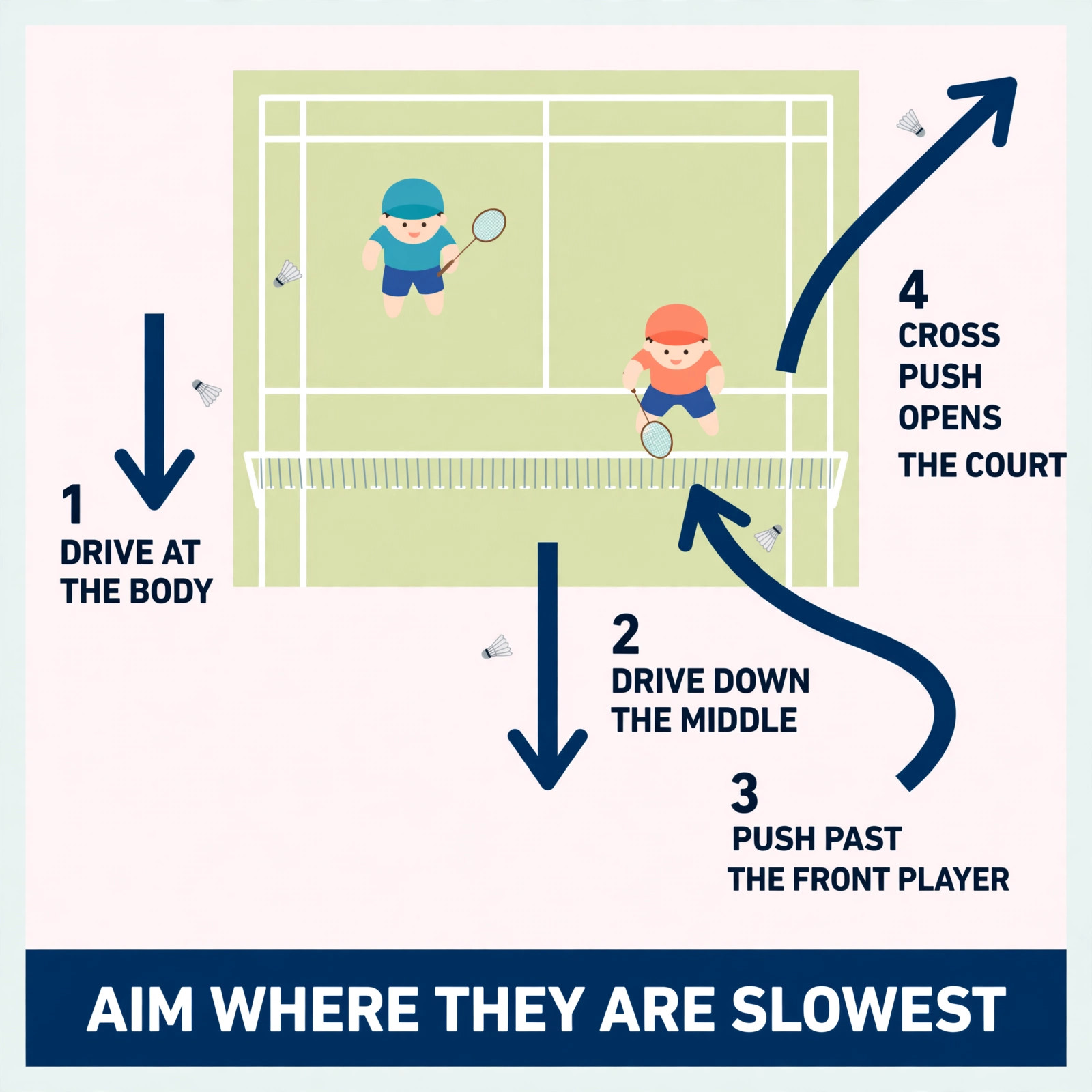
In a rally, reach for the drive when the shuttle sits up and your opponent is still moving. Drive at the player who has just played a shot and is resetting their feet. Drive at the body to jam a tall player. In doubles, drive down the middle when the pair in front of you has not agreed who takes it. The drive is a question asked at speed. Aim it where the answer is slowest, and be ready for the reply, because a good drive often comes straight back.
Reach for the push when the front player crowds the net. A soft, flat push past them into the mid court turns their pressure into a problem for their partner. In singles, push from the net when your opponent expects another net shot and is leaning forward: the shuttle slides past their racket into space they have already left. Cross-court pushes open the widest space of all, but they cross the lowest part of your margin, so earn them with good position first.
Then combine the two. Drive first to rush them, push next when they lean in to block the drive. Drive twice straight, push the third one cross. Small patterns like these, agreed with yourself before the rally, keep your flat game a plan instead of a panic. And after every flat shot, recover: racket up, feet reset, eyes on their racket. The flat game rewards the player who is ready second, not only the player who was fast first.
Myth vs Reality
Myths About Flat Shots
Myth: “A drive is just hitting the shuttle hard.” Reality: hard and high is a gift. A drive earns its points by being flat and early, arriving before the opponent is set. A medium-paced drive played flat over the tape beats a full-power drive that rises into the smash zone. If your drives keep getting smashed, the problem is usually height and contact, not power.
Myth: “You need a long follow-through to hit powerful flat shots.” Reality: in the flat game, a long follow-through is a slow recovery. The points are won by the short swing and the fast reset. Myth: “The push is a soft, defensive shot.” Reality: a push played past the front player is an attacking shot that wins the mid court. Soft hands, attacking idea.
Myth: “A stiffer, heavier racket will fix a weak drive.” Reality: equipment only helps a sound swing. A head-heavy racket in 3U or 4U can add punch once your contact is early, and lighter setups help some players change grips faster, but no racket fixes contact that happens behind your body. Fix the contact first, then choose gear that suits the swing you actually own.

Why Choose Us
Flat Game Skills, Coached Rep by Rep
At ST Badminton Academy KL, drives and pushes are coached inside small group classes capped at max 4 students. That size matters for flat work: the coach can stand at the net and feed shuttles flat at your exact speed, watch your grip change as you move, and stop the exchange the moment your contact point drifts. Flat skills grow quickly when every repetition is checked.
Mr Eric Chuar has over 15 years of coaching experience in Singapore and Malaysia. His flat game rule is the one this page is built on: contact first, power later. Within the first few feeds he can see whether your drive problem is the grip, the ready position or the contact point, and he fixes one thing at a time, testing each fix at a faster feed before moving on.
Our academy is based in Setapak, Kuala Lumpur, convenient for players from Wangsa Maju, Melati Utama, Danau Kota and Gombak. If your drives keep floating, your pushes keep finding the front player’s racket, or fast exchanges feel like they happen to you instead of with you, bring your flat game to a session. Ten minutes of honest feeding will show us exactly what to fix.
FAQs: Badminton Drives and Pushes in Malaysia (KL)
These are the questions players ask us most about drives, pushes and the flat game in Malaysia. If your question is not here, message us, tell us which flat shot breaks down and when it breaks, and we will give you a straight answer about what to check first.
How can I improve my drives and pushes if I live in Setapak or Gombak?
Start with the contact point. In our Setapak classes, the coach feeds flat at a speed you can handle, checks your grip and where you meet the shuttle, then raises the pace step by step. Short sets inside small groups of max 4 students fix drives and pushes faster than long, tired drills.
What is the difference between a drive and a push in KL?
A drive travels flat and fast, just over the tape, to rush your opponent. A push is softer: it sends the shuttle past the front player into open mid court space. Learn the forehand drive first, because its grip and early contact carry into every other flat shot you will play.
How often should I practise drives and pushes to improve at a steady level?
Short flat sets inside your normal sessions work best: ten to fifteen minutes of drives and pushes, two or three times a week. Keep the feed fast but controlled, rest before your form drops, and test the shots in real exchanges at the end of each session.
Can a school player learn drives and pushes while still in school?
Yes. Drives and pushes suit school players well, because the habits are simple: racket up, contact in front, short swing. Coaches keep the feed controlled while the grip change becomes automatic, then add speed and movement in small steps, so the flat game still works when school matches get quick.
Which flat shot should I test first in a match I enter?
Test the forehand drive first, played flat at the body of the player in front of you. It appears in almost every fast exchange. Once it stays flat under pressure, add the backhand drive, then the push past the front player, which needs the same early contact and a softer hand.
Do you coach drives and pushes in classes near Wangsa Maju?
Yes. ST Badminton Academy KL is based in Setapak, a short drive from Wangsa Maju, Melati Utama and Danau Kota. Groups are capped at max 4 students, so the coach can feed flat at your speed, watch your grip change, and correct your contact while the exchange is live.
Does your academy teach the flat game and quick exchanges in Malaysia?
Yes. The flat game is a set routine at ST Badminton Academy in Malaysia: grip checks first, then contact point, then feeding at rising speed, then live exchanges. Drives and pushes are trained inside normal sessions, because flat shots appear in almost every rally our students play.
Where is ST Badminton Academy KL located for drives and pushes training?
ST Badminton Academy KL is based in Setapak, Kuala Lumpur, where flat game work happens inside small group classes of max 4 students. The academy is convenient for players from Gombak, Air Panas, Sentul, Jalan Genting Klang and Ampang. Message us before your first session and we will confirm the venue details.
What makes Mr Eric Chuar a suitable coach for drives, pushes and badminton?
Mr Eric Chuar has over 15 years of coaching experience in Singapore and Malaysia. His flat game rule is simple: contact first, power later. He checks where you meet the shuttle within the first few feeds, then builds your hand speed on top of a contact point that already works.
Badminton Drives and Pushes in Action


What It Takes to Own the Flat Game
A player meets our flat game standard when five habits hold: the racket is up between shots, contact happens in front of the body, drives travel flat over the tape, pushes are placed past the front player with control, and the recovery starts before the player watches the shot. Our flat game standards below are the checkpoints our coaches use.
| Factor | Wild Swinging | Compact Flat Game FLAT |
|---|---|---|
| Frequency | 1 or 2 times a week. Mostly for fun and sweat. | Short backswing and early contact: the shuttle stays flat and arrives before the opponent is set. |
| Drills Focus | Basic static feeding. Minimal footwork pressure. | Racket up and ready between shots, so every exchange starts from the same calm position. |
| Physical Conditioning | Rarely included. Just playing games on court. | Core, agility, and speed training included in every session to prevent injury and build stamina. |
| Tactical Awareness | "Just hit it over." No real game plan. | Video analysis, point construction, and learning to read the opponent's game. |
| Coach Ratio | Large groups (8-10 kids). Coach barely watches you. | Max 4 students. Mr Eric Chuar personally corrects every stroke and movement detail. |
| Goal Setting | Fun and exercise. | Simple weekly targets: contact in front, flat over the tape, recover for the next shot. |
| Long Term Result | Good recreational player. | A player who wins the fast exchanges, because the flat game was built one calm rep at a time. |
Badminton Drives and Pushes in Kuala Lumpur
This page covered badminton drives and pushes: the difference between the two shots, the grips and thumb support behind them, ready position and early contact, the short swing and short follow-through, and how to combine both shots in real rallies. ST Badminton Academy KL coaches the flat game in small group classes of max 4 students in Setapak. If you are in Wangsa Maju, Gombak, Cheras or nearby, contact us today.






