Badminton Coaching For Beginners (Beginner Guide)
Starting badminton looks simple from the sidelines: one racket, one shuttle, hit it over the net. Then a total beginner steps on court and finds out the shuttle rarely goes where it is aimed. Badminton coaching for beginners exists to close that gap quickly and safely. This guide explains what new players in Kuala Lumpur actually learn in their first months: the grip, the ready position, the basic shots, footwork patterns, and the rules and scoring that make games make sense.
At ST Badminton Academy Malaysia in Setapak, head coach Mr Eric Chuar teaches beginners in small groups of max 4 students, so every grip and every step gets seen and corrected from the very first session.

Beginner Check #1
Can You Learn Badminton Properly Without a Coach?
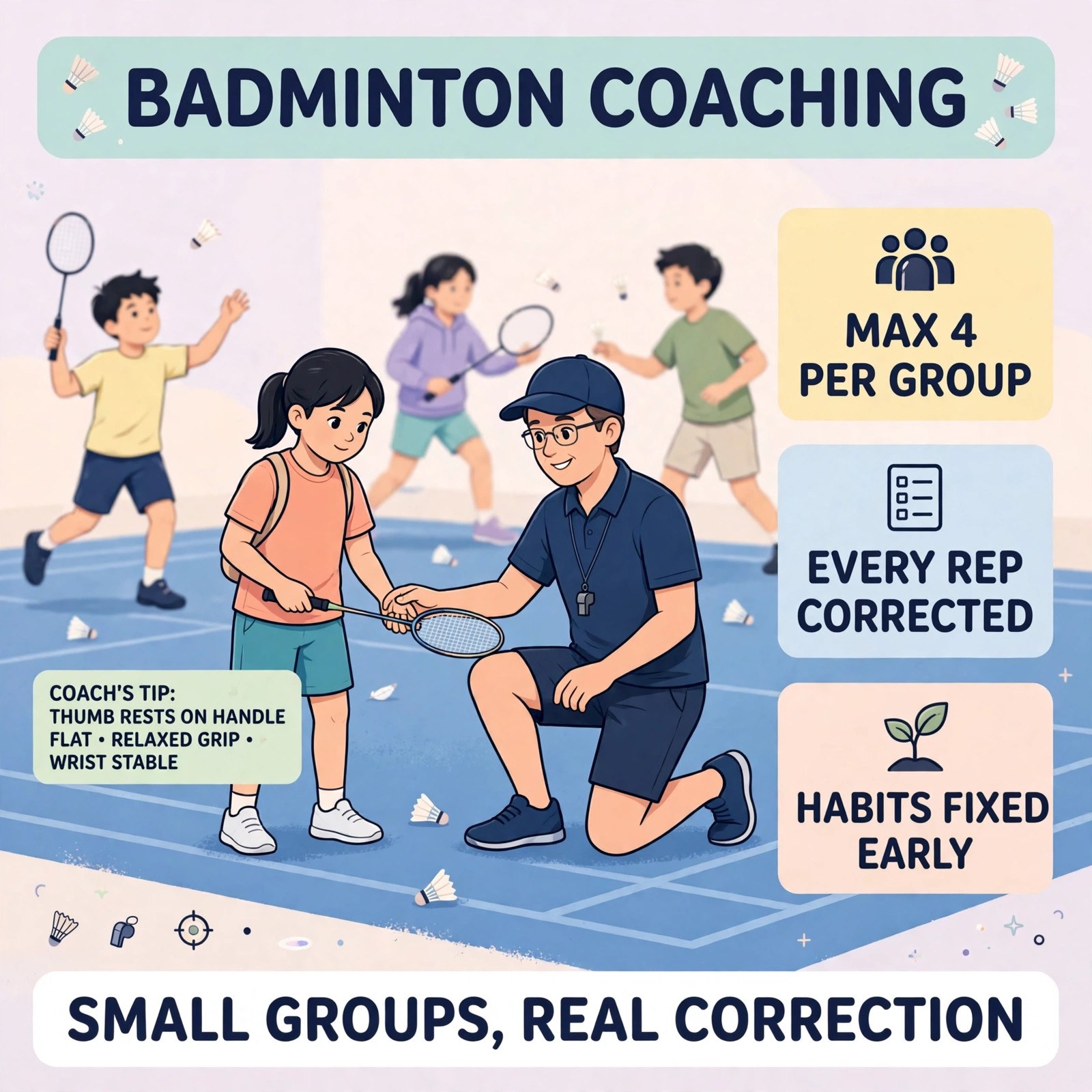
You can pick up the rough shape of badminton from videos and social games, and many players do. The problem is what you cannot see on yourself. A thumb placed wrong for the backhand, a grip held like a frying pan, feet crossing over on the way to the net, these small faults feel normal to the player doing them. Left alone for a year, they become habits that are slow and painful to undo. A coach standing two metres away spots them in the first ten minutes.
Coaching also gives your practice an order. On your own, it is tempting to spend every session smashing, because smashing is fun. A beginner program builds the shots in the order the game needs them: reliable clears and lifts first, then net play and defence, with power added once the movement is tidy. Players in our badminton coaching for beginners program in Kuala Lumpur usually feel the difference within a month, rallies last longer, and the shuttle starts going where they aim it.
Beginner Check #2
What Should Beginners Learn In the First Months?
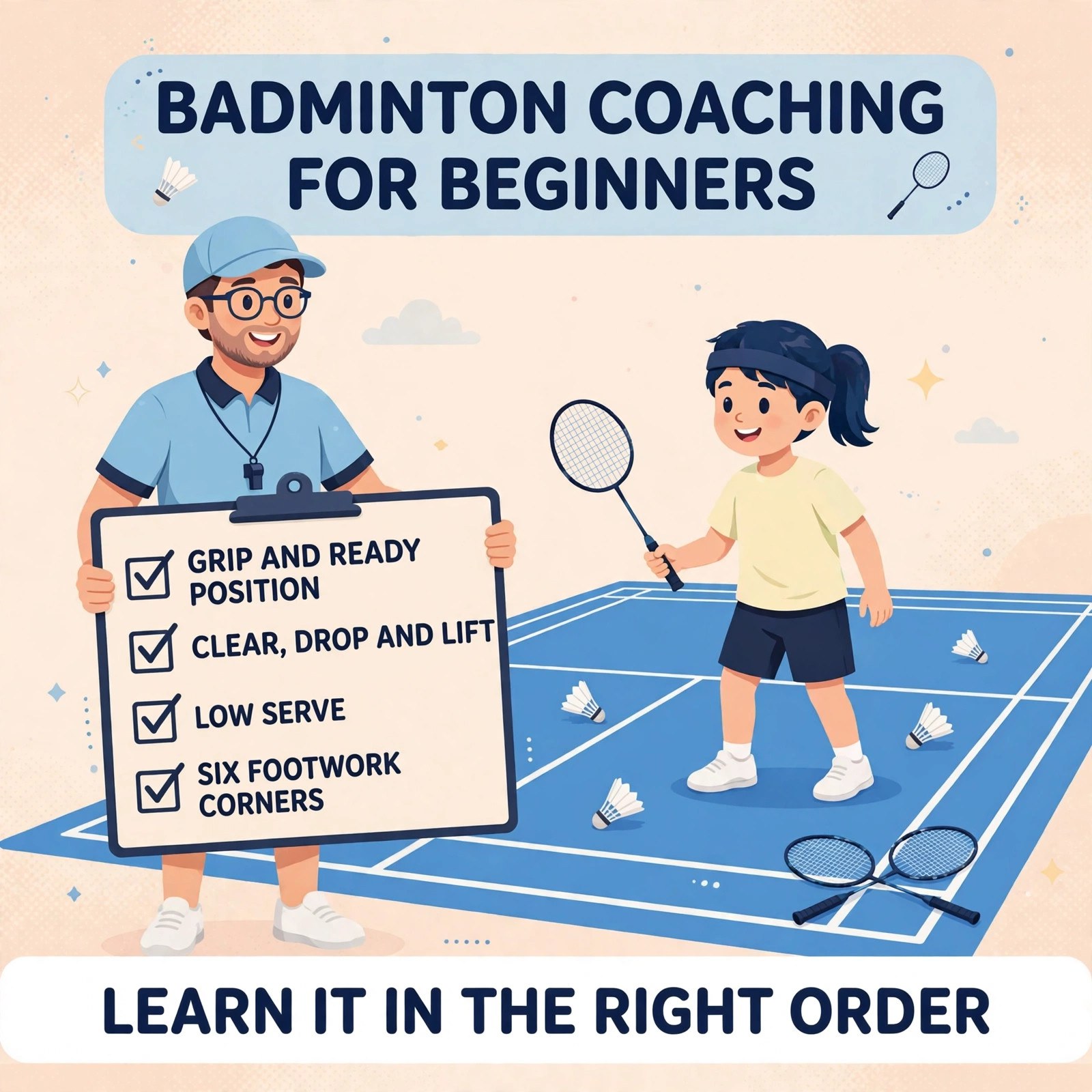
The first thing we fix is the grip. Most beginners hold the racket like a hammer, with the palm wrapped tight around the handle. Badminton grip is closer to a handshake: relaxed fingers, thumb and index finger doing most of the work, and small grip changes between forehand and backhand shots. From there we set the ready position, knees soft, weight forward, racket up in front, because every shot in badminton starts from being ready early.
Then come the core shots. The clear sends the shuttle high and deep to the back of the court. The lift does the same job from the front when you are under pressure. The drop shot brings your opponent forward, and the net shot keeps the shuttle tight and low at the front. The low serve starts most rallies in singles and doubles, so beginners learn it early and practise it every session. Drives and smashes join in later, once the basics hold together.
Equipment for the first months stays simple. A light racket with a flexible or medium shaft is forgiving while strokes are still forming, and proper non-marking court shoes protect your ankles far better than running shoes. Shuttles, court time and a water bottle complete the starter kit. Our coaches in Setapak are happy to check a beginner’s racket and shoes before money gets spent on the wrong gear.

Beginner Check #3
Why Footwork Comes Before Fancy Shots?
Ask any coach what separates a beginner who improves from one who stays stuck, and the answer is footwork. Badminton is played in six corners: front left and right, both sides, and both back corners. If your feet arrive late, even a good stroke falls apart, you reach, lean, and push the shuttle anywhere. If your feet arrive early and balanced, the same stroke suddenly looks easy. That is why beginner coaching spends so much time on movement before power.
The patterns are simple to learn step by step. A small split step as your opponent hits. Side steps and chasse steps across the middle. A long lunge at the net with the racket leg leading. Then the recovery back to base position, ready for the next shot. One rule our coaches repeat in every session in Kuala Lumpur: never cross your legs when you move, because crossed legs cannot change direction quickly.
Footwork practice does not need a shuttle at all. Shadow movement to the six corners, short side shuffles and cone drills build speed and balance, and beginners can repeat them at home between sessions. Ten quiet minutes of shadow footwork a few times a week does more for a new player’s game than an extra hour of casual hitting.

Beginner Check #4
What Are the Basic Rules, Scoring and Positions?
Badminton uses rally scoring: every rally wins a point, whether you served or not. A game goes to 21 points, and a match is the best of three games. If the score reaches 20-all, play continues until one side leads by two points, with a hard cap at 30. Knowing this stops the confusion many beginners feel when the other player seems to score. The server keeps serving while they keep winning rallies.
The lines matter too. In singles, the court is long and narrow: the back tramline counts, the side tramlines do not. In doubles the court is wider but shorter at the back, and the serve must land in the short, wide service box. The serve itself must travel upwards from below the fixed service height, which is why the low serve is such a useful beginner skill. Faults are simple: shuttle into the net, out of the lines, or hit twice.
Court positioning ties the rules to real play. In singles you return to a base near the middle after every shot. In doubles, partners work as a pair: side by side when defending, front and back when attacking. Beginners who understand where to stand stop colliding with partners and stop leaving big open spaces. Parents watching from Setapak, Gombak and Sentul often tell us the game finally makes sense once their child learns positioning.

The Sessions
What Happens in Beginner Coaching Sessions?
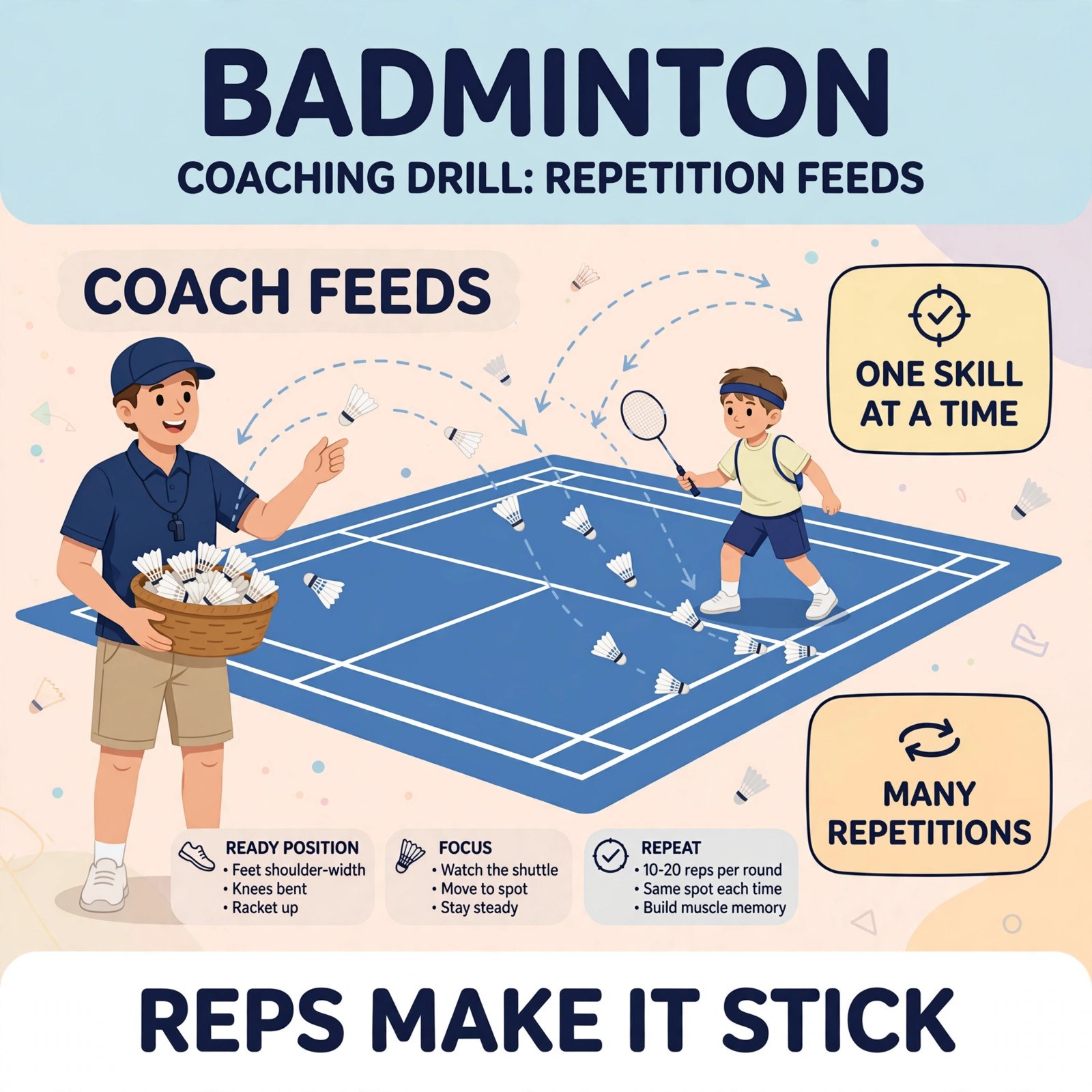
A beginner coaching session at our academy runs for about two hours and follows a steady rhythm. We start with a warm-up and movement work so ankles, knees and shoulders are ready. Then comes the main teaching block: one skill at a time, shown slowly by the coach, practised with feeding drills, and corrected rep by rep. A typical early focus might be the forehand clear, broken into grip, swing path, contact point and recovery.
Serves get their own practice slot, because every rally starts with one. Beginners learn the low serve for control, the high serve for singles depth, and later the flick serve as a surprise option. Practice drills rotate through forehand and backhand work, serve-and-return games, and footwork circuits, so no session is only one thing. The mix keeps new players fresh while the basics get the repetitions they need.
Sessions end with short conditioned games: real rallies, but with one rule added, such as scoring only when a point is won with a clear, or playing everything to the back court. This is where drilled skills meet real decisions. Coaches in our Kuala Lumpur program use these games to see what holds under pressure and what needs one more week of drilling.

Myth vs Reality
Myths About Learning Badminton as a Beginner
Myth: “Beginners should hit every shot as hard as they can.” Reality: Power without control just sends the shuttle out or into the net. In beginner badminton, accuracy is the first scoreboard skill: a clear that lands near the back line beats a wild smash that flies long. Speed and power grow naturally once timing and technique are in place.
Myth: “Playing more matches is the fastest way to learn.” Reality: Matches repeat whatever technique you already have, including the faults. A beginner who only plays games practises their mistakes at full speed. Myth: “I am too old, or my child is too young, to start learning properly.”
Reality: Beginners improve fastest with a mix, coached drills to build correct movement, then games to use it. Children as young as four and adults picking up a racket for the first time both progress well when the basics are taught in order. Students in our badminton coaching KL program are grouped by level, so new players are never thrown in against advanced juniors.
Why Choose Us
Beginner Coaching That Fixes Habits Early
ST Badminton Academy Malaysia is a coaching academy in Setapak built around small groups: max 4 students per group, always. For beginners this matters more than anything else. In a group of fifteen, a coach sees your grip once a session if you are lucky. In a group of four, head coach Mr Eric Chuar, who has over 15 years of coaching experience in Singapore and Malaysia, watches your grip, feet and swing in every drill and fixes faults while they are still small.
Beginner plans are personal. A nine-year-old starting from zero, a teenager moving up from school badminton, and an adult playing for fitness do not need the same first ten sessions. We assess every new student in their first session, set the first targets together, steady clears, a reliable low serve, tidy six-corner footwork, and build from there. Parents get honest feedback on progress, not sales talk.
We also keep the setting friendly. Beginners improve fastest when they are not embarrassed to miss. Our groups mix hard work with plenty of encouragement, and new players are grouped with others at a similar level. If you live in Setapak, Wangsa Maju, Gombak or nearby and want to start badminton the right way, bring your racket, or borrow our advice on buying one, and come for a first session.
FAQs: Badminton Coaching for Beginners in Malaysia (KL)
Here are answers to common questions from parents, students and adult beginners in Kuala Lumpur about starting badminton coaching.
What is the best way for a beginner to improve at badminton in KL?
Practise one skill at a time, with a coach watching. Focus on grip, footwork and one stroke until they feel steady, then move on. Coached sessions once or twice a week, plus short practice between sessions, beat long random hitting. The right beginner racket and proper court shoes also help more than most new players expect.
How often should a beginner practise badminton each week in KL?
Two or three sessions a week suits most beginners who want steady progress. One coached session a week still works if you practise a little between sessions. Rest days matter as much as training days, especially for children: muscles and joints need time to recover while new movement patterns settle in.
What badminton racket should a beginner use when starting lessons?
Choose a light racket, 4U or 5U, with a flexible or medium shaft and an even balance. It should feel easy to swing and gentle on your arm while your strokes are forming. Check the grip fits your hand with a small fingertip gap. Avoid very stiff pro rackets and heavy steel rackets at the start.
Are there any badminton tournaments for beginners in Malaysia?
Yes. Schools, community clubs and local halls in Malaysia run beginner-friendly events and internal competitions with simple draws, so new players can taste match play without facing advanced juniors. We prepare our Setapak students step by step: training games first, then friendlies, then small events when their basics are ready.
How do I find a good badminton coach for beginners?
Start with established academies in your area and read real reviews from students and parents. Look for small group sizes, a coach who teaches personally instead of leaving everything to assistants, and a clear beginner plan. Be careful with very cheap large-group classes: one coach cannot correct twenty beginners at the same time.
Do you offer badminton coaching for beginners near Wangsa Maju?
Yes, our academy is based in Setapak, a short drive from Wangsa Maju, Melati Utama and Danau Kota. Many of our beginner students come from these areas because the trip is short enough for two or three sessions a week. Groups stay small, max 4 students, so beginners from Wangsa Maju get personal correction every session.
What should a beginner bring to the first coaching session in Malaysia?
Bring non-marking indoor court shoes, comfortable sports clothing, a water bottle and a towel. If you already own a racket, bring it and we will check whether it suits a beginner. If you do not own one yet, come first and get advice before buying, so you do not spend money on the wrong weight or shaft.
What gear does a beginner need before joining coaching?
Very little. A light beginner racket with a flexible or medium shaft, proper non-marking court shoes, and sports clothing you can move in. That is enough to start. During our sessions, training shuttles are part of the setup at the academy, so new students do not need to buy tubes of shuttles before their first lesson.
What makes Mr Eric Chuar a suitable coach for beginner badminton?
Mr Eric Chuar has over 15 years of coaching experience in Singapore and Malaysia, and he personally teaches the small groups at our Setapak academy. He is patient with total beginners, breaks every skill into small steps, and corrects grip and footwork kindly but precisely, so new players build clean habits from their very first month.
Beginner Badminton Coaching in Action



What It Takes to Learn the Right Way
Learning badminton the right way takes honest basics, steady practice and a coach who actually watches you. It does not take talent or expensive gear. Our standards below are the same ones we set for every beginner group in Setapak, from young juniors to adults starting their first sport in years.
| Factor | Learning Alone | Beginner Coaching COACH |
|---|---|---|
| Frequency | 1 or 2 times a week. Mostly for fun and sweat. | Basics touched every session: grip, footwork and one stroke focus, in small groups of max 4 students. |
| Drills Focus | Basic static feeding. Minimal footwork pressure. | Feeding drills matched to beginner level, with the coach correcting grip and movement on the spot. |
| Physical Conditioning | Rarely included. Just playing games on court. | Core, agility, and speed training included in every session to prevent injury and build stamina. |
| Tactical Awareness | "Just hit it over." No real game plan. | Video analysis, point construction, and learning to read the opponent's game. |
| Coach Ratio | Large groups (8-10 kids). Coach barely watches you. | Max 4 students. Mr Eric Chuar personally corrects every stroke and movement detail. |
| Goal Setting | Fun and exercise. | Clear beginner targets: steady clears, a reliable low serve, and tidy footwork patterns. |
| Long Term Result | Good recreational player. | A confident beginner with clean habits who is ready for school and social matches. |
Badminton Coaching for Beginners in Kuala Lumpur
This guide shows what badminton coaching for beginners really covers: grip, footwork, basic shots, rules and the confidence to play real games. ST Badminton Academy KL provides small-group beginner coaching in Setapak with personal correction in every session. If you are in Wangsa Maju, Gombak, Cheras or nearby and want to start badminton properly, contact us today.






