Master The Art Of Badminton Serving Techniques (Serving Guide)
Every rally in badminton begins with a serve, and the serve is the one shot nobody rushes you on. No opponent charging at it, no shuttle flying at your face, just you, the shuttle, and a target you picked. That makes the serve the most coachable shot in the game, and the one club players practise the least.
This guide breaks serving down properly: the routine before the serve, the four serves that actually exist, the rules that get serves called as faults, and how to practise serving under pressure. It is the same work we do at ST Badminton Academy Malaysia in Setapak, Kuala Lumpur, in small groups of max 4 students, where serves are trained with targets and scores, not just tossed over in the warm-up.
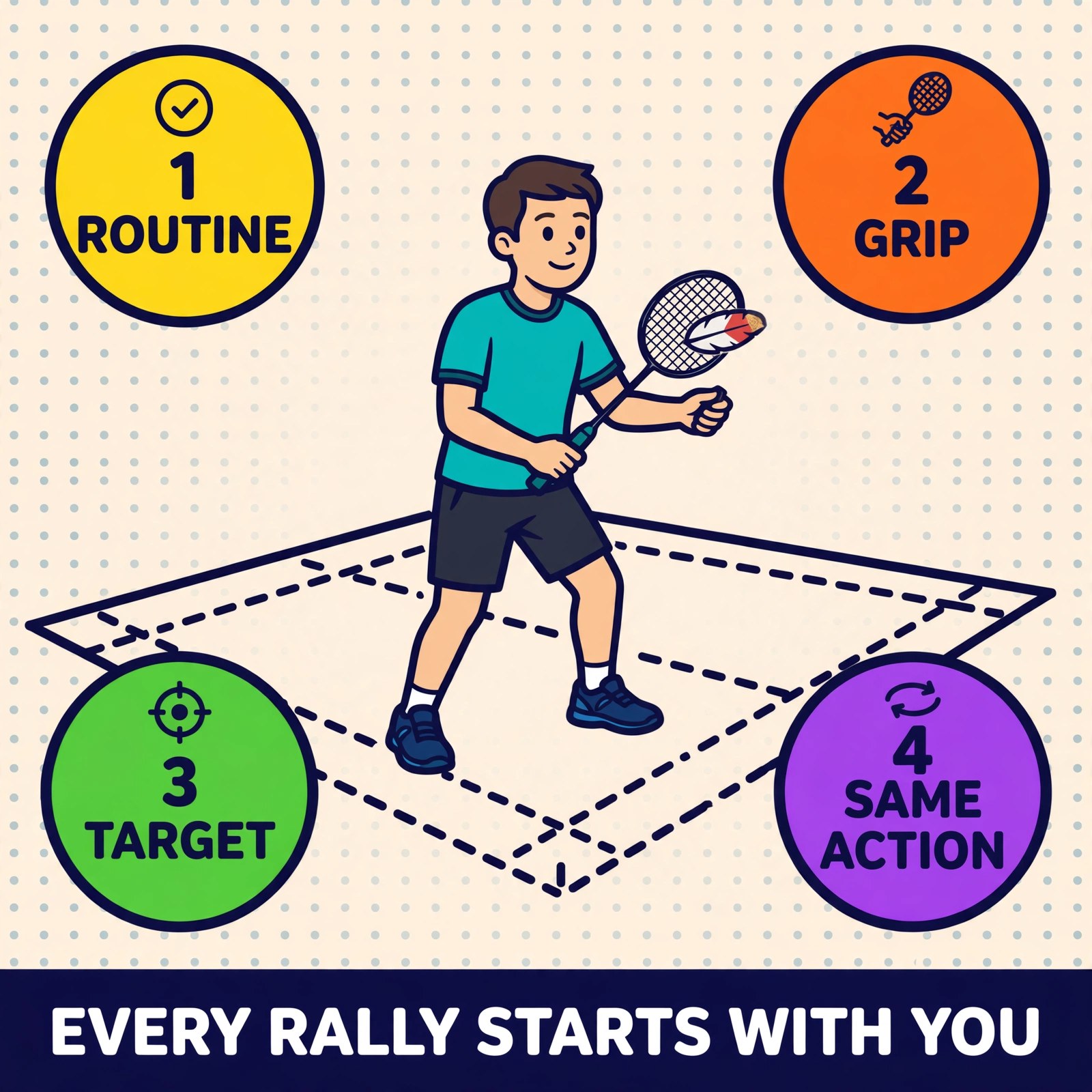
Serving Check #1
Is the Serve Just How a Rally Starts?
A rally does not start neutral. A good low serve takes the attack away from your opponent before the rally begins; a loose serve that sits up hands them the first smash and puts you on the back foot. Watch strong players and you will notice their serves are not an afterthought, they are the first move of a plan they have already made.
That is the mindset shift this guide is built on. The serve is not just how a rally starts; it is how you start winning it. You choose the serve, you choose the target, and you know what return you want back. Everything after that is reaction. Control the one shot that is fully yours, and the rest of the rally gets easier to read.
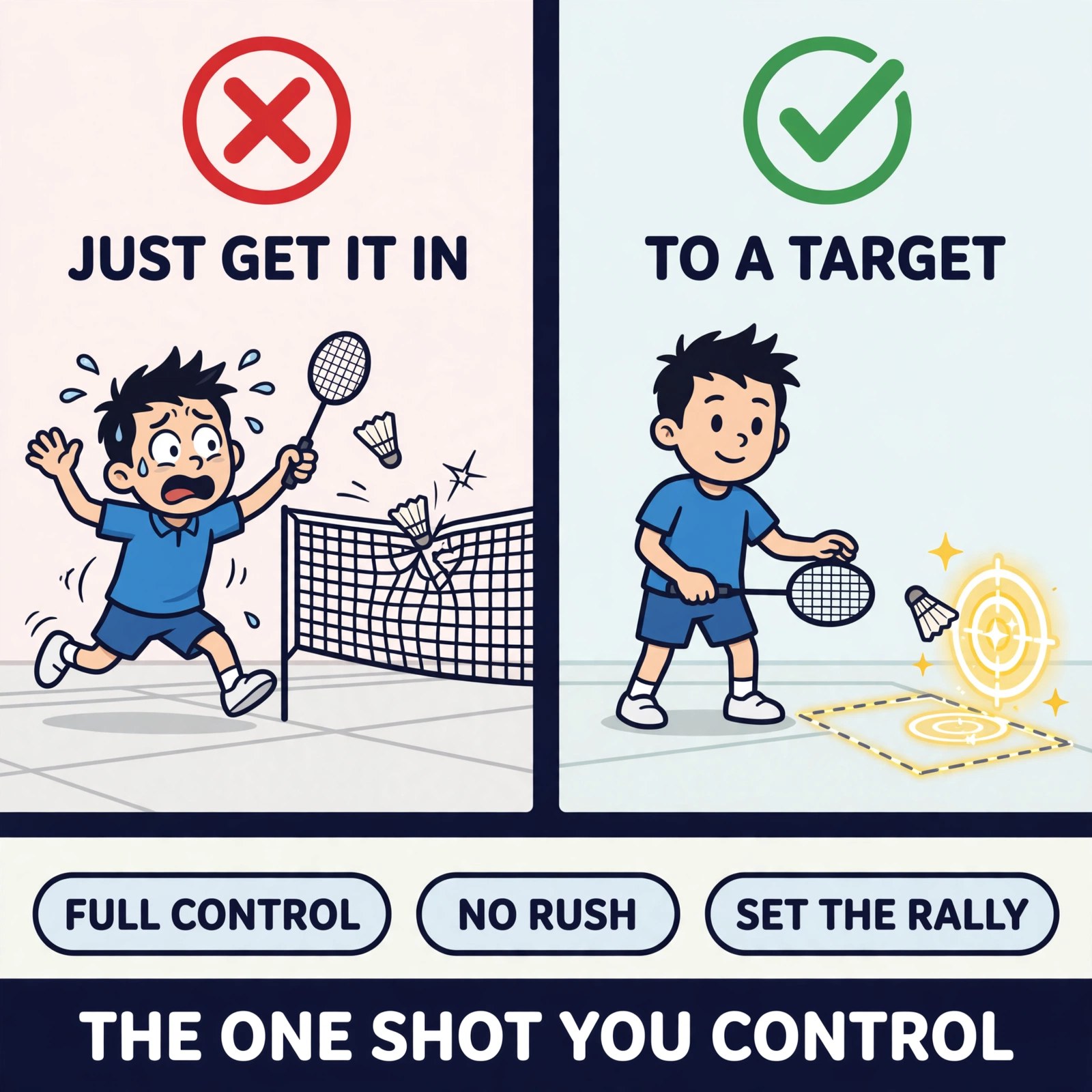
Serving Check #2
What Should You Set Before Every Serve?
Good servers look boring before the serve, and that is the point. Same stance, same breath, same pause, every time. Feet planted inside the service box, weight balanced, shuttle held still at the same height. A fixed routine does two jobs: it calms you down, and it makes every serve look identical to the person trying to read it.
Build the stance first. Stand relaxed, non-racket foot slightly forward for a backhand serve, body side-on enough to shield the racket. For the backhand short serve, the serve most doubles players and many singles players rely on, use a backhand grip with your thumb resting on the wide bevel of the handle, fingers relaxed. A tight grip makes a stiff push; relaxed fingers let the shuttle float off the strings.
Hold the shuttle by the feathers, cork facing your racket, and keep it still until you strike. In badminton the shuttle is never tossed into the serve like a tennis ball, it is held and released in one smooth forward motion, and struck below 1.15 metres. Check the small things too: strings in good shape, a shuttle that flies straight, and shoes that let you stand balanced without sliding.
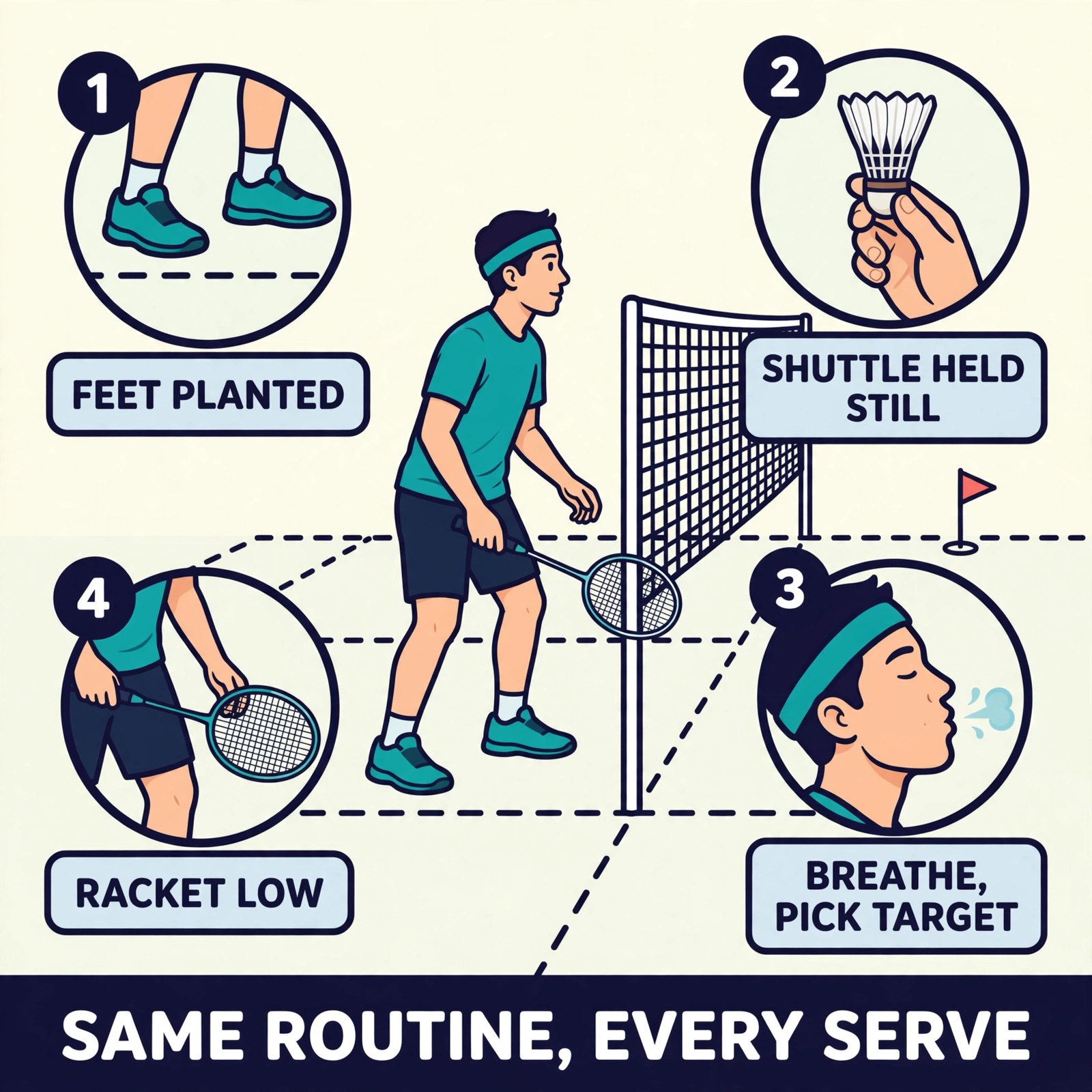
Serving Check #3
Low, Flick, High or Drive: Which Serve and When?
The low serve is the bread and butter. It skims the tape, lands just past the short service line, and arrives too low to attack. In doubles it is the default serve; in singles it is the safe serve that says: you are not smashing this one. Master one serve first, and master this one, the other serves only work because this one is respected.
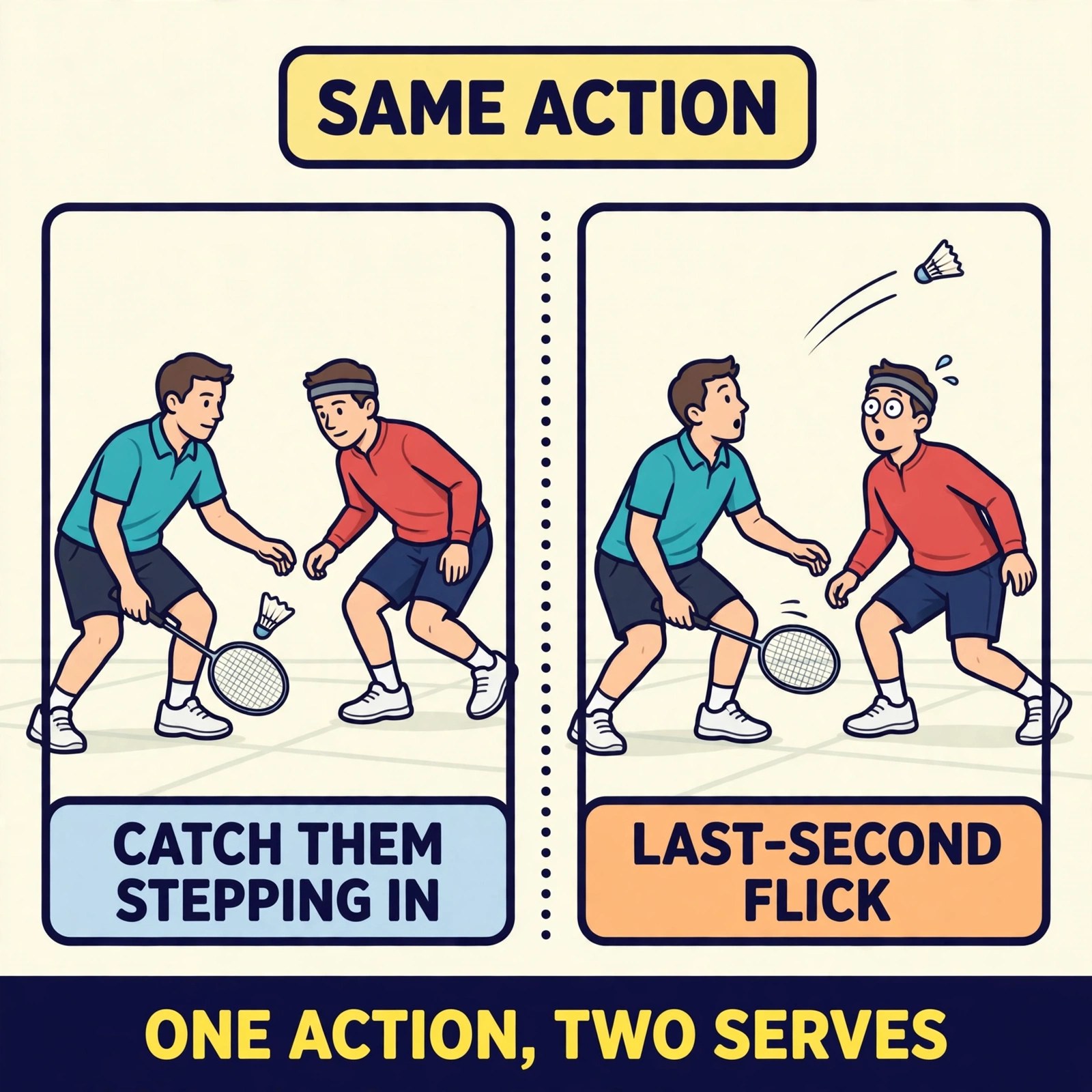
The flick serve is the low serve’s partner. Identical stance, identical hold, identical action, until the last moment, when the wrist flicks the shuttle deep to the back of the court. It exists to punish receivers who creep forward. The high serve belongs to singles: one big swing that sends the shuttle to the very back line, buying you time and pushing your opponent as far from the net as the court allows.
The drive serve is the ambush: fast, flat, aimed at the receiver’s body or backhand side, best used rarely and never twice in a row. Choosing between the four is a reading game. Receiver standing close and rushing? Flick. Receiver hanging back? Low serve, tight. Singles opponent camped near the front? High serve to the back line. The serve is a question, pick the one they answer worst.

Serving Check #4
Why Do Good Serves Get Called Fault?
Serves get called as faults for plain reasons, and every one of them is fixable. The shuttle must be struck below 1.15 metres, the fixed service height used in the modern game. The racket must move in one continuous forward motion; a stop-start double action is a fault. Your feet must stay inside your service box, on the floor, until the serve is struck. And the serve goes diagonally: even score, right box; odd score, left box.
The common mistakes are just as predictable. Contact creeping higher as you try to add pace. A low serve flicked with the wrist so it pops up mid-court. A foot resting on the line. Rushing the serve right after a mistake, which is exactly when your routine matters most. None of these need talent to fix, they need someone watching, and reps at the right height.
Accuracy is what turns a legal serve into a weapon. Low serves should land close to the front corner of the service box, just past the short service line. Flicks should land deep, falling steeply near the back of the box. Practise to targets, not to the other side in general: a serve aimed at somewhere over there lands exactly there, somewhere.

The Sessions
What Happens in Serving Practice Sessions?
Serving practice starts with target games. Corners of the service box marked with shuttle tubes or tape, sets of ten serves, a score kept out loud. Nine out of ten low serves in the box, skimming the tape, is the standard we chase. When the target is small and the score is real, twenty serves teach more than two hundred casual ones.
Then we add pressure, because a serve that only works alone is just a rumour. A receiver stands in and rushes you, the way real opponents do. Sets are scored, and the last two serves of a set carry double points, the same nerves as serving at 19 to 19. In groups of max 4 students, everyone serves under eyes, and the coach spots the small fault, the rising contact point, the flick shown too early, in the set where it happens.
Serving is also one of the few skills you can sharpen at home. A wall target at tape height, a line on the floor for the service box, ten minutes a day of low serves with a score kept in a notebook. It looks too simple to matter, until a match serve at a key point lands exactly where three weeks of wall practice put it.

Myth vs Reality
Myths About Badminton Serving
Myth: “A faster serve is a better serve.” Reality: Pace is the last thing a serve needs. A fast serve that sits up or sails long is a gift; a slow, low serve that skims the tape takes the attack away completely. Control first, always.
Myth: “You can smash the serve for free points.” Reality: There is no smash serve in badminton, a serve struck like a smash is usually a fault or a sitting target. Real serve points come from variation: low, flick, high and drive, mixed so the receiver can never settle. Myth: “Toss the shuttle up like tennis.”
Reality: The shuttle is held and released, never tossed, and struck below 1.15 metres in one smooth forward motion. At ST Badminton Academy KL we rebuild serves from the hold up, stance, grip, contact height, then targets, so the first shot of every rally is one you trust.

Why Choose Us
Real Serving Coaching for Match Players
Serving faults are small and hard to see on yourself, which is why serving is coached best in small groups. At ST Badminton Academy Malaysia in Setapak, groups are capped at max 4 students, so the head coach watches your contact height, your routine and your targets serve by serve, and fixes the wobble in the same session.
Our head coach, Mr Eric Chuar, has over 15 years of coaching experience in Singapore and Malaysia. His serving work is patient and plain: one serve grooved at a time, pressure added only when the shape holds, and scores kept so progress is something you can point at, not just feel.
If your serve is the shot you apologise for, bring it to a session in Setapak, a short reach from Wangsa Maju, Gombak and Danau Kota. One target game usually shows exactly which small habit has been leaking your points.
FAQs: Badminton Serving in Malaysia (KL)
Here are answers to common questions from players and parents in Kuala Lumpur about badminton serving rules, faults and practice.
Where can I learn badminton serving technique if I live in Setapak or Gombak?
Train with us in Setapak, we are close to Gombak, Wangsa Maju and Danau Kota, and serving is coached as its own skill with targets and scores. In small groups of max 4 students, the coach watches your contact height and routine on every set and fixes faults on the spot.
What is the smart way to practise badminton serving in KL?
Practise the low serve first, with a target: sets of ten serves at the front corner of the box, scored out loud. Add the flick serve only when your low serve holds, so the two serves look identical. Short scored sets beat long casual serving every single time.
How many sessions a week does a player need for serving practice at club level?
Two or three sessions a week suit most club players: technical serving work in one, match play in the others. Serving itself needs only short daily reps, ten minutes of serves with a target, even at home against a wall, keeps the contact point honest between coached sessions.
Can a player fix a weak serve if they start learning at 13 or 14?
Yes, 13 or 14 is a good age to rebuild a serve, because the habits are still young. We start from the hold and the grip, groove the low serve with targets, then add the flick. Most students serve legally and accurately under pressure within a few months of steady practice.
What badminton tournaments in Malaysia should serving practice prepare players to enter?
Start with school competitions, club leagues and small local open events around Kuala Lumpur and Selangor. Real matches test your serve like no drill can, a rushing receiver and a tight score teach quickly. We prepare students in training with pressure serving, so match serves feel familiar, not new.
Do you offer serving coaching near Wangsa Maju?
Yes. Our academy is based in Setapak, a short drive from Wangsa Maju, Melati Utama and Danau Kota. Serving is part of our small-group sessions, with target games and pressure sets built in. Groups stay at max 4 students, so your contact height and routine get checked every session.
Does your academy help players fix serving faults and plan serves in Malaysia?
Yes. Fault-fixing is exactly where we start: contact height below 1.15 metres, one smooth forward motion, feet still inside the box. Then we build the serving plan, which serve, which target, against which receiver. It is all practised in scored sets, so the fix holds in matches.
Where is ST Badminton Academy KL located for serving training?
We are based in Setapak, Kuala Lumpur, easy to reach from Gombak, Air Panas, Wangsa Maju and nearby areas. Most students train after school or in the evening in small groups of max 4. If you are nearby, come and watch a session, the serving target games are easy to spot.
What makes Mr Eric Chuar a suitable coach for serving badminton?
Mr Eric Chuar has over 15 years of coaching experience in Singapore and Malaysia, and he teaches the small groups at our Setapak academy personally. He spots serving faults in a single set, contact creeping high, a flick given away early, and rebuilds the serve in a safe, patient order.
Badminton Serving Coaching in Action



What It Takes to Build a Serve You Can Trust
A serve you can trust follows the same standards every time: a calm routine, a legal contact below 1.15 metres, a target picked before the swing, and variation the receiver cannot read. Our serving standards below are the checkpoints we use when we rebuild a student's serve in Setapak.
| Factor | Social Serving | Serve Training SERVE |
|---|---|---|
| Frequency | 1 or 2 times a week. Mostly for fun and sweat. | One serve repeated until it holds: the low serve first, then flick and high serves with the same routine. |
| Drills Focus | Basic static feeding. Minimal footwork pressure. | Target practice with scores: front corners, body serves and deep corners, counted in sets. |
| Physical Conditioning | Rarely included. Just playing games on court. | Core, agility, and speed training included in every session to prevent injury and build stamina. |
| Tactical Awareness | "Just hit it over." No real game plan. | Video analysis, point construction, and learning to read the opponent's game. |
| Coach Ratio | Large groups (8-10 kids). Coach barely watches you. | Max 4 students. Mr Eric Chuar personally corrects every stroke and movement detail. |
| Goal Setting | Fun and exercise. | Pressure serving against a rushing receiver, so the serve survives real matches. |
| Long Term Result | Good recreational player. | A player whose serve starts rallies on their own terms, in singles and doubles. |
Badminton Serving Coaching in Kuala Lumpur
This guide shows how to master badminton serving: the routine and grip, the four real serves and when to use each, the rules that cause faults, and how to practise under pressure. ST Badminton Academy KL provides small-group coaching in Setapak. If you are in Wangsa Maju, Gombak, Cheras or nearby and want a coach to check your serve, contact us today.






