Master The Powerful Badminton Smash With Expert Tips (Smash Power Guide)
Every player wants a bigger smash. Most chase it the same way: swing the arm harder. Then the shuttle floats, the shoulder aches, and the smash stays ordinary. Real smash power does not live in the arm. It travels up the body in a chain: legs drive, core rotates, shoulder follows, the forearm turns, and the fingers squeeze at the very end. This guide covers the powerful badminton smash the way we coach it at ST Badminton Academy in Setapak, Kuala Lumpur: the power chain link by link, the contact point that makes a smash steep, the smash variations worth owning, and how to train power without wrecking your shoulder.

Power Check #1
Is a Powerful Smash Just Arm Strength?
A smash is a downward attacking shot played from above the net, usually from the rear or mid court, hit hard and steep so the opponent has the least possible time to reply. Speed matters, but angle matters just as much. A fast smash hit flat from behind your body gives the defender time and an easy block. A slightly slower smash taken high and in front dives into the tramlines and ends the argument. Power, in other words, is speed plus position, and position is the half most players skip.
That is why strong smashes look easy. The player is behind the shuttle early, balanced, and the whole body turns through the shot in order. Weak smashes look forced because they are: the player is late, reaching, and trying to buy with one arm what the legs and core should have paid for. This page follows the chain in order, so you can find the link that is leaking your power and fix that one first.

Power Check #2
The Power Chain: Legs, Core, Arm
The chain starts in the floor. To smash hard you must be behind the shuttle, which means moving back early with quick steps and setting a wide, balanced base. From there the legs drive upward and forward as the shot begins. Players who wait under the shuttle and swing from a standstill have cut the first link out of the chain, and no arm can replace what the legs were supposed to give.
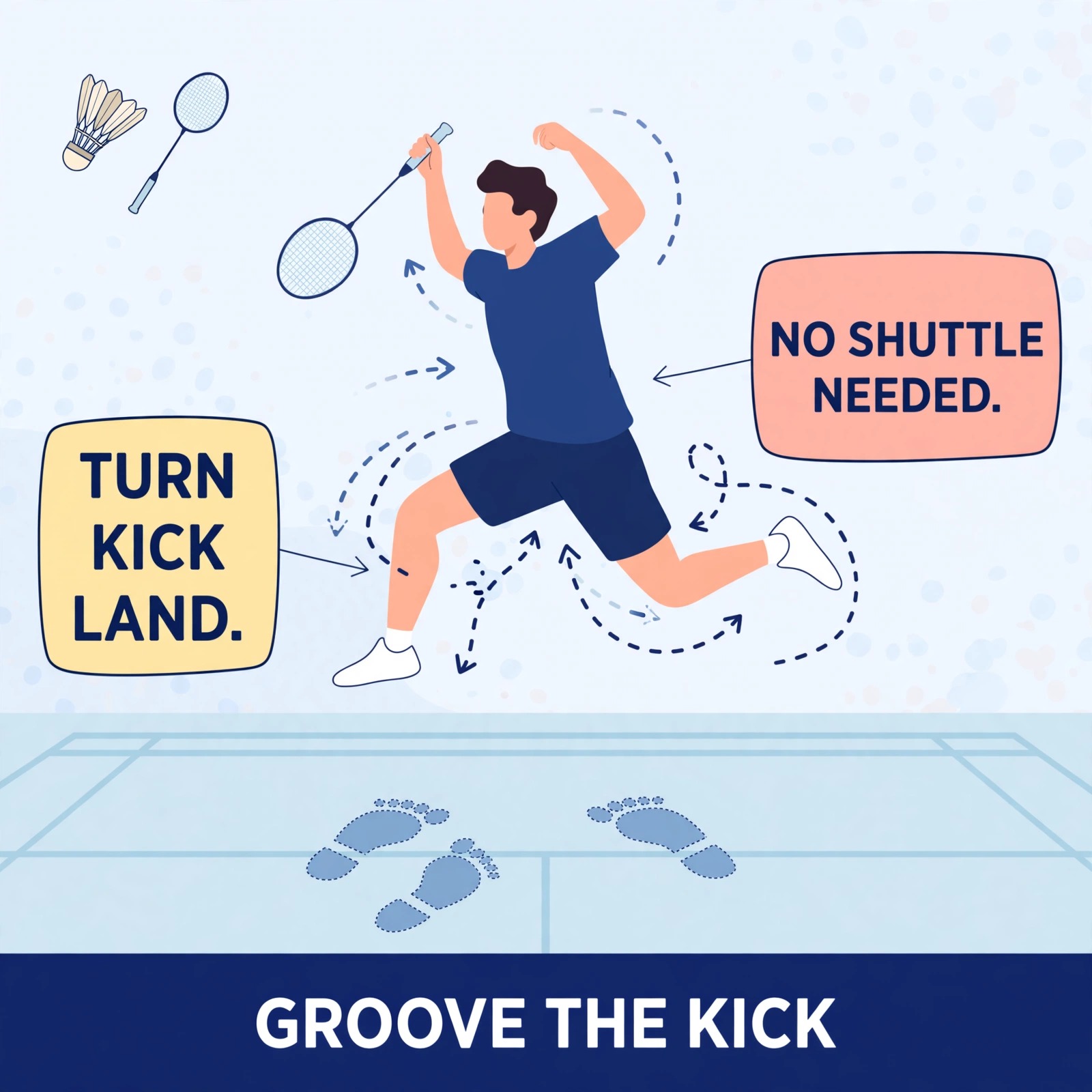
Next, the core turns. Set up side-on to the net, non-racket shoulder pointing roughly at the shuttle, chest coiled away. As the swing starts, the hips and chest rotate toward the net, and that rotation is the engine room of the smash. It is also why the scissor kick exists: as you strike, the legs swap in the air, the racket leg landing behind, so the body rotation completes and you land facing the net, ready to recover instead of falling backward.
The arm is the last link, not the first. The upper arm follows the body turn, then the forearm rotates: the racket face turns from sideways to square through contact, which is where most of the racket head speed is actually made. The fingers finish the job. They stay relaxed during the swing, then squeeze the handle at contact, snapping the racket head through. A hand that grips tight from the start has no squeeze left, which is why the strongest-looking swings often produce the softest smashes.

Power Check #3
Where Should Contact Happen?
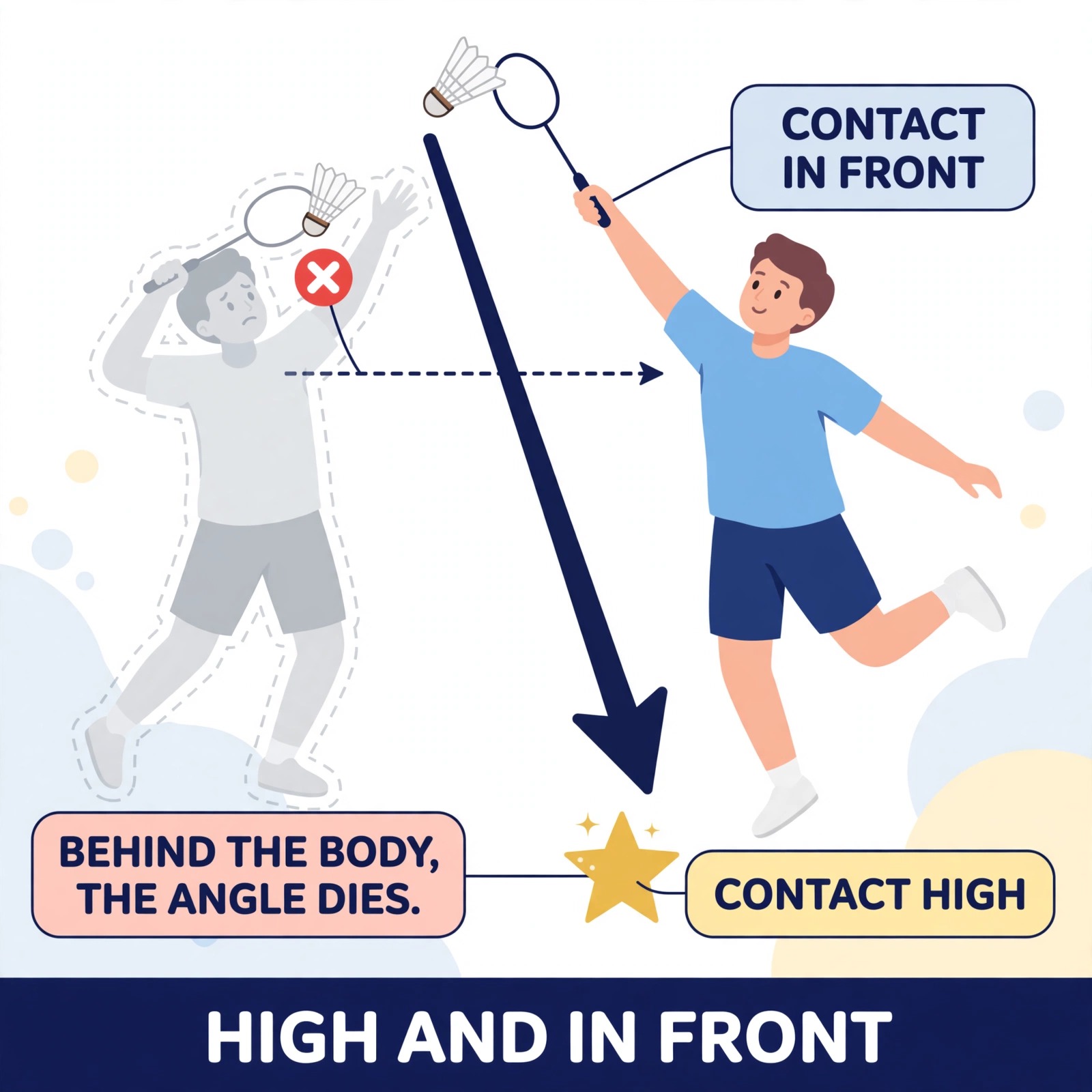
Power leaks fastest at the contact point. The shuttle should be taken at the highest point you can reach, and in front of your body, roughly where you could see it over your racket shoulder. Up there, your swing can drive down at a steep angle. Let the shuttle drop or drift behind your head and the geometry turns against you: the same swing now hits flat or upward, and your hardest shot becomes an easy block or a clear in disguise.
The jump smash exists to protect that contact point. Jumping lifts the contact higher and steepens the angle, and it lets you smash shuttles that would pass a grounded player. It does not add power by itself. A jump timed late, with the body drifting back, produces a weaker smash than a grounded one played in balance. Learn the standing smash first, with the chain in order. Add the jump when your timing, not your wishes, asks for it.
One coaching myth needs clearing here: there is no wrist flick in a good smash. Players told to snap the wrist usually bend it, lose the forearm rotation, and send the shuttle anywhere but down. The wrist stays firm and in line; the speed comes from the forearm turning and the fingers squeezing. If your smash feels like all wrist, that is the fault to fix, and fixing it usually adds power in a single session.
Power Check #4
Which Smash Should You Actually Use?
With the chain working, choose the smash that fits the moment. The straight smash down the tramlines is the workhorse: shortest distance, least time for the defender. The cross-court smash travels further and opens the diagonal, best used when the defender is set and waiting straight, or when your partner in doubles is ready to cover the reply. Aim at the body of a defender who is still moving; a smash at a moving player is harder to control than one into open space.
The stick smash is the smart player’s variation. The preparation looks the same, but the swing is shorter and the contact a touch lower, trading a little power for a much faster recovery. Use it when you are slightly late or not fully behind the shuttle, when a full swing would leave you stranded. Many rallies are won by the player who smashed at eighty percent and was ready for the block, not by the player who swung at everything and watched the reply pass.
The backhand smash is real but rare, and it should stay that way. Even strong players produce a modest backhand smash, because the chain cannot load properly on that side. When the shuttle is behind you on the backhand, the better answers are usually a round-the-head forehand if you have time, or a clear or drop that keeps the rally honest if you do not. Build your power where the chain works: on the forehand side, behind the shuttle, in balance.

The Training
Building Smash Power in Weekly Training
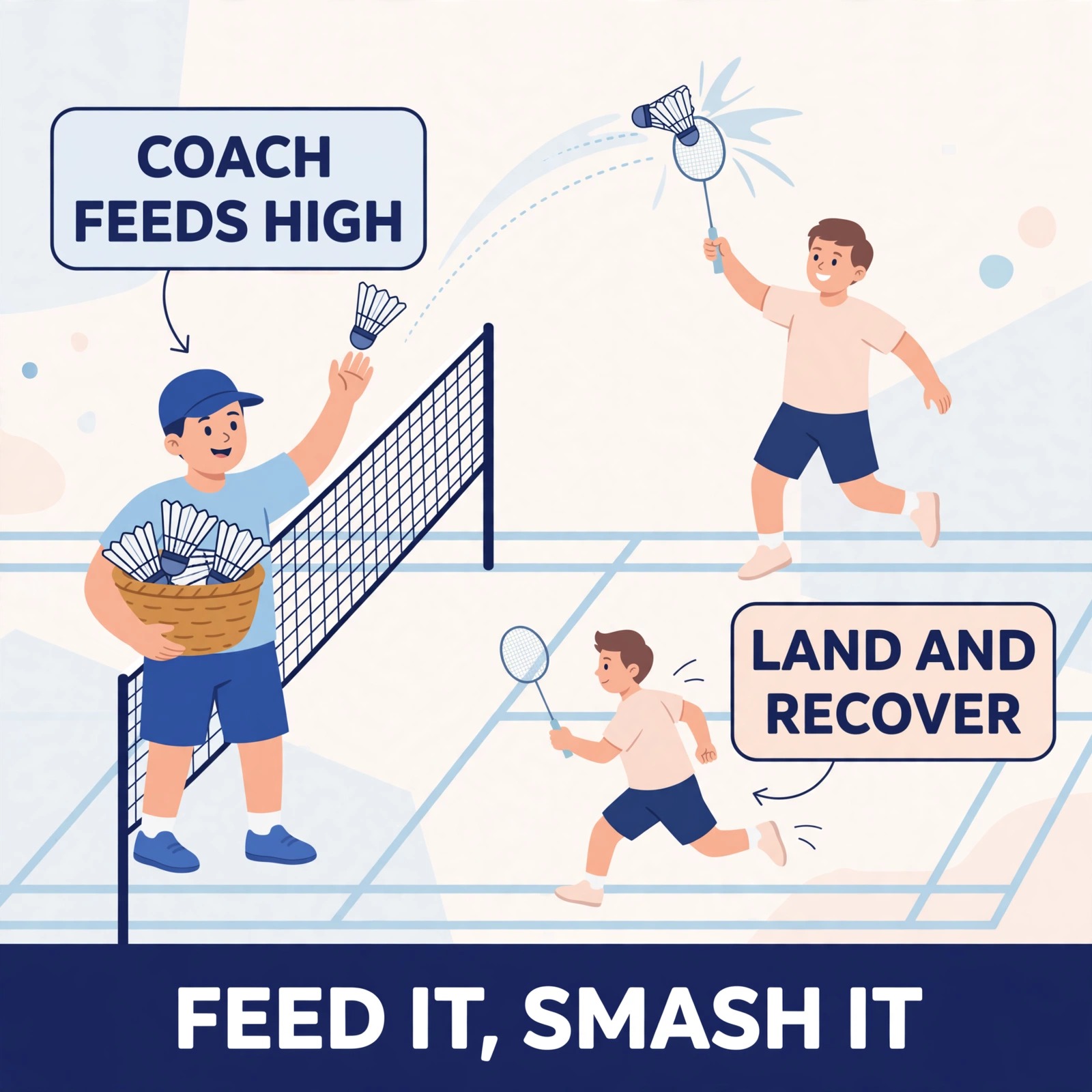
Power is trained in patterns, not in single heroic swings. Multi-shuttle feeding gives you the repetition: the coach lifts or feeds to the rear court, you move behind it, strike, and recover, again and again, with the chain checked on every rep. Shadow smashing does the same work without a shuttle: scissor kick, rotation, contact point in the air, land and recover. Short sets, done cleanly, beat long tired sessions where the chain falls apart and the faults get the practice.
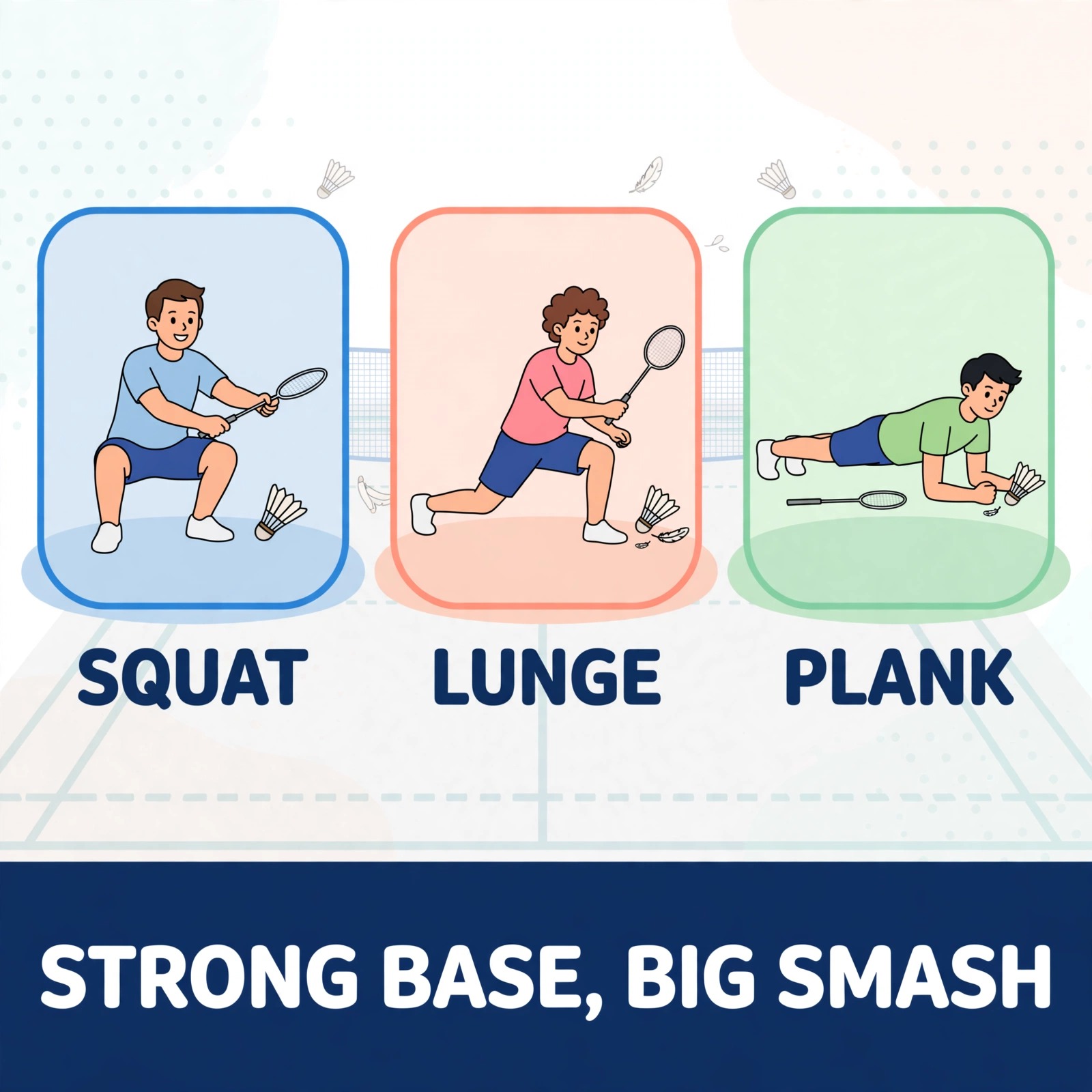
Your body needs the base to hold the chain together. Legs that can drive and land, and a core that can rotate and brace, are the two physical pieces that matter most. Squats, lunges and simple core work like planks support the smash far better than endless arm exercises. Keep the claim honest: conditioning supports technique, it does not replace it. And look after the shoulder. Good mechanics share the load across the body, which lowers the strain any one joint has to carry.
Equipment helps at the edges. A head-heavy racket adds a little momentum to the swing, an even-balanced one moves faster in defence; neither creates power a player does not have. String tension is a trade: higher tension gives control to players whose technique can handle it, lower tension gives an easier rebound. Choose for the game you actually play today. Technique first, chain in order, contact high and in front. The racket is the last five percent, and it only pays once the other ninety-five is working.

Myth vs Reality
Myths About Smash Power
Myth: “Smash power is all in the arm.” Reality: the arm is the last link of a chain that starts in the floor. Players who swing with the arm alone get a tired shoulder and a smash defenders read early. Build the chain and the same arm suddenly looks strong.
Myth: “Flick your wrist for a harder smash.” Reality: bending the wrist kills the forearm rotation that makes racket head speed. Keep the wrist firm, turn the forearm, squeeze the fingers. Myth: “Tighter strings mean a bigger smash.” Reality: tension trades rebound for control; a tighter bed only pays players whose contact is already clean.
Myth: “You must jump to smash hard.” Reality: the jump adds height and angle, not power by itself. A balanced standing smash taken in front beats a jumping one played while drifting back. Earn the jump after the standing chain works, and it will actually add something when it arrives.

Why Choose Us
Smash Power, Coached Link by Link
At ST Badminton Academy KL, smash power is coached inside small group classes capped at max 4 students. Four students means the coach sees every swing: who is late behind the shuttle, whose forearm is not turning, whose fingers are already tight before the swing starts. Feeding is matched to your fault, and the chain is rebuilt link by link instead of being shouted at from across the court.
Mr Eric Chuar has over 15 years of coaching experience in Singapore and Malaysia. His smash rule is simple: find the broken link before adding speed. When he watches a new student smash, he reads the chain from the floor up: base, rotation, contact, squeeze. Then he fixes one link at a time, because a chain repaired in order stays repaired.
Our academy is based in Setapak, Kuala Lumpur, convenient for players from Wangsa Maju, Melati Utama, Danau Kota and Gombak. If your smash feels like hard work for ordinary results, or your shoulder complains every time you swing big, bring it to a session. One look at your chain usually shows exactly where the power is leaking.
FAQs: Badminton Smash Power in Malaysia (KL)
These are the questions players ask us most about building a powerful smash in Malaysia. If your question is not here, message us, describe where your smash breaks down, and we will give you a straight answer about which link to fix first.
How can I learn a powerful smash if I live in Setapak or Gombak?
Start with your chain, not your arm. In our Setapak sessions, your smash is filmed and read link by link: base, rotation, contact point, finger squeeze. Groups are capped at max 4 students, so the fix is practised against live feeding from the first session, not left as homework.
What is the fastest way to build real smash power in KL?
The chain. Legs drive, core rotates, the forearm turns and the fingers squeeze at contact, with the shuttle taken high and in front. Arm strength is the smallest part of it. When the order is right, ordinary arms produce smashes that look anything but ordinary in matches.
How many times a week should I practise smashing to reach a good level?
Two to three focused sessions a week is a good rhythm for most players, with smashing inside your normal training rather than as a separate marathon. Short sets with the chain checked beat one long session a week where tired swings practise the fault. Consistency builds the timing that power needs.
Can an adult beginner learn a real smash, or is it only for juniors?
Yes. The chain is a skill, not a gift of age, and adult beginners often learn it faster because they follow the order instead of swinging on instinct. Start with the standing smash, build the links slowly, and add speed only when the shape holds. The jump can wait until the base is honest.
What racket weight and string tension suit a power game, and where do I start?
Start with balance before labels: an even-balanced or slightly head-heavy racket you can swing all session without your forearm dying. For tension, stay in a comfortable middle range while your contact is still developing; tighter beds reward clean technique and punish late contact. Bring your racket to a session and we will read it with you.
Do you coach smash technique in classes near Wangsa Maju?
Yes. Smash technique is part of our regular group classes in the Setapak area, a short trip from Wangsa Maju. You do not need a separate power course: your chain is checked inside normal sessions, and feeding is adjusted to the link you are rebuilding that month.
Does smashing hurt the shoulder, and does your academy teach safe technique in Malaysia?
A smash should not hurt. Pain usually means one link is doing another link’s job, most often the shoulder covering for legs and core that never loaded. Correct mechanics share the load across the body, which lowers the risk of strain. In class we rebuild the chain and keep loads sensible while it settles.
Where is ST Badminton Academy KL located for smash training?
We are based in Setapak, Kuala Lumpur, close to Wangsa Maju, Melati Utama, Danau Kota and Gombak. Sessions run in small groups of max 4 students. Message us for the current class schedule and we will match your smash work to a group at your level.
What makes Mr Eric Chuar a suitable coach for smash power and badminton?
Fifteen years of coaching in Singapore and Malaysia, and a habit of fixing causes instead of symptoms. Eric reads a smash from the floor up, one link at a time, and teaches in small groups where every swing is seen. Players leave knowing exactly which link they own and which one is next.
Badminton Smash Power in Action

What It Takes to Smash With Real Power
A player meets our smash standard when five habits hold: they are behind the shuttle early, the chain runs legs, core and arm in that order, contact is high and in front, the hand stays relaxed until the squeeze, and they land ready to recover. When those five hold, power stops being something they chase and becomes something they repeat.
| Factor | Arm-Only Swing | Full Power Chain POWER |
|---|---|---|
| Frequency | 1 or 2 times a week. Mostly for fun and sweat. | Before the shot, the body is set behind the shuttle: wide base, side-on, chest coiled and ready to turn. |
| Drills Focus | Basic static feeding. Minimal footwork pressure. | During the swing, power travels in order: legs drive, core rotates, forearm turns, fingers squeeze last. |
| Physical Conditioning | Rarely included. Just playing games on court. | Core, agility, and speed training included in every session to prevent injury and build stamina. |
| Tactical Awareness | "Just hit it over." No real game plan. | Video analysis, point construction, and learning to read the opponent's game. |
| Coach Ratio | Large groups (8-10 kids). Coach barely watches you. | Max 4 students. Mr Eric Chuar personally corrects every stroke and movement detail. |
| Goal Setting | Fun and exercise. | Contact is high and in front, so the shuttle dives steeply instead of floating into an easy block. |
| Long Term Result | Good recreational player. | A smash that ends rallies, because the whole body paid for it and no single joint carried the load. |
Badminton Smash Power Training in Kuala Lumpur
This page covered the powerful badminton smash: the chain from legs to fingers, the contact point that makes a smash steep, the variations worth owning, straight, cross, stick and jump, and how power is trained without punishing the shoulder. If one link in your chain is leaking, that link is your next session. Bring your smash to Setapak and let us read it with you.






