Improve Your Game With Essential Badminton Drills (Drills Guide)
Games are fun, but games are a test, not a teacher. If your backhand clear drops short in matches, playing more matches will mostly give you more chances to watch it drop short. Drills are how a shot actually gets built: one skill, repeated with a target, until it holds under pressure.
This page covers the essential badminton drills we use at ST Badminton Academy Malaysia in Setapak, Kuala Lumpur, footwork drills, stroke drills, net and defence drills, and how to run them so they change your game, not just fill your training time.

Drill Check #1
Why Do Drills Improve Your Game Faster?
A rally in a match asks for many skills at once: footwork to arrive, balance to hit, judgement to choose the shot. When one link is weak, the whole rally breaks, but the game moves too fast to show you which link failed. A drill slows the game down and isolates the weak link. Twenty clears aimed at the back tramlines will tell you more about your clear than a month of social games.
Drills also make practice honest. A target can be counted: eight out of ten serves inside the box, six corners completed without a stumble, a wall rally streak of thirty. Numbers do not flatter, and that is their value. When the numbers rise week by week, you know the work is landing; when they stall, the drill, not your effort, usually needs adjusting.

Drill Check #2
Which Footwork Drills Build Your Base?
Every footwork drill starts and ends in the same place: the split step at base. From base, the six corners cover the whole court, two front corners with a lunge, two side corners with a step or chasse, and two back corners where you turn and move behind the shuttle. Shadow footwork means running these patterns without a shuttle, slowly at first, so your feet learn the routes without rushing.
Three details make shadow footwork worth doing. First, split step every time you return to base, it loads your legs for the next move. Second, lunge with the racket leg at the front and recover by pushing back off that leg, not by standing up and walking. Third, at the back corners, turn your body side-on early so the hitting shoulder is behind the shuttle. Get these right slowly and speed becomes safe to add.
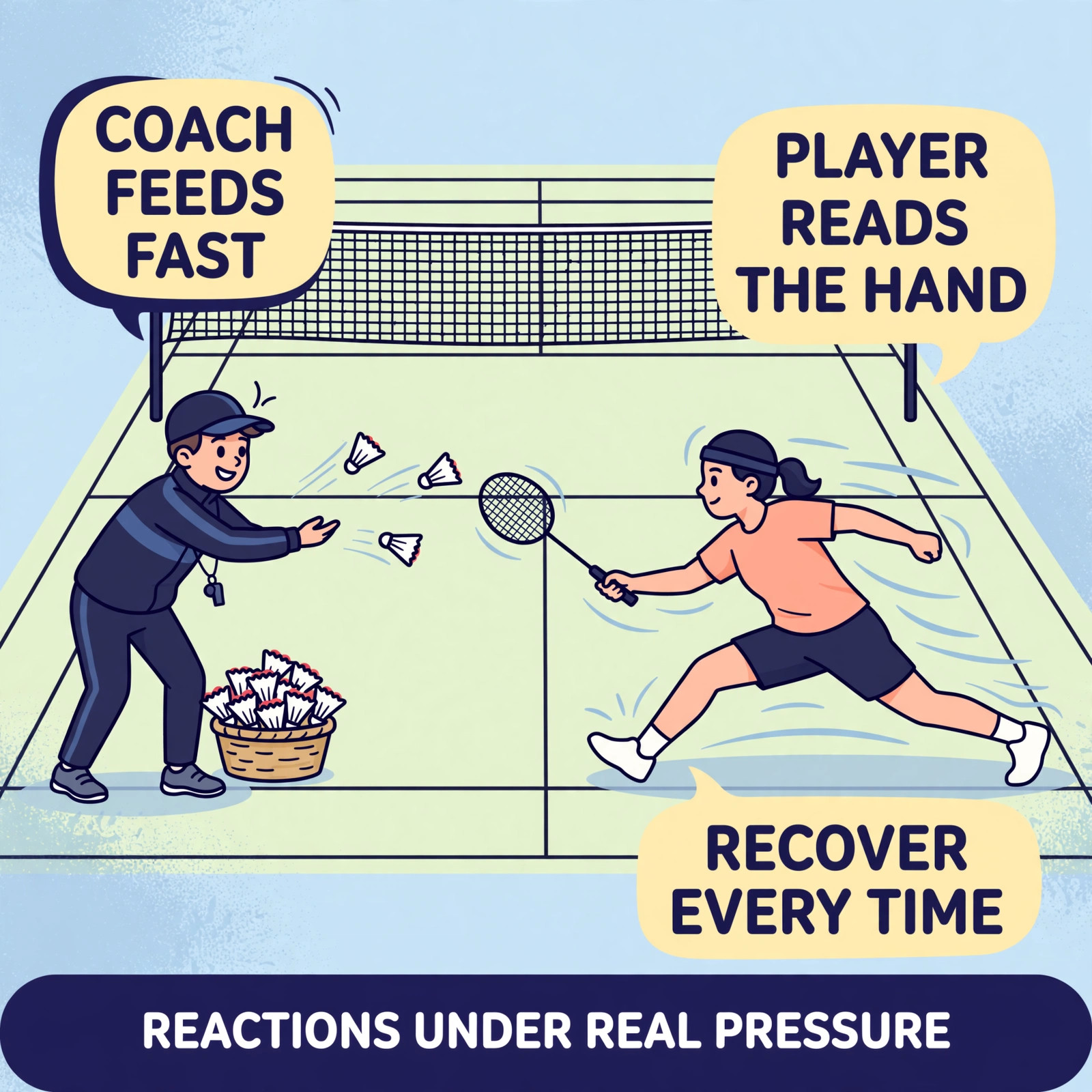
Once the patterns are clean, a feeder turns shadow into match movement. In multi-shuttle feeding, the coach sends shuttles to random corners while you move, hit and recover, no time to admire your shot, just like a rally. Start with four corners, build to six, and keep the sets short. Footwork quality drops fast when you are tired, and drilling tired movement teaches tired movement.

Drill Check #3
Which Stroke Drills Build Real Match Shots?
The clear is the foundation stroke, so clear drills come first. Rally clears with a partner, aiming every shot into the back tramlines, until both of you can hold ten in a row. Then add the drop: same preparation, same swing shape, but the shuttle lands softly just over the net. An opponent who cannot tell your clear from your drop until the last moment is an opponent standing in the wrong place.
Drive drills build the flat, fast exchange used in doubles and mid-court play. Stand near the front service line with a partner and drive the shuttle flat past each other, keeping it low over the tape and fast enough that there is no time for a big swing. Short backswings, quick hands, feet set early. When the rally holds, move a step back and keep the same flat flight.
Smash work belongs in drills too, but it comes after the feet. A simple pattern: feeder lifts high to the back, you move behind it, turn side-on, and hit down into a target zone, then recover to base before the next feed. Power comes from the turn of the body and the timing of the contact, not from swinging harder with the arm alone. Five good smashes with recovery teach more than twenty wild ones.
Drill Check #4
Backhand, Net and Defence Drills
The backhand corner is where rallies go to test you. Backhand drills start with footwork: turn early, step across with the racket leg, and take the shuttle as high and as far in front of your body as the rally allows. The backhand clear drill uses a feeder at the net sending high shuttles to your backhand corner, your job is depth, sending each one back to the rear tramlines, not winning the point.
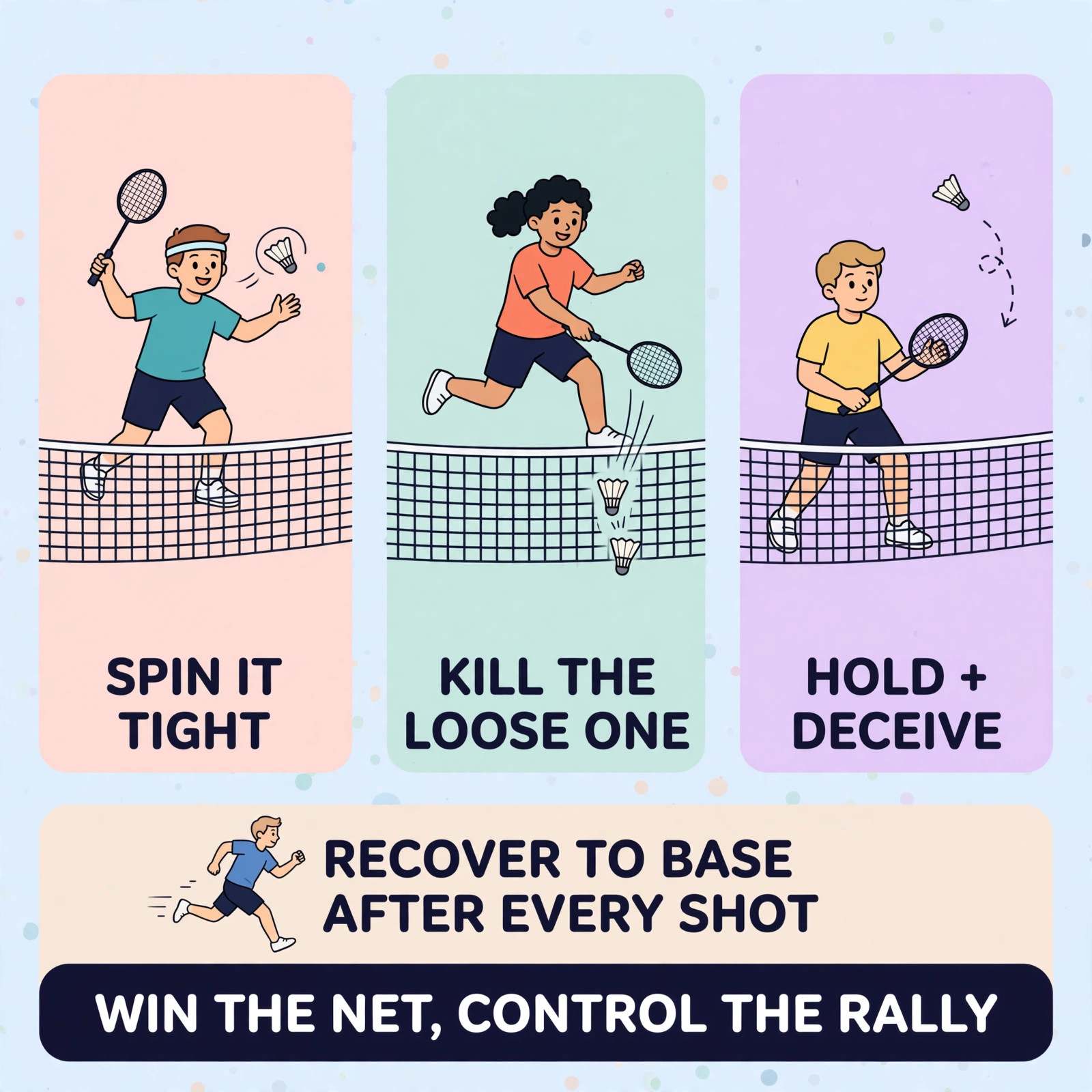
Net drills teach soft hands. In the net-and-lift routine, one player plays a tight net shot, the partner lifts, and the rally resets, over and over, with the net shot judged by how close it tumbles over the tape. A racket held up early and a still, quiet hand beat a jabbing motion every time. Add a cross-court net reply once the straight one is steady.
Defence drills prepare you for the shot every opponent wants to hit at you. The coach or a partner smashes from the front while you hold a low, wide stance, racket in front, and block the shuttle back to the net instead of swinging at it. Blocks that land softly turn defence into counter-attack. Start at half power, and only add speed when your blocks stop flying out.

The Drill Session
How to Build a Drill Session That Works
A drill session needs the same shape as a good class. Warm up properly first, jogging, leg swings, arm circles and walking lunges, because cold muscles and fast lunges do not mix. Then work in blocks: one block per theme, each with a target and a time limit. Rest between sets; the next set should look as clean as the first, or the rest was too short.
Finish with a conditioned game that forces the day’s drill into a rally. If the theme was net play, award double points for points won at the net. If it was clears, require every rally to start with a high serve and a clear. This last step is where drills become habits, the shot you repeated fifty times appears in a game because the game was built to ask for it.
Across a week, spread the themes instead of repeating one until you hate it: footwork on one day, strokes on another, net and defence on a third, with games woven through. Keep a simple note of your counted targets. When a target has been met three sessions in a row, make it harder, a smaller target, a faster feed, one more corner. Drills should always sit just at the edge of what you can do cleanly.

Myth vs Reality
Myths About Badminton Drills
Myth: “Drills are only for beginners.” Reality: professionals drill the same basics every day, six-corner footwork, clear accuracy, net control. The drills get faster and the targets smaller, but the basics never stop being the game. If the best players in the world still drill, a club player skipping drills is not being advanced, just untested.
Myth: “More hours of drilling always means more improvement.” Reality: tired reps teach tired technique. Short, focused sets with rest beat one long grind. Myth: “I can skip drills because I play many games.” Reality: games test what you already have; they rarely build what you are missing, because the missing shot is exactly the one games punish you for trying.
Myth: “A drill is working if it feels hard.” Reality: a drill is working if the counted target is improving, clears landing deeper, serves landing tighter, corners reached without stumbling. Effort matters, but effort aimed at a target is what changes a shot. Choose drills by what they fix, not by how much they exhaust you.

Why Choose Us
Coached Drills for Players Who Want More
At ST Badminton Academy KL, drills are coached, not just assigned. Our groups in Setapak are capped at max 4 students, small enough for the coach to feed by hand, watch every rep and stop a drill the moment a fault creeps in. A drill done wrong fifty times is worse than no drill at all, somebody has to be watching, and in our sessions somebody always is.
Mr Eric Chuar has over 15 years of coaching experience in Singapore and Malaysia. He builds drill programmes the way he builds players: basics first, one theme at a time, targets you can count, and games at the end to test whether the work survived contact with a real rally. Students usually discover that the drill they found hardest was aimed at exactly the leak in their game.
Our academy is based in Setapak, Kuala Lumpur, easy to reach from Wangsa Maju, Melati Utama, Danau Kota and Gombak. If your game has stopped improving even though you play every week, the missing piece is usually structured drilling with a coach’s eye on it. Talk to us about your game, and we will show you the drills that fit it.
FAQs: Essential Badminton Drills in Malaysia (KL)
These are the questions players ask us most about badminton drills and drill training in Kuala Lumpur. If your question is not here, message us, tell us the shot that keeps breaking down, and we will point you to the drill that fixes it.
How can I improve my game with badminton drills if I live in Setapak or Gombak?
Message us and tell us which shot keeps breaking down in your games. We will place you in a small group in Setapak, capped at max 4 students, where the coach builds drill blocks around your weak shots and checks your counted targets every session.
Which badminton drills should a player learn first in KL?
Start with footwork: six-corner shadow patterns with a split step and a clean recovery to base. Add clear-to-clear rallies aimed at the back tramlines, a simple net-and-lift routine, and serve target practice. These four drills cover the movements and shots that appear in almost every rally you will play.
How many times a week should I practise badminton drills to improve at a steady level?
Two or three drill sessions a week suit most players, each with one main theme, footwork one day, strokes the next, net and defence after that. Short focused sets with rest between them beat one long session, and a game at the end tests whether the work is sticking.
I only play games and never do drills. Can drills still fix my game?
Yes, that is exactly the player drills help most. Games keep testing your strong shots and hiding your weak ones. A coach will spot the shot that breaks down, isolate it in a drill with a target, and rebuild it until it survives in your normal games again.
Which badminton drills should I use to fix a weak backhand?
Use the backhand corner set: a feeder sends high shuttles to your backhand side while you turn early, step across and aim every clear at the back tramlines. Add backhand net replies once the clear holds. Depth is the target first, power and disguise come after the shape is right.
Do you offer badminton drill training near Wangsa Maju?
Yes. Our academy is based in Setapak, a short drive from Wangsa Maju, Melati Utama and Danau Kota. Drill training runs in small groups of max 4 students, so the coach feeds by hand and corrects your technique during the drill, not after the session is over.
What equipment do I need for badminton drills in Malaysia?
You need very little: your racket, a tube of shuttles (nylon lasts longer for heavy drill work), proper non-marking court shoes, and a water bottle. Cones or floor tape help mark targets, and your coach provides the feeding. Targets and a feeder matter far more than any special training gadget.
How long does it take for badminton drills to improve my game?
Most players feel a drilled shot steadying within three to four weeks of regular sessions, the footwork arrives earlier and the clear stops dropping short. Bigger rebuilds take longer, but the counted targets tell the truth early: when your numbers rise, your matches follow soon after.
What makes Mr Eric Chuar a suitable coach for badminton drill badminton?
Mr Eric Chuar has over 15 years of coaching experience in Singapore and Malaysia, and he designs the drill programmes at our Setapak academy himself. He is known for choosing the one drill that targets a player’s real leak, then setting a counted target so progress is visible, not guessed.
Essential Badminton Drills in Action


What It Takes to Build Shots That Hold in Matches
A player is drilling well when the numbers move: clears landing in the back tramlines most of the time, six corners completed without breaking form, serves hitting the target box in sets of ten, and blocks staying low instead of flying out. Our drill standards below are the checkpoints our coaches use before a target is made harder.
| Factor | Only Games | Games Plus Drills DRILLS |
|---|---|---|
| Frequency | 1 or 2 times a week. Mostly for fun and sweat. | Drill blocks every week, each built around one skill that needs work, not random hitting until you are tired. |
| Drills Focus | Basic static feeding. Minimal footwork pressure. | Fed and target-based drills with a coach watching: six corners, back-court depth, tight net control. |
| Physical Conditioning | Rarely included. Just playing games on court. | Core, agility, and speed training included in every session to prevent injury and build stamina. |
| Tactical Awareness | "Just hit it over." No real game plan. | Video analysis, point construction, and learning to read the opponent's game. |
| Coach Ratio | Large groups (8-10 kids). Coach barely watches you. | Max 4 students. Mr Eric Chuar personally corrects every stroke and movement detail. |
| Goal Setting | Fun and exercise. | Counted targets you can track: ten clean clears, serves on target, corners reached in order without stumbling. |
| Long Term Result | Good recreational player. | A player whose weak shots get fixed, not just tested, week after week of training. |
Essential Badminton Drill Training in Kuala Lumpur
This page covered the essential badminton drills, footwork, strokes, net play and defence, and how to run them with targets that show real progress. ST Badminton Academy KL runs coached drill training in Setapak, in groups of max 4 students. If you are in Wangsa Maju, Gombak, Cheras or nearby and your game has stopped improving, contact us today.






