Improve Your Footwork With These Badminton Drills (Drills Guide)
Every badminton rally is a footrace you have to win before you can hit anything. Players blame their racket or their smash, but watch the point again and the real problem is usually below the waist: they arrived late, off balance, and had to reach for the shuttle.
This guide shares the footwork drills we use at ST Badminton Academy Malaysia in Setapak, Kuala Lumpur, what footwork actually is, the patterns behind it, and the drills that build speed you can use in a real match. Our groups stay small, max 4 students, so a coach watches every split step and every recovery, not just the shots.
Footwork Check #1
Is Footwork Just About Fast Legs?
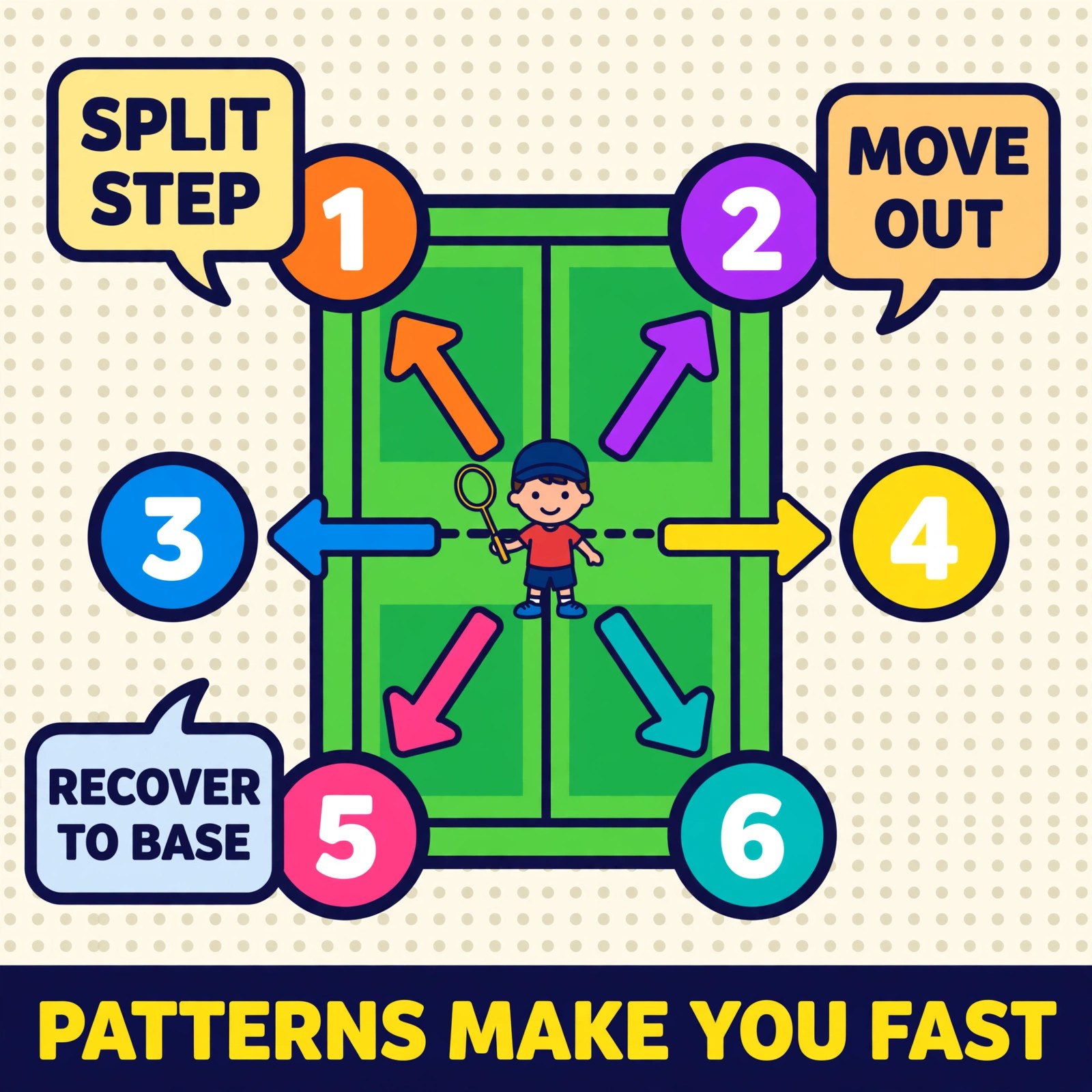
Ask players why they are slow on court and most give the same answer: my legs are not fast enough. So they run more, sprint more, and still get caught standing flat when the shuttle goes to the backhand corner. The problem is rarely leg speed. Badminton movement is not running. It is a set of short, repeated patterns, a split step, two or three quick steps, a balanced hit, then a recovery back to base.
Once the patterns are coached, ‘slow’ players suddenly look quick, because they start moving at the right time and stop wasting steps. Good footwork also buys thinking time: arrive early and balanced, and you can choose your shot instead of just surviving the rally. That is why footwork training sits underneath everything else we teach in Setapak, before power, before fancy shots, feet first.

Footwork Check #2
What Should Your Feet Do Before Anything Else?
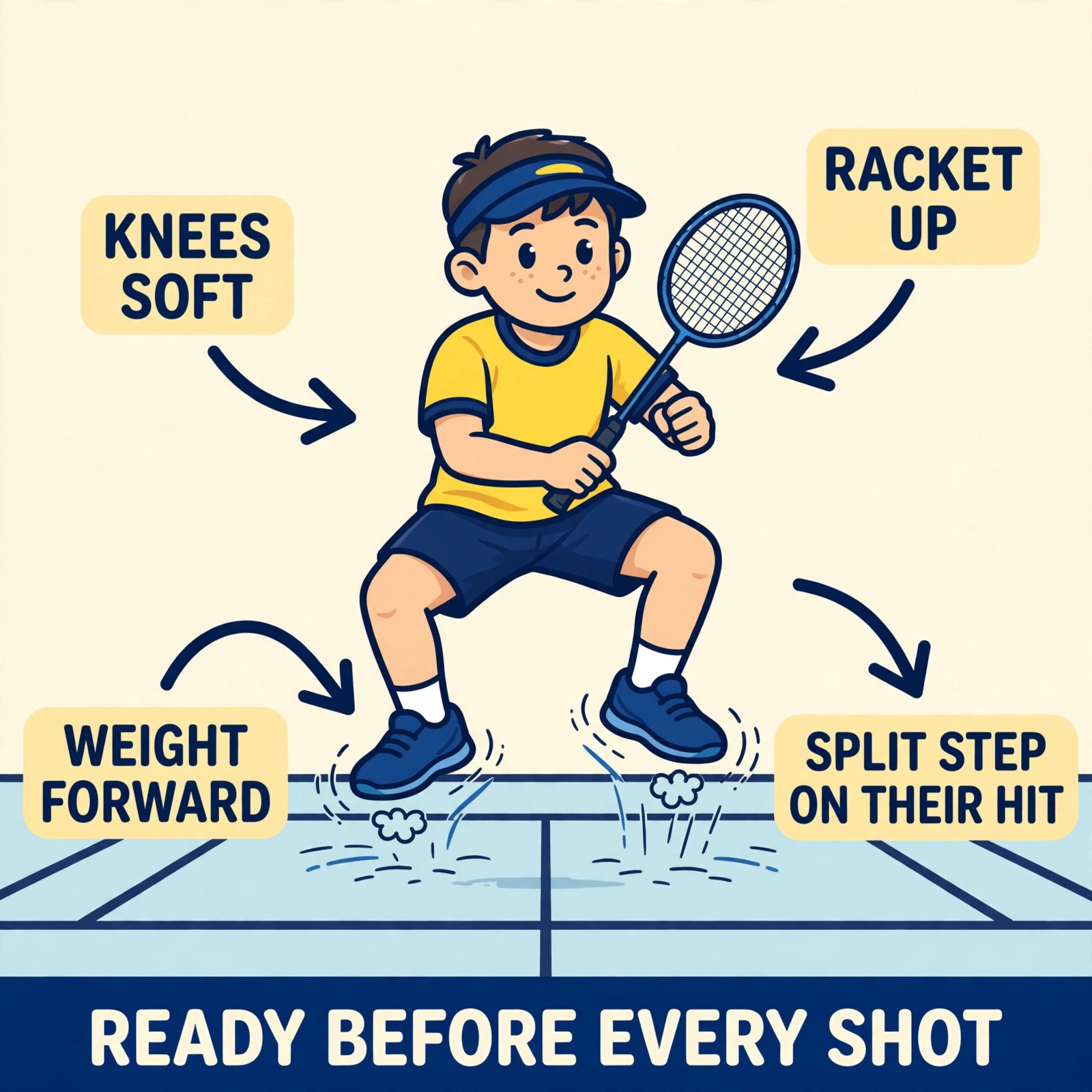
Everything starts from your base: the ready position near the centre of the court, just behind the short service line in singles. Feet about shoulder width apart, knees soft, weight on the front of your feet, racket up in front of you. From here you can push off in any direction. Stand flat-footed or lean back on your heels, and every first step starts late.
The split step is the trigger. Just before your opponent strikes the shuttle, you land from a small hop with both feet, knees bent, ready to explode either way. Land too early and you are stuck; land too late and you are moving after the shuttle has already gone. Timed right, the split step loads your legs like a spring and cuts your reaction time without any extra fitness.
The last habit is recovery. After every shot, your first job is to move back towards base, not to stand and admire the shot. Players who recover give themselves time; players who watch the shuttle get punished by the next one. In our sessions, recovery is coached as part of the shot itself: hit, recover, split step, go again.
Footwork Check #3
Why Do the Six Corners Decide Your Footwork?
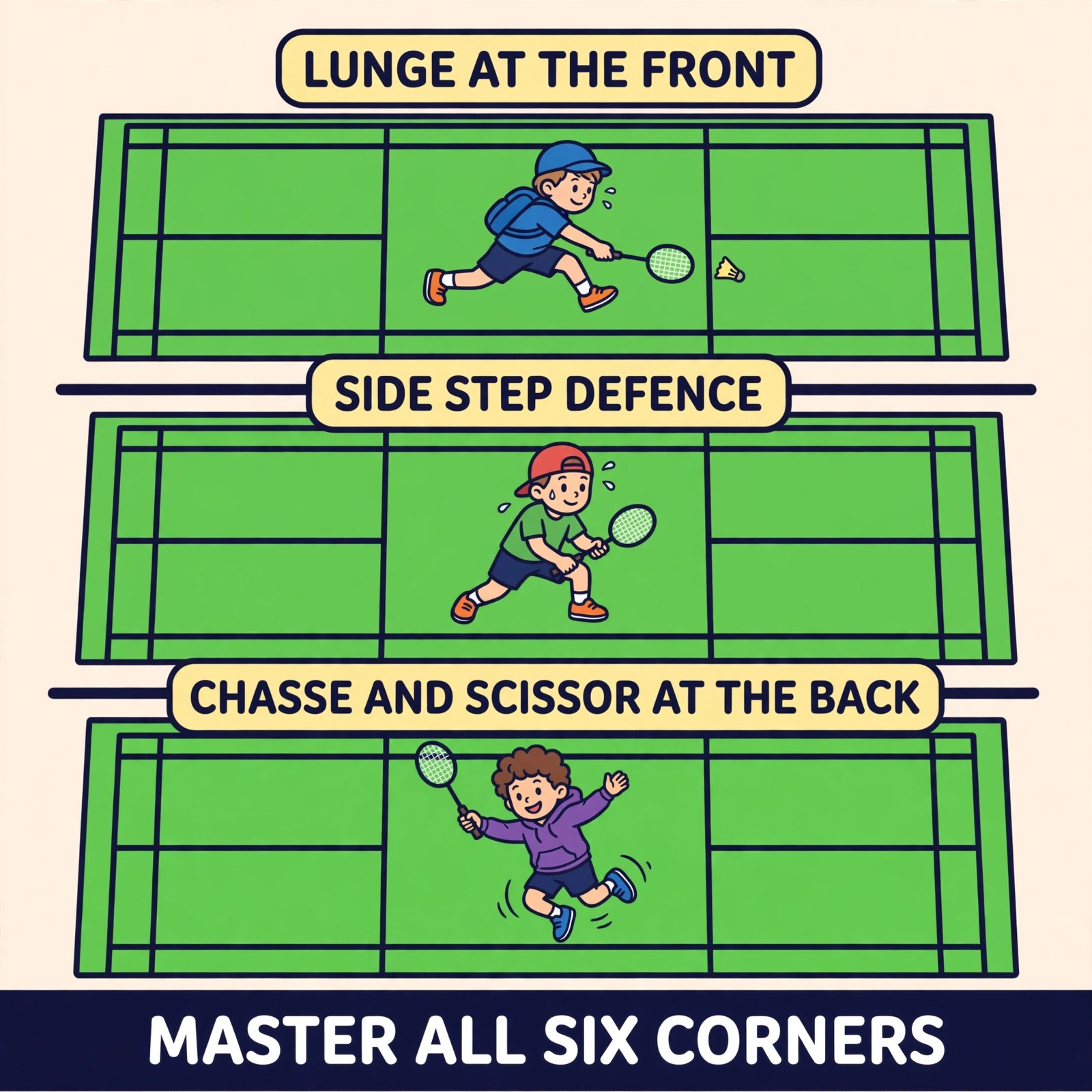
A singles court has six corners your feet must own: two at the net, two at the sides for defence, and two deep rear corners. Each direction has its own pattern. There is no single ‘run to the shuttle’ movement, and players who treat every corner the same end up lunging where they should turn, and turning where they should lunge.
To the front corners you lunge: a big final step on the racket leg, heel down first, knee tracking over the toes, so you can push straight back. To the rear corners you chasse or use a scissor movement, quick steps back, plant, turn side-on, hit, and let the rotation carry you forward again. Sideways defence uses a lower stance and a quick step out, staying balanced enough to block and counter.
Learn the six patterns and the court shrinks. You stop guessing where your feet should go, so your eyes can stay on the shuttle and your brain can plan the next shot. This is also where injuries are prevented: a proper lunge loads the leg muscles in the right order, while a panicked reach overloads knees and ankles.
Footwork Check #4
Which Drills Build Match Footwork?
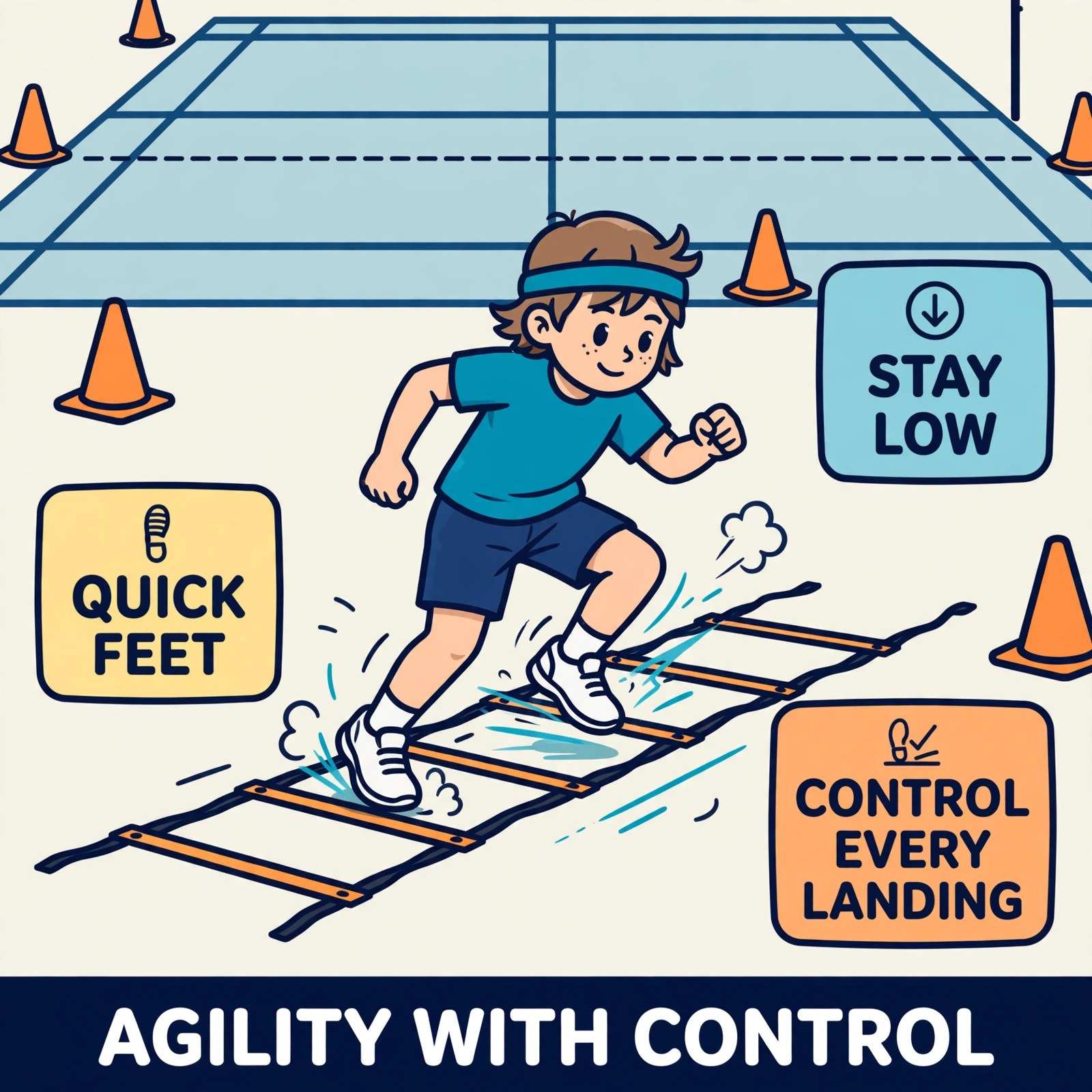
The first drill family builds your stride and step patterns. Lateral shuffles teach quick side movement without crossing your feet. Cross-over steps cover longer distances to the rear court. Quick-feet drills, short, fast contacts on the spot or through a ladder, sharpen the small steps you use around base. Skipping and rope work add rhythm and light feet.
Agility drills add change of direction: cone patterns, zig-zag defence movements, and side-to-side jumps over a line or a low hurdle, always landing balanced. Balance work holds it together, weight shifts between two cones, single-leg hops with soft landings, and holds that teach your body to stay centred while it moves fast.
Core and leg strength support everything: planks, squats, lunges and hip bridges, two short sessions a week, give your patterns a strong base to push from. But strength work supports footwork, it never replaces it. The order in training is always patterns first, speed second, and strength as the base underneath.

The Practice
What Happens in Footwork Training Sessions?
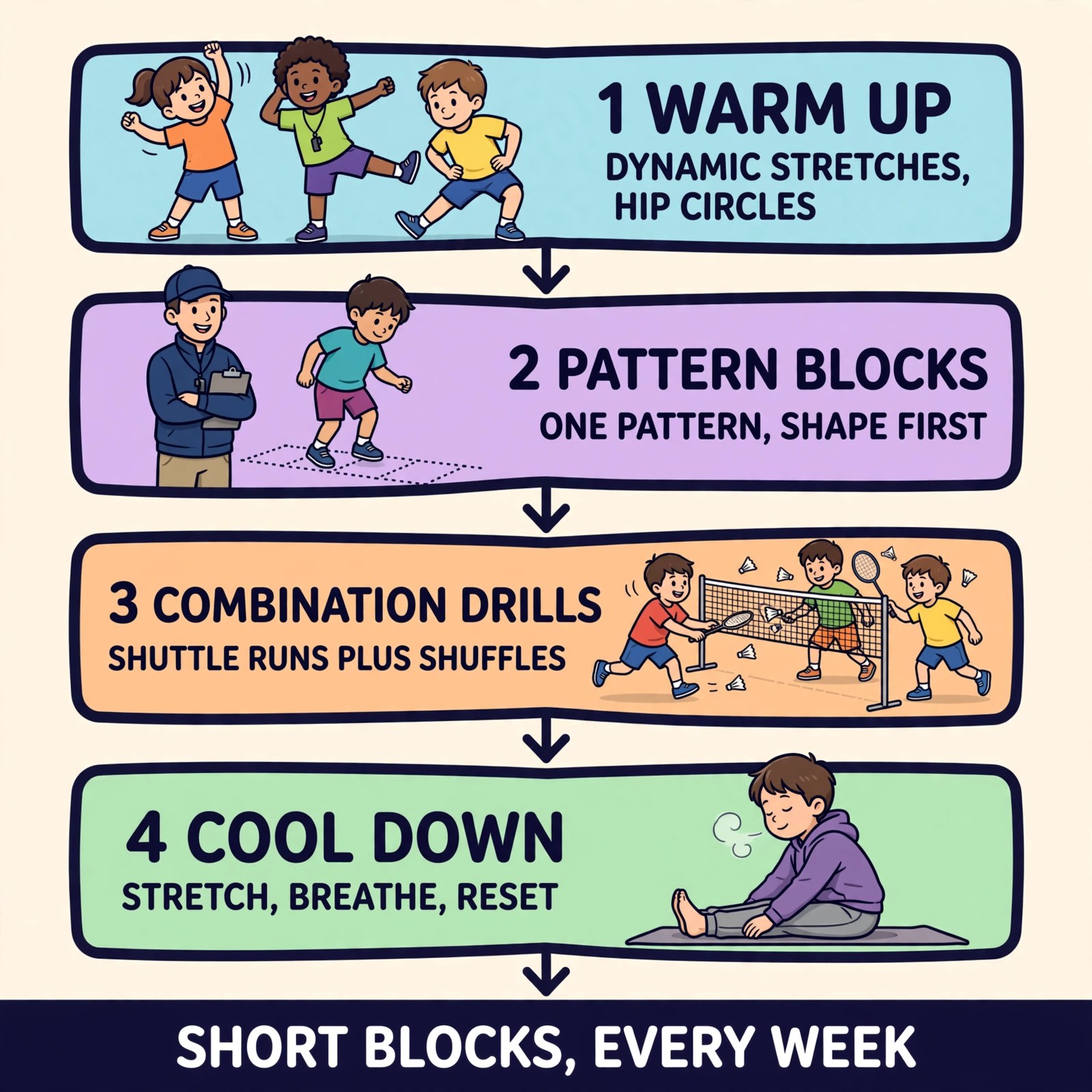
A footwork session at our academy starts with a proper warm-up: dynamic stretching, shoulder rolls and hip circles to open the joints, then light shadow movement so the patterns are awake before the speed rises. Cold muscles and full-speed lunges do not mix, and five calm minutes here save weeks of sore knees later.
Then come the drill blocks. One block repeats a single pattern slowly until the shape is right; the next links patterns together, shuttle runs across the net, then side shuffles down the court, then random corners called by the coach. In group sessions each drill runs about five minutes, with rest built in, so quality stays high and nobody practises tired, sloppy steps.
Sessions end with a cool-down: easy stretching, a few deep breaths, heart rate settling back down. The bigger lesson is rhythm. Footwork improves with short, regular practice, three focused sessions a week beat one exhausting marathon. Muscle memory is built by repetition done well, and that is what carries your feet through the third game.
Myth vs Reality
Myths About Badminton Footwork
Myth: “Fast players are born, not trained.” Reality: Court speed is mostly pattern and timing. Players who split step on time and recover to base look fast with ordinary legs, while naturally quick athletes look slow when their feet start late and finish off balance.
Myth: “More running means better footwork.” Reality: Matches are short bursts, two to four steps, a hit, a recovery. Distance running builds general fitness, but it does not teach a lunge, a chasse or a split step. Myth: “Any sports shoes are fine for footwork drills.”
Reality: Badminton shoes are built for lunges and side movement: a gum rubber sole that grips the court without sticking, and support that stops the foot rolling at the end of a lunge. Running shoes pitch you forward and grip in the wrong places. For footwork training, the right shoes are safety equipment, not fashion.

Why Choose Us
Real Footwork Coaching for Juniors and Adults
Footwork is where small groups pay off most. At ST Badminton Academy Malaysia in Setapak, groups are capped at max 4 students, always. The head coach can see whether your split step lands before the hit, whether your lunge knee tracks straight, and whether you recover after every shot, details that vanish in a big class.
Our head coach, Mr Eric Chuar, has over 15 years of coaching experience in Singapore and Malaysia. His footwork coaching follows a steady order: base and split step first, the six corner patterns second, then speed and pressure only when the shape holds. Students build movement they can still use in the last rally of a long match.
If your feet feel like the weak part of your game, bring them to a session in Setapak, close to Wangsa Maju, Gombak and Danau Kota. One session of honest pattern work usually shows players exactly which step has been costing them points.
FAQs: Badminton Footwork Drills in Malaysia (KL)
Here are answers to common questions from players and parents in Kuala Lumpur about badminton footwork drills and training.
Where can I learn proper footwork drills if I live in Setapak or Gombak?
Train with us in Setapak, we are close to Gombak, Wangsa Maju and Danau Kota, and footwork is built into every session. In small groups of max 4 students, the coach corrects your split step, lunges and recovery one pattern at a time. Book a trial session and feel the difference proper patterns make.
What is the right order to learn badminton footwork in KL?
Start with base position and the split step, then learn the six corner patterns one at a time, lunge, chasse, scissor and side defence. Add speed only when the shape holds, then pressure with random feeding. Skipping steps is why many players move fast in drills but fall apart in rallies.
How often should a player practise footwork drills to reach match level?
Two or three short footwork blocks a week, built into normal training, work better than one long session. Fifteen to twenty minutes of patterns, agility and shadow work at a time is plenty. Consistency builds muscle memory, so your feet keep working late in matches when tired legs usually give up.
Can a player fix slow footwork if they start at 13 or 14?
Yes, 13 or 14 is a great age to fix footwork, because patterns are still easy to rebuild. We strip movement back to base, split step and the six corners, then add speed step by step. Most students feel lighter on court within weeks, and the new habits grow with them.
What badminton tournaments in Malaysia should young players enter?
Start with school competitions, club friendlies and small local open events around Kuala Lumpur and Selangor. That level tests your footwork honestly without overwhelming new players. We prepare students step by step in training, so their first events feel like slightly bigger practice games, with feet that hold up under pressure.
Do you offer footwork coaching near Wangsa Maju?
Yes. Our academy is based in Setapak, a short drive from Wangsa Maju, Melati Utama and Danau Kota. Footwork patterns are part of every small-group session, with shadow work, feeding and agility blocks. Groups stay at max 4 students, so your split step and recovery get corrected every session, not just watched.
Does your academy help players build match-ready footwork in Malaysia?
Yes. Building match-ready footwork is a process we coach directly: base and split step first, then the six corner patterns, then speed, agility and random feeding under pressure. The aim is movement that survives real rallies, early arrival, balance at the hit, and a fast recovery after every single shot.
Where is ST Badminton Academy KL located for footwork training?
We are based in Setapak, Kuala Lumpur, easy to reach from Gombak, Air Panas, Wangsa Maju and nearby areas. Most students train after school or in the evening in small groups of max 4. If you are nearby, come and watch a session first, you will see the footwork blocks for yourself.
What makes Mr Eric Chuar a suitable coach for footwork badminton?
Mr Eric Chuar has over 15 years of coaching experience in Singapore and Malaysia, and he teaches the small groups at our Setapak academy personally. He spots the small things that decide footwork, a late split step, a short lunge, a missing recovery, and fixes them in a safe order.
Badminton Footwork Training in Action



What It Takes to Build Real Court Speed
Good footwork follows the same standards every time: a balanced base, a split step on the opponent's hit, the right pattern for each corner, and a recovery after every shot. Our coaching standards below are the checkpoints we use when we rebuild a student's movement in Setapak.
| Factor | Casual Games | Footwork Training FOOTWORK |
|---|---|---|
| Frequency | 1 or 2 times a week. Mostly for fun and sweat. | Footwork patterns drilled in most sessions: split step, six corners and recovery to base. |
| Drills Focus | Basic static feeding. Minimal footwork pressure. | Multi-shuttle feeding to random corners at match speed, so movement holds up under pressure. |
| Physical Conditioning | Rarely included. Just playing games on court. | Core, agility, and speed training included in every session to prevent injury and build stamina. |
| Tactical Awareness | "Just hit it over." No real game plan. | Video analysis, point construction, and learning to read the opponent's game. |
| Coach Ratio | Large groups (8-10 kids). Coach barely watches you. | Max 4 students. Mr Eric Chuar personally corrects every stroke and movement detail. |
| Goal Setting | Fun and exercise. | Drills scored and timed: clean arrivals at all six corners, not just fast running. |
| Long Term Result | Good recreational player. | A player who arrives early and balanced, with time to choose every shot. |
Badminton Footwork Coaching in Kuala Lumpur
This guide shows how to improve your badminton footwork with drills: base and split step, six corner patterns, agility and balance work, and a steady weekly rhythm. ST Badminton Academy KL provides small-group coaching in Setapak. If you are in Wangsa Maju, Gombak, Cheras or nearby and want a coach to check your footwork, contact us today.






