How To Play Badminton With Focus And Concentration: Techniques And Mindset (Focus Guide)
Badminton rallies are kind to your attention. A shuttle flying at you leaves no room for anything else, and most players discover they can concentrate perfectly well for the nine seconds a rally lasts. The match is lost in the other moments: the walk back to base after an error, the pause before a serve at a tight score, the three points your opponent just won while you were still replaying the first one. Focus and concentration, in real badminton, are mostly about those in between moments. This guide stays inside the rally flow: how to play one point at a time, how a small routine before each point settles the mind, how to give your eyes a job so attention has somewhere to sit, how to reset after errors and distractions, and how to stay level when momentum swings. Nothing here is therapy and none of it is magic. It is habit building, and habits can be practised.

Focus Check #1
One Point at a Time: The Only Point You Can Play
A rally has one honest rule: only the point being played can be won or lost. The point before it is finished, whatever happened, and the points after it do not exist yet. This sounds obvious and is surprisingly hard to live by. Players carry the last error forward like luggage, replaying a missed smash while the next serve is already coming. Others play the future: protecting a lead, fearing a comeback, counting points they have not won. Both habits steal the same thing, the small slice of attention the current rally needs. The score is a summary of the match. It is not an instruction for this shot, and the shot does not improve because you stared at the scoreboard during the break.
Playing the point in front of you has a physical shape. It looks like this: after each rally, a breath and a walk back to base, eyes settling on the opponent and the shuttle, feet set in the ready position before the serve comes. Nothing dramatic. The mind follows the body more often than the body follows the mind, so a player who performs the small actions of readiness usually finds the thoughts arrive in order behind them. Start with the serve points, because they come with a natural pause you control. Serve only when your own small routine is finished. Receive the same way: set before the server is ready, not after. Within a few games, one point at a time stops being advice and starts being simply how points begin.

Focus Check #2
The Pre-Point Routine: Small Steps That Settle the Mind
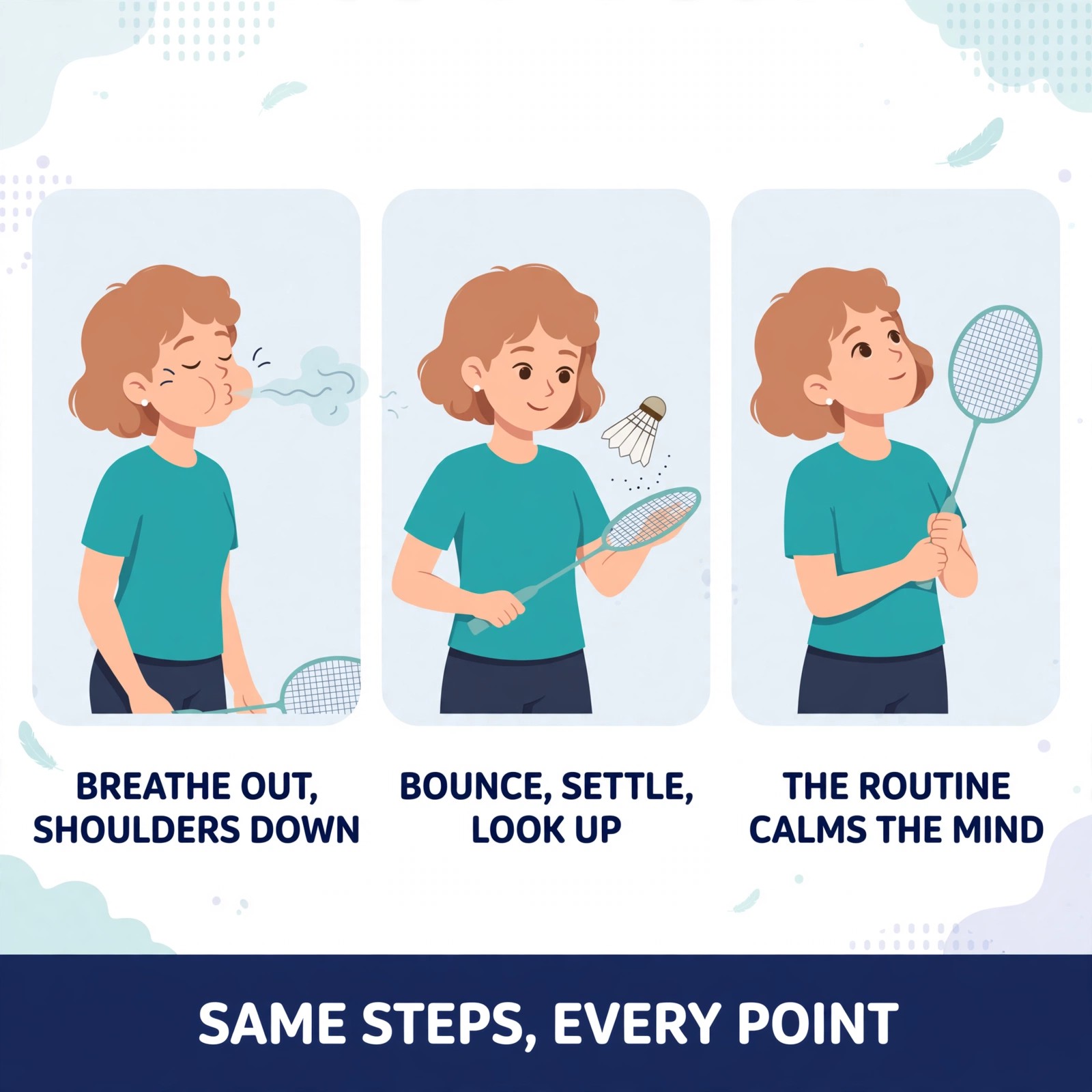
A pre point routine is a short sequence of actions you perform before every point, always the same: perhaps a breath out, two bounces of the shuttle on the strings, a glance at the corner you plan to serve to, and one quiet word. Its power comes from sameness. The brain reads familiar actions as safety. When the same steps happen before a friendly rally and before match point, the second situation borrows calm from the first, because as far as your habits are concerned, this is just another point like the hundreds before it. Routines also give wandering attention a timetable. There is no empty gap in which worry can set up camp, because the next step of the routine is always arriving.
Build your own routine from actions you can perform anywhere, in roughly ten seconds, without disturbing anyone. Breathe out slowly once, letting the shoulders drop. Touch or bounce the shuttle. Look at something specific: the target corner when serving, the server hand when receiving. Finish with one cue word if words help you, something plain like ready, or next, or a reminder of your first shot plan. You need versions for serving and receiving, and they can share most of their steps. What you do not need is a copy of a famous player routine with twelve steps and a superstition attached. A routine you own beats a routine you borrowed, because ownership is what makes it automatic under pressure.
The routine only works in matches if it has lived in practice first. Players happily follow routines in games and abandon them in drills, then wonder why the routine feels fragile when a match tightens. Run it in training: before every feed in a drill, before every serve in a practice game, every time. Coaches can help by leaving a genuine pause between feeds instead of firing the next shuttle instantly, so the pause itself gets trained. Keep the routine short enough that it never delays play or annoys an opponent; it is a personal anchor, not a ceremony. After a few weeks it will feel strange to start a point without it, which is exactly the sign that it has become yours.
Focus Check #3
Eyes on the Shuttle: Simple Anchors for Attention
Attention follows the eyes, so the simplest focus tool in badminton is giving your eyes a clear job. During the rally, the job is the shuttle, picked up as early as it leaves the opponent racket. Early pickup is a focus skill before it is a speed skill: players who watch the shuttle from the moment of contact are not just reacting faster, they are also mentally inside the rally, because there is genuinely nothing else in their visual world. Train it in ordinary hitting by quietly noticing the shuttle spin or the sound of contact. Small noticing tasks like these sound trivial and work remarkably well, because a mind busy watching has no spare capacity for commentary about the score.
Between shots, the useful anchor is the opponent racket and body. A soft, steady gaze toward the other side keeps you connected to the rally without the strain of staring. Staring hard is a common mistake: wide eyes, held breath, a face doing effort. That kind of focus burns out in minutes and blurs at the worst moments. Real concentration in a long match looks almost lazy from outside: relaxed eyes, regular breathing, attention resting on the shuttle and the racket, returning gently each time it slides away. Think of the anchor as a place your attention sits, not a target it grips. When you notice the slide, and you will, the anchor gives you somewhere specific to come back to, which is most of what refocusing ever is.
Words and touch can anchor attention too. Many players use one cue word per situation: calm for receiving serve, forward for net play, patience when defending a lead. Others squeeze and release the grip between points, or touch the strings, a tiny physical full stop that ends one point and starts the next. Keep anchors few and simple. One for the eyes, perhaps one word, perhaps one touch. A pocketful of techniques collapses under pressure; a single familiar anchor survives it. If an anchor stops working for a while, that is normal too. Swap it for another simple one rather than layering three together. The principle never changes: attention rests somewhere chosen, or it rests somewhere random, and chosen beats random over three games.

Focus Check #4
When the Mind Wanders: Resets After Errors and Distractions
Errors are not the problem. The carry over is the problem. A missed smash costs one point. The rushed serve that follows it, played while the mind is still arguing about the smash, costs a second. The tentative net shot after that, played at half commitment because confidence is leaking, costs a third. Coaches call this the error tax, and it is paid by good players and beginners alike. The rally flow breaks not at the mistake but in the ten seconds after it, which is fortunate, because those ten seconds are entirely trainable. You cannot promise yourself fewer errors. You can promise yourself a practised answer to each one, and that answer protects more points than any technical fix at most levels of the game.
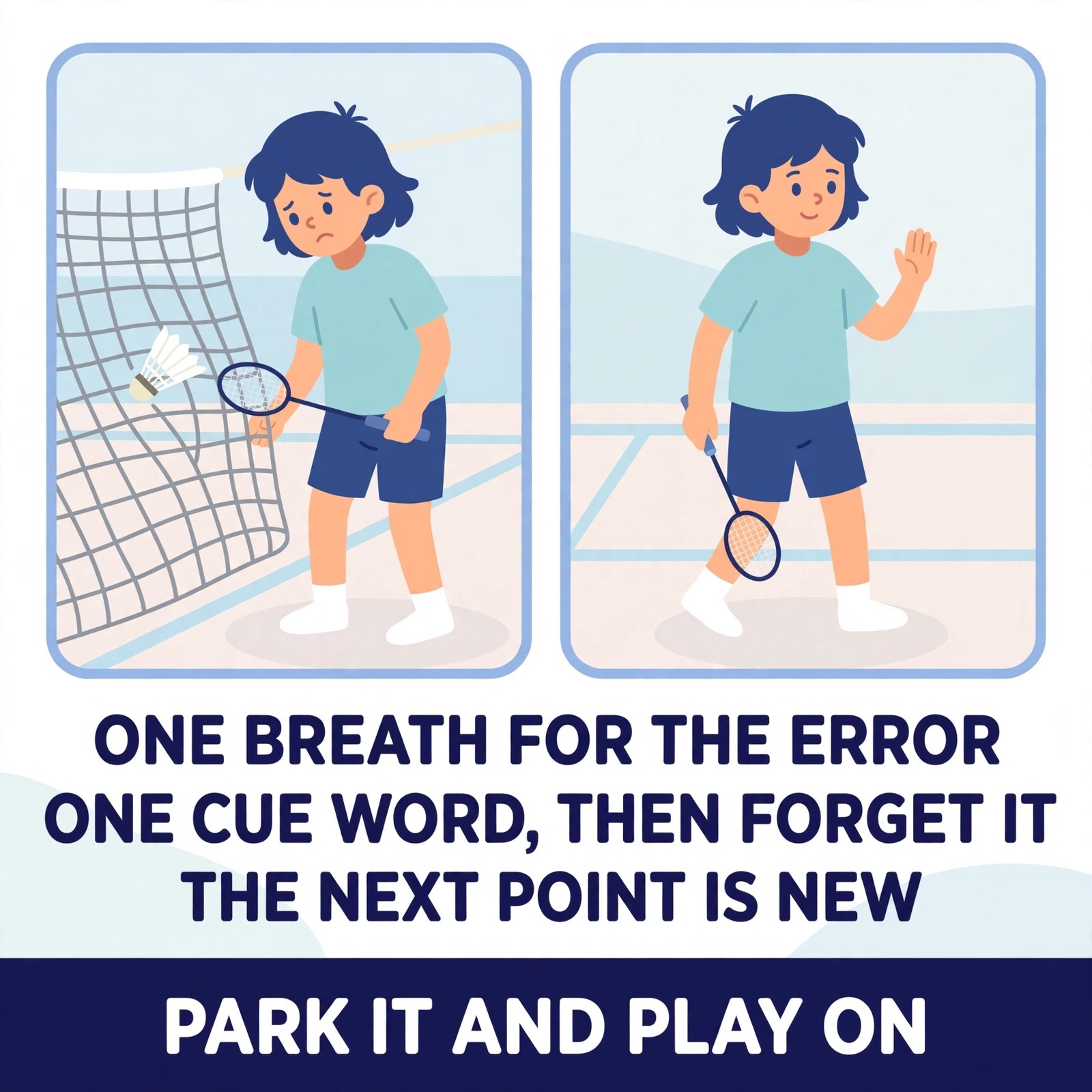
The reset is a sequence, and like the routine it works through sameness. First, breathe out, slowly, all the way: the body cannot stay braced while the breath leaves. Second, turn or walk a step away from the net, a small physical goodbye to the finished point. Third, say your cue word. Fourth, name the plan for the next point in a few words: serve low to the backhand, or push the return deep. Then walk back, set your feet, and play. The whole reset fits inside the normal pause between points, and the breaks the game gives you, towel breaks and intervals, are longer versions of the same tool: slow breaths, one plan, no replaying. Practise the reset after errors in training games until it looks boring. Boring is the goal.
Distractions arrive from outside too: noise from the next court, a disputed line call, an opponent who celebrates loudly or plays mind games with slow serves. The reset handles them the same way, because the mechanism is identical: attention has been pulled somewhere unhelpful, and it needs a route back. Arguing with the moment never works; the call will not change, the hall will not quieten. What works is treating the distraction as just another error to reset from: breath, turn, cue, plan. Between games, use the interval properly. Sit, breathe, review one thing only, the pattern that is working or the one adjustment worth making. Players who flood themselves with five corrections come back scattered. One clear thought is a focus tool. Five thoughts are a committee.
Focus Check #5
Momentum Swings: Staying Level When Games Turn
Every player knows the wave. Three points arrive together, then four slip away, and the match feels like weather: nothing you do changes it, until suddenly it changes itself. Momentum feels mysterious and is mostly mechanical. Runs of points usually follow one small cause: a target that keeps working, a serve the receiver has not solved, or one player rushing and gifting errors while the other simply keeps the shuttle in play. Naming the cause shrinks the wave back to human size. Your shots have not become good or bad in the last two minutes. One pattern is repeating, and patterns can be answered. That thought alone steadies many players, because a wave feels like fate and a pattern feels like a problem with a shape.
When the run is going against you, slow the game down inside the rules. Walk the full distance back to base. Use your whole routine, every step. Choose your highest percentage shots for a few rallies: the clear you never miss, the serve you trust, targets with generous margins. The aim is not caution for its own sake. It is to give your timing two or three honest rallies to return, and to stop feeding the opponent run with rushed gifts. Lengthen rallies if you can; the player enjoying the wave is often playing on rhythm, and long, varied rallies disturb rhythm better than desperate winners. If a towel break or interval is near, value it: breaks end runs as reliably as any tactic, because the wave needs continuity to survive.
When the run is yours, the discipline flips: change nothing. Players sabotage their own waves by getting excited, trying to finish the match in three shots, or experimenting with shots the moment confidence rises. The wave was built by a pattern that works, so keep serving it. Guard the routine most carefully here, because excitement rushes it: the serve that leaves two seconds early, the return played while still walking in. Let the opponent be the one who changes, gambles and rushes. Staying level does not mean feeling nothing. It means your actions look the same at 15-5 up and 5-15 down, same walk, same breath, same plan. Opponents find that deeply discouraging, which is its own quiet form of pressure.

Myth vs Reality
Myths About Focus and Concentration
The first myth says focus means trying harder: clenched jaw, hard stare, total intensity from the first point. Watch what that costs. The player is exhausted by the second game, attention fried by the effort of gripping it, and the smallest distraction shatters the whole performance because it was held together by force. Real focus in badminton is economical. It rises for the rally, rests in the pauses, and is spent where it counts. The calmest looking players on court are often concentrating the best, because they are not wasting attention on performing concentration. If your focus style leaves you mentally drained after one social game, it is not focus. It is acting, and it is too expensive to last.
The second myth says good players never lose focus, as if their attention were welded in place. Talk to honest strong players and a different picture emerges: their minds wander too, mid match, mid rally sometimes. The difference is recovery speed. A club player notices the drift three points later, after the tax is paid. A strong player notices within a point, often within the pause, and the reset fires automatically. Focus, it turns out, is not the absence of drift. It is the shortness of the return trip. That is wonderful news for the rest of us, because return speed is trainable in a way that perfect, unbroken attention is not. Every reset you practise shortens the trip.
The third myth says focus is a talent: you are born a cool head or you are not, and training cannot move it. The evidence of ordinary coaching says otherwise. Put a junior player in conditioned games where the routine is required before every serve, and within a month their error tax shrinks visibly. Teach an adult social player one reset sequence and watch their third games improve, not because their shots changed but because their points stopped travelling in packs of three. Nobody claims training makes everyone identical. Temperaments differ, and some players will always settle faster than others. But the gap between your current focus and your trained focus is large, free to close, and waiting in the pauses you are currently spending on regret.

Why Choose Us
Why Players Choose ST Badminton Academy
At ST Badminton Academy, focus is not a speech before training. It is built into the session structure. Groups are capped at a maximum of 4 students, so the coach can see the pauses as well as the shots: who rushes the serve after an error, who drifts after losing two points, who tightens at the front of a tight game. Those moments get coached on the spot, with a routine or reset fitted to the player, then tested immediately in the next rally. Players learn their own patterns quickly when someone kind and observant names them out loud.
Conditioned games carry much of the focus training. A game might restart the score at a tight margin for the last points, so routines get rehearsed under real pressure. Another might award a bonus point for winning a rally immediately after losing one, which pays players for resetting instead of sulking. Feeding drills include true pauses between feeds, so the pre point routine is practised hundreds of times a month without a single lecture about it. Players in Setapak and across Kuala Lumpur tell us the transfer is what surprises them: the calm they practised at training shows up in their weekend games uninvited, because habits travel where willpower cannot.
Honesty matters here as much as anywhere. Focus training will not fix a broken technique, and it is not a treatment for anything beyond the court; heavy or lasting low mood deserves proper support from a doctor or counsellor, not a coaching tip. What we teach is narrower and genuinely useful: routines, anchors and resets that help you spend your attention on the point being played. Players who build them give away fewer cheap points, recover from errors in seconds instead of games, and enjoy their badminton more, because a mind on the rally is a mind having fun. That is a promise small enough to keep.
FAQs: Badminton Focus, Concentration and Mindset in Malaysia (KL)
Below are the questions players ask us most about focus and concentration at ST Badminton Academy. If your question is not here, bring it to a trial session; focus problems are easiest to spot while you are actually playing.
Can focus and concentration really be trained in Setapak or Gombak?
Yes, focus is a trainable habit, not a personality trait you are born with. Players practise it the same way they practise footwork: small routines, repeated in every drill and game, until settling the mind takes seconds. You will not become a statue of calm. You will become faster at noticing a drift and coming back.
What is a pre-point routine and how do I build one in KL?
A pre point routine is a set of actions you repeat before every point: a breath out, a bounce of the shuttle, a glance at the target, one word. Build yours from steps you can do anywhere in ten seconds, keep it identical in drills and matches, and let the familiarity tell your brain it is time to play.
How do I stop thinking about the last mistake during a match at any level?
Use a reset, the same one every time. Let the breath out slowly, turn away from the net for a second, say your cue word, and name the plan for the next point. The mistake cannot be replayed, but the next point is fully yours. Players who reset quickly give away one point for an error, not three.
The crowd and noise distract me in matches. Should I practise with noise or in quiet?
Practise mostly in realistic noise, because matches will not quieten down for you. Train your anchors during normal busy sessions: eyes on the shuttle, routine before every point, cue word after errors. Save quiet practice for learning new technique. Focus is not the absence of distraction. It is the habit of returning, and returning is trained where distractions live.
How long should a junior player be able to focus in training?
In short bursts, and that is normal for every age. Juniors focus best in focused blocks of a few rallies, followed by a drink, a laugh, and a reset. Coaches build sessions that way on purpose. Concentration grows like stamina: the blocks get longer over months of training, and nobody sensible expects a child to switch on for an hour.
Do you coach focus and match routines near Wangsa Maju?
Yes. Focus work is woven into our normal sessions at the Setapak base and nearby areas including Wangsa Maju. Players practise routines inside drills, resets inside conditioned games, and calm decision making when the score is set tight on purpose. The mind is trained in the same place as the shots: on court, in rallies, under friendly pressure.
Where does ST Badminton Academy teach focus and concentration in Malaysia?
Our base is in Setapak, Kuala Lumpur, and players join us from across the city and from Singapore. Focus and concentration coaching runs inside regular training rather than as a separate talk: routines before points, anchors during rallies, and honest reviews after games. Bring a notebook if you like; your focus log becomes part of your training record.
How do I book a trial session to work on my match focus?
Message us on WhatsApp or through the website and tell us honestly what happens to your focus in matches. We will place you in a small group, watch your routines and resets across a full session of drills and games, and give you straight feedback and one routine to start with before you commit to regular training.
How does Mr Eric Chuar coach focus and concentration for badminton?
He coaches focus the practical way: routines you repeat, anchors you can see, and reviews that name what actually happened to your attention and when. His groups are capped at four students, so he can spot the exact rally where your mind leaves and teach the reset on the spot, while the moment is still fresh and useful.
Focus and Concentration Training in Action


One Standard for Every Session and Every Player
Every session at ST Badminton Academy follows the same coaching standards for focus work. Routines and resets are taught as practical habits, fitted to each player, and practised inside drills and games rather than lectured. Coaches never promise that mindset work replaces technique or fitness, and any player carrying heavy or lasting low mood is pointed toward proper professional support. Progress is judged honestly: not by whether your mind ever wanders, because it will, but by how quickly and calmly you return to the point in front of you.
| Factor | Scattered Mind | One Point Focus FOCUS |
|---|---|---|
| Frequency | 1 or 2 times a week. Mostly for fun and sweat. | A short routine before every point: breathe, settle the feet, pick one simple plan. |
| Drills Focus | Basic static feeding. Minimal footwork pressure. | Errors are parked in seconds: one breath, one cue word, then the next point only. |
| Physical Conditioning | Rarely included. Just playing games on court. | Core, agility, and speed training included in every session to prevent injury and build stamina. |
| Tactical Awareness | "Just hit it over." No real game plan. | Video analysis, point construction, and learning to read the opponent's game. |
| Coach Ratio | Large groups (8-10 kids). Coach barely watches you. | Max 4 students. Mr Eric Chuar personally corrects every stroke and movement detail. |
| Goal Setting | Fun and exercise. | Attention sits on the shuttle and the opponent racket, not on the score or the crowd. |
| Long Term Result | Good recreational player. | A player who stays level: the same routine whether the score is up or down, and points played one by one. |
Badminton Focus Coaching in Kuala Lumpur
Your next point deserves your whole attention, and it can have it. Come to ST Badminton Academy in Kuala Lumpur, build a routine that settles you, learn your reset, and watch your points stop travelling in packs. Small classes, patient coaching, and a calmer head on court, one point at a time.






