Find The Best Badminton Training Camps Near You (Camp Guide)
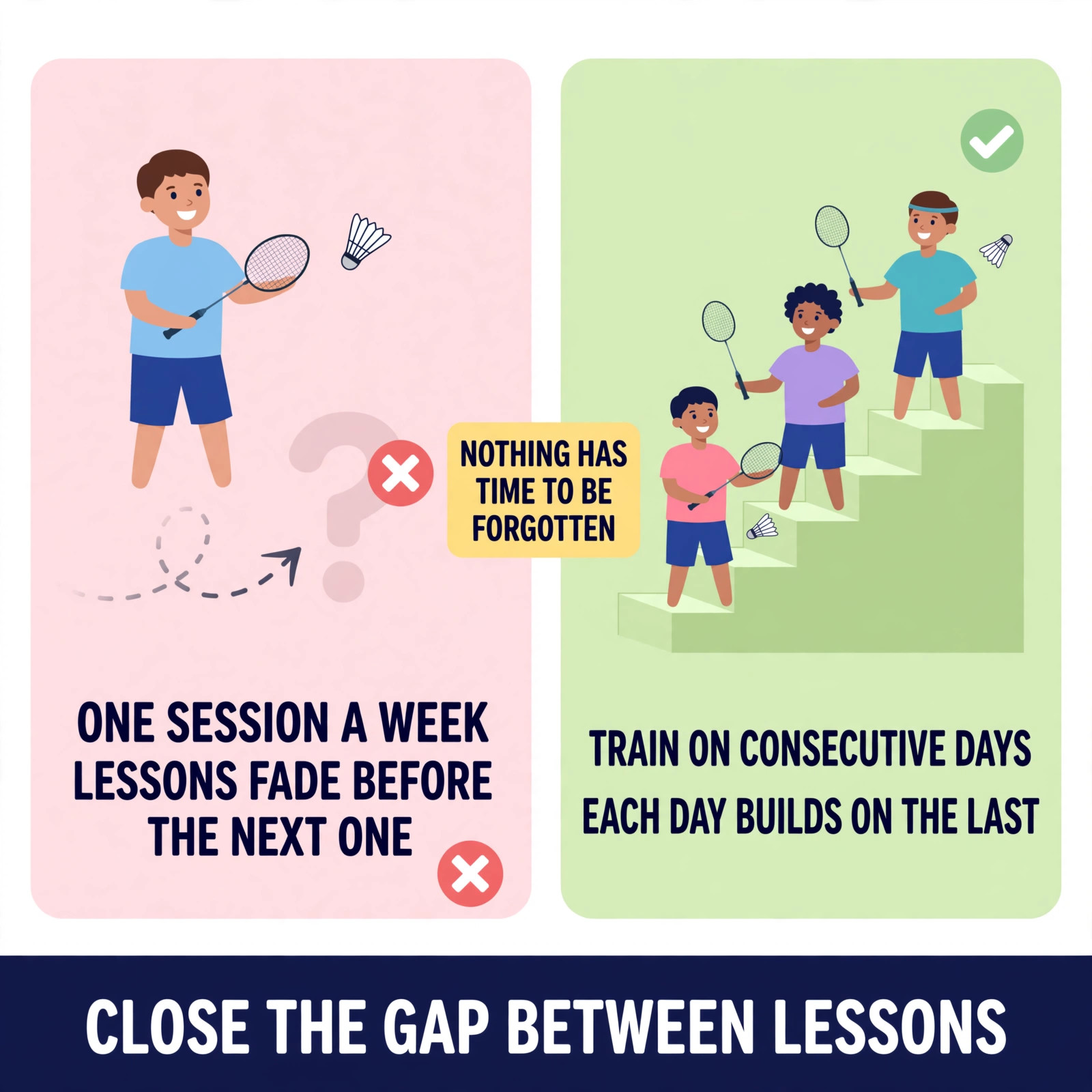
A training camp is different from a weekly class. Instead of one session a week, a camp packs coaching into a block of focused days, so a skill taught on the first morning is drilled, tested in games, and revisited before the camp is out. Players often improve faster in camps for one simple reason: nothing has time to be forgotten between sessions.
This guide explains how to find the best badminton training camps near you in Malaysia: what camps are, the kinds on offer, what to check before you book, what a camp day feels like, and how to make the gains last. Camp dates, venues and fees change from programme to programme, so confirm those with the organiser; what follows is how to judge any camp you are considering.
Camp Check #1
Why a Camp Works: Days in a Row
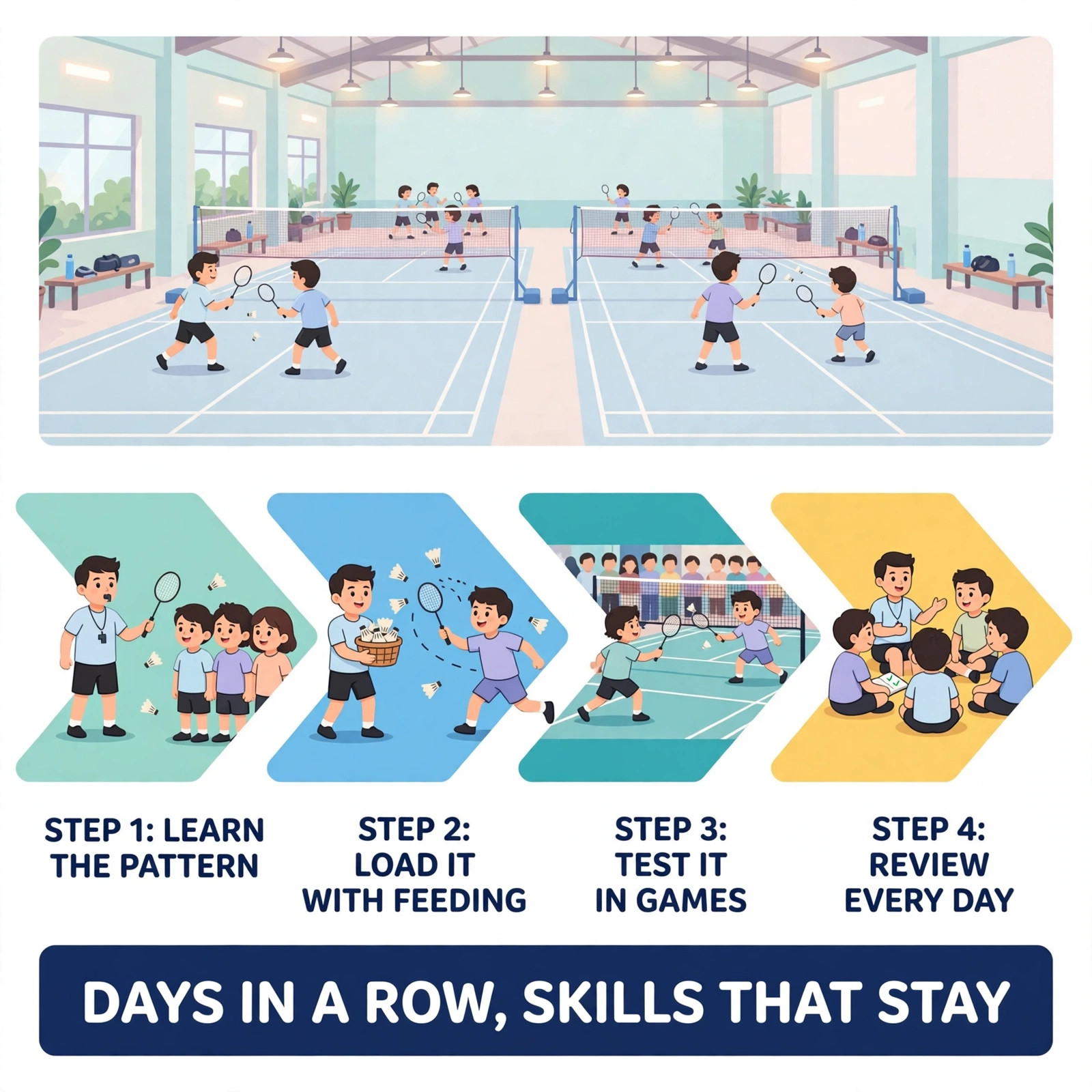
Weekly classes build skills steadily, but a week has a leak in it: by the next session, part of the last lesson has faded. A camp closes that leak. When a player trains on consecutive days, the coach can teach a pattern one day, load it with feeding the next, and test it in conditioned games before the camp ends. The layers land on top of each other while they are still fresh.
Camps also change the training company you keep. A hall full of players who all gave up their free days to improve raises everyone’s standard: rallies run longer, drills run harder, and younger players copy the habits of serious ones. Many players say the camp feeling, being a badminton player all day rather than for one hour, is what finally turns practice into a habit that survives after the camp.
Camp Check #2
Three Kinds of Training Camp
Group camps are the most common kind. Players are grouped by level and train together through the programme: technique blocks, feeding, footwork, conditioned games and matches. A good group camp keeps groups small enough for the coach to correct individuals, and mixes the groups for games so players meet new styles. This is the right shape for most players, and the one to look for first.
Private and small intensive camps trade the crowd for attention. One player, or a pair, works with a coach on a short list of problems: a weak backhand corner, a serve that keeps getting attacked, a tournament coming up. The days can be shaped exactly around the player, but the trade-off is fewer fresh opponents, so most players use this kind of camp to fix something specific.
Clinic-style camps sit between the two: a short course built around one theme, such as doubles rotation, net play, or tournament preparation, often over a weekend or a few sessions. Clinics suit players who already train weekly and want one part of their game rebuilt properly. Whichever kind you look at, the questions to ask are the same, and the next section lists the ones that matter.

Camp Check #3
What to Check Before You Book
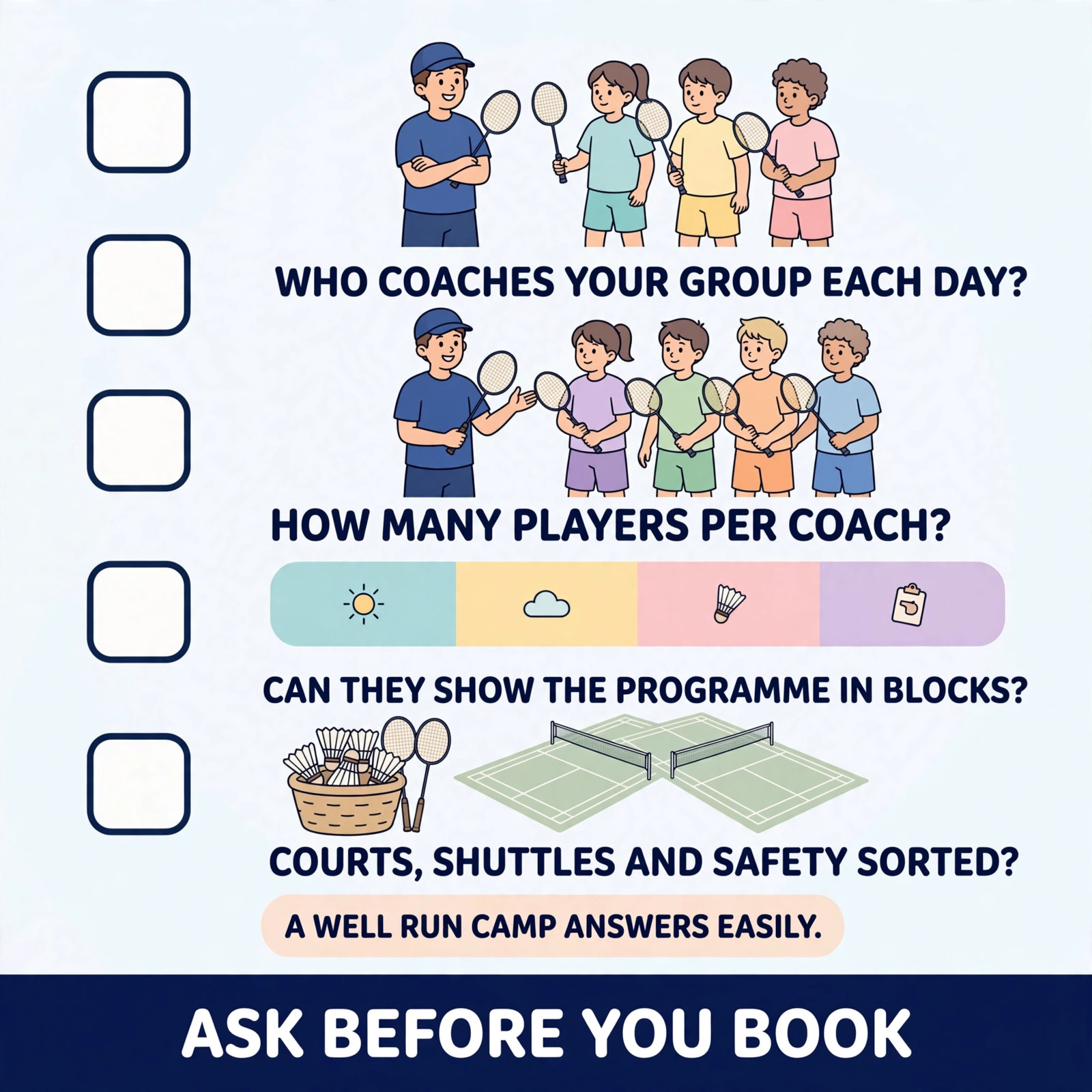
Start with the coaching. Who actually coaches on court each day, and how many players does each coach watch? A camp where one coach feeds two courts of twenty players is a hitting hall, not coaching. Our own academy’s standard is a max of 4 students per group in regular classes; for a camp, ask plainly what the ratio is, and be wary of answers that stay vague.
Then ask for the programme. A serious camp can describe its days in blocks: warm-up, technique theme, feeding and drills, games, review. It can tell you how players are grouped, how progress is checked, and what a player at your level will work on. A camp that can only promise hard training and famous names has not shown you a programme. Ask what happens on the last day too: a good camp ends with matches and a review, not just exhaustion.
Finish with the practical checks. Are the courts proper badminton courts with mats and nets at the right height, 1.55 metres at the posts and 1.524 metres in the centre? Who provides shuttlecocks, and are they feather or nylon? What should players bring? What is included, and what costs extra? How are injuries handled, and who do parents contact during the day? None of these questions is rude. A well-run camp answers them easily, because it has answered them before.
Camp Check #4
Inside a Camp Training Day
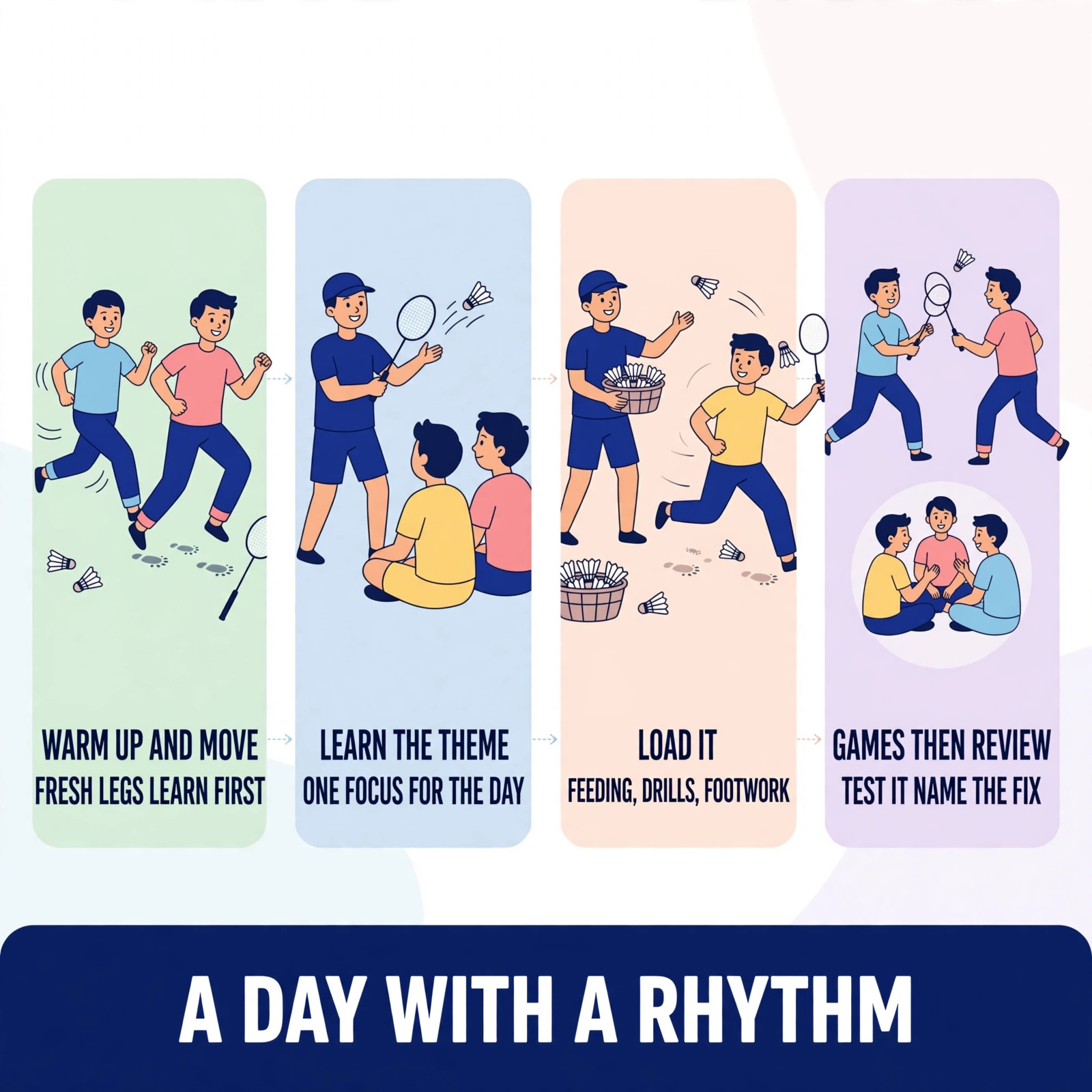
A camp day has a rhythm, even though exact timings differ from camp to camp. Most begin with a warm-up and movement work while legs are fresh: jogging, mobility, shadow footwork. Then comes the technique block, the teaching heart of the day, where one theme is explained, demonstrated and drilled with the coach correcting as you go. Mornings suit this work, because minds and legs learn fastest before fatigue arrives.
The middle of the day usually loads the theme: multi-shuttle feeding at higher speed, pattern drills, and footwork under pressure. This is where fitness grows quietly, because the work is badminton-shaped: short bursts, recoveries, direction changes. Coaches watch the quality line carefully here. When steps get heavy and landings get loud, good camps rest players or switch the work, because tired reps teach tired technique.
Camp days end with games: conditioned games that reward the day’s theme, then freer matches where players test it for real. A short review closes the day: what improved, what still leaks, what tomorrow will work on. Expect to be tired, and expect the good kind of tired: used legs, a clear head, and one or two fixes you can name. If a camp leaves players only sore and confused, the programme is missing its teaching blocks.
After the Camp
Making a Camp Count for Months
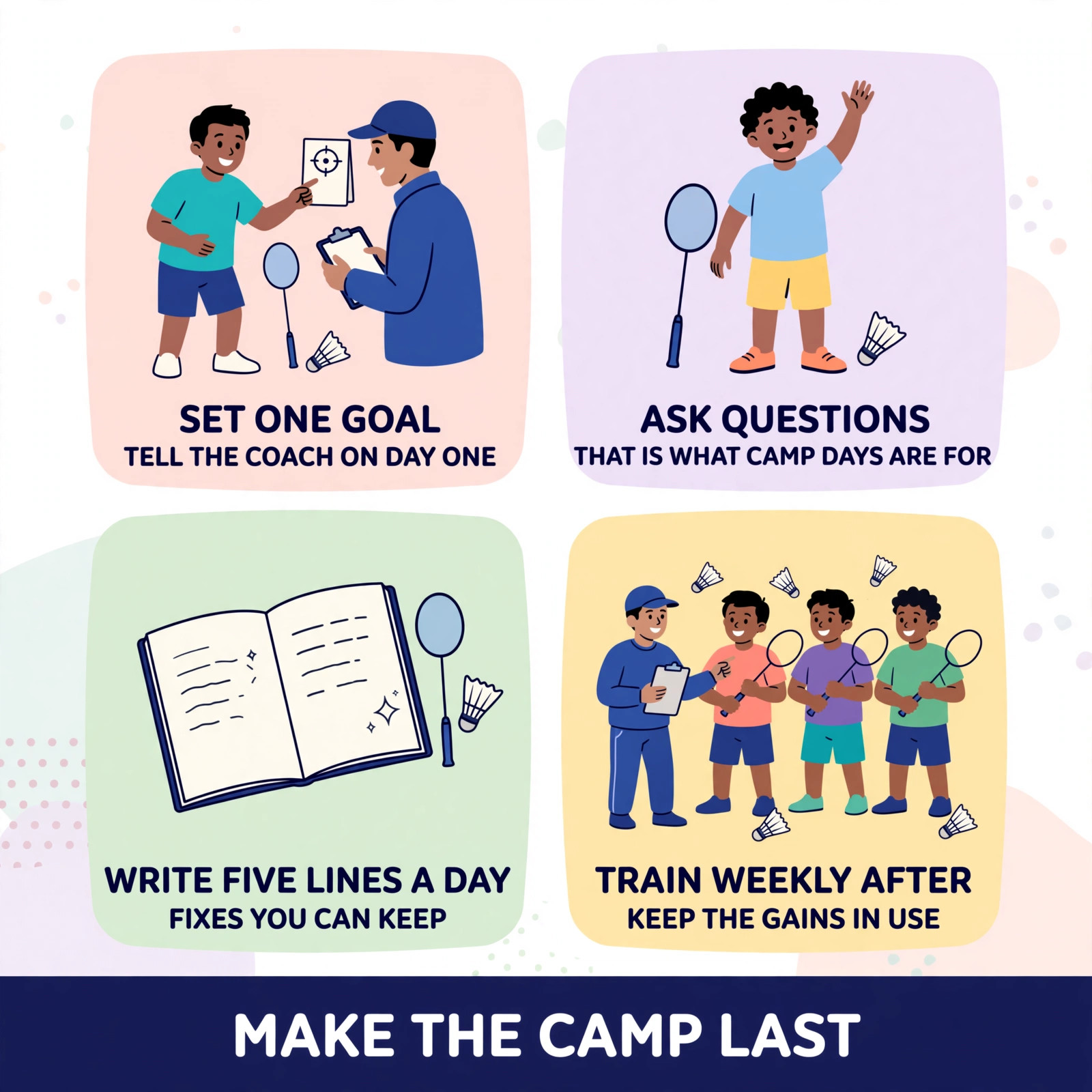
Before any camp, set one goal. Not five, one: the backhand corner, the low serve under pressure, staying calm at close scores. Tell the coach on the first morning. A named goal turns a camp from a busy week into targeted training, and it gives the coach a reason to watch the exact rallies where your problem lives. Players who drift through camps hoping to improve everything usually improve nothing they can point to.
During the camp, ask questions and write things down. Coaches expect questions at camp; that is what the days are for. Keep a small notebook or a notes page on your phone: the fix for your clear, the footwork cue that worked, the pattern to practise at home. Five lines a day is enough. Players forget most verbal coaching within days; the ones who note it down carry it into the rest of their season.
After the camp, the gains need somewhere to live. A weekly class or regular group games keep the new habits under use, and your notebook sets the practice list. If no camp runs near you at the right time, the alternatives are real ones: a block of private lessons on one problem, or a coached weekly group with a clear programme. What matters is structured days with a coach’s eye on you, not the word camp on the banner.
Myth vs Reality
Myths About Training Camps
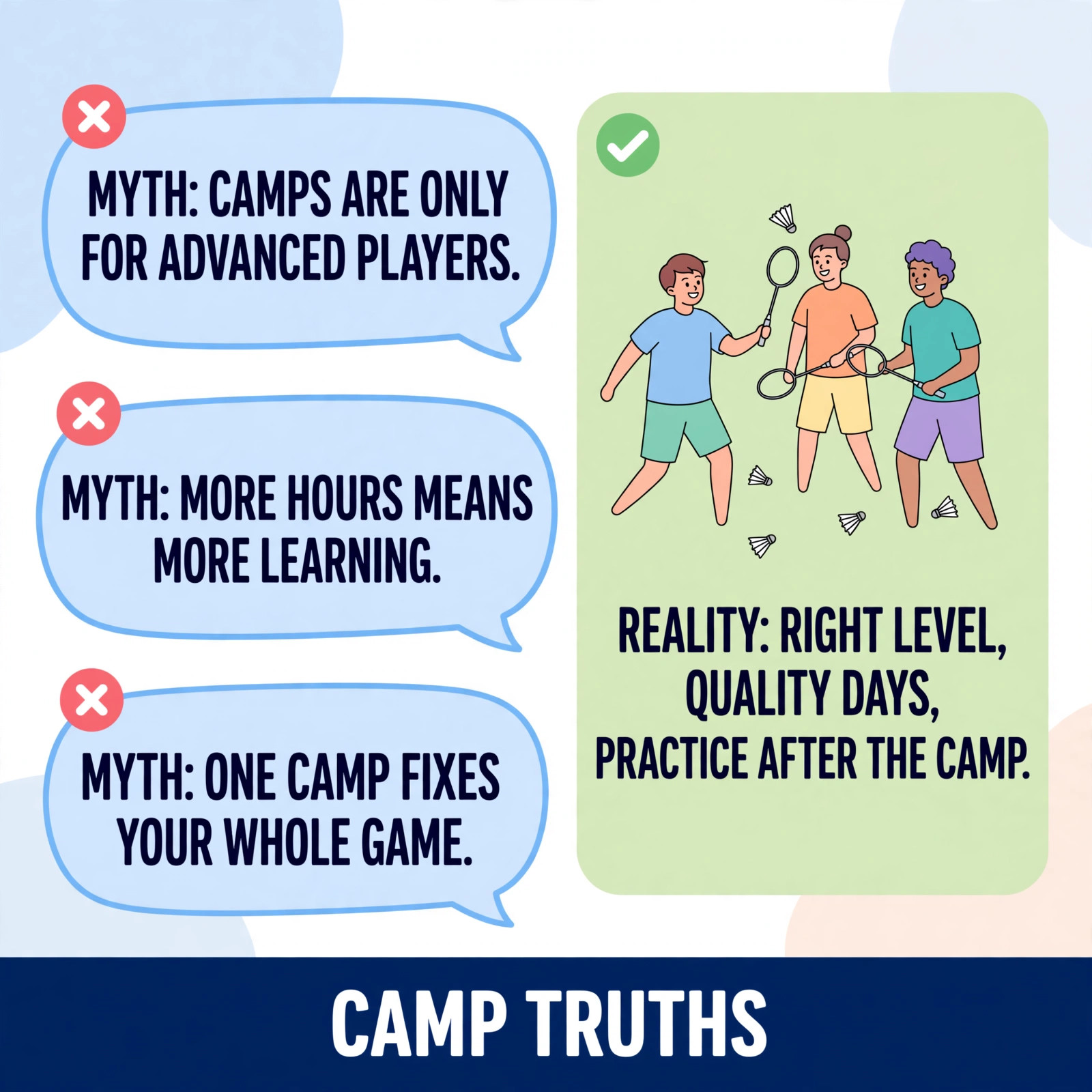
Myth: “Training camps are only for advanced players and future state players.” Reality: camps exist at every level, and beginners often gain the most, because a block of days can build grip, footwork and basic strokes in the right order before bad habits form. The question is never whether you are good enough for a camp. It is whether the camp groups players at your level and teaches at that level honestly.
Myth: “The best camp is the one with the longest training hours.” Reality: more hours of tired, sloppy reps teach sloppy technique. Quality camps protect rest, food and sleep as part of training, because players learn between sessions as much as during them. Myth: “A camp fixes your game in one go.” Reality: a camp finds and fixes your biggest leaks and hands you a practice list. The months after decide how much of it stays.
Myth: “A famous coach’s name on the poster guarantees a great camp.” Reality: what matters is who coaches your group, on your court, each day, and how many players they watch. A small camp with a working coach who corrects every rep beats a big name who appears for a photograph. Judge the programme, the ratio and the daily review, and let the poster’s names impress you last.
Why Choose Us
Coaching Built Like a Good Camp
At ST Badminton Academy KL, our regular coaching already runs the way a good camp should: groups capped at max 4 students, a theme for every session, feeding, games, and a review of what to fix next. Players who train with us weekly often treat a holiday training block as a camp: several focused days that push one part of the game forward quickly.
Mr Eric Chuar has over 15 years of coaching experience in Singapore and Malaysia. His camp advice to parents is plain: ask who coaches, ask how many per group, ask what the days look like, and ask what your child will be able to do afterwards that they cannot do now. A camp that answers those four questions well is worth your days, wherever it runs.
Our academy is based in Setapak, Kuala Lumpur, convenient for players from Wangsa Maju, Melati Utama, Danau Kota and Gombak. Camp dates, venues and fees change from programme to programme, so we do not print them here: message us and ask for the current camp details, and we will tell you what is running, who it suits, and what it includes, before you decide anything.
FAQs: Badminton Training Camps in Malaysia (KL)
These are the questions players and parents ask us most about badminton training camps in Malaysia. If your question is not here, message us, tell us your level and what you want from a camp, and we will give you a straight answer about what to look for and what is currently running.
How do I find a good training camp if I live in Setapak or Gombak?
Start with the coaching, not the poster. Ask who coaches your group each day, how many players each coach watches, and what the days look like in blocks. In Setapak, our academy groups are capped at max 4 students, and we will happily tell you what any camp should be able to promise before you book.
What should I check first when I compare camps in KL?
Check the ratio first: how many players one coach actually watches on court. Then ask for the programme in blocks, how players are grouped by level, and what the last day looks like. A camp that answers clearly, including what is not included, is already ahead of one that only promises hard training and famous names.
How much training fits into a camp day at a steady level?
It varies from camp to camp, so ask the organiser for the day plan rather than trusting a headline number. What matters is the shape: teaching blocks while players are fresh, loading work in the middle, games and a review to close. Long hours of tired reps teach less than shorter days done at full quality.
Can a school player join a training camp while still in school?
Yes, camps are often where school players improve fastest, because a block of days builds skills in the right order and the games test them daily. Look for a camp that groups by level rather than mixing everyone together, and ask how younger players are supervised during breaks. The right group matters more than the camp’s name.
What should I pack for the first training camp I enter?
Bring a racket you swing comfortably, non-marking court shoes, a towel, a water bottle and a change of shirt. Pack a small notebook too: five lines of fixes a day is what turns camp coaching into season-long improvement. Ask the organiser beforehand whether shuttlecocks and meals are provided, because that differs from camp to camp.
Do you run badminton training camps near Wangsa Maju?
Our academy base is in Setapak, a short drive from Wangsa Maju, Melati Utama and Danau Kota, and camp programmes run from there when scheduled. Dates and venues change between programmes, so message us for the current camp details: what is running, which levels it suits, what a day looks like, and what is included before you book.
Does your academy run training camps and holiday programmes in Malaysia?
Yes, ST Badminton Academy runs coached training in Malaysia in small groups capped at max 4 students, and camp-style blocks when programmes are scheduled. Tell us your level and the part of the game you want to push forward, and we will tell you honestly whether a current programme fits, or whether weekly classes serve you better.
Where is ST Badminton Academy KL located for camp training?
ST Badminton Academy KL is based in Setapak, Kuala Lumpur, convenient for players from Wangsa Maju, Melati Utama, Danau Kota and Gombak. Our regular classes run in small groups of max 4 students. For camps, message us before you plan anything and we will confirm the current programme, venue and what to bring.
What makes Mr Eric Chuar a suitable coach for camp training and badminton?
Mr Eric Chuar has over 15 years of coaching experience in Singapore and Malaysia, and camp training is where his structure shows: one theme a day, feeding that loads it, games that test it, and a review that names the next fix. Players leave his sessions knowing exactly what improved and what to practise next.
Badminton Training Camps in Action




What It Takes to Use a Camp Well
A player uses a camp well when five habits hold: one clear goal is set before the first day, questions are asked while the coach is there, fixes are written down daily, rest and food are treated as part of training, and a weekly session afterwards keeps the gains alive. Our camp standards below are the checkpoints we use.
| Factor | Drifting Through | Using the Camp GOALS |
|---|---|---|
| Frequency | 1 or 2 times a week. Mostly for fun and sweat. | One clear goal set before the first day, shared with the coach on the first morning. |
| Drills Focus | Basic static feeding. Minimal footwork pressure. | The programme checked in blocks: teaching, loading, games and a daily review. |
| Physical Conditioning | Rarely included. Just playing games on court. | Core, agility, and speed training included in every session to prevent injury and build stamina. |
| Tactical Awareness | "Just hit it over." No real game plan. | Video analysis, point construction, and learning to read the opponent's game. |
| Coach Ratio | Large groups (8-10 kids). Coach barely watches you. | Max 4 students. Mr Eric Chuar personally corrects every stroke and movement detail. |
| Goal Setting | Fun and exercise. | Fixes written down each day, then practised in weekly sessions after the camp. |
| Long Term Result | Good recreational player. | A player who leaves with named improvements and a practice list for the season. |
Badminton Training Camps in Kuala Lumpur
This page covered badminton training camps: why a block of focused days works, the kinds of camps on offer, what to check before booking, what a camp day looks like, and how to make the gains last. ST Badminton Academy KL coaches in small groups of max 4 students in Setapak. Message us for current camp details.






