Badminton And Dynamic Stretching: Techniques For Improving Mobility And Flexibility (Dynamic Guide)
Watch the first rally of a cold player and you can read the warm-up they skipped. The lunge is short, the turn is stiff, the overhead reach is a negotiation. Ten minutes later the same player looks like a different athlete, because muscles, joints and nerves all work better warm. Dynamic stretching is the bridge between the car park and that tenth minute: controlled movement through a growing range, done before play, that raises temperature, wakes the joints and rehearses the shapes badminton is about to demand. This guide covers dynamic stretching the way we teach it at ST Badminton Academy in Setapak, Kuala Lumpur: how to check your starting range, the movements that matter, and a ten minute routine that fits before any session.

Mobility Check #1
Why Cold Muscles Start Slow
Cold muscles are not lazy muscles, they are unprepared ones. Blood flow is low, the fluid in the joints is thick, and the nervous system has not yet mapped the ranges you are about to use at speed. Ask cold tissue for a full split step lunge or a fast overhead reach and it answers slowly, and sometimes it answers with a strain. The first rallies of a session are the fastest way to find every stiff corner of your body. A moving warm-up finds them gently, at walking pace, while there is still time to do something about what you find.
This is also where dynamic stretching parts company with the old habit of long, still holds before play. Holding a deep stretch on a cold muscle can temporarily blunt the power you ask for next, and it does nothing to rehearse speed. Movement does both jobs: each swing, circle and lunge takes the joint a little further than the last one while the temperature climbs. Range earned by moving is range the body trusts at speed. That trust is the real product of a warm-up, and it is why our academy’s first ten minutes are always on the move.

Mobility Check #2
Know Your Starting Range
Before you fix your range, measure it. Three checks cover most of a badminton player’s map. First, a deep squat: can you sit low with heels down and chest up. Second, a full lunge: can the trunk stay tall while the front knee bends deeply. Third, an overhead reach: can both arms travel up and back freely, without the lower back arching to help. None of these need equipment, and none of them are pass or fail tests. They are a starting photograph. Retake it every month or so, and your warm-up stops being guesswork.
Most adult players find the same stiff addresses: hips shortened by desk chairs, ankles that lost their bend years ago, and shoulders that reach forward all day toward keyboards and steering wheels. Juniors hide their stiffness better, but tight hamstrings and sleepy ankles show up there too. The point of checking is aim. A player whose ankles are the stiff link should spend warm-up minutes differently from a player whose shoulders limit the clear. Ten generic minutes help everyone a little. Ten aimed minutes change the corner that was costing you rallies.
A warning about honesty: range checks are information, not a competition. Never force a check position to match a partner, and never treat pain in a joint as a score to beat. Sharp pain, pinching or one side suddenly far worse than the other are reasons to get checked properly, not reasons to stretch braver. Dynamic work is gentle by design. Its job is to tell the truth about your body at walking pace, so match pace never has to deliver the news.

Mobility Check #3
Legs, Hips and Trunk: The Moving Set
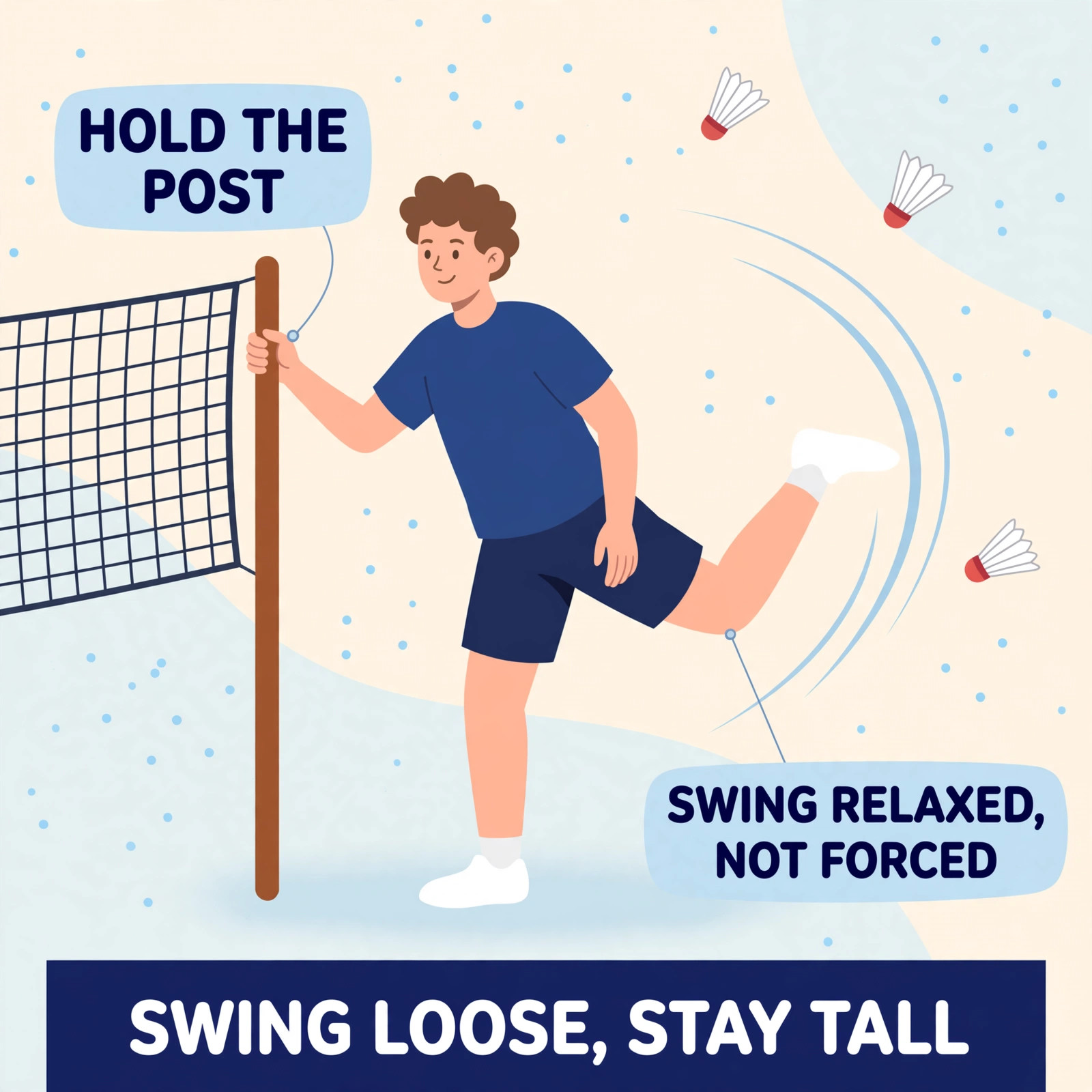
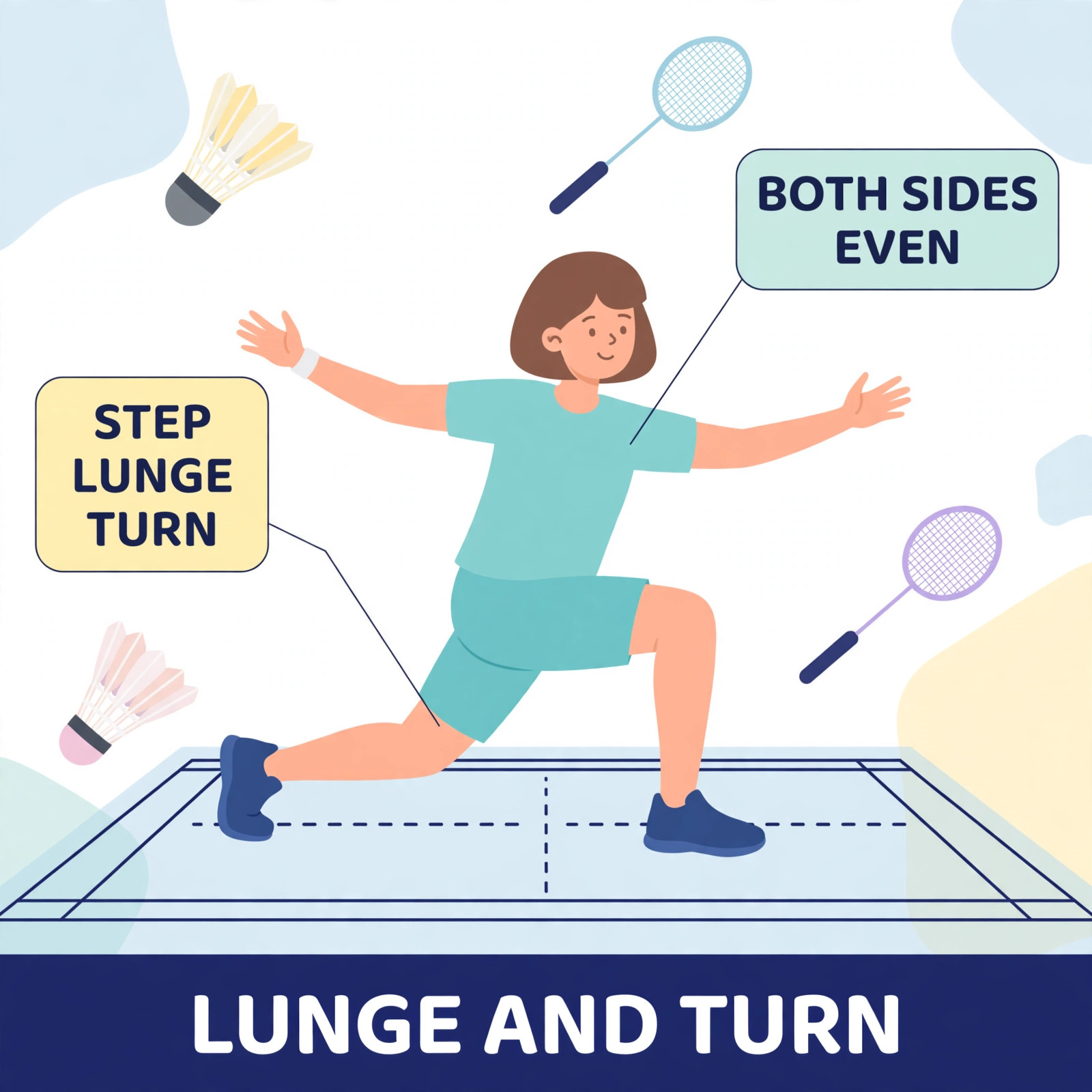
The legs start the moving set, because badminton starts there. Leg swings come first: holding a net post or a wall, swing one leg front to back like a pendulum, relaxed, letting the arc grow over ten or fifteen swings, then side to side across the body. Walking lunges follow, long steps with a tall trunk, sometimes with a gentle rotation over the front leg. Hip openers, lifting the knee and turning it out like stepping over a gate, wake the joint that desk life puts to sleep. Everything is controlled. Nothing is kicked, bounced or forced.
The trunk is the bridge between the legs and the racket, and it warms up like one. Standing rotations with arms wide, turning smoothly left and right, teach the spine to rotate the way a clear or a smash will ask it to. Gentle side bends and cat-like rounding and arching of the back, done standing or on all fours, move the spine through its ranges before the game loads them. Players are often surprised how much of their early stiffness was trunk, not legs. Warm the bridge and both ends work better.
Technique in dynamic work is mostly about the word growing. The first swing is small. The fifth is bigger. The tenth approaches the range the game will use, reached without a single forced moment. Breathing stays easy, the face stays relaxed, and the speed stays honest: every movement should look like something you could stop mid way if asked. If a movement needs momentum and a grimace, it is not a warm-up movement any more. Control is the quality that transfers to the court, so control is what we practise.

Mobility Check #4
Shoulders, Arms and Shadow Swings
Shoulders carry the overhead game, and they warm up in circles. Start with small arm circles, forward and back, and let them grow round by round until the arms are painting the biggest smooth circles you own. Shoulder rolls, slow and full, forward then backward, free the neck and the top of the back. Cross body arm swings, opening wide then wrapping across the chest, rehearse the two directions every clear and drive will use. Two minutes here is the difference between an arm that is asked and an arm that is ready.
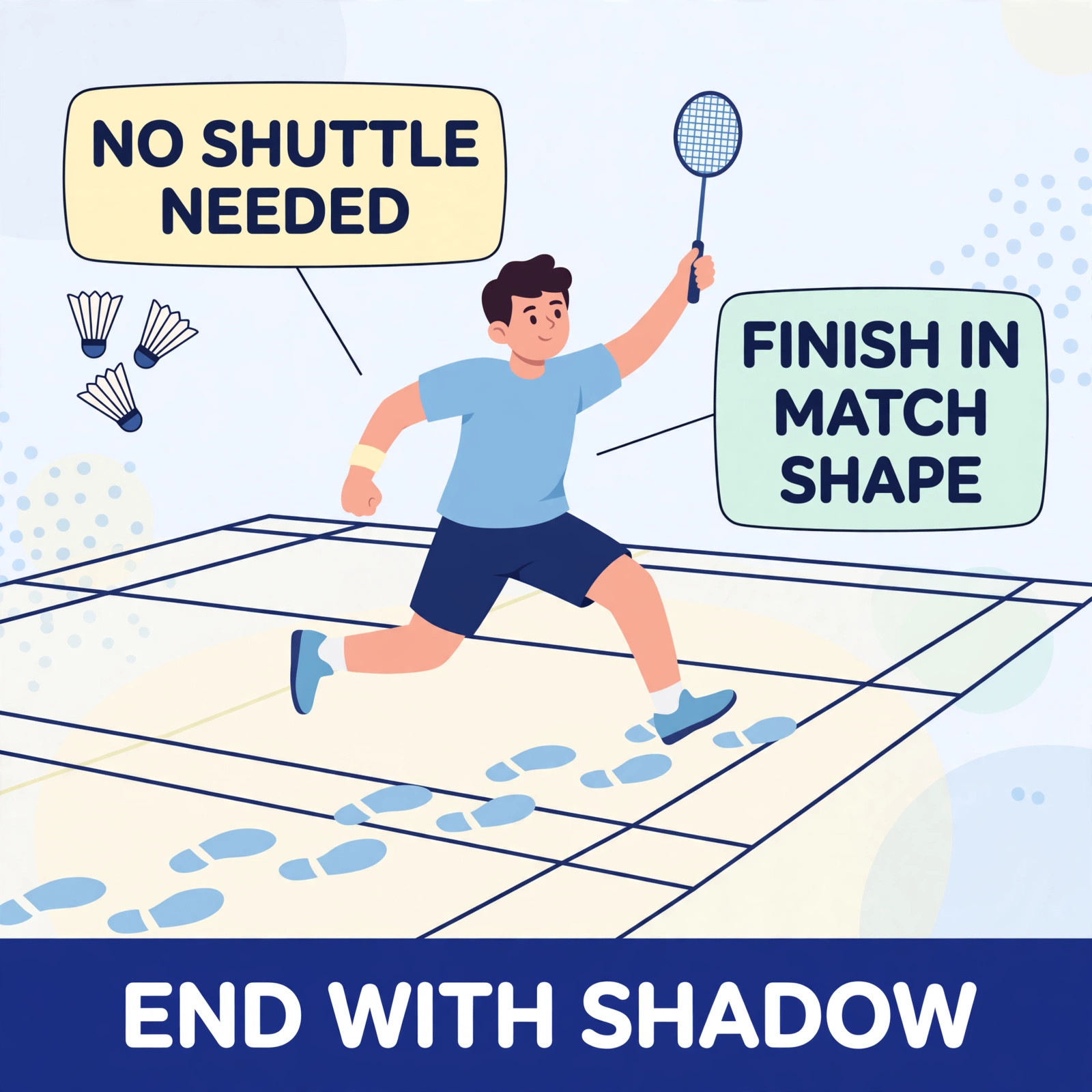
The racket joins last, and that order matters. Shadow swings copy the shots without a shuttle: slow clears with a full reach, gentle drives at shoulder height, easy net shapes at the front. The shadow is where the warm-up stops being general and becomes badminton. By the time the racket is moving, the legs have swung, the trunk has turned and the shoulders have circled, so the shapes you rehearse are the shapes of a warm body, not the stiff rehearsal of a cold one.
Finish the moving set with footwork patterns themselves, because they are the truest warm-up of all. Easy shadow footwork to the corners at half pace, then three quarter pace, split steps at base, lungs waking up corner by corner. A player who ends the warm-up moving like the game rarely needs the first rally to find their feet. The warm-up has already played it for them, quietly, at a pace the body could learn from. That is the whole idea: arrive at the first rally already being the player the tenth rally needs.

The Routine
Ten Minutes Before Every Session
Put it together and the routine writes itself. Minute one and two: easy jogging around the court and gentle joint circles, wrists, shoulders, hips, knees, ankles. Minutes three to six: leg swings, walking lunges, hip openers and trunk rotations, range growing rep by rep. Minutes seven and eight: arm circles, shoulder rolls and cross body swings. Minutes nine and ten: shadow swings, then shadow footwork at rising pace. Ten minutes, the same order every session, so the routine becomes a habit your body starts before your brain has finished tying your shoes.
Dose matters more than invention. This routine belongs before every session and every match, not as a special event when you feel stiff. Dynamic stretching is preparation, not treatment: it will not fix an injury, and it is not the place to chase new range. Range building belongs after play, in the cool-down, where held stretches on warm muscles slowly do that work. Keep each job in its place and both jobs get done properly. Players who mix them up usually get neither: a warm-up that tires, and stretching that never builds.
One last habit makes the routine stick: start it together and start it on time. Groups that warm up together police each other’s range, notice each other’s stiff days, and arrive at the first drill as a team instead of as four late arrivals. At our academy the warm-up is coached like any other part of the session, with the coach’s eyes on the checks from the earlier sections: whose ankles are tight today, whose shoulder is quiet. Ten minutes is a small price for a body that tells the truth early.

Myth vs Reality
Myths About Dynamic Stretching
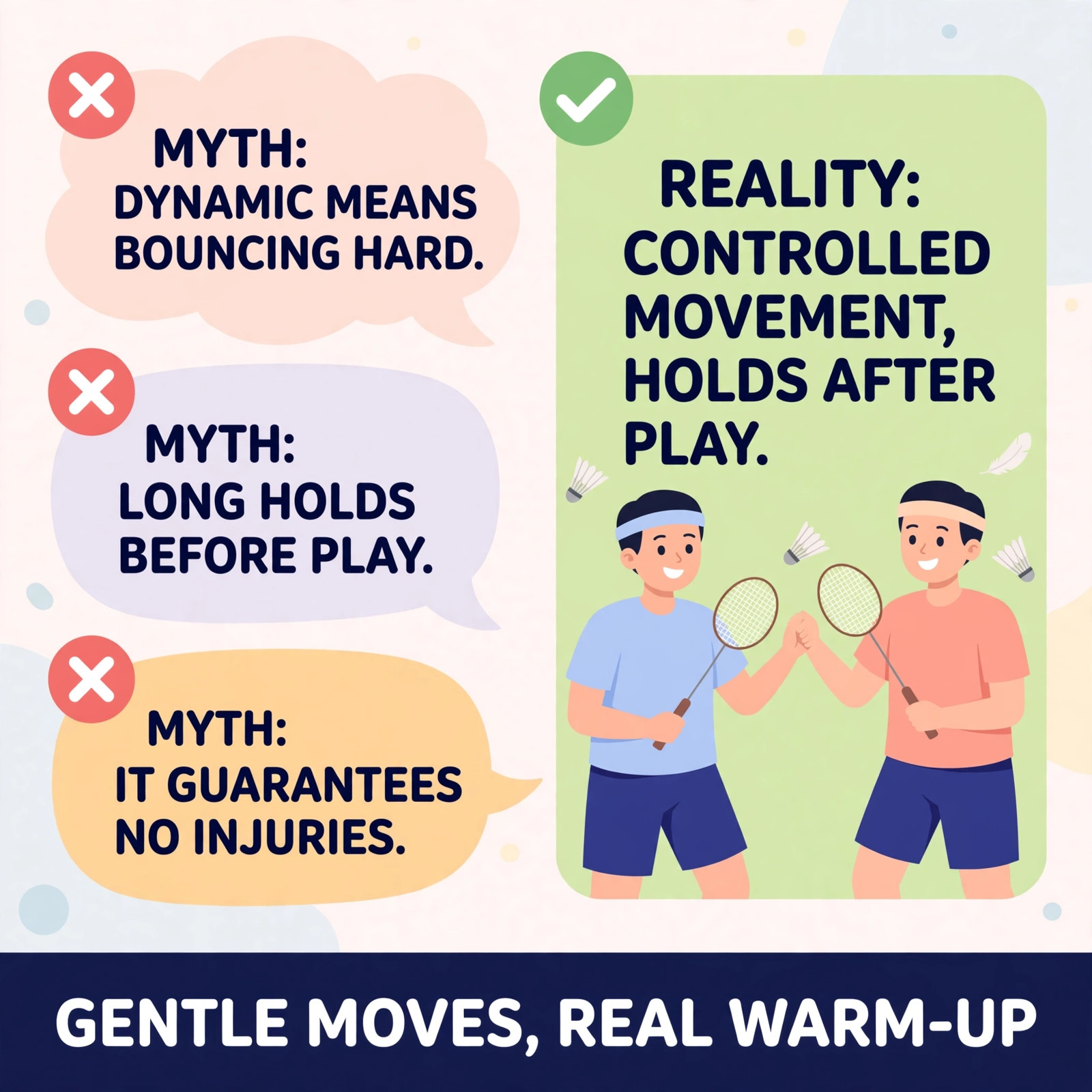
Myth: “Dynamic stretching means bouncing hard at the end of your range.” Reality: dynamic work is controlled movement through a growing range. The moment a swing needs a bounce or a grimace, it has stopped being a warm-up and started being a risk.
Myth: “Long, still stretches before play are the best preparation.” Reality: holds on cold muscles can blunt power and rehearse nothing. Warm up by moving; save the holds for the cool-down. Myth: “A good warm-up guarantees no injuries.” Reality: a warm body is a prepared body, and preparation lowers risk. It promises nothing, and anyone who promises more is selling something.
Myth: “Only stiff players need to warm up; flexible players can start cold.” Reality: warmth is about temperature and readiness, not just range, and even the loosest player moves better in rally ten than rally one. Myth: “Ten minutes is too long to spend before playing.” Reality: ten minutes is the cheapest performance work in the sport. The first game pays it back.
Why Choose Us
Dynamic Warm-Up Coaching for Badminton Players
At ST Badminton Academy KL, the warm-up is coached inside small group classes capped at max 4 students, not left as a private habit at the edge of the court. In groups that small, the coach runs the same checks this guide teaches, watches whose hips and ankles are limiting the day, and adjusts the moving set to the bodies actually present.
Mr Eric Chuar has over 15 years of coaching experience in Singapore and Malaysia. His warm-up rule is plain: move first, hold later, and let the range grow on its own schedule. He reads a player’s warm-up the way he reads a rally, looking for the stiffest link, and he would rather see ten honest minutes than twenty performed ones.
Our academy is based in Setapak, Kuala Lumpur, convenient for players from Wangsa Maju, Melati Utama, Danau Kota and Gombak. If your first game always feels like the warm-up your second game deserved, bring that pattern to a session. We will check your starting range, build your ten minute routine, and coach it until it runs itself.
FAQs: Dynamic Stretching in Malaysia (KL)
These are the questions players ask us most about dynamic stretching and warm-ups in Malaysia. If your question is not here, message us, tell us which movement or corner feels stiff when you start, and we will give you a straight answer about your routine.
How can I warm up with dynamic stretching if I live in Setapak or Gombak?
Use the ten minute order: jog easy, circle the joints, leg swings and walking lunges, arm circles, then shadow swings and footwork at rising pace. In our Setapak classes the warm-up is coached in small groups of max 4 students, and your routine is set to your stiffest areas.
What matters most in dynamic stretching for badminton in KL?
Control and aim. Movements stay smooth and grow rep by rep, never forced, and the minutes go to your stiffest link: hips, ankles, spine or shoulders. A warm-up that looks easy is usually the right one. In our training the coach checks your starting range and aims the routine at it.
How many minutes of dynamic stretching should I do before I play at club level?
About ten minutes before club sessions covers it for most players: two minutes of jogging and joint circles, four of swings and lunges, two of arm work, and two of shadow swings and footwork. In matches, protect the routine even when the schedule squeezes. In our classes it is never skipped.
My hips and ankles feel stiff from desk work. Where do I start?
Start with the hips and ankles, because desks shorten one and stiffen the other. Leg swings, hip openers and ankle rocks in every warm-up, plus the kneeling hip flexor held after sessions. Most players feel the lunge open within weeks. Bring your stiffest link to a session and we will aim the routine.
Which dynamic movements should I do right before a match?
The movements closest to the game: leg swings, walking lunges with rotation, big arm circles, then shadow swings and shadow footwork at rising pace, finishing at match shape. If the hall gives you only five minutes, keep the shadow work and the leg swings. In our classes these minutes are protected.
Do you teach warm-up routines in classes near Wangsa Maju?
Yes. Warm-ups are taught and run inside regular group classes at our Setapak base, a short trip from Wangsa Maju. The routine is coached in small groups of max 4 students, with the moving set adjusted to the stiff areas the coach sees that day. Nobody warms up alone in a corner.
Can the academy help our players prepare a warm-up routine for a competition in Malaysia?
Yes. We build and rehearse the full warm-up routine with players before their events, so competition day runs a routine the body already knows. Range grows over weeks, so start early. Our players practise the checks and the ten minute order in small groups until the routine runs itself.
Where is ST Badminton Academy KL located for mobility training?
We are based in Setapak, Kuala Lumpur, close to Wangsa Maju, Melati Utama, Danau Kota and Gombak. Sessions run in small groups of max 4 students, and warm-ups are coached as part of every class. Message us for the current class schedule and we will place you in a group at your level.
What does Mr Eric Chuar teach about warming up in badminton?
Fifteen years of coaching in Singapore and Malaysia, and a warm-up philosophy of small causes first: move before you hold, grow range rep by rep, and read the stiffest link before the first drill. Eric runs the warm-up himself inside small groups, so preparation is coached, not assumed.
Dynamic Stretching in Action

What It Takes to Move Well From Point One
A player meets our mobility standard when five habits hold: the warm-up happens before every session without being reminded, movements stay controlled while the range grows, the three checks are retaken honestly each month, pain is treated as a stop signal, and held stretches wait for the cool-down where they belong. When those five hold, the first rally stops being a surprise.
| Factor | Stands and Holds | Warms Up Moving MOBILITY |
|---|---|---|
| Frequency | 1 or 2 times a week. Mostly for fun and sweat. | The warm-up moves from the first minute: jogging, swings and lunges through a range that grows rep by rep. |
| Drills Focus | Basic static feeding. Minimal footwork pressure. | Range is earned under control, with no bouncing or forcing, so the first rally is played warm. |
| Physical Conditioning | Rarely included. Just playing games on court. | Core, agility, and speed training included in every session to prevent injury and build stamina. |
| Tactical Awareness | "Just hit it over." No real game plan. | Video analysis, point construction, and learning to read the opponent's game. |
| Coach Ratio | Large groups (8-10 kids). Coach barely watches you. | Max 4 students. Mr Eric Chuar personally corrects every stroke and movement detail. |
| Goal Setting | Fun and exercise. | Shadow swings and footwork patterns finish the routine, rehearsing exactly the shapes the game uses. |
| Long Term Result | Good recreational player. | A player whose first rally looks like their tenth: warm, loose and on time to every corner. |
Dynamic Stretching and Mobility Training in Kuala Lumpur
This page covered dynamic stretching for badminton from the checks outward: why cold muscles start slow, how to read your starting range, the moving set for legs, hips, trunk and shoulders, and a ten minute routine that ends in shadow footwork. Bring your stiffest corner to a session in Setapak and let us build your warm-up properly.






