The Best Badminton Support Braces For Injury Prevention And Rehabilitation (Brace Guide)
Almost every badminton bag in Malaysia carries a brace of some kind: an ankle brace after a sprain last season, a knee sleeve that a parent bought hopefully, a wrist support living at the bottom under the shuttles. This guide treats braces with the care they deserve, because they sit close to injury, and injury is where honest advice matters most. A brace can help support a joint, keep it warm, and help a player feel where the joint is during movement. Used that way, as one part of a return plan or as light support on a known weak spot, it has a place. A brace cannot heal an injury, cannot guarantee a joint will not be hurt again, and cannot replace the strength and balance work that truly protects a player. After any real injury, the doctor or physio comes first and the brace comes second, if at all. This guide covers what braces can and cannot do, the main types, honest fitting, the right order after an injury, and the red flags that mean stop playing and get checked. No brand names, no prices, no promises a brace cannot keep.
Brace Check #1
What a Brace Can and Cannot Do
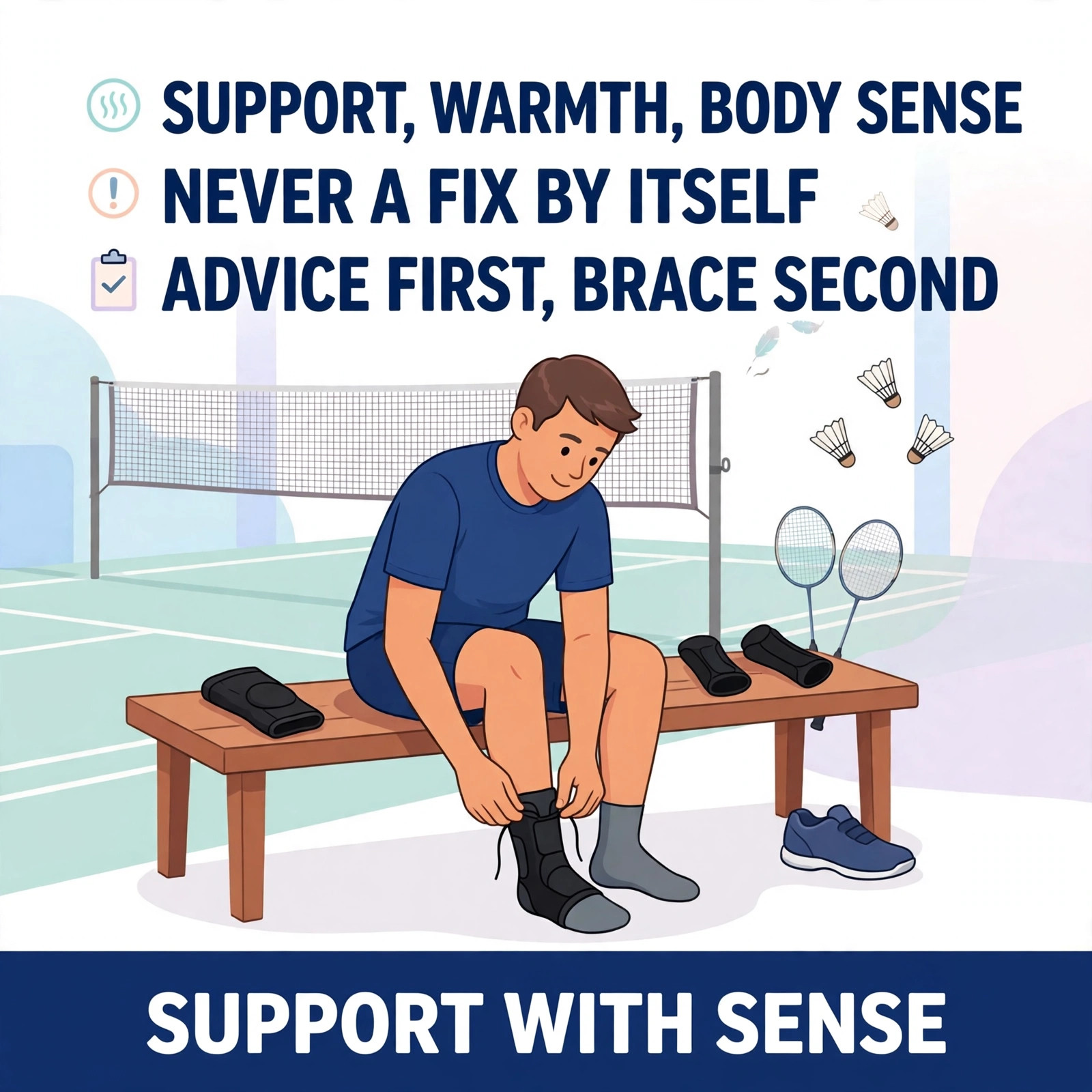
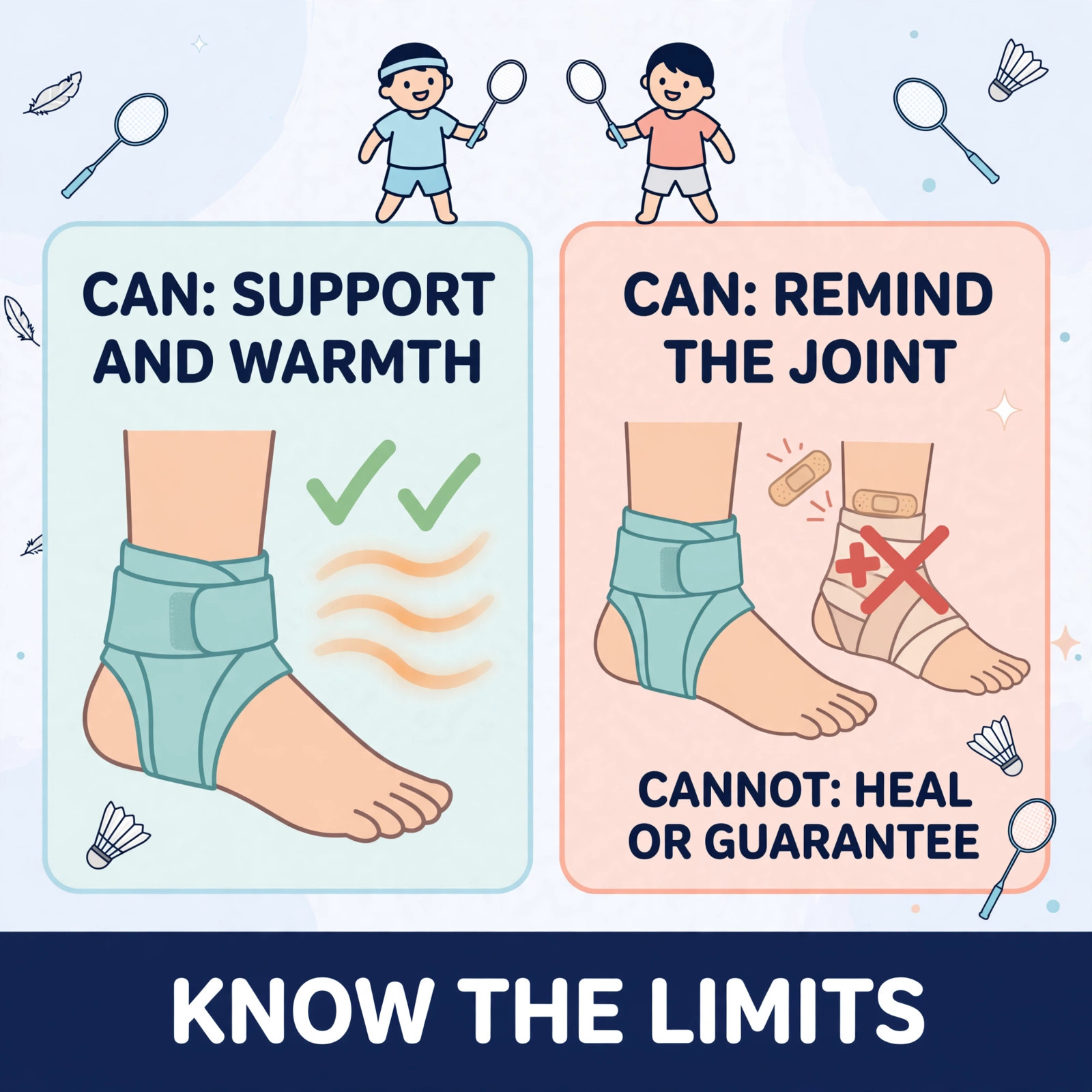
A brace can do three honest things. It gives gentle compression and warmth around a joint, which many players find comfortable. It supports the joint from outside: straps and sleeves limit the wildest part of a movement and remind the player, physically, that this joint needs respect today. And it helps the player feel where the joint is. Coaches call that body sense, and it matters in a sport of lunges and landings: a player who feels the ankle clearly plants it more carefully. For a player returning from a sprain in the agreed stages, these three things together can steady the first weeks back.
A brace cannot do the things packaging loves to claim. It cannot make an injured ligament heal faster. It cannot guarantee prevention: players injure braced ankles and unbraced ones, because injury risk lives in strength, fatigue, movement quality and luck, not in one product. And it cannot replace muscle. A joint that is carried by a brace every session while its muscles do no work becomes a joint that needs the brace more, not less. That trap is the most common brace mistake we see: support worn forever, strength never rebuilt, confidence resting on elastic instead of on the leg itself.
Brace Check #2
The Main Types: Ankle, Knee, Wrist and Elbow
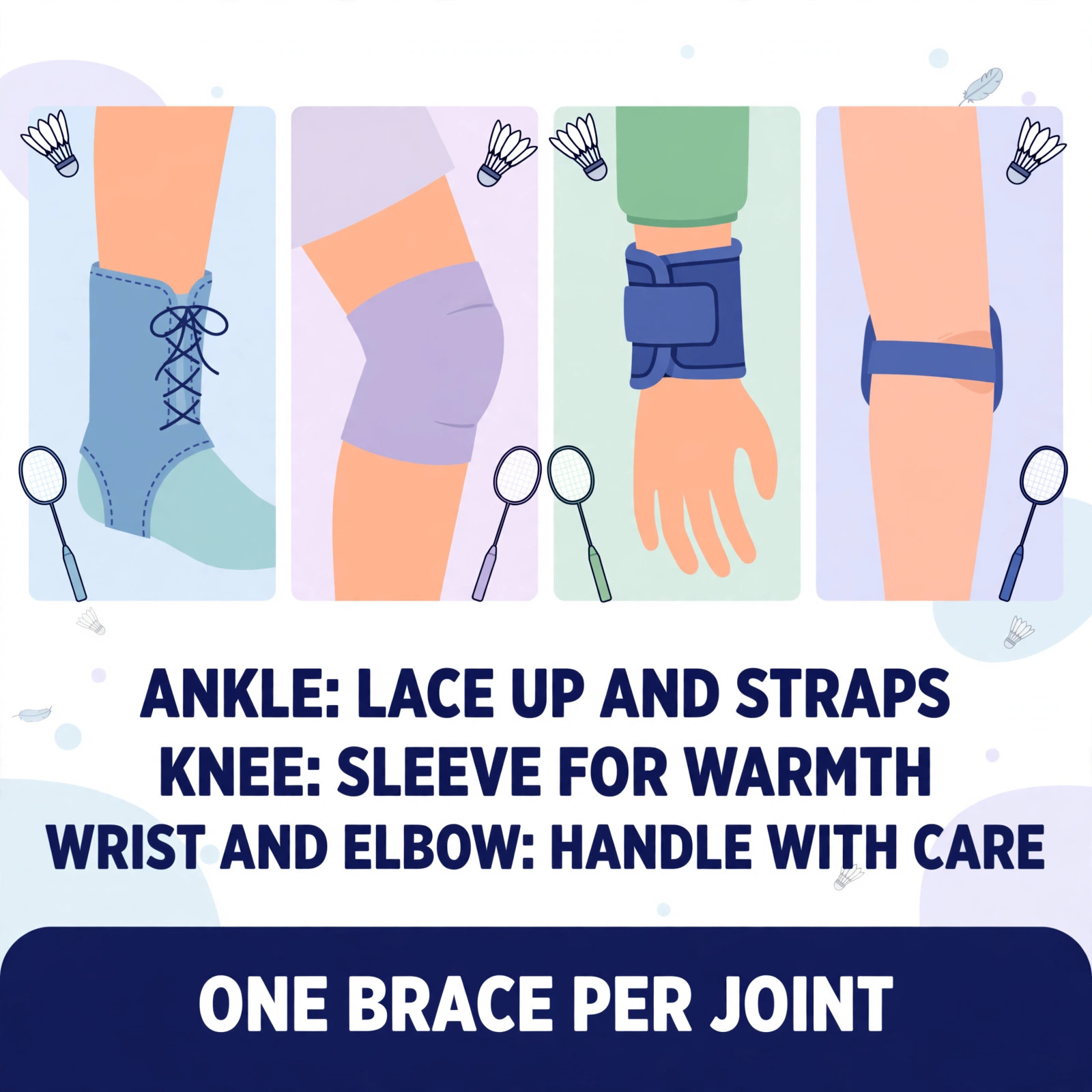
Ankle braces are the most common in badminton, because the ankle is the joint this sport twists most. Two families cover most players. Soft lace up braces with straps give adjustable support and fit inside a court shoe, which is the first test any ankle brace must pass. Stiffer braces with side panels give more control and are usually chosen with a physio’s advice after a bigger sprain. Whichever type, an ankle brace is worn over a sock, laced firmly, and checked in a lunge: if it folds, digs or pushes the foot into a strange angle, the fit is wrong.
Knee supports split by job. Plain knee sleeves give warmth and gentle compression, and players wear them for general comfort. A strap below the kneecap is a small, specific tool some players use for soreness at the front of the knee, though persistent pain there needs checking, not just strapping. Hinged knee braces, with metal sides, belong to the world of diagnosed injuries and should only appear on a player’s leg when a doctor or physio has said so. A junior in a hinged brace bought off a shelf, with no diagnosis behind it, is a sight coaches should gently question.
Wrist and elbow supports appear less often and deserve extra care. A wrist brace limits how far the wrist bends, which is why it is mostly a return from injury tool used on professional advice, not an everyday playing aid; full wrist movement is part of hitting well. Elbow straps sit on the forearm for tendon soreness at the elbow, and they can feel helpful, but elbow pain that keeps returning is a signal to have the arm checked and the technique looked at, not a signal to tighten the strap. Shoulder braces are rare in badminton and firmly specialist territory: if a shoulder needs one, a clinic is leading that story, not a shop.
Brace Check #3
Fit and Fastening: Firm Support That Still Lets You Move
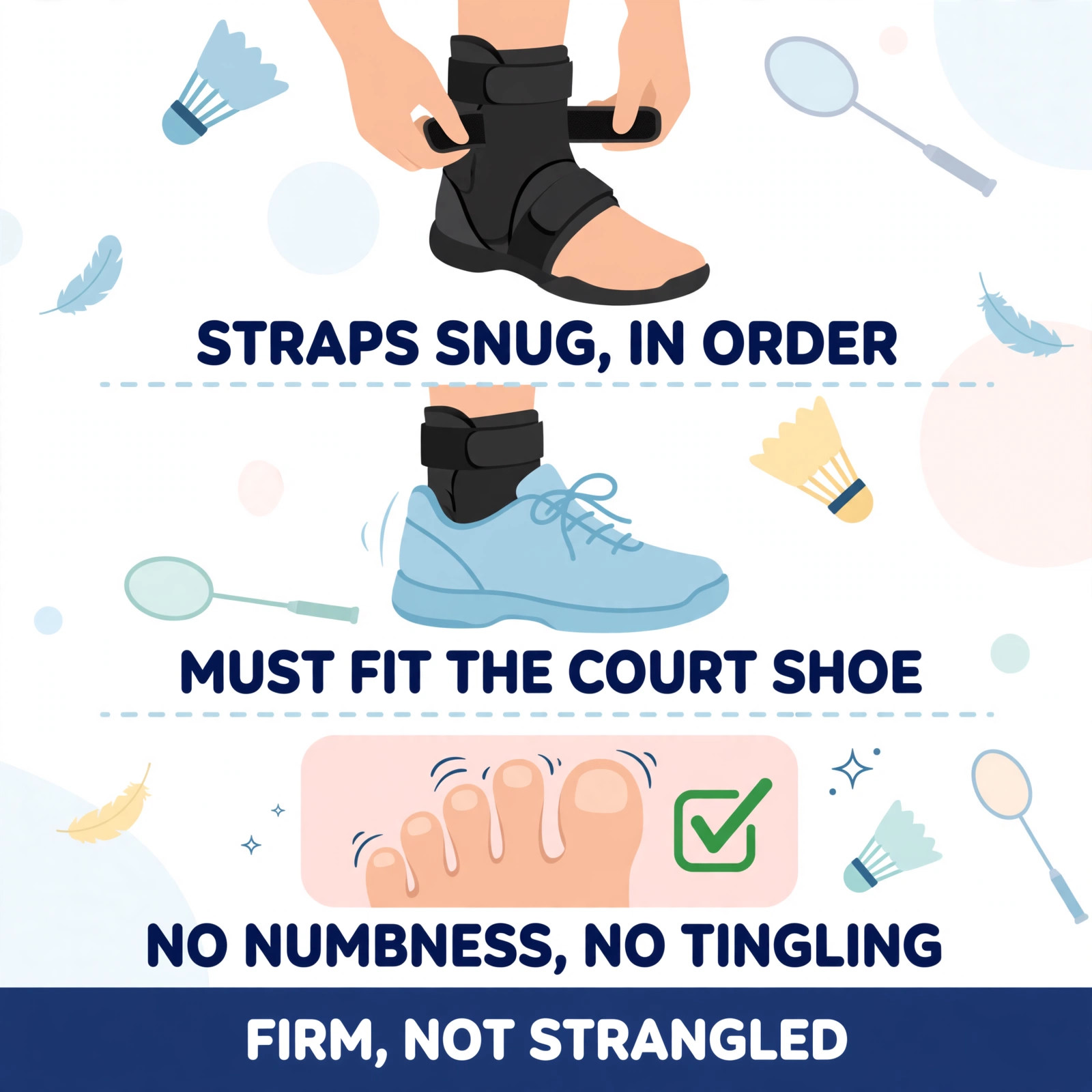
Fitting starts with measuring the joint the maker’s chart names: around the ankle bones for an ankle brace, around the knee or thigh for knee supports, around the wrist for wrist braces. Charts differ between makers, so yesterday’s size is not today’s promise. For ankle braces, do the measuring and the trying on with the court shoe in hand: the brace plus the foot must fit the shoe without crushing toes or lifting the heel. A brace that only fits in a loose trainer will not be worn on court, and support in a drawer supports nobody.
The firmness test is a balance. Done up properly, the joint should feel held and reminded, while the player can still run, lunge and jump without fighting the brace. Straps go on in the order the maker shows, snug from the first to the last, not one strap strangled and the rest loose. Then the safety checks, the same as for any compression gear: no numbness, no tingling, no colour change below the brace, no sharp digging at any edge. If a coach or parent has to ask whether it looks too tight, it usually is.
Comfort across a whole session is the last fitting test. Braces bunch behind knees, rub at ankle bones, and warm up until they itch. A brace that behaves in a two minute shop test can still fail at minute forty, so break a new brace in at training, never for the first time at a tournament. If you keep stopping to adjust it, the fit, the size or the type is wrong. Players should also say so early: juniors often suffer quietly with a rubbing brace because an adult bought it with good intentions. Ask them directly. Fit is feedback, not obedience.
Brace Check #4
After an Injury: The Doctor and Physio Come First
After an injury, the order never changes, and a brace is not step one. Step one is stopping and getting the injury checked: a clinic visit, a physio assessment, a name for what actually happened. Step two is the plan you are given: rest where rest is ordered, exercises where they are set, and a staged return. Step three, if the professional advises it, is choosing a brace to support the return: the type and firmness follow the diagnosis. Buying the biggest brace first and diagnosing later is backwards, and it can hide injuries that needed real treatment while the player trained on bravely.
The return itself moves in stages that badminton players at our academy will recognise: fitness work first, then controlled drills, then full games, with each stage passed before the next begins. A brace often appears in the drill stage, when the joint is moving at speed again but strength is still rebuilding. Coaches watch returning players closely for the honest signs: Is the player protecting the joint? Is the movement normal or guarded? Sharp pain, swelling after sessions, or a joint that feels unstable are stop and report signs at every stage. No timetable belongs in this guide, because every injury keeps its own calendar.
The quiet goal of a good return is a joint that works without the brace for most play. That is why strength and balance work sit at the centre of rehabilitation: calf raises, single leg balance, controlled lunges, the unglamorous repetitions that rebuild what the injury took. Many players keep the brace for matches for a while after training without it, and that is a sensible halfway stage when the physio agrees. What should not happen is the brace quietly becoming permanent with no plan and no progress. If a player cannot imagine playing without it after months, that is a conversation for the physio, not a bigger brace.

Brace Check #5
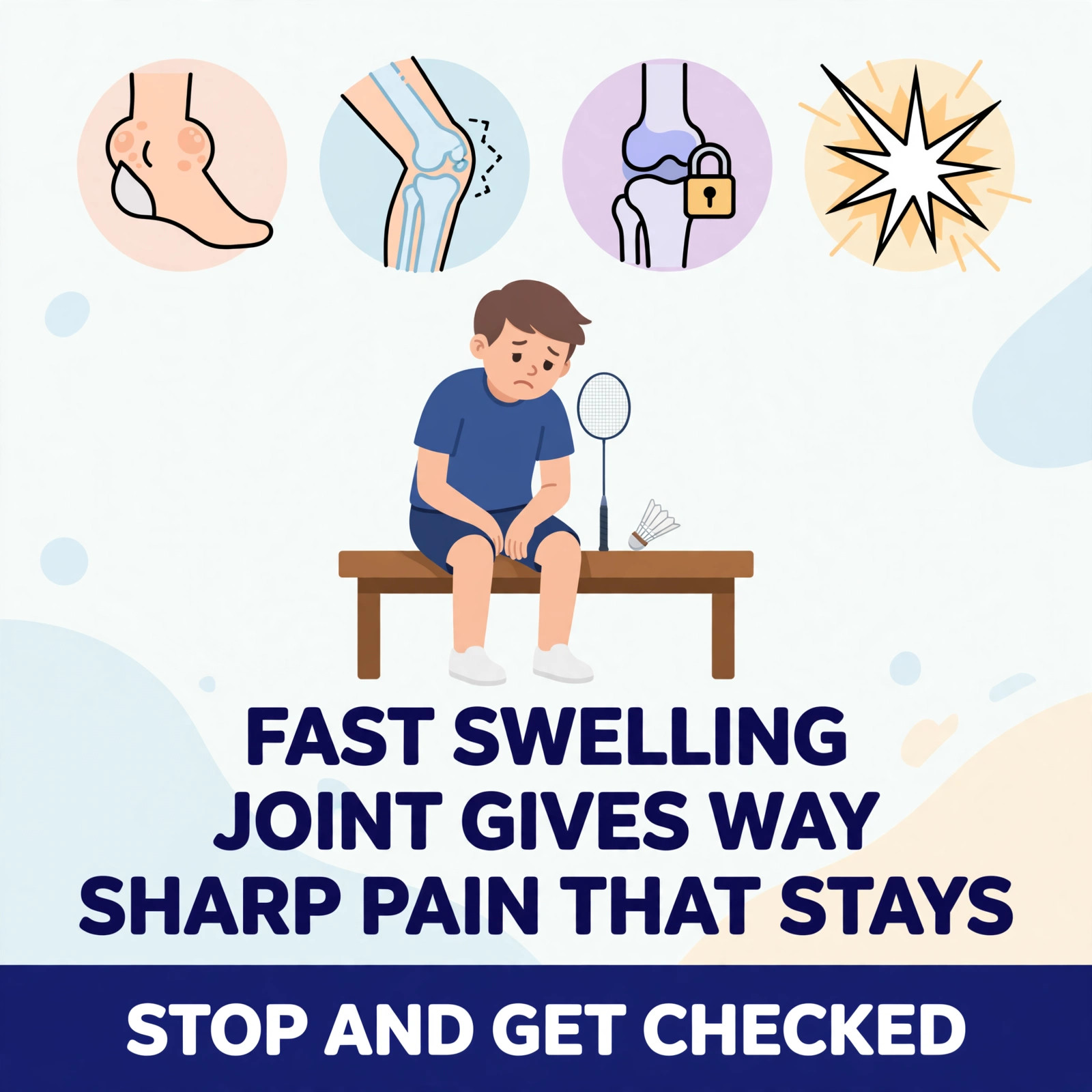
Red Flags: When to Stop Playing and Get Checked
Red flags are the most important section in this guide. Learn them, and teach them to juniors. Swelling that comes up fast after a twist. A joint that gives way, buckles or feels like it will not hold you. A knee or ankle that locks, catches or cannot straighten. Numbness, or pain that is sharp, growing, or still there the next day. Bruising that spreads after a knock. Any one of these means the same thing: stop playing, do not brace up and carry on, and get the joint checked. A brace over a red flag does not make it amber. It makes the delay longer.
Pain during play follows a simple rule: sharp pain is a stop signal, not a challenge. Players, especially keen juniors, hide pain to stay in the game, and a brace can help them hide it longer, which is the one way a brace truly can make things worse. Coaches and parents set the culture here. Praise the player who reports pain early. Never praise playing through it. A checked joint that turns out fine costs one visit. An unchecked joint trained on for a month can cost a season, and young joints deserve better arithmetic than that.
When in doubt, rest and check. That sentence sounds plain because it is plain, and it saves more playing years than any product. Missing one week to have a joint looked at beats missing a season to a problem that grew in the dark. Braces have their honest place: support, warmth, body sense, confidence inside a proper plan. They never turn a red flag green, and they never outrank the professionals whose job is diagnosis. If this guide leaves a player slightly less impressed by braces and slightly more respectful of checking, it has done its work.
Myth vs Reality
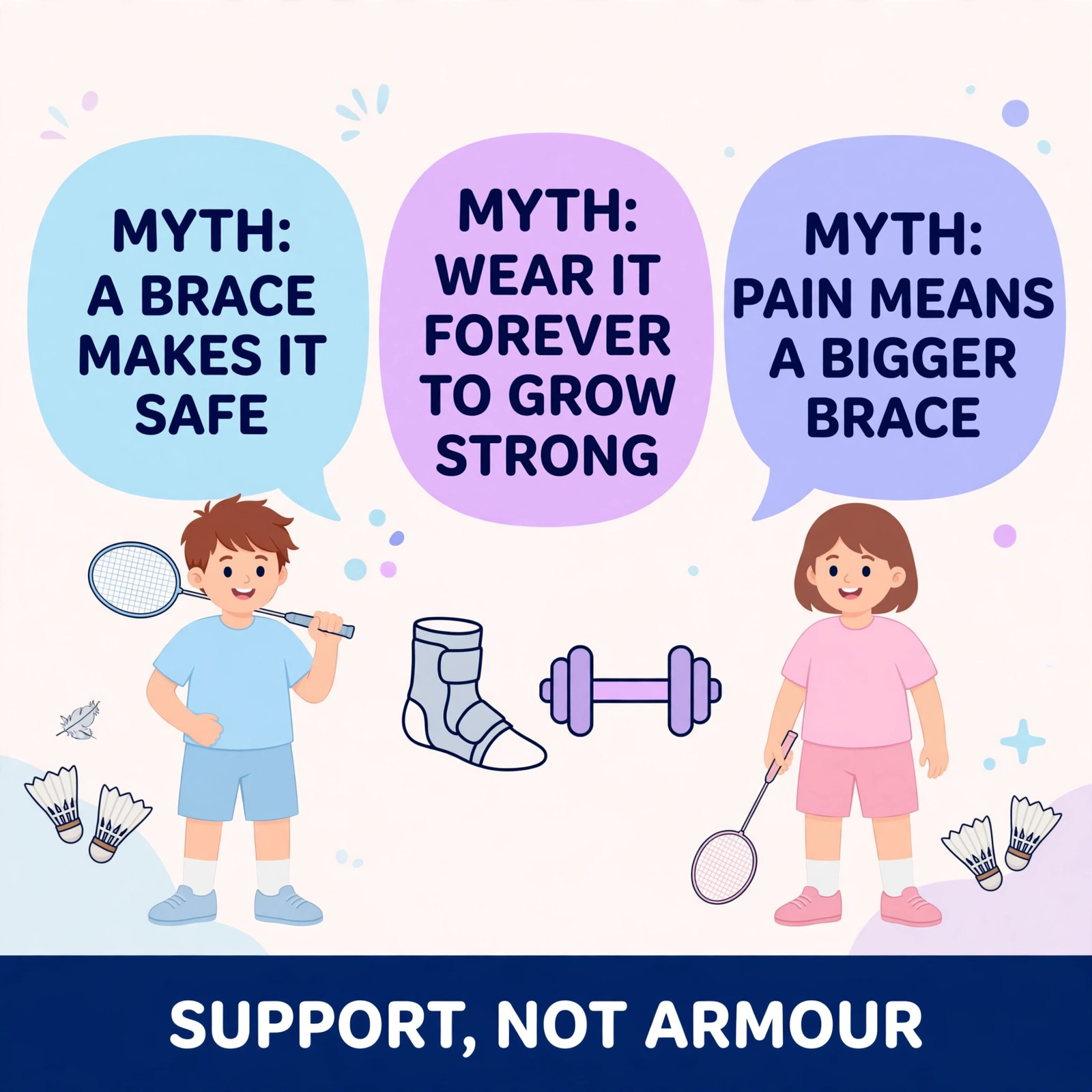
Myths About Support Braces
Myth one: a strong brace makes a weak joint safe for full play. It does not. A brace supports from outside; safety comes from a joint that is healed, strong and moved well. A player who returns at full speed on an unhealed joint because the brace feels solid is borrowing confidence the joint has not earned. The brace belongs inside a staged return, after advice, alongside strength work. Outside that plan it is a costume of safety: it looks the part and changes very little underneath.
Myth two: wearing a brace all the time makes the joint stronger. The truth runs the other way. Muscles that are carried stop working as hard, and a joint whose muscles switch off grows less stable, not more. That is why good return plans shrink brace use over time as strength grows: brace for the hard sessions first, then fewer, with exercises filling the gap. A brace worn forever is not a plan; it is the absence of one. If your brace use has no direction, ask the physio to give it one.
Myth three: if it still hurts, the answer is a bigger brace. Pain is information, and covering information with a stiffer product destroys the signal you most need. Continuing pain means the injury was not fully understood, has not finished healing, or is being loaded too early. Each of those has the same next step: go back and get checked. Players sometimes shop through three braces while a treatable problem waits. Skip the shopping. The clinic answers in one visit what three parcels cannot.
Why Choose Us
Why Players Choose ST Badminton Academy
At ST Badminton Academy, returning players are handled slowly and openly. Coaches ask about injuries at the start, and with a maximum of four students per group they can actually watch a returning player’s movement across a whole session: the guarded lunge, the landing that avoids one leg, the wince a junior tries to hide. Drills get adjusted: less jumping this week, more shadow work, a smaller court. No returning junior is rushed to prove anything. A careful month now protects the years of badminton after it.
The academy coaches badminton; it does not diagnose injuries, and it does not sell braces. When a joint needs more than coaching eyes, we say so and point families to clinics and physios, the same way this guide does. That boundary is deliberate and it protects players. A coach who happily advises on everything would be advising beyond his licence on the topic where mistakes cost most. What coaches can do, and do, is run the staged return well once the professionals have set it, and flag any red flag the moment it appears.
The culture we want is simple to say: nobody at the academy is praised for playing hurt. Players are praised for reporting pain early, for doing dull rehabilitation exercises properly, and for returning in stages without sulking. Parents hear the same message, because the pressure to play through pain often comes from love and hope rather than from any coach. Long careers are built by players who were protected at twelve, fifteen and eighteen by adults who chose the joint over the weekend’s result. That is the standard this academy keeps.
FAQs: Badminton Support Braces and Safe Play in Malaysia (KL)
Here are the questions parents and players ask us most about badminton support braces, safe returns from injury, and how our coaches handle players coming back, in Kuala Lumpur and Setapak.
How does your academy handle support braces for juniors in Setapak or Gombak?
Coaches ask what happened and what the doctor or physio has said, then fit the returning player into sessions at the right stage: fitness and shadow work before full games. With small groups, the coach watches that player’s landings and lunges all session and will stop the session early if red flags show.
Can a brace protect a player from injury during a match in KL?
A brace can help support a joint and remind a player to respect it, and that can lower some risk in some moments. It cannot promise protection: injuries happen in braces too. Warm up, strength, sound technique and honest rest protect a player far more, with the brace as a small extra, never the main plan.
How firm should a brace feel when a player trains at a steady level?
Firm enough that the joint feels held, loose enough that the player can run, lunge and jump without fighting it. Straps snug in order, no single strap strangled. The safety signs decide the rest: no numbness, no tingling, no colour change below the brace. If you keep asking whether it looks too tight, loosen it.
Should a player wear a brace for every session after an injury, or as the physio advises?
Follow the physio’s advice, because the right wear time depends on the injury, not on the calendar. Many returns use the brace for harder sessions first and less as strength grows. Wearing it for everything forever, with no plan, usually means the plan is missing, so ask for one at the next appointment.
What should parents check before buying a brace for a junior?
Measure the joint the maker’s chart names, try the brace with the court shoe for ankle braces, and check that straps adjust smoothly and edges do not dig. Ask what injury it is meant for: hinged and rigid braces belong to diagnosed injuries on professional advice, not to hopeful shelf shopping for juniors.
Do your coaches watch how braces fit during classes near Wangsa Maju?
Yes. Coaches see fit problems as they happen: straps loosening, a brace bunching behind the knee, a player landing stiffly to protect a joint. Near Wangsa Maju and Setapak the approach is the same: adjust what can be adjusted in class, and send anything medical back to the clinic where it belongs.
Does your academy sell braces or refer players to specialists in Malaysia?
We refer. The academy sells coaching, not braces, and it does not diagnose injuries. Coaches explain the types in plain words and what each is for, then families see a physio or buy on professional advice. That boundary keeps players safe and keeps our advice free of sales interest.
How long should a player keep using a brace during return to training?
As long as the return plan says, and not one fixed period for everyone. Some players train without the brace within weeks and keep it for matches a while longer; others follow a longer plan after bigger injuries. The direction should always be towards needing it less as strength returns.
What makes Mr Eric Chuar a careful coach for players returning from injury in badminton?
Mr Eric Chuar has coached for over 15 years and is known by parents for stopping sessions rather than pushing hurt players. He asks for the doctor’s or physio’s plan, sets the staged return inside it, and watches returning players closely in small groups. Care with other people’s children is his first rule.
Badminton Support Braces and Joint Care in Action


One Standard for Every Player and Every Session
The academy's standard for braces matches its standard for returns: professional advice first, support second, strength always. Nobody at ST Badminton Academy will tell a family a brace prevents injury or heals one. We will help a player choose sensibly on advice, fit it carefully, and return in stages that respect the joint.
| Factor | Risky Use | Sensible Use BRACE |
|---|---|---|
| Frequency | 1 or 2 times a week. Mostly for fun and sweat. | A brace fitted after advice, worn for support while strength work rebuilds the joint. |
| Drills Focus | Basic static feeding. Minimal footwork pressure. | Red flags checked first: swelling, giving way and pain that stays mean a clinic visit. |
| Physical Conditioning | Rarely included. Just playing games on court. | Core, agility, and speed training included in every session to prevent injury and build stamina. |
| Tactical Awareness | "Just hit it over." No real game plan. | Video analysis, point construction, and learning to read the opponent's game. |
| Coach Ratio | Large groups (8-10 kids). Coach barely watches you. | Max 4 students. Mr Eric Chuar personally corrects every stroke and movement detail. |
| Goal Setting | Fun and exercise. | Muscles keep training, because a brace is a helper, never a replacement. |
| Long Term Result | Good recreational player. | A player who returns in stages and stays back on court. |
Badminton Coaching With Safe Returns in Kuala Lumpur
Braces are neither heroes nor villains in badminton. In the right place, chosen on advice, fitted with care, they help a player return with a steadier joint and a calmer mind. In the wrong place, bought in hope and worn through pain, they hide problems until the problems grow teeth. If your child trains with us at ST Badminton Academy in Setapak, Kuala Lumpur, you will hear the same order from every coach: get checked, follow the plan, rebuild strength, and let the brace be the helper it is good at being.






