Dominate The Court With Badminton Offensive Play Strategies (Attack Guide)
Most players think attacking is just smashing harder. It is not. Real offensive play is taking control of the rally: pushing your opponent deep, pulling them forward, rushing their replies, until a loose shot appears and you finish it. The smash is only the last sentence of a story the earlier shots wrote.
This guide explains badminton offensive play strategies that work at club level: the shots that do the damage, the feet and positions that set them up, how to read an opponent and find the weak side, and how to put it all together in a match, the same way we coach it at ST Badminton Academy in Setapak, Kuala Lumpur.
Attack Check #1
Why Does Attacking Play Take Over a Rally?
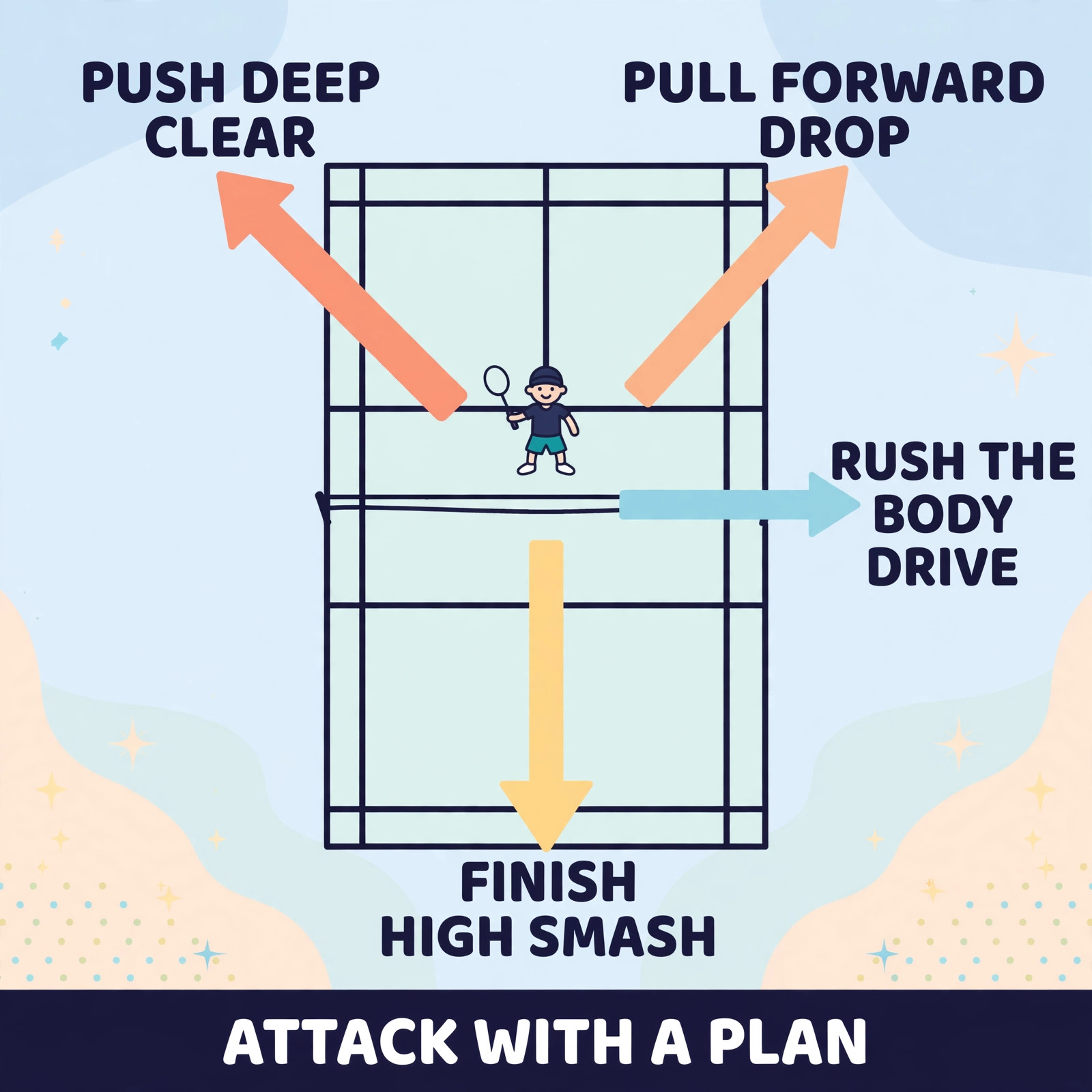
An attack starts long before the big shot. Watch a strong player and you will see the pattern: a clear that pins the opponent to the back line, a drop that drags them to the net, a drive that rushes their reply, and only then the smash, hit at a player who is already stretched and late. Attacking is rally construction. Each shot has a job, and the finishing shot is simply the one the earlier jobs made easy.
That is why the attacking mindset is patient, not wild. Players who swing at everything give away as many points as they win: they smash from the back tramline, off balance, into a ready defence. Players who build first attack from better positions, on better shuttles, against opponents who are already moving the wrong way. Same arm, same racket, completely different results, decided by the three shots before the smash.

Attack Check #2
Which Offensive Shots Do the Damage?
The smash is the finisher, and placement beats raw pace. A steep smash aimed at the sideline or into the body wins far more points than a flat thunderbolt hit straight at a set defender. Learn to vary it: full smash for the short lift, stick smash for speed off a shorter swing, and the occasional slice that drops it shorter than expected. The jump smash is the last layer, not the first, timing and landing matter more than height.
Drops and drives are the attack’s working tools. A fast drop shot, cut from the same preparation as your clear, holds its shape and then falls, it drags opponents forward and opens the back court behind them. Flat drives rush the body and the backhand side, denying time. Cross-court versions change the angle and pull players wide; straight versions arrive sooner. A rally usually needs two or three of these working shots before the finishing chance appears.
The front court finishes what the back court starts. A net kill, taking a loose net reply early and high and punching it down, is the fastest point in badminton. Spinning net shots tumble over the tape and force weak lifts. Even the serve is an attacking shot: a low serve that skims the tape denies the receiver any attack, and a well-timed flick punishes a receiver who creeps forward. Attack begins with the first shot of the rally, not the last.

Attack Check #3
How Do Feet and Position Set Up the Attack?
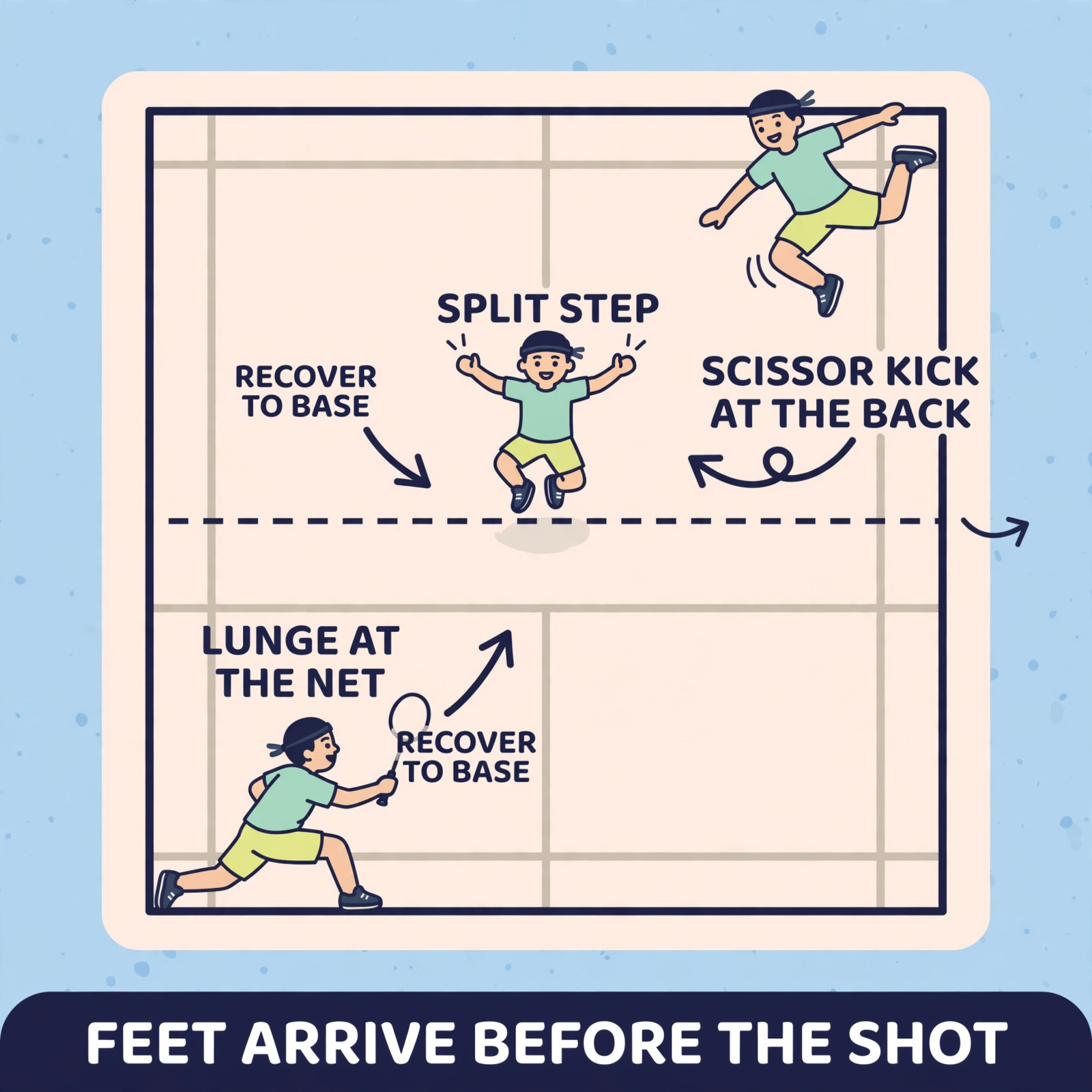
Feet decide whether your attack exists. Every attacking shot in this guide is hit from a position your footwork bought: the split step that loads your legs as the opponent strikes, the scissor kick that rotates you through back-court shots, the lunge that puts you over the shuttle at the net. When the feet arrive late, the same player hits the same shots weakly, from below the tape, leaning backwards, and calls it a technique problem.
Position is the other half. Attacking players take the shuttle early and high wherever they can: stepping into drives instead of reaching back, meeting net shots at tape height instead of below it. In singles, that means recovering to a base that lets you threaten every corner. In doubles, it means holding the front-and-back shape while your pair attacks, so the net stays guarded and the smash keeps coming. Early contact is what pressure actually looks like.
Be honest about the cost, though. Repeated jump smashes and full-speed lunges drain legs fast, and an attack built on tired legs collapses by the third game. Strong attackers pace themselves: they attack in patterns, defend in blocks when the rally is lost, and keep their biggest swings for the shuttles that deserve them. Fitness supports the strategy, it does not replace it.
Attack Check #4
How Do You Read an Opponent and Find the Weak Side?
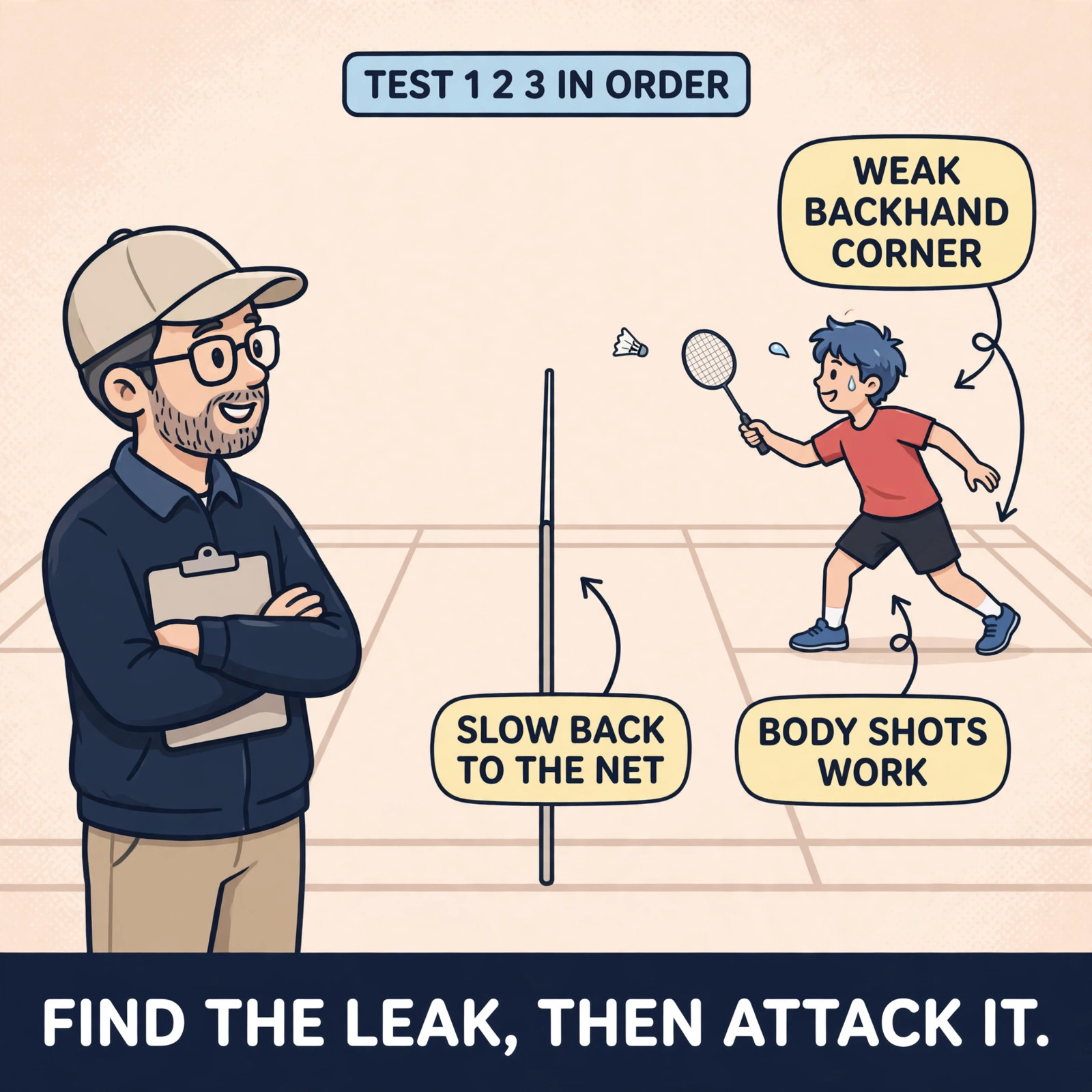
Before you attack a player, study them. The warm-up and the first few rallies tell you most of what you need: which back corner they reach late, whether the backhand clears under pressure, how they handle shots driven into the body, whether they creep towards the net on serve. Everyone has a leak. Your job in the first game is to find it, quietly, before the score forces you to guess.
Test in order, and keep score of the answers. Clear to the backhand corner: did it come back short? Drop to the forehand net: was the recovery slow? Drive at the body: did the racket get tangled? Two or three leaks is all a game plan needs. Then return to what worked, not every rally, which becomes predictable, but often enough that your opponent must protect that side and open space somewhere else.
Deception ties it together. Clear, drop and smash should leave your racket with the same preparation and the same swing shape for as long as possible, so the opponent cannot move until the shuttle is gone. Hold the shot a fraction longer at the net and their feet freeze; freeze their feet and your attack gains a free half-metre everywhere. Deception is not trickery for its own sake, it is how a normal swing becomes an attacking one.
Building the Attack
How Do You Put It All Together in a Match?
A match plan does not need twenty ideas. It needs two or three patterns built on your best shots: perhaps serve low, attack the third shot; or clear to the backhand, drop straight, kill the loose net reply. Write them down before the match if it helps. When pressure rises, players do not rise to their hopes, they fall back on their patterns, so make sure yours exist.
And plan for the attack to fail, because sometimes it will. A good defender will block your best smash three times in a row. The backup plan is simple: lift, reset your feet, defend in blocks, and build again next rally. Risk also changes with the score, at 19-all you play your highest-percentage pattern; at 10-4 you can afford the spectacular one. Shot selection is score selection.
Training attack means feeding it properly: multi-shuttle feeds that force smash-and-follow-in, conditioned games where points only count when a rally is built before the finish, and short reviews of which patterns actually scored. In our small classes, capped at max 4 students, a coach sees every swing and can tell you the truth about your patterns, which ones the scoreboard likes, and which ones only feel good.

Myth vs Reality
Myths About Attacking Play
Myth: “Attacking means smashing every shot.” Reality: smashing everything is the fastest way to tire your arm and feed a good defender. Real attack is pressure, clears, drops and drives that move the opponent until the finishing shot is easy. The best attackers in any hall smash less often than the wild ones, and score more when they do.
Myth: “Smash power comes from a strong arm.” Reality: power is a chain, legs drive, hips and trunk rotate, the arm follows, and the forearm snaps through at contact. Myth: “Only advanced players can play attacking badminton.” Reality: every level can attack; beginners attack with placement and patterns long before they own a big smash.
Myth: “When you are losing, hit harder.” Reality: losing usually means your patterns are being read, not that your shots are too soft. Change the pattern, change the target, change the pace, then the power you already have starts landing. Attacking harder into a set defence is how close games become routs.

Why Choose Us
Offence, Taught Shot by Shot
At ST Badminton Academy KL, attacking play is coached as a system, not a talent. In classes capped at max 4 students, coaches break the rally down with you: which shot built the opening, which one wasted it, and what your two best patterns are. Students stop guessing and start constructing, and their match results change before their smashes get any bigger.
Mr Eric Chuar has over 15 years of coaching experience in Singapore and Malaysia, and his attacking rule is famous among his students: feet first, patterns second, power last. He has watched hundreds of strong-armed players lose to patient ones, and he teaches the patient’s game, read the opponent, build the rally, and finish only what you have built.
Our academy is based in Setapak, Kuala Lumpur, convenient for players from Wangsa Maju, Melati Utama, Danau Kota and Gombak. If you attack a lot but score less than you should, bring your game to a session, a coach will watch two rallies and show you which shot in your pattern is giving the rally away.
FAQs: Badminton Offensive Play Strategies in Malaysia (KL)
These are the questions players ask us most about badminton offensive play strategies in Malaysia. If your question is not here, message us, tell us your level and whether you play singles or doubles, and we will give you a straight answer about where your attack is leaking.
How do I attack better if I play in Setapak or Gombak?
Start with your feet, not your smash. In our Setapak classes, players who attack well split step early, take the shuttle high and build rallies with clears and drops before finishing. Tell us your level and whether you play singles or doubles, and we will point you to the right group.
Which offensive shots should a club player learn first in KL?
Learn them in the order rallies need them: a clear that reaches the back line, a drop that holds its shape, a drive that stays flat, and a smash you can place, not just hit hard. Net kills come last, they need the early feet the other shots teach you first.
How often should a player practise attacking shots at a steady level?
Twice a week is a solid rhythm for most club players: one session for pattern drills and feeding, one for games where the patterns get tested. Short, focused practice beats one long smashing session, your shoulder and your timing both keep better shape that way, week after week.
Can a junior start learning attacking play at 13 or 14?
Yes, at thirteen or fourteen a junior can learn attacking play, and should: patterns, deception and shot choice matter more than raw smash power at that age. Coaches keep the volume sensible while joints are still growing, build the footwork first, and add jump smashes only when the legs are ready.
What should I watch for in an opponent before a match I enter?
Watch the warm-up and the first few rallies. Note which corner they reach late, how their backhand holds up under pressure, whether they creep forward at the net, and how they defend shots into the body. Test each thing once, early, then attack what actually leaked, not what you guessed.
Do you coach attacking play in classes near Wangsa Maju?
Yes, attacking play is coached inside our small group classes at the Setapak academy, a short drive from Wangsa Maju, Melati Utama and Danau Kota. Groups are capped at max 4 students, so a coach watches every swing, corrects your patterns on the spot and builds your attack week by week.
Does your academy teach shot selection and attacking patterns in Malaysia?
Yes, shot selection is part of how ST Badminton Academy teaches in Malaysia: which shot, from which position, against which opponent, and when to hold back and rebuild instead. Students practise patterns in drills, then test them in conditioned games where only well-built attacks score, so decisions become habits.
Where is ST Badminton Academy KL located for attacking-play training?
ST Badminton Academy KL is based in Setapak, Kuala Lumpur, where our classes run in small groups of max 4 students. The academy is convenient for players from Wangsa Maju, Melati Utama, Danau Kota and Gombak. Message us before your first session and we will confirm the venue details and what to bring.
What makes Mr Eric Chuar a suitable coach for attacking play and badminton?
Mr Eric Chuar has over 15 years of coaching experience in Singapore and Malaysia, and he teaches attack the way rallies actually work: feet first, patterns second, power last. He spots the one fault costing you points, a late split step, an early show of the shot, and fixes that first.
Badminton Attacking Play in Action


What It Takes to Attack With Control
A player meets our attacking standard when five habits hold: the feet are set before the swing, the shuttle is taken early and high, patterns are chosen before power, the player recovers ready after every attack, and the score decides how much risk a shot carries. Our attacking standards below are the checkpoints our coaches use when they rebuild a student's offence.
| Factor | Random Smashing | Building the Attack PATTERN |
|---|---|---|
| Frequency | 1 or 2 times a week. Mostly for fun and sweat. | Every shot has a job: move the opponent, stretch them, rush them, then finish. |
| Drills Focus | Basic static feeding. Minimal footwork pressure. | Feet arrive first: split step early, shuttle taken high, balanced before the big swing. |
| Physical Conditioning | Rarely included. Just playing games on court. | Core, agility, and speed training included in every session to prevent injury and build stamina. |
| Tactical Awareness | "Just hit it over." No real game plan. | Video analysis, point construction, and learning to read the opponent's game. |
| Coach Ratio | Large groups (8-10 kids). Coach barely watches you. | Max 4 students. Mr Eric Chuar personally corrects every stroke and movement detail. |
| Goal Setting | Fun and exercise. | Two or three patterns rehearsed until they still hold at 19-19 under pressure. |
| Long Term Result | Good recreational player. | A player who controls rallies instead of gambling on them, point after point. |
Badminton Offensive Play in Kuala Lumpur
This page covered badminton offensive play strategies: building rallies before finishing them, the shots that do the damage, the feet and positions behind them, reading an opponent, and planning for the days the attack fails. ST Badminton Academy KL coaches attack inside small group classes of max 4 students in Setapak. If you are in Wangsa Maju, Gombak, Cheras or nearby, contact us today.






