Build A Stronger Badminton Team With Fun Activities (Team Guide)
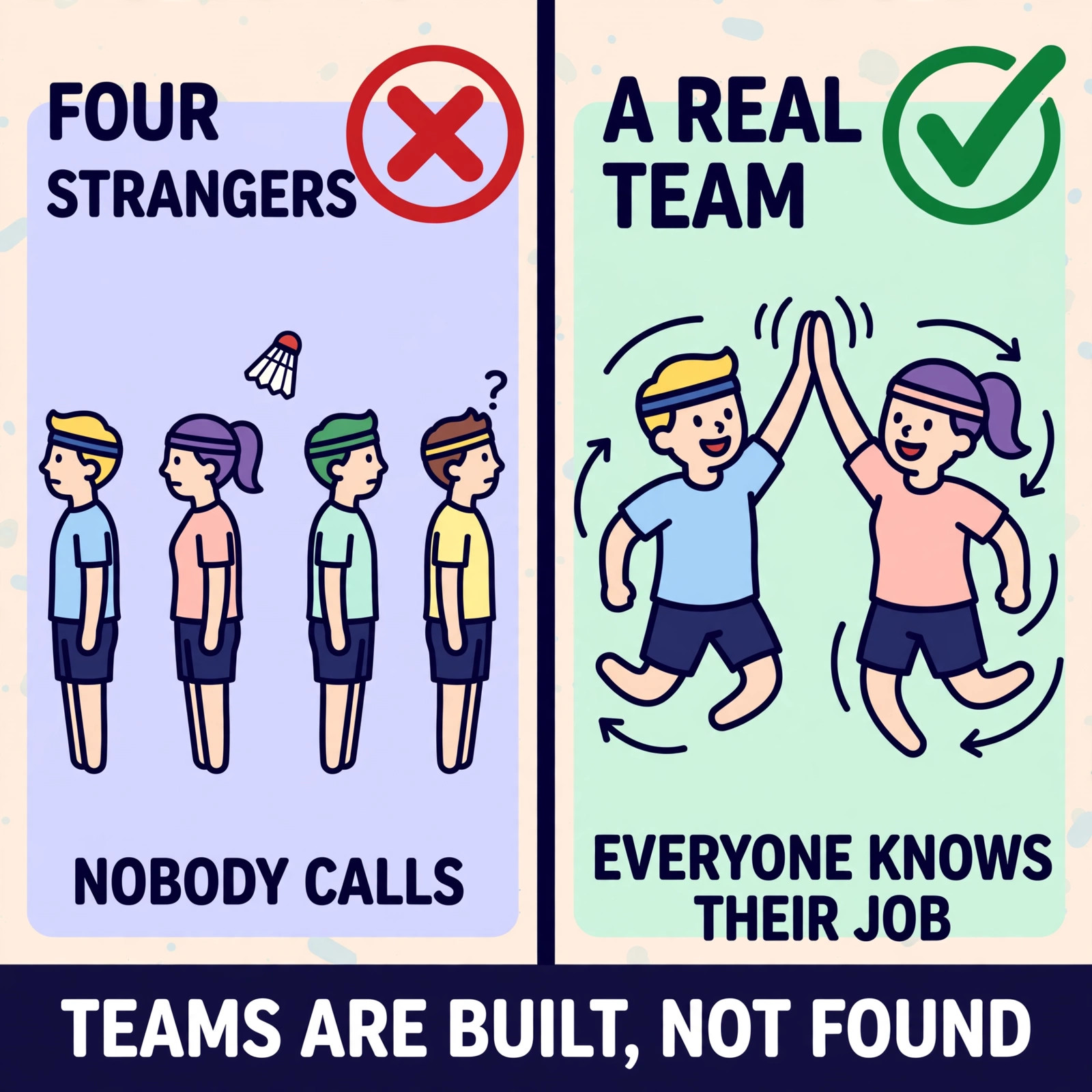
A badminton team is not just the players standing on the same side of the net. It is the pair who call early and trust each other’s calls, the training group that pushes and backs each other, the bench that stays loud when the match turns. Teams like that are not found, they are built, session by session, and fun is one of the building tools.
This guide shows how to build a stronger badminton team with fun activities: games that teach real court teamwork, communication habits for doubles, shared goals, time together away from the court, and the honest work of sorting out disagreements early.

Team Check #1
Why Do Strong Teams Start With Trust?
Strong teams start with trust, and trust starts with small repeated evidence: your partner calls “mine” and means it, covers your corner when you are pulled wide, and does not sulk when you miss. None of that arrives by talent. It arrives because the group trains together, talks openly and learns how each person plays, including how they react when a match turns against them.
Fun is not decoration on top of that work; it is how the work sticks. Players who laugh together in training talk more in matches. Juniors who play team games learn each other’s names, habits and tempers within weeks instead of months. A team that enjoys its sessions shows up more often, and showing up is where every other improvement begins.
Team Check #2
What Fun Games Build Real Court Teamwork?
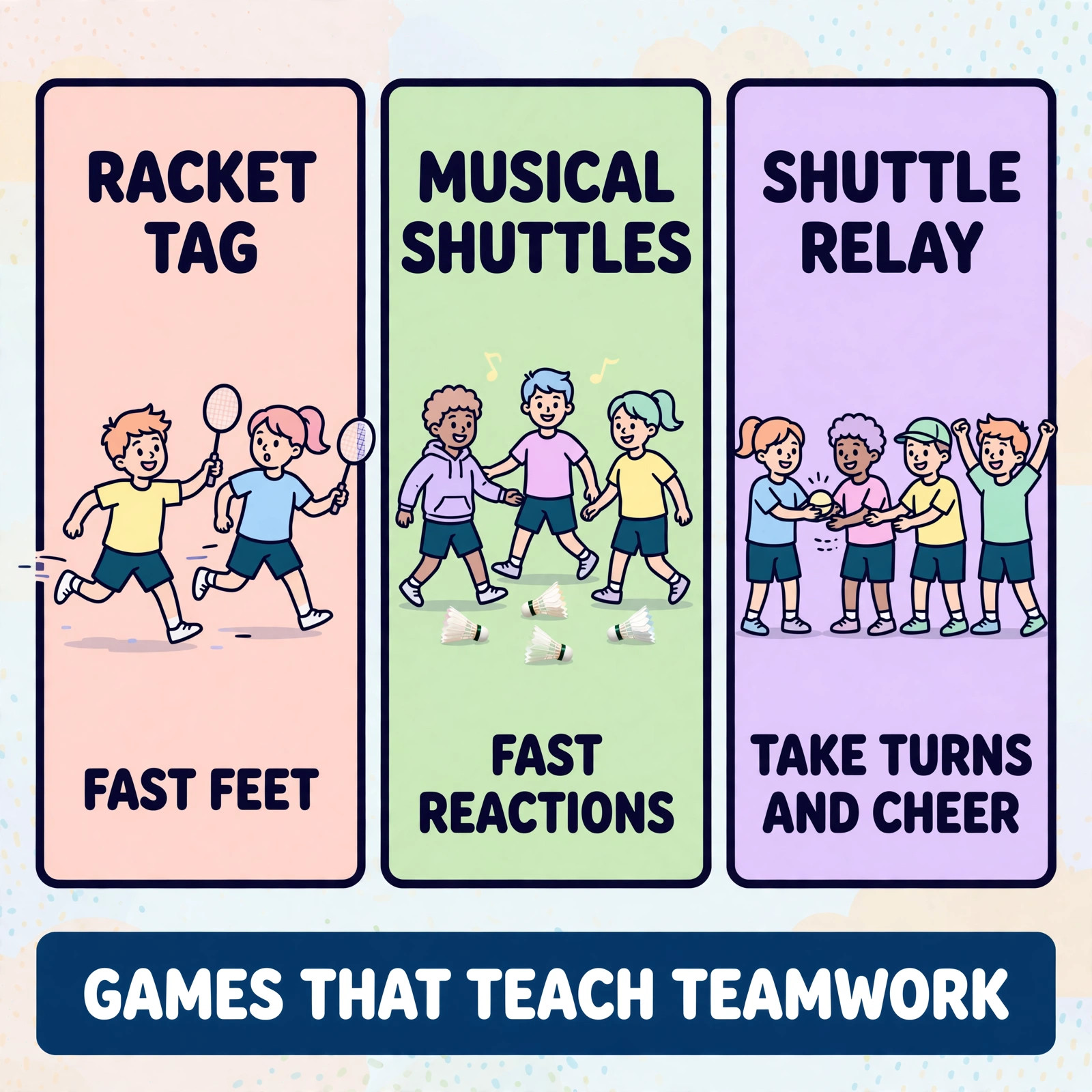
The best team games are badminton in disguise. Racket tag warms up feet and awareness, players move in a marked area, rackets held safely, trying to tag knees while protecting their own. Musical shuttles starts and stops rallies on a signal, training fast reactions and faster communication. A shuttle relay race sends pairs down the court in turns, feeding and returning against the clock.
These games teach real skills. Tag games build the split step and change of direction. Relay formats teach pairs to organise themselves: who feeds, who hits, who counts, who encourages. Players must talk constantly to avoid collisions and dropped shuttles, which is exactly the talking a doubles pair needs at 18-18, learned at low stakes with everyone laughing.
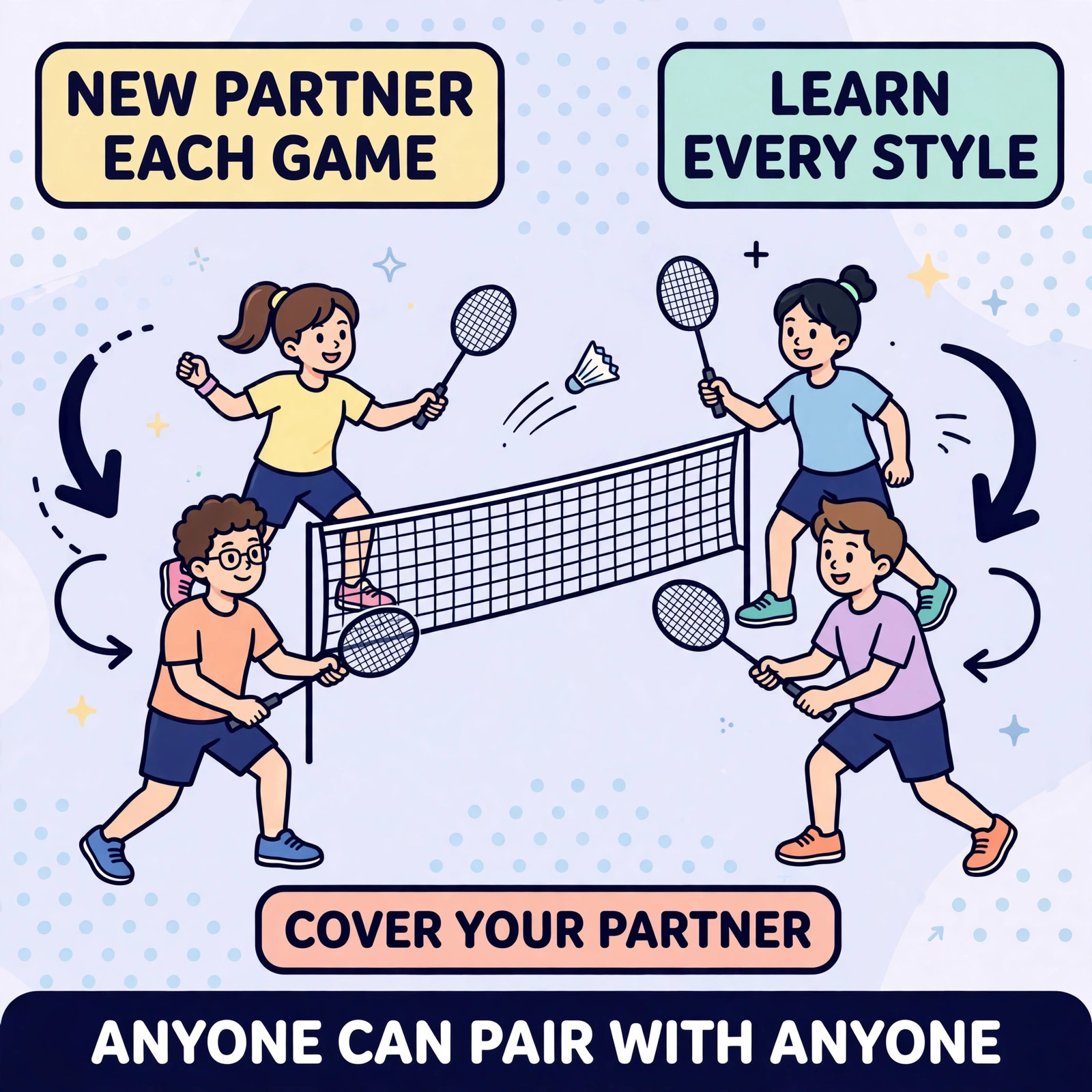
Keep the mix rotating. Because groups at our academy are capped at max 4 students, team games in class run in changing pairs, and nobody hides behind one fixed partner. One week you organise the relay with a quiet partner, the next with a loud one. That rotation is deliberate: strong teams can pair anyone with anyone when injuries or absences hit.
Team Check #3
How Do Pairs Learn to Talk on Court?
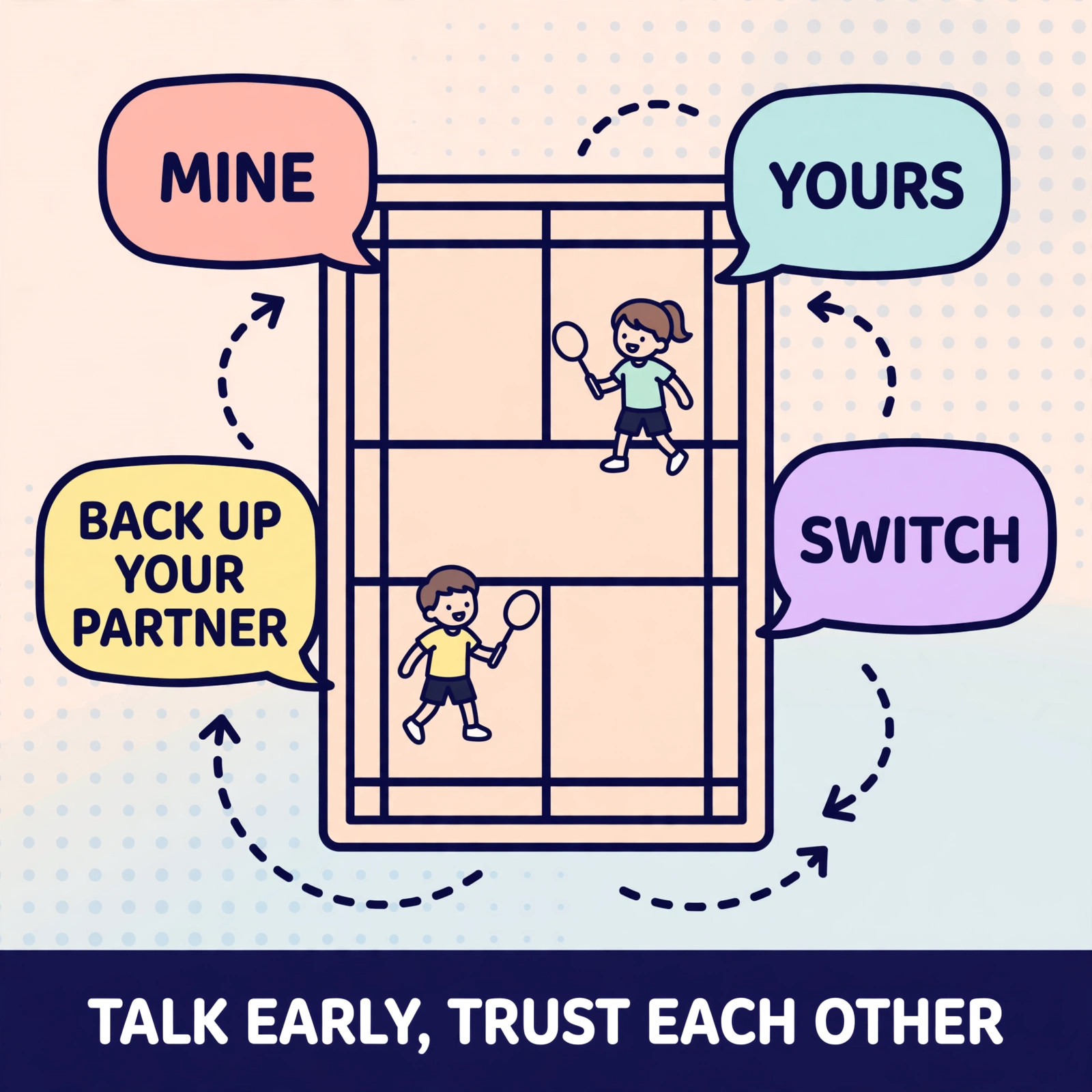
Doubles is a conversation played at speed. Pairs need a small shared language and the habit of using it early: “mine”, “yours”, “leave”, “switch”. Calls made before the shuttle arrives prevent the two classic disasters, both players lunging for the same shuttle, and both watching it land between them. In training we drill the calls until they come out automatically, under fatigue, without thinking.
Rotation is the other half of pair talk. Partners agree who takes the middle ball, when to switch from attacking formation to defensive, and how to reset after a rally breaks down. Good pairs also agree on emotional jobs: who steadies the pair after two lost rallies, who calls the pattern for the next three serves. The best pairs sound boring from outside, short words, same meanings, no debate mid-rally.
Backing your partner is a team skill, not a personality trait. After an error, the strong response is a racket tap, one useful word and the next rally, not a stare, a sigh or a lecture. And feedback flows after games in a set order: what worked, what broke, what we try next time. Pairs that review honestly improve; pairs that blame each other just rehearse losing.
Team Check #4
How Do Shared Team Goals Keep Everyone Together?
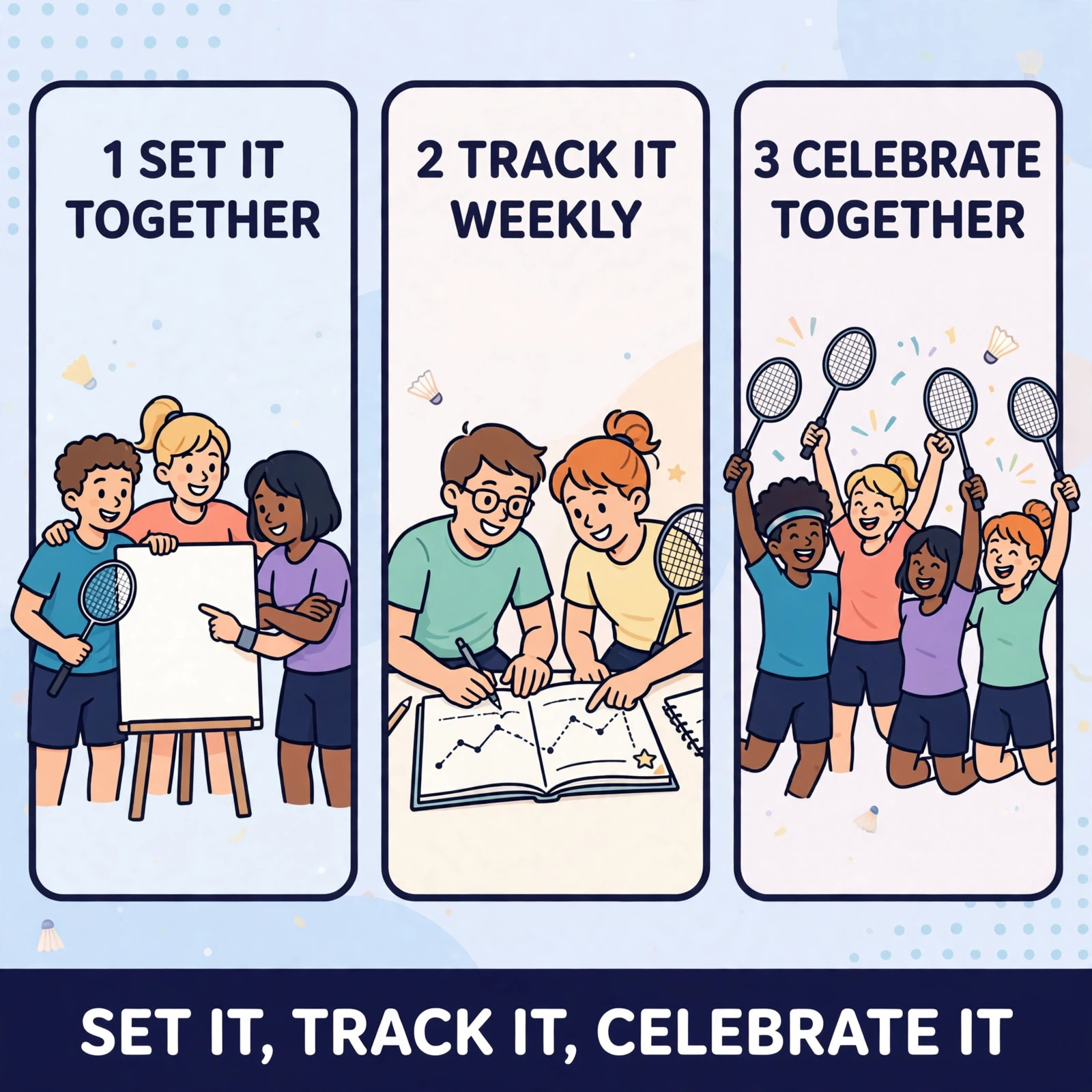
Teams move together when the target is shared and visible. Set goals the plain way: specific enough to picture (win our backhand corner exchanges), measurable (count them in Friday games), hard but reachable, and given a date. A goal the whole team helped set gets defended by the whole team; a goal handed down from a poster gets admired and forgotten.
Track progress in the open. A simple board or notebook, this week’s focus, what improved, what is next, takes two minutes at the end of a session and keeps the target alive between sessions. Players see their own names next to improvements, which does more for effort than any speech. When a target is missed, the team adjusts the plan, not the blame.
Celebrate successes together, including the small ones: a junior’s first full game, a pair’s first win over the senior group, a month of perfect attendance. Recognition in front of teammates tells everyone what this team values. It also balances the hard days, every team has them, with proof that the work is going somewhere.
Off the Court
Why Does Time Together Away From the Court Build Teams?
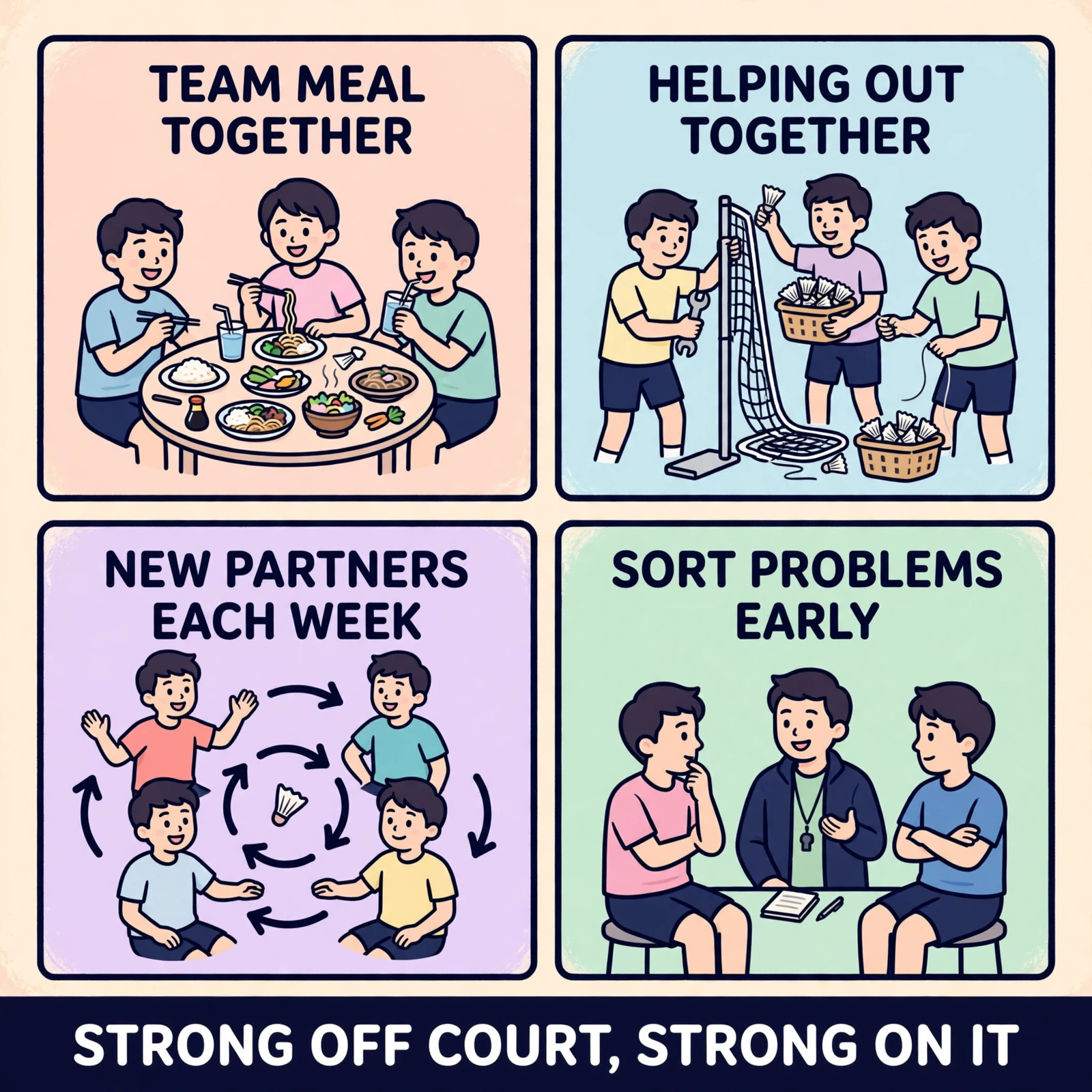
Time away from the court builds the part of a team that pressure cannot. A shared meal after a tournament, a team outing once a term, even helping at a community event together, these hours create the easy familiarity that lets a captain say a hard true thing and be heard kindly. Teams that only meet under match pressure are strangers with matching shirts.
Mix people deliberately in that time too. Sit the new junior next to the senior player at the team meal. Pair different partners in social scrimmages. Let younger players organise a warm-up game for the group. Belonging grows when everyone has a job in the team, not only the strongest four.
And when conflict comes, it always does, sort it early, calmly and face to face. A coach or captain who hears both sides within the week stops a misunderstanding hardening into factions. The rule we teach: criticise the rally, never the person; raise problems in the week they happen; leave the court with the team intact.
Myth vs Reality
Myths About Team Building
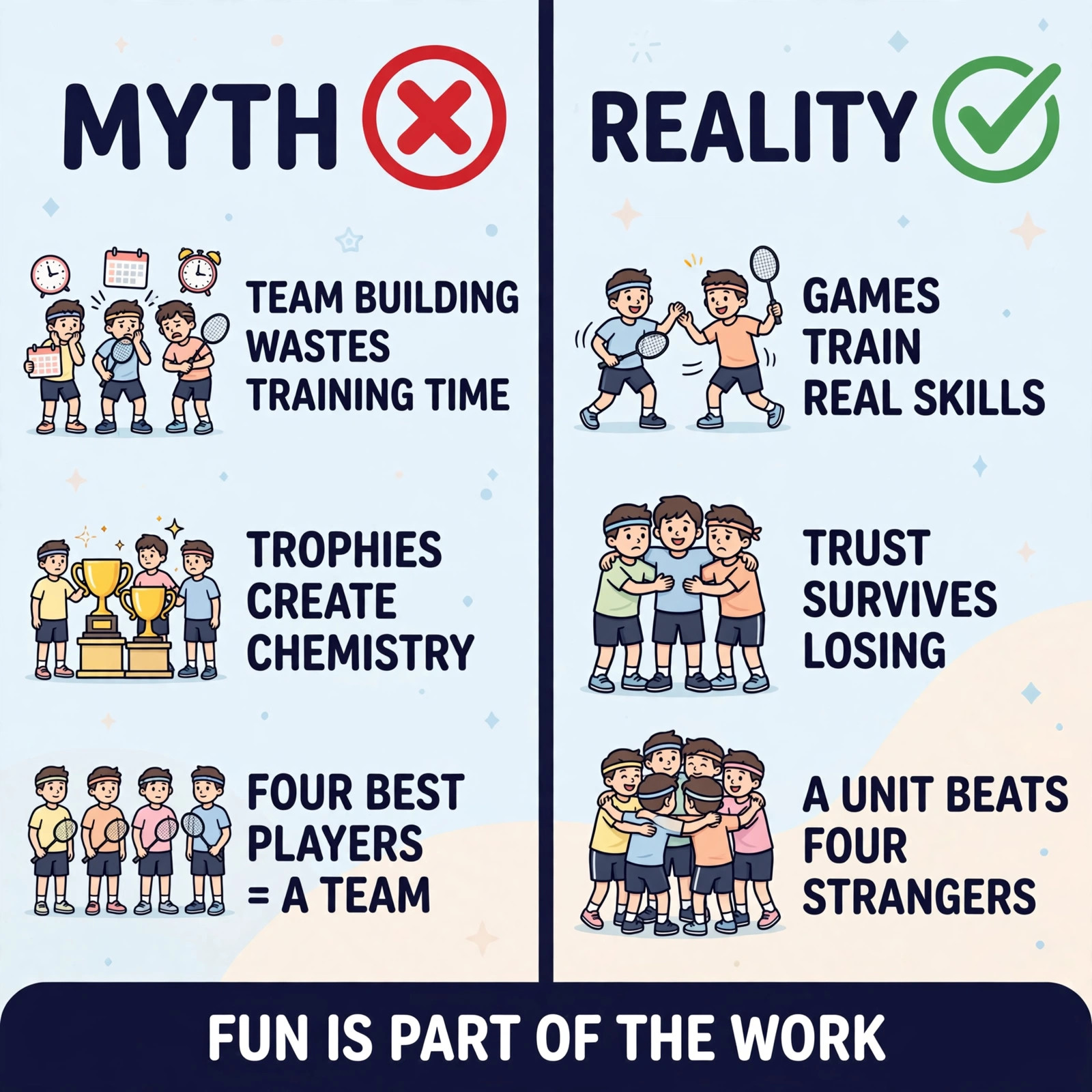
Myth: “Team building is just games, a waste of real training time.” Reality: the right games train calling, rotation and trust at full speed, and teams that trust each other practise harder and stay together longer. Ten minutes of the right game can buy a season of better doubles.
Myth: “Winning teams bond automatically, chemistry comes from trophies.” Reality: winning helps, but plenty of winning pairs cannot stand each other by the second season and fall apart the first time results dip. Myth: “Pick the four strongest players and you have a team.” Reality: four strong strangers lose to a slightly weaker unit that calls early, rotates cleanly and refuses to fracture at 18-18.
Myth: “Fun in training means the team is not serious.” Reality: watch any serious squad’s warm-up and you will find games, laughter and competition woven together. Serious is about standards, not faces, a team can be laughing at 6pm and ruthless about its drills at 6:10.
Why Choose Us
Team Spirit Is Trained in Our Sessions
At ST Badminton Academy KL, team spirit is trained inside normal sessions. Groups are capped at max 4 students, partners rotate every week, class games end with handshakes, and every group works to a shared target that the coach reviews out loud. Juniors learn to call, cover and encourage as deliberately as they learn to clear and drop.
Mr Eric Chuar has over 15 years of coaching experience in Singapore and Malaysia, and team building is built into how he runs a hall: mixed pairs, honest reviews, small celebrations when a group hits its target. His view is plain, a coach does not just build players, he builds the environment players grow in, and that environment decides how far talent travels.
Our academy is based in Setapak, Kuala Lumpur, convenient for players from Wangsa Maju, Melati Utama, Danau Kota and Gombak. School teams, doubles pairs and junior groups are all welcome, tell us about your team and its weak spot, and we will show you how a few structured weeks change how a group plays together.
FAQs: Building a Stronger Badminton Team in Malaysia (KL)
These are the questions coaches, captains and parents ask us most about building a stronger badminton team in Malaysia. If your question is not here, message us, tell us about your team, its size and where it keeps breaking down, and we will give you a straight answer about the work that would help most.
What team activities do you run for players in Setapak or Gombak?
We run partner-rotation games, team relays, shared target-setting and honest post-game reviews inside normal sessions for players in Setapak and Gombak, in groups of max 4 students. Juniors and school teams get the same structure: changing pairs, clear calls drilled early, and a team target reviewed each week so progress stays visible to everyone.
How does teamwork change results for doubles pairs in KL?
Teamwork changes doubles results in practical ways: fewer shuttles landing between partners, cleaner rotation after smashes, and pairs that keep their pattern when the score tightens. In KL school and club matches, most close games are lost on confusion and hesitation, not shot quality, a pair that talks early wins rallies it used to donate.
How often should a team do bonding work at a normal training level?
Once a week is a good rhythm for most teams: ten to fifteen minutes of team games or shared review inside a normal session, with partners rotated. That keeps calls sharp and morale high without eating technique time. Consistency beats the occasional big team day, small habits, repeated weekly, are what actually change a group.
Can a new player fit into a team when joining at 13 or 14?
Yes. New players fit in by being given a role, a rotating partner and honest encouragement from the first session. At thirteen or fourteen, juniors settle fastest when the group has clear habits, everyone calls, everyone rotates, everyone shakes hands, because the newcomer copies the culture simply by joining the games.
How should a team prepare in the week before a tournament they enter?
Use the week to sharpen, not to rebuild: light team games early in the week to settle nerves, your best pair combinations tested in conditioned games, calls and rotation reviewed once, then rest the day before. Arrive with roles agreed, who leads warm-up, who tracks scores, so tournament day runs on habits, not hope.
Do you run team training and group classes near Wangsa Maju?
Yes, our Setapak academy runs team training and group classes a short drive from Wangsa Maju, Melati Utama and Danau Kota. Sessions mix technique work with partner rotation, team games and shared targets, in groups capped at max 4 students. School teams and regular doubles pairs are welcome to train with us on a weekly rhythm.
Does your academy help school teams build spirit in Malaysia?
Yes, building team spirit is part of how ST Badminton Academy coaches in Malaysia: rotating partners, team games inside sessions, shared targets and reviews, and handshakes after every class game. Parents and school coaches tell us the same habits, calling clearly, backing partners, sorting problems early, start showing up in school teams within a term.
Where is ST Badminton Academy KL located for team training?
ST Badminton Academy KL is based in Setapak, Kuala Lumpur, where our team training runs in small groups of max 4 students. The academy is convenient for teams from Wangsa Maju, Melati Utama, Danau Kota and Gombak. Message us before your first session and we will confirm venue details and how a first month would look.
What makes Mr Eric Chuar a suitable coach for team badminton?
Mr Eric Chuar has over 15 years of coaching experience in Singapore and Malaysia, and he coaches teams the way he coaches players: watch first, set a target, review it honestly. He builds calling, rotation and trust into every session and settles disagreements early, students describe his groups as close-knit because behaviour standards are as clear as footwork standards.
Badminton Team Building in Action



What It Takes to Build a Real Team
A team meets our standard when five things hold in a real match: calls come early and mean something, rotation stays clean after the smash, partners back each other after errors, the shared target is known by everyone, and disagreements get settled in the week they happen. Our team standards below are the checkpoints our coaches use when reviewing a group.
| Factor | Just Playing Together | Building a Team TEAM |
|---|---|---|
| Frequency | 1 or 2 times a week. Mostly for fun and sweat. | Set team goals together and review them out loud week by week. |
| Drills Focus | Basic static feeding. Minimal footwork pressure. | Rotate partners and roles so everyone learns to play with everyone. |
| Physical Conditioning | Rarely included. Just playing games on court. | Core, agility, and speed training included in every session to prevent injury and build stamina. |
| Tactical Awareness | "Just hit it over." No real game plan. | Video analysis, point construction, and learning to read the opponent's game. |
| Coach Ratio | Large groups (8-10 kids). Coach barely watches you. | Max 4 students. Mr Eric Chuar personally corrects every stroke and movement detail. |
| Goal Setting | Fun and exercise. | Call early, back your partner after errors, and sort problems out fast. |
| Long Term Result | Good recreational player. | A group that trusts each other and plays as one unit under pressure. |
Badminton Team Building in Kuala Lumpur
This page covered building a stronger badminton team with fun activities: games that teach teamwork, doubles communication, shared goals, time together away from the court and sorting conflict early. ST Badminton Academy KL trains teams and groups of max 4 students in Setapak. If your team is in Wangsa Maju, Gombak, Cheras or nearby, contact us today.






