Badminton And Resistance Training: Exercises For Building Strength And Power (Strength Guide)
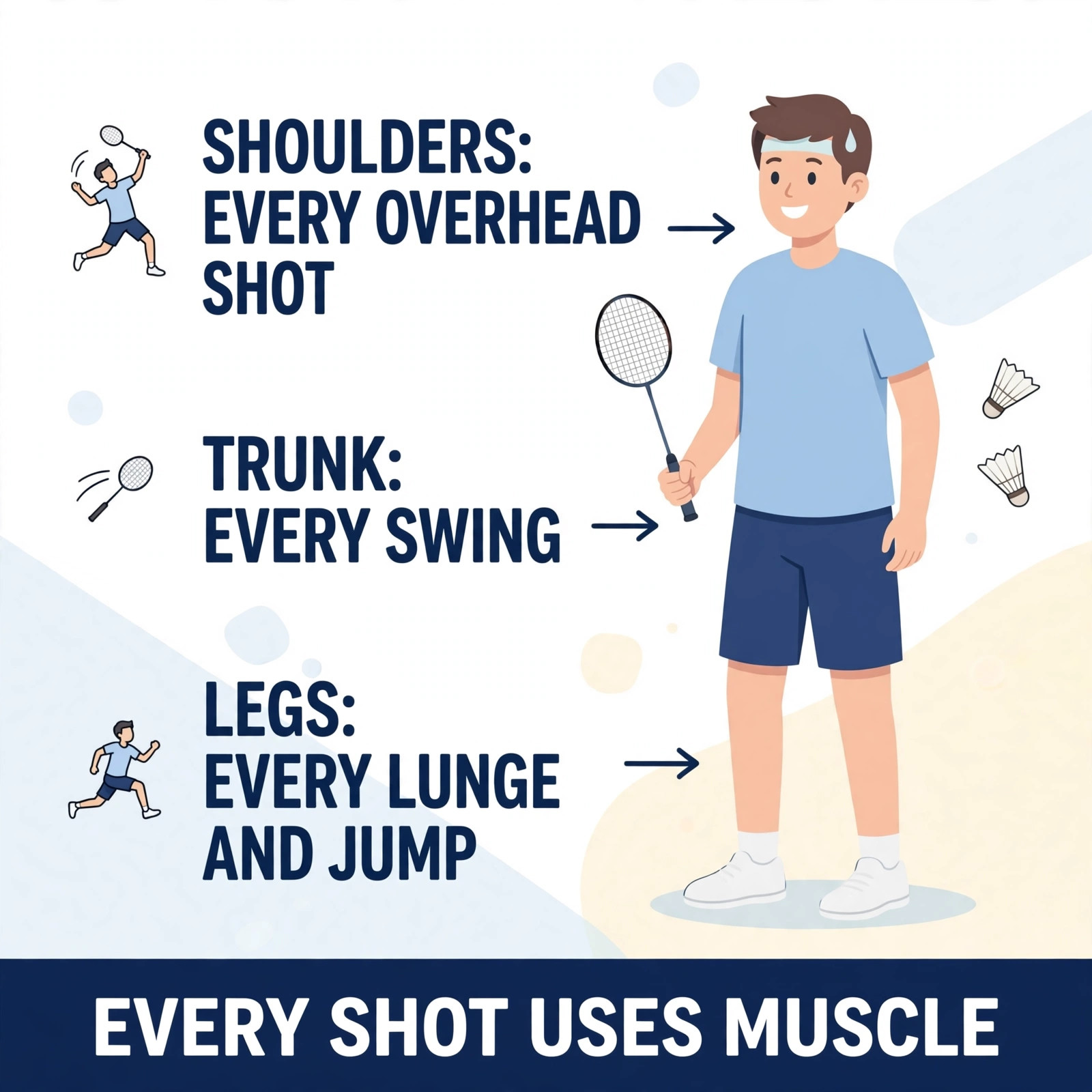
A badminton match asks a lot from muscle. Your legs lunge, brake and push off hundreds of times. Your trunk turns on every overhead swing. Your shoulder hits at full stretch for an hour or more. Resistance training is how you build the muscle behind those actions: squats, lunges, hinges, rows and presses, done with good form and slowly rising loads. This page covers what strength work actually does for a badminton player, the big lifts that matter, the pulling and pressing that protect your shoulders, how to load safely, and how strength days fit around court days.

Strength Check #1
What Resistance Training Does for a Badminton Player
Start with the legs. Every lunge is a single leg strength test at speed, and every recovery is a push off that same leg. Stronger legs push off harder, brake later and cleaner, and hold a deep lunge without the knee wobbling inward. A stronger trunk transfers force from the legs into the racket instead of leaking it through a soft middle. Stronger back and shoulder muscles support the overhead action rally after rally. Training these muscles with resistance can also help lower the risk of some common strains, because the tissues that absorb the load are stronger.
None of this replaces court training, and it is not meant to. Strength is the support act. Your footwork decides where your strength gets used, and your technique decides how much of it reaches the shuttle. A strong player with poor footwork still arrives late, just more powerfully. The aim of this page is a body that lets your skills show for a full match: legs that still lunge deep in the third game, a trunk that still turns, and shoulders that still hit with shape when tired.
Strength Check #2
The Big Lifts: Squats, Lunges and Hinges
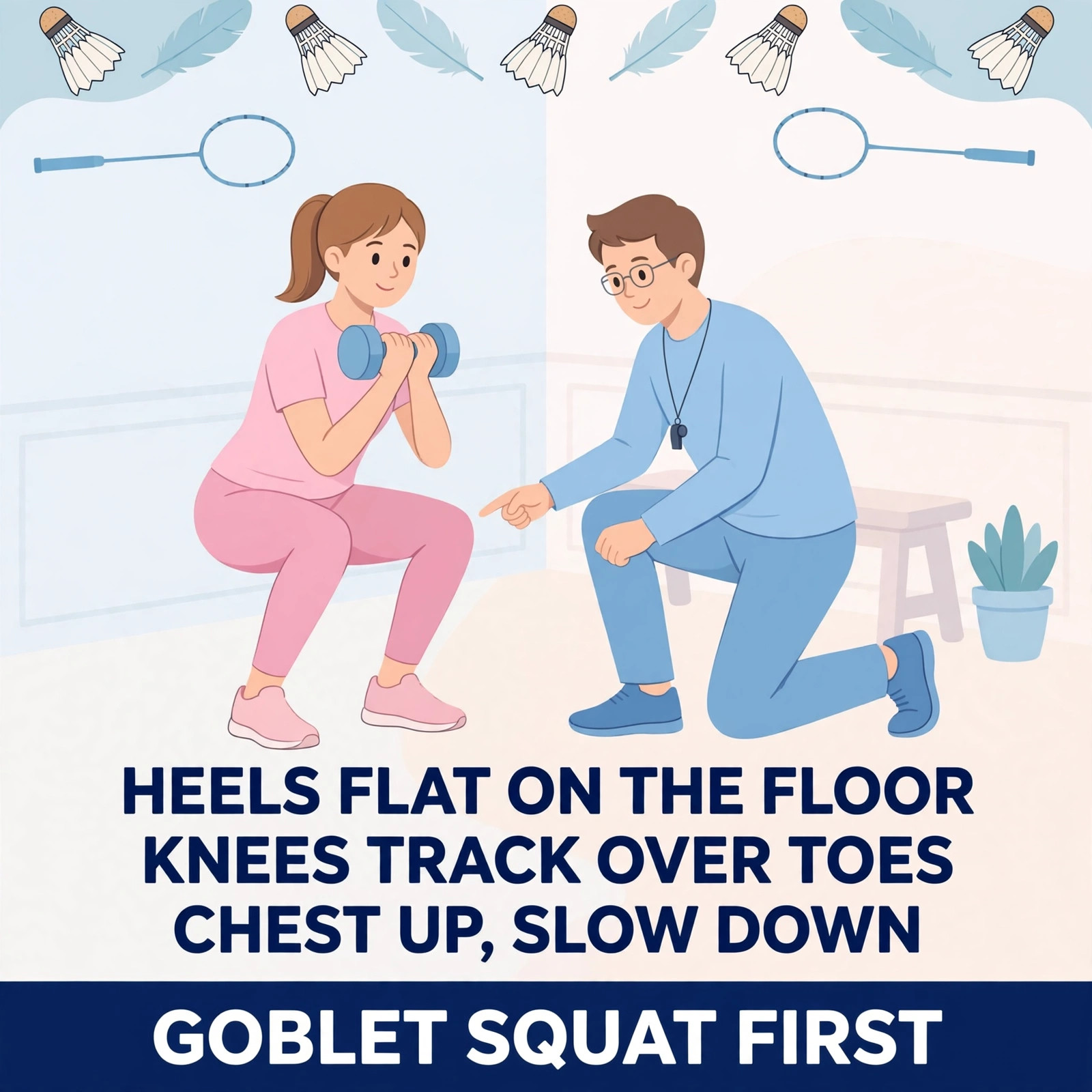
The squat is the first pattern to learn, because it trains both legs together in the shape you use to push off and land. The goblet squat is the teaching version: hold one dumbbell at your chest, feet about shoulder width, and sit down between your heels. Your knees track in line with your toes, your heels stay down, and your chest stays proud rather than folding forward. Learn the shape with a light weight until it looks the same on every rep. Depth you can control is worth more than depth you fall into.
Lunges and split squats are the badminton shapes. A split squat is a lunge held in place: front leg bent like a net lunge, back knee lowering toward the floor, torso tall. It loads one leg at a time, the way badminton actually uses them, and it quickly shows up a weaker side that two leg work hides. Train both sides with even reps, and let the weaker side set the load. Step lunges, forward and reverse, come after the split squat is stable. These are the lifts that make deep defensive lunges feel ordinary instead of desperate.
The hinge is the third pattern: push your hips back, keep your back flat, and let the load hang close to your legs, as in a Romanian deadlift. It builds the back of the legs and hips, plus the back muscles that hold your posture when you bend low in defence or pick up a racket bag a hundred times a season. The hinge is a skill before it is a strength exercise. Start very light, groove the hip movement with no rounding in the back, and add load only when the shape survives every rep of the set.

Strength Check #3
Pulling and Pressing for the Back and Shoulders
Rows build the upper back, the most undertrained area in racket players. A one arm dumbbell row, one knee on a bench and back flat, teaches you to pull the weight to your hip and lower it slowly. Strong rows hold your chest open and your shoulders back during long rallies, so your hitting posture does not collapse forward as you tire. Rows also balance the front of the shoulder, which does heavy work in every smash and clear. If you only add one upper body lift, add the row.
Pressing builds the pushing side: dumbbell presses overhead or from the chest, done with control and a quiet trunk. Press within a range that feels smooth in your shoulder, and stop any set where the shape turns into a back bend to finish the rep. Overhead athletes need pressing strength, but they need it in balance. A player who presses far more than they can row is building a shoulder that pulls itself forward, which is the posture that complains during long overhead sessions.
The balance rule is simple: pull as much as you push. For every pressing exercise in your week, match it with rowing or pulling work of similar effort. Add simple trunk work that fits the gym setting: planks held with a level back, and farmer’s carries, walking tall while holding weights at your sides, which build grip, trunk and posture in one honest movement. None of this needs to be fancy. It needs to be balanced, regular, and logged, so the hitting side of your body is never the only side that trains.

Strength Check #4
Load, Reps and Form: Progressing Safely
Load is where good intentions get hurt, so the order is strict: form first, load second, always. Your first weeks with any lift should use weights that feel almost too easy while you learn the shape. If you can, have a coach or an experienced lifter watch your early sets, because the errors you cannot feel are the ones that matter. Muscle effort and a deep stretch feeling are normal. Sharp pain, joint pain or pain that changes how you move is a stop signal, not a challenge. Get the movement checked before you load it again.
Reps and sets can stay plain. Main lifts usually live in sets of about four to eight controlled reps, where the last rep is hard but clean. Support work such as rows, carries and trunk work often sits around eight to twelve reps. Rest between sets long enough that your form resets fully, usually a few minutes for the big lifts. Rushing sets to feel tired turns strength training into sloppy conditioning. Strength is built by good reps done fresh, repeated across weeks, not by one heroic afternoon.
Progress by small steps. When every rep at a load stays clean across two sessions, add a little: the next dumbbell size, or a small plate. Write down the lift, the load and the reps every session, because memory lies and logs do not. Big jumps in load are where form breaks, and broken form under load is where most gym injuries in court players come from. Slow progress feels boring for a month and then suddenly looks like a different athlete by the end of a season.

Strength Check #5
How Strength Work Fits the Training Week
Two strength sessions a week suits most badminton players, placed where they do not fight your court work. Good options are strength after a light court day, or on a day with no court at all. Treat the week as one load budget: legs trained hard in the gym are legs that must be counted in your court sessions too. A coach who sees your whole week will place the lifting where it supports the badminton, instead of two programs competing for the same legs.
Keep heavy lifting away from the day before a match or a hard footwork session. Sore, heavy legs make slow first steps and sloppy lunges, and you end up practising poor movement at exactly the wrong time. After a tough match, take the light day you have earned rather than testing your squat. As your training age grows you will learn how much you can carry in a week, but the learning should be gradual. The players who stay strong for years are rarely the ones who won the first month.
Beginners improve quickly on simple programs, and that is a reason to keep them simple. The same squat, lunge, hinge, row and press, done twice a week with tidy form and slowly rising loads, will carry a new lifter for months. Variety is not the point at the start; repetition is. When progress honestly stalls for several weeks, a coach can change one variable: a new variation, a different rep range, or a deload week. Changing everything every fortnight is how players stay beginners for years.

Myth vs Reality
Myths About Lifting Weights
Myth one: weights make badminton players slow and bulky. Bulky bodies are built with years of eating and training aimed at size. Strength training at the doses on this page builds muscle that pushes off harder and brakes better, and it is paired with court speed work, not instead of it. Players get slow from fatigue and from skipping court training, not from owning stronger legs. The strongest juniors on court are usually also among the quickest, because their first steps carry more force.
Myth two: soreness proves the workout worked. Soreness mostly proves the work was new. It fades as your body adapts, which is a good thing, and chasing it by constantly changing exercises keeps you sore and weak at the same time. Progress is written in your log: heavier loads, more clean reps, better shapes. A player can be badly sore and no stronger, or barely sore and clearly progressing. Judge the training by the numbers that matter.
Myth three: heavier is always better, so max out often. A maximum attempt tests strength; it does little to build it, and it carries the most risk of any lift you will do. Court athletes have nothing to gain from weekly heroics under a bar. Most of your work should feel challenging but controlled, finished with a rep or two still in you. Save the testing for rare, planned checks with a coach watching, and let the ordinary weeks do the building.

Why Choose Us
Why Players Choose ST Badminton Academy
At ST Badminton Academy, strength work for badminton is coached in groups of no more than four students, whether the session is on court or in the training area. Form is watched set by set, because a squat pattern that drifts at rep six is exactly the drift that matters. Loads are set per player and logged, so a junior and an adult in the same group each lift what is right for them, and nobody copies the strongest person in the room.
Coach Eric Chuar has spent more than 15 years coaching players in Singapore and Malaysia, and he plans strength work around the court schedule rather than beside it. Lifts are chosen for what badminton asks: lunging legs, a turning trunk, and shoulders balanced between hitting and pulling. Progress is checked in the log and on the court at the same time, because gym numbers only matter when the third game looks better.
The academy is based in Setapak, Kuala Lumpur. If your legs fade late in matches or your shots lose shape when you tire, a trial session is a sensible start: play a little, show us your squat and lunge shape, and we will tell you honestly where your strength base stands and what to build first. No hype and no promises of instant power, just a plan you can follow.
FAQs: Badminton Resistance Training in Malaysia (KL)
Players and parents ask the same fair questions before starting strength work. Here are straight answers, with no hype and no promises we cannot keep.
Where can I learn resistance training for badminton if I live in Setapak or Gombak?
With us, in Setapak. ST Badminton Academy is based in Setapak, Kuala Lumpur, and players travel in from Gombak, Wangsa Maju and nearby areas. Strength work is coached in small groups of no more than four, so your squat, lunge and rowing form is watched set by set, not left to guesswork.
What is the most useful strength work for badminton in KL?
The big patterns first: squat, lunge, hinge, row and press. Between them they cover the legs, hips, back and shoulders that badminton uses most, and they carry over to lunges, jumps and overhead shots. Fancy machines and long exercise lists can wait. Five patterns done well beat twenty done loosely.
How often should I lift weights to reach a steady level?
Two sessions a week is the rhythm that works for most players. Strength changes slowly and rewards steadiness: the same lifts, tidy form, and loads rising a little at a time over months. Missing weeks stall progress more than any program detail, so pick days you can actually keep.
Can I start resistance training at home with no gym or machines?
Yes. Bodyweight squats, split squats, hip hinges and press ups build a real base with no equipment, and a backpack or a pair of dumbbells can add load later. What home training cannot give you is a coach watching your back round or your knees cave, so learn the shapes in coached sessions first.
How heavy should I lift when I first start training for badminton?
Light enough that every rep looks clean and you could still do two more. If your knees wobble, your back rounds or you have to throw the weight up, it is too heavy that day. Start almost too easy, learn the shapes for a few weeks, then add load in small steps.
Do you offer strength coaching for badminton near Wangsa Maju?
Yes. Our base is in Setapak, a short drive from Wangsa Maju, and strength coaching runs inside our regular small group sessions. Groups are capped at four students, so loads and form are watched closely, and your lifting is planned around your court days rather than competing with them.
Is resistance training suitable for young players in Malaysia?
Yes, with the loads kept sensible. Young players start with bodyweight patterns and light weights, form first, and no maximum attempts. Supervised strength work at this level is about building strong movement habits: squatting, lunging and hinging well. Small groups matter, because a coach must see every set.
Where does ST Badminton Academy run badminton strength training?
At our home base in Setapak, Kuala Lumpur. Strength coaching runs inside small group training with no more than four students per session, mixing court work and resistance work in one plan. Players come in from Gombak, Wangsa Maju and across the Klang Valley, and trial sessions can be arranged through the academy.
What does a coach check first when a player starts lifting for badminton?
Your squat and lunge shape, before any talk of weights. A coach watches whether your knees track over your toes, your heels stay down and your trunk stays tall, then how you hinge at the hips. Those patterns decide your starting loads and show what needs fixing first, so they come before everything else.
Badminton Strength and Power Training in Action


One Standard for Every Player and Every Session
Strength is tested in the log and on the court. Every few weeks, a player repeats the same checks: goblet squat load for clean reps, split squats on each side, and a rowing load with a flat back. The standard is a slowly rising load with form unchanged, never a single heroic attempt. When the log rises and the third game looks stronger, the training is doing its job.
| Factor | Playing Only | Playing Plus Strength Work STRENGTH |
|---|---|---|
| Frequency | 1 or 2 times a week. Mostly for fun and sweat. | Two strength sessions a week beside regular court training. |
| Drills Focus | Basic static feeding. Minimal footwork pressure. | Squats, lunges, hinges, rows and presses taught with checked form. |
| Physical Conditioning | Rarely included. Just playing games on court. | Core, agility, and speed training included in every session to prevent injury and build stamina. |
| Tactical Awareness | "Just hit it over." No real game plan. | Video analysis, point construction, and learning to read the opponent's game. |
| Coach Ratio | Large groups (8-10 kids). Coach barely watches you. | Max 4 students. Mr Eric Chuar personally corrects every stroke and movement detail. |
| Goal Setting | Fun and exercise. | Loads logged and raised a little at a time, never by guessing. |
| Long Term Result | Good recreational player. | A player whose legs and shoulders hold up late in the third game. |
Badminton Strength Coaching in Kuala Lumpur
This page covered what resistance training gives a badminton player: stronger lunges and push offs, a trunk that transfers power, shoulders balanced between pressing and pulling, and a safe way to load it all across the week. ST Badminton Academy coaches strength and court work together in small groups of no more than four students in Setapak, Kuala Lumpur. If you play in Wangsa Maju, Gombak or nearby and want a stronger base for your game, contact us today.






