Badminton Court Etiquette: Play Fair And Respectful (Etiquette Guide)
Badminton runs on trust. In most games in Malaysia there is no umpire and no line judge, the players call their own lines, keep their own score and settle their own disagreements. That only works when everyone on court plays fair and treats each other with respect.
This guide covers badminton court etiquette the way we teach it at ST Badminton Academy in Setapak, Kuala Lumpur: honest line calls, correct scoring, how to move around a busy hall, what to do when things go wrong, and how to leave the court ready for the next group.
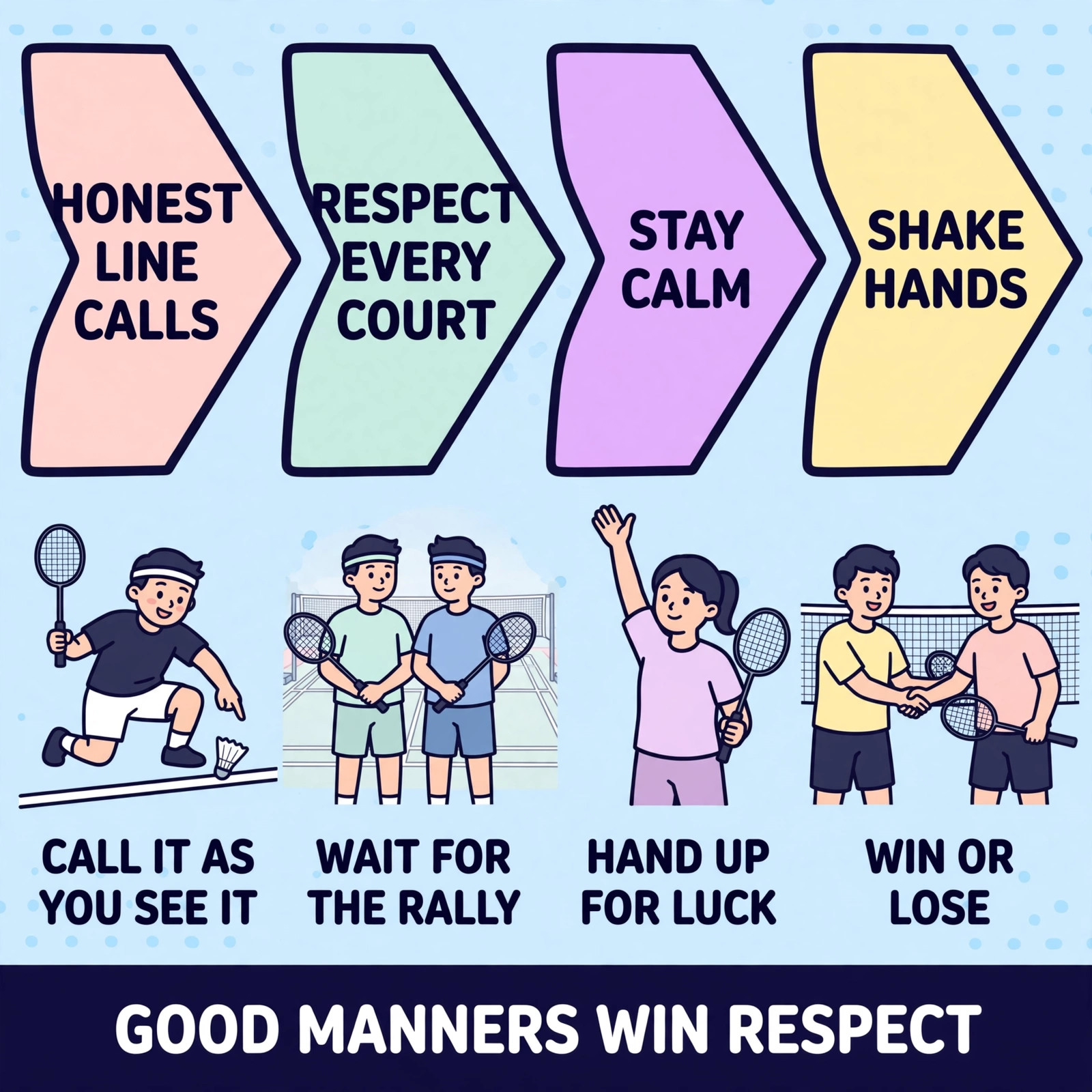
Etiquette Check #1
Why Does Good Court Etiquette Matter in Every Game?
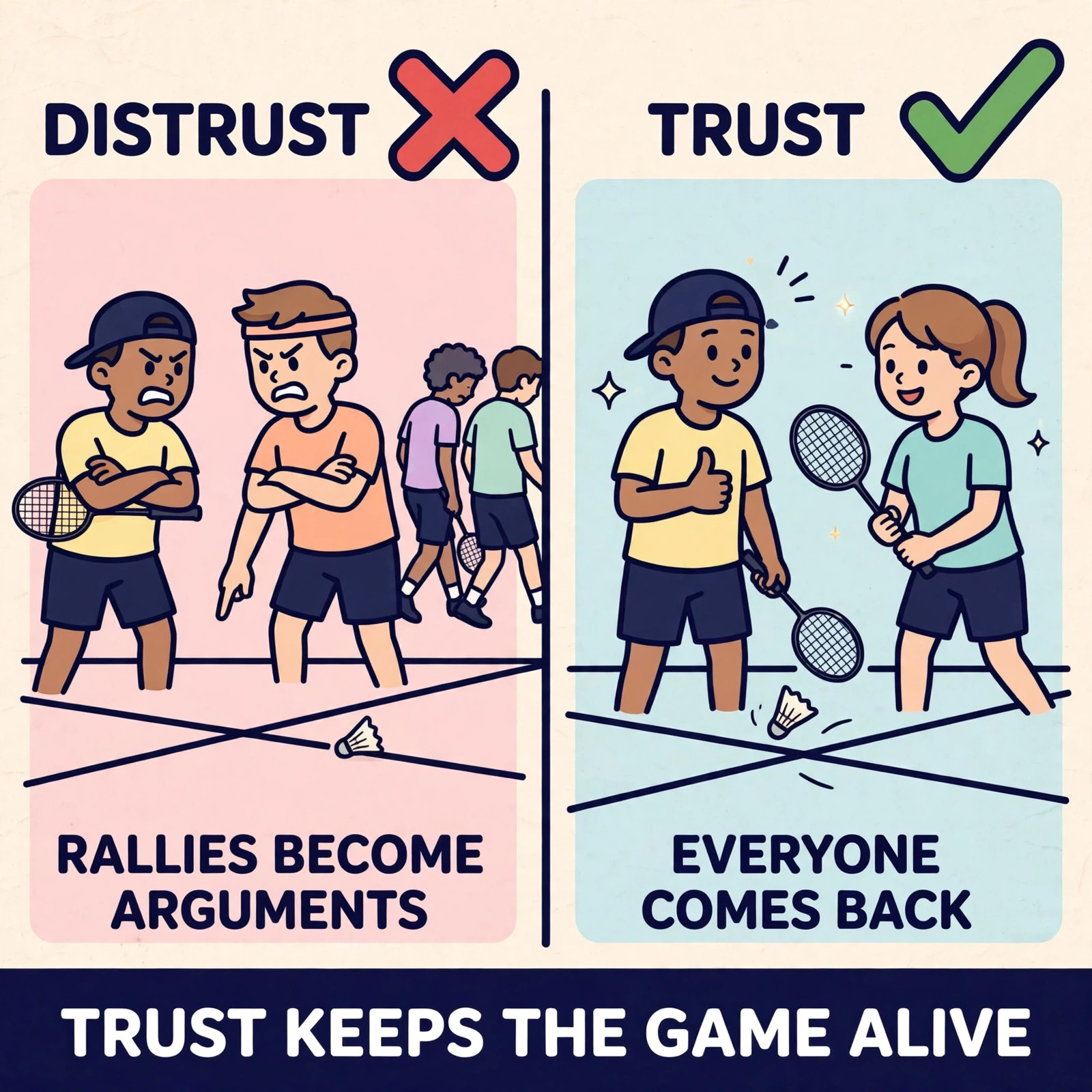
Etiquette matters because the game has no referee to hide behind. In a social game or a class game, the player closest to the shuttle calls the line, and everyone else has to trust that call. One player who stretches the truth on close shuttles poisons the whole evening: rallies stop being rallies and become arguments, and good players quietly stop inviting that person back.
Good manners on court are small and easy to spot. Arrive on time and ready. Greet your partner and opponents. Share the warm-up shuttles instead of hogging them. Keep your bag and bottle at the side of the court, not in the playing area. None of this needs talent, it just needs the decision that the game belongs to everyone on the court, not only to you.
Etiquette Check #2
How Do You Call Lines and Keep Score Honestly?
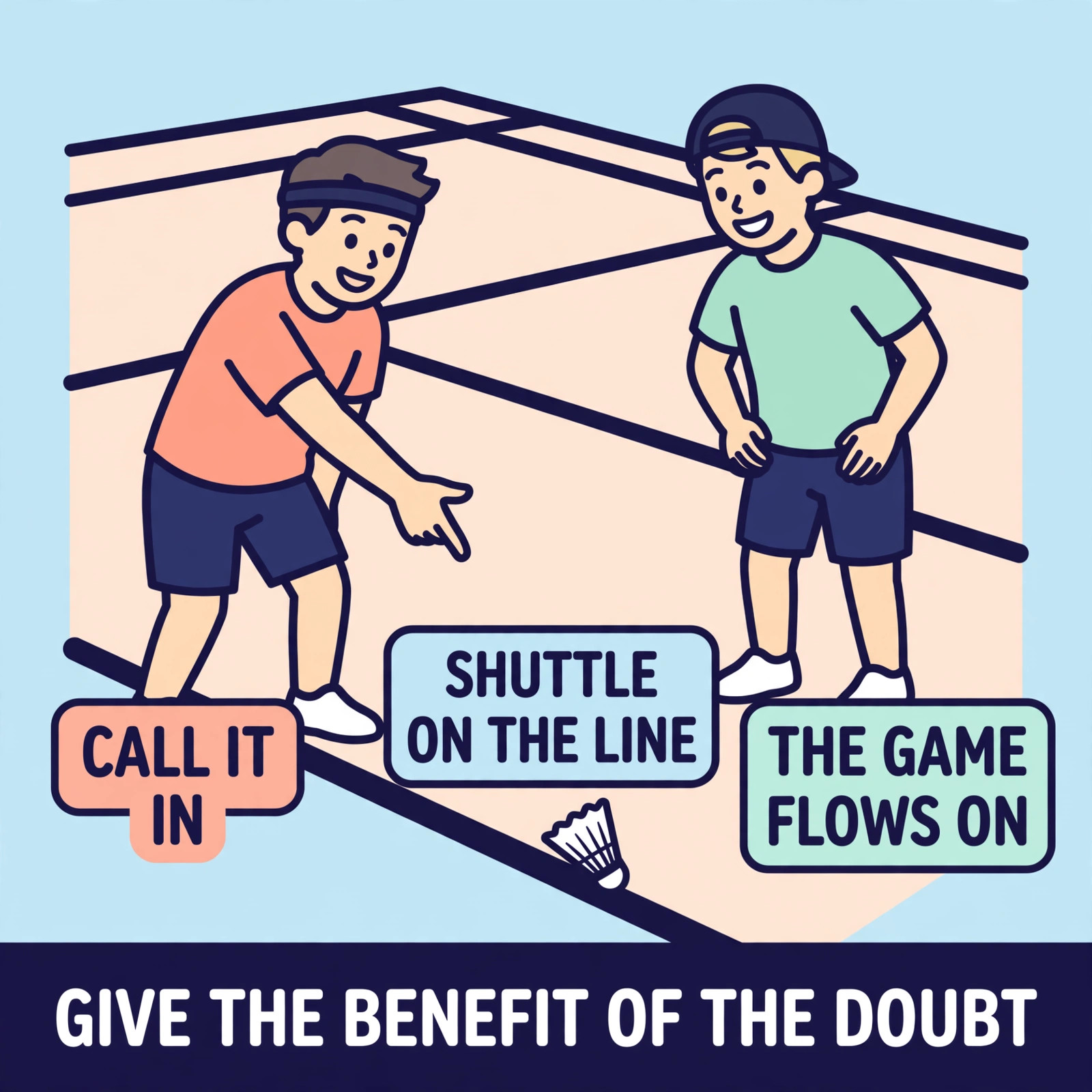
Call lines at once, clearly, and honestly. The player nearest the shuttle makes the call, in or out, loud enough for the other side to hear. If the shuttle lands on the line, it is in. And if you are honestly not sure whether it caught the line, the respected habit in badminton is to give your opponent the benefit of the doubt. A point won on a doubtful call is remembered for the wrong reasons.
Keep the score the modern way. Badminton uses rally scoring: every rally is worth one point, whoever wins the rally scores, and the winner of the rally serves the next one. A game is played to 21 points with at least a two-point lead; at 29-all, the side that scores the 30th point wins the game. Say the score out loud before you serve, it stops most disagreements before they start.
When a call is genuinely disputed in a friendly game, settle it like an adult: talk for ten seconds, and if nobody can be sure, replay the rally and move on. Arguing for five minutes over one point in a social game costs everyone the evening. In our classes we teach juniors the same order, call it, accept it, play the next rally.

Etiquette Check #3
How Should You Behave Around Other Courts?
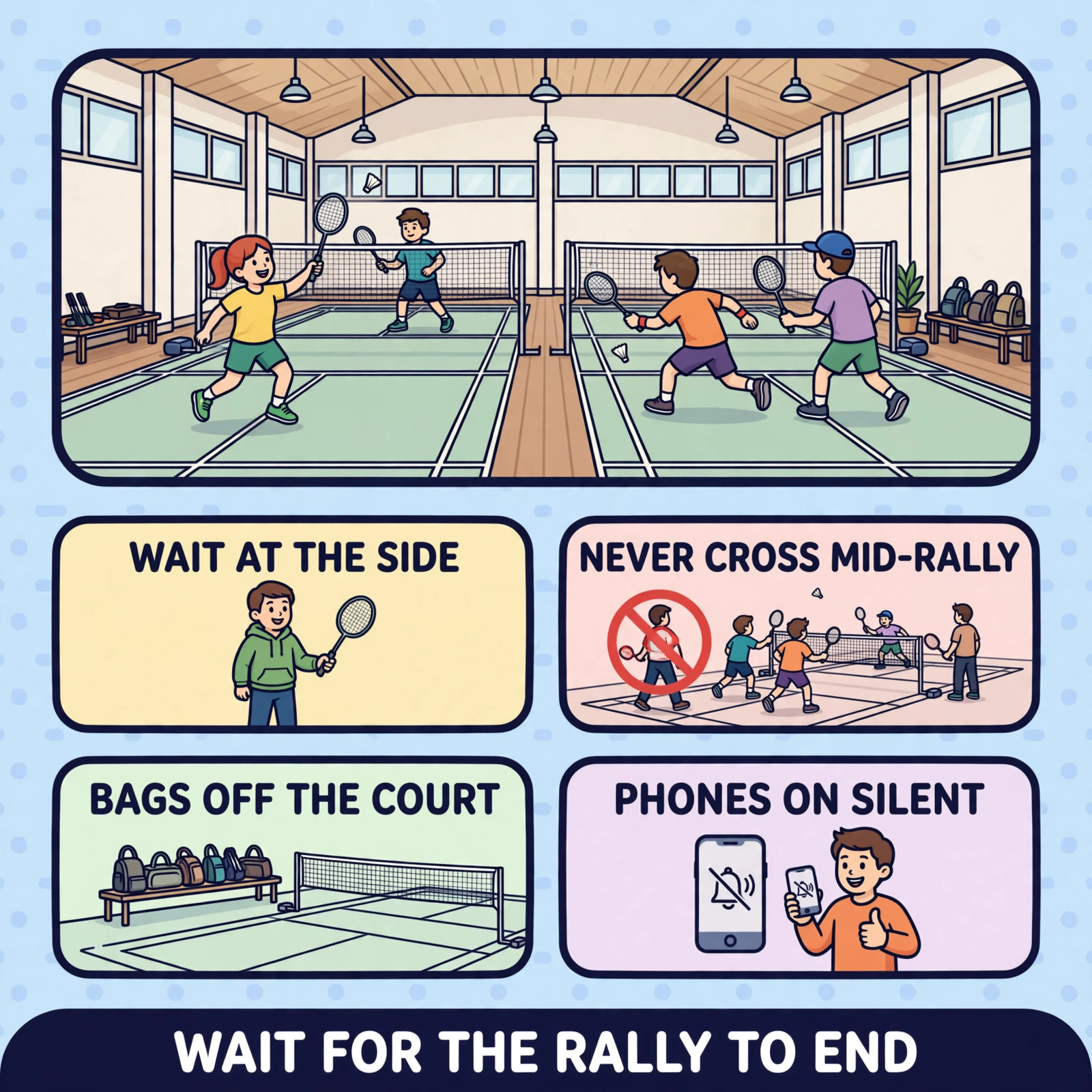
Malaysian badminton halls are busy places, with courts side by side and games running back to back. The first rule of moving around them: never walk behind a court while a rally is being played. Walking across someone’s back boundary mid-rally is dangerous and rude, a player stepping back for a clear cannot see you coming. Wait at the side, let the rally finish, then cross quickly.
Give players their space. Do not stand on the edge of a court that is in use, do not lean on the net, and do not practise swings in the walkways where people pass. If your shuttle rolls onto the next court, wait for their rally to end before you step in to collect it, or let them flick it back to you between rallies.
Keep noise and phones under control. Shouting across the hall during another court’s rally, loud arguments, and phones ringing at the side of the court all break other players’ concentration. Keep your phone silent and off the court during play, and keep celebrations and groans at a level that respects the games around you.
Etiquette Check #4
What Do Fair Players Do When Things Go Wrong?
Things go wrong in every game, and etiquette is mostly about those moments. If your shot clips the tape and dribbles over for a lucky point, raise a hand to your opponent. It costs nothing and everyone does it at every level of the game. If the shuttle hits your opponent’s body, apologise straight away and check that they are fine before the next rally.
Losing your temper is the fastest way to lose respect. No swearing at calls, no throwing rackets, no smashing shuttles into the net, no sarcastic clapping when an opponent makes a mistake. Frustration is normal, even professionals feel it, but good players park it, breathe, and play the next rally. In class we treat a thrown racket as a safety problem, not a passion problem.
Accept decisions and keep coaching in its place. In a match with an umpire, the umpire’s call stands; in a friendly game, your opponent’s honest call stands. Spectators and friends should not coach or shout calls from the sideline during a game, it unsettles both sides and starts arguments the players did not ask for. Save the advice for after the match.

After the Game
What Happens After the Last Point Is Played?
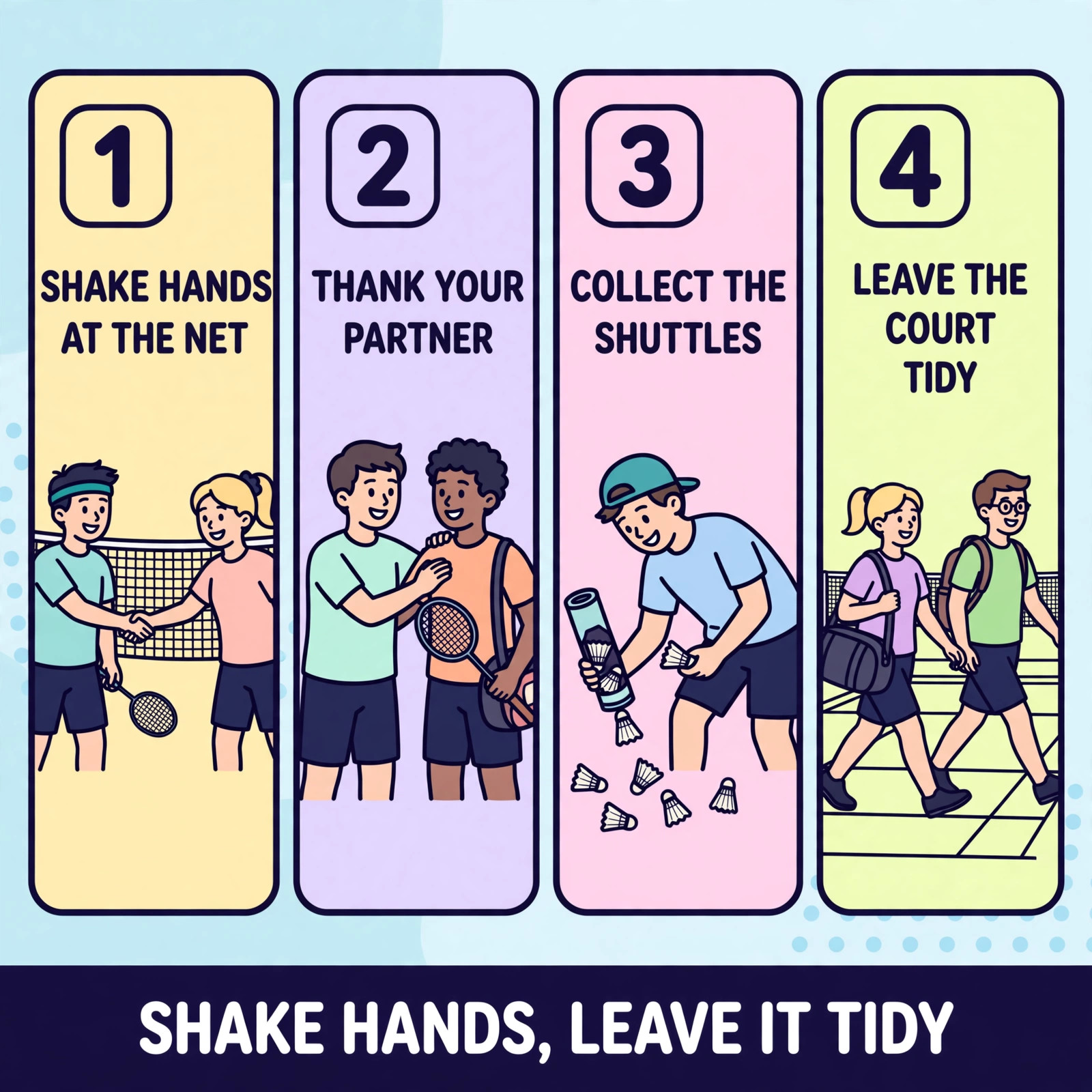
When the last point ends, walk to the net and shake hands, or tap rackets, whether you won or lost. Thank your partner, thank your opponents, and if a call went your way on a doubtful shuttle, a quiet word at the net settles it. The handshake is not a ceremony for winners; it is the receipt that both sides played the game properly.
Say something honest and kind about the game. A specific word, “your cross-court drops were hard to read”, means more than a trophy speech, and it keeps the door open for the next game. If something upset you during the match, the time to raise it is calmly, after the handshake, or not at all. Score disputes and grudges should never be carried off the court screaming.
Leave the court the way you would like to find it. Collect the shuttles, take your bottles and towels with you, and move off promptly when your booking ends so the next group can start on time. Courts in KL run back to back in the evenings; a group that drifts off slowly steals playing time from strangers who paid for it.
Myth vs Reality
Myths About Court Etiquette
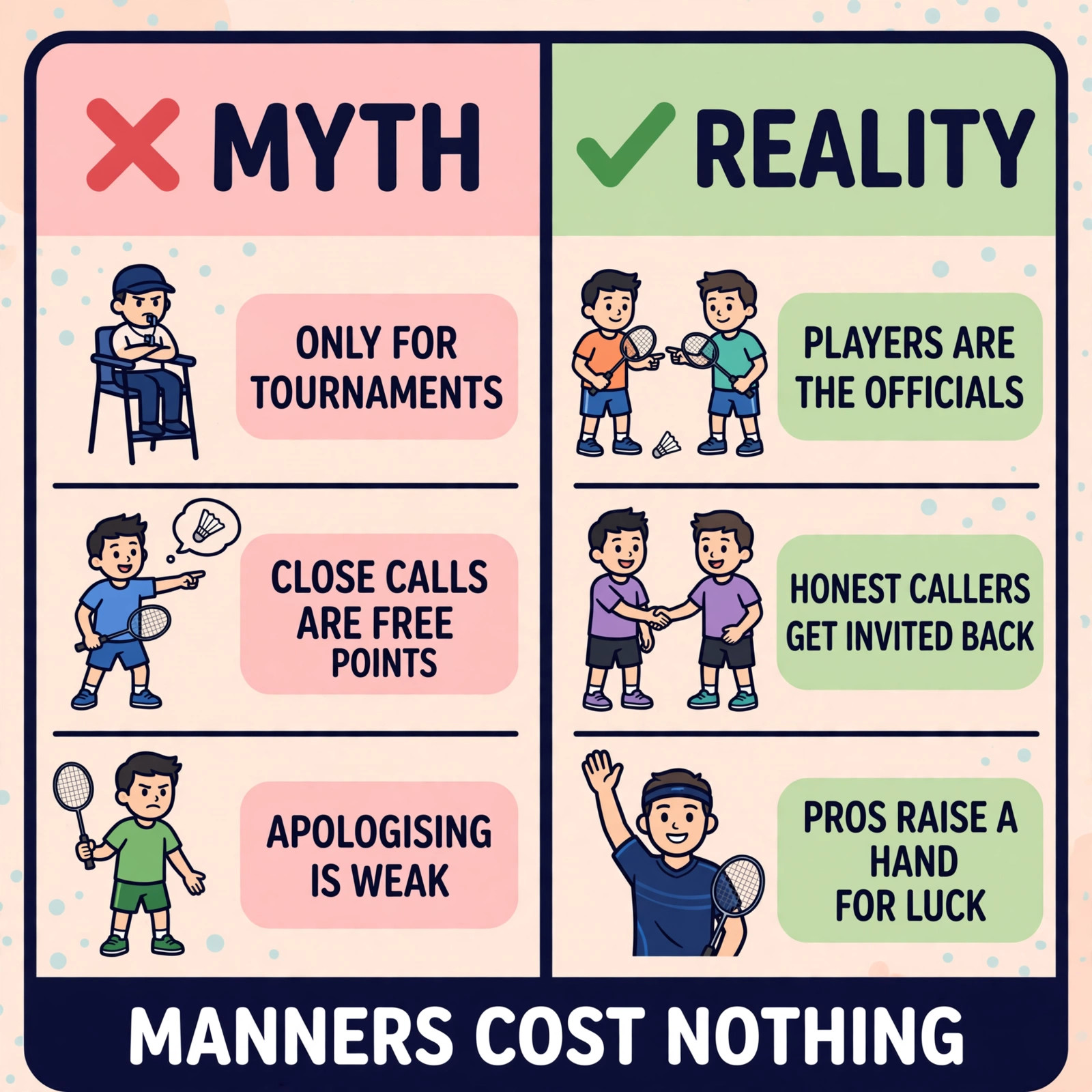
Myth: “Etiquette only matters in tournaments with umpires.” Reality: etiquette matters most where there is no umpire, in social games and classes, where the players themselves are the officials. A hall full of honest callers runs itself.
Myth: “Calling every close shuttle out is just smart, competitive play.” Reality: it is the quickest way to stop being invited. Myth: “Apologising for a net cord or a body hit shows weakness.” Reality: professionals raise a hand for luck at the highest level of the game. The apology is a mark of a player who knows the difference between winning a rally and earning it.
Myth: “Good manners are soft, real competitors are ruthless.” Reality: the most respected competitors are the hardest to play and the easiest to play with: full effort in the rally, full honesty on the calls, full respect after the last point. Ruthless about the shuttle, courteous about everything else.
Why Choose Us
Good Manners Are Coached Like Every Other Skill
At ST Badminton Academy KL, etiquette is coached like a stroke, from a student’s first session. Juniors learn to call lines out loud, announce the score before serving and shake hands after every class game. Adults train in groups capped at max 4 students, and the standards are the same: honest calls, calm disagreements, courts left tidy.
Mr Eric Chuar has over 15 years of coaching experience in Singapore and Malaysia, and he holds his classes to a simple rule: play hard, call honest, treat people well. Students who argue calls in his sessions learn quickly that the fastest way to lose a coach’s respect is to win a point dishonestly.
Our academy is based in Setapak, Kuala Lumpur, convenient for players from Wangsa Maju, Melati Utama, Danau Kota and Gombak. If you are looking for classes where your child, or you, learns the game and its manners together, message us with your level and the days you are free.
FAQs: Badminton Court Etiquette in Malaysia (KL)
These are the questions players and parents ask us most about badminton court etiquette in Malaysia. If your question is not here, message us, tell us what happened in your game, and we will give you a straight answer about what fair play looks like in that situation.
What court etiquette matters most if I play in Setapak or Gombak?
Start with the basics that every hall respects: call your lines honestly and out loud, give the benefit of the doubt on close shuttles, announce the score before serving, never walk behind a court mid-rally, and shake hands after the game. Those five habits cover most situations a social player will ever meet.
Who makes the line calls in a social game played in KL?
In a social game the players make the calls, and the player closest to where the shuttle lands calls it, usually the player on whose side it fell. Call once, clearly, and at once. If both sides are honestly unsure, friendly games simply replay the rally and carry on without a long argument.
What should a player do when a call is too close to judge at any level?
Yes, rally scoring means every rally is worth a point, and whoever wins the rally scores it and serves the next one. Games go to 21 points with a two-point lead, and at 29-all the next point wins. Announcing the score before each serve keeps both sides in agreement throughout the game.
Is it too late to learn court manners if a player only starts at 13 or 14?
It is never too late. Court manners are habits, not talents: call honestly, control your temper, respect other courts and shake hands. A teenager who starts at thirteen or fourteen picks them up within a few weeks of guided games, especially when the coach corrects behaviour the same way as technique, early and plainly.
Why do players tap rackets and shake hands after matches they win or lose?
Shake hands or tap rackets at the net, thank your opponents and your partner, collect the shuttles and your bottles, and leave the court promptly and tidy for the next group. If a doubtful call went your way during the game, a quiet honest word at the net earns more respect than silence.
Do your coaches teach court etiquette in classes near Wangsa Maju?
Yes. Etiquette is part of our coaching at the Setapak academy, a short drive from Wangsa Maju, Melati Utama and Danau Kota. In every class game, students call their own lines, announce scores and shake hands afterwards, juniors and adults alike, the habits are taught, corrected and repeated until they feel normal.
Does your academy teach fair play and manners in Malaysia?
Yes, fair play is taught in every ST Badminton Academy class in Malaysia: honest line calls, calm handling of disputes, respect for other courts and proper post-game manners. Parents often tell us these habits show up at school and in other sports too, which is exactly why we coach them deliberately.
Where is ST Badminton Academy KL based for etiquette and training?
ST Badminton Academy KL is based in Setapak, Kuala Lumpur, where our etiquette and training sessions run in small groups of max 4 students. The academy is convenient for players from Wangsa Maju, Melati Utama, Danau Kota and Gombak. Message us before your first session and we will confirm the venue details and what to bring.
What makes Mr Eric Chuar a suitable coach for fair-play badminton?
Mr Eric Chuar has over 15 years of coaching experience in Singapore and Malaysia, and fair play sits at the centre of how he coaches: honest calls, calm tempers and respect for every player on court. Students learn manners the way they learn footwork, by doing them every session, with a coach watching.
Badminton Court Etiquette in Action


What It Takes to Be Respected on Court
A player meets our etiquette standard when five habits hold under pressure: lines called honestly even at 19-19, close shuttles given to the opponent, no walking behind live courts, temper kept through bad patches, and a handshake offered after every game. Our etiquette standards below are the checkpoints our coaches use in class games.
| Factor | Sloppy Habits | Fair Play Habits FAIR |
|---|---|---|
| Frequency | 1 or 2 times a week. Mostly for fun and sweat. | Calls lines honestly and gives the benefit of the doubt on close shuttles. |
| Drills Focus | Basic static feeding. Minimal footwork pressure. | Waits for the rally to end before crossing behind a court or collecting shuttles. |
| Physical Conditioning | Rarely included. Just playing games on court. | Core, agility, and speed training included in every session to prevent injury and build stamina. |
| Tactical Awareness | "Just hit it over." No real game plan. | Video analysis, point construction, and learning to read the opponent's game. |
| Coach Ratio | Large groups (8-10 kids). Coach barely watches you. | Max 4 students. Mr Eric Chuar personally corrects every stroke and movement detail. |
| Goal Setting | Fun and exercise. | Announces the score before serving and settles disagreements calmly and quickly. |
| Long Term Result | Good recreational player. | A player every hall is happy to share a court with, win or lose. |
Badminton Court Etiquette in Kuala Lumpur
This page covered badminton court etiquette: honest line calls, rally scoring, moving safely around a busy hall, handling luck and frustration with grace, and leaving the court tidy. ST Badminton Academy KL teaches these habits in small group classes of max 4 students in Setapak. If you are in Wangsa Maju, Gombak, Cheras or nearby, contact us today.






