Essential Badminton Skill Development For Every Player (Skills Guide)
Every badminton player, from a first-timer in a community hall to a school team regular, is built from the same set of skills: grip, footwork, a handful of core shots, the serve, and the judgement to choose between them. The difference between levels is rarely a secret technique, it is how cleanly those basics are done, and in what order they were learned.
This guide explains essential badminton skill development for every player in Singapore: the foundation skills first, the core shots, serving and positioning, and how skills are built layer by layer, the same order our coaches use in ST Badminton Academy’s small group classes in Singapore.

Skills Check #1
Why Do Skills Have an Order?
Skills have an order because each one holds the next up. A player with a wrong grip fights every shot they try to learn. A player whose feet arrive late cannot use a good swing. Coaching that respects the order, grip, movement, strokes, then game play, feels slower for two weeks and faster for two years. Coaching that skips it produces players with one big smash and holes everywhere else.
The encouraging part: the order is the same for everyone. A beginner in Singapore learning a first clear and a competitive school player sharpening a cross-court drop are on the same road, just at different points. That is why our classes group players by level but teach from one map, so you always know which skill you are building, and which one comes next.

Skills Check #2
Grip and Racket Skills: Where Does It Start?
The grip is the first skill because your hand is where every shot starts. The forehand grip is a relaxed handshake on the handle, V of thumb and index finger along the top bevel, fingers loose until the moment of contact. The backhand grip turns the thumb up behind the handle for leverage. Gripping tightly all the time is the most common beginner fault: a tight hand locks the wrist and kills both power and touch.
From the grip comes racket skill: the small movements that control the shuttle. Finger power, the final squeeze through contact, adds snap to drives and net shots without a bigger swing. Players also learn to keep the racket up and in front between shots, so the next shot starts from ready instead of from a recovery swing. These habits look minor and decide rallies.
Test your grip honestly. If clears feel weak despite a full swing, if net shots bounce instead of spin, if your forearm aches after games, the grip is the first suspect, before strength, before the racket. A coach can spot a grip fault in one rally and fix it in one session; left alone, players build years of compensating technique around it.

Skills Check #3
Footwork: the Base Under Every Shot
Footwork is the second foundation, because shots only exist where your feet take you. The base position and split step start every movement; the lunge owns the front court; side steps and cross steps cover the sides; the scissor kick powers the back court. Players learn the six corners as patterns, then link them: out, strike, recover. Singles and doubles use the same patterns at different speeds and distances.
Good footwork is quiet and economical. Two or three early steps beat five late ones, and balance at contact matters more than raw speed, a slightly slower arrival, balanced, produces a better shot than a desperate stretch. That is why footwork is drilled slowly first: the pattern must be right before it is fast, or speed simply makes the wrong movement permanent.
Footwork also protects the body. Lunges with the knee tracking over the toes, landings absorbed through the leg, and recoveries that keep the trunk upright all spread the load the way joints prefer. Warming up properly and building movement gradually lower the risk of the strains that interrupt a player’s season, one more reason skills are taught in order, not all at once.

Skills Check #4
The Core Shots: Five Shots, Five Jobs
With grip and feet in place, the core shots follow quickly. The clear sends the shuttle high and deep to the back line. The drop brings it down tight over the net. The drive keeps it flat and fast past the body. The smash finishes downward when the lift is short. The net shot spins it close to the tape. Five shots, each with a job, and most rallies are just these five, chosen well.
Shot quality is judged by where the shuttle goes, not how hard the swing looks. A clear is good when it lands within a step of the back line; a drop is good when the opponent must lunge to reach it. Players train shots against targets, zones on the court, not just ‘over the net’, because accuracy under a target is what transfers into matches.
Deception arrives last in this block, and only on top of clean basics: clear, drop and smash leaving the racket with the same preparation, so opponents cannot read the shot early. It is a layer added to finished technique, not a substitute for it. Players who chase deception before their basic shots land consistently end up fooling themselves more often than opponents.

Serving and Positioning
How Do Serves and Positioning Turn Skills Into a Game?
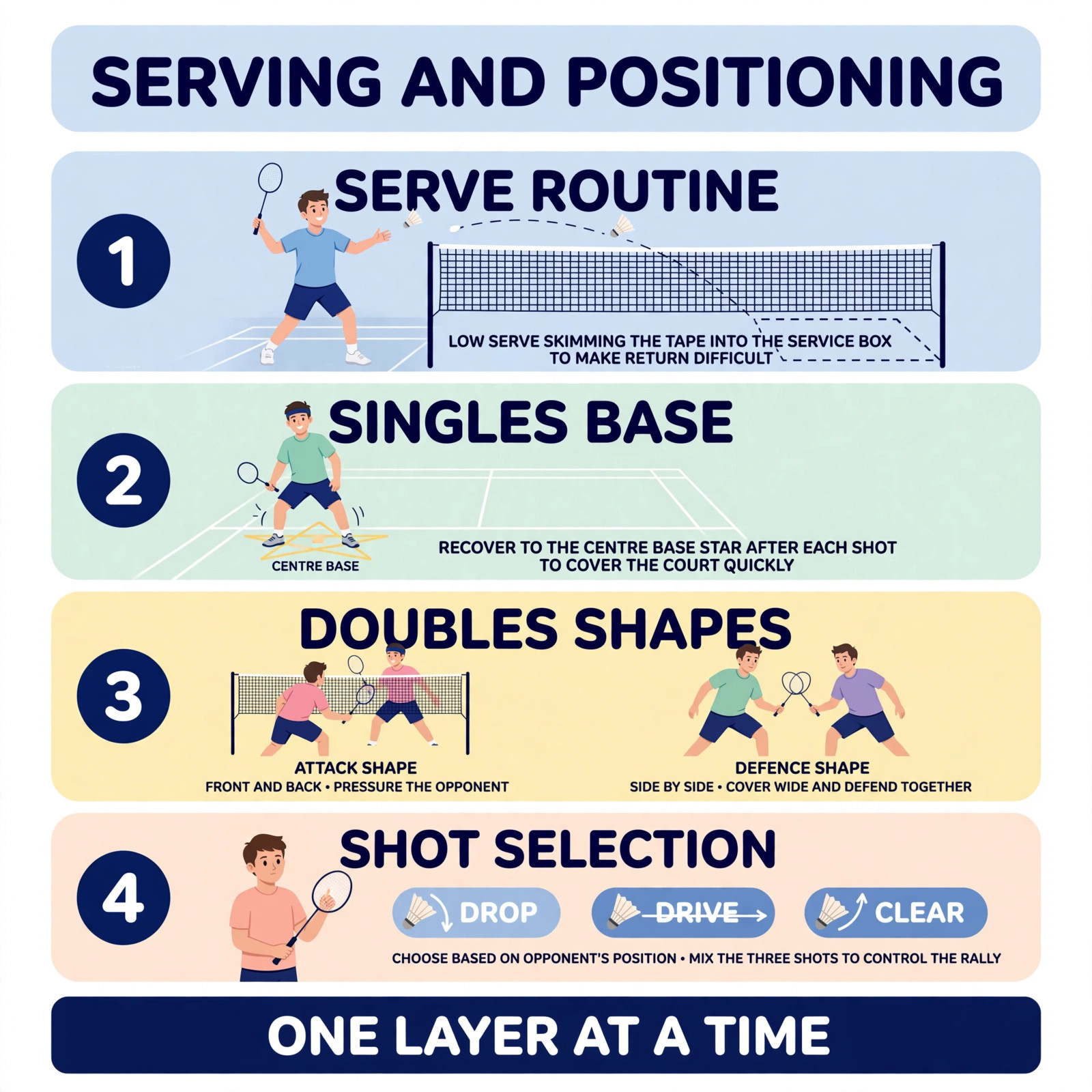
The serve starts every rally, and it is the one shot you fully control. The low serve skims the tape into the diagonal box; the flick serve punishes a receiver who creeps forward; the high serve pushes a singles opponent deep; the drive serve rushes the body. All serves are struck below 1.15 metres, in one forward motion, shuttle held, never tossed. Serving well is a skill like any other: routine, target, repetition.
Positioning turns skills into a game. Singles players recover to a base that threatens every corner and learn to move opponents before finishing. Doubles pairs learn the two shapes, front-and-back to attack, side-by-side to defend, and how to rotate between them. Shot selection sits on top: which shot, from this position, against this opponent. This is where coaching earns its keep, because positioning faults are hard to see in your own game.
So a training week mixes it all in the right proportions: technique blocks for the current skill layer, feeding and drills to groove it, conditioned games where the new skill is tested under rules that reward it, and free games to finish. In our Singapore classes, capped at max 4 students, the coach sets the mix per group, beginners get more technique, advanced groups more pressure.
Myth vs Reality
Myths About Learning Skills
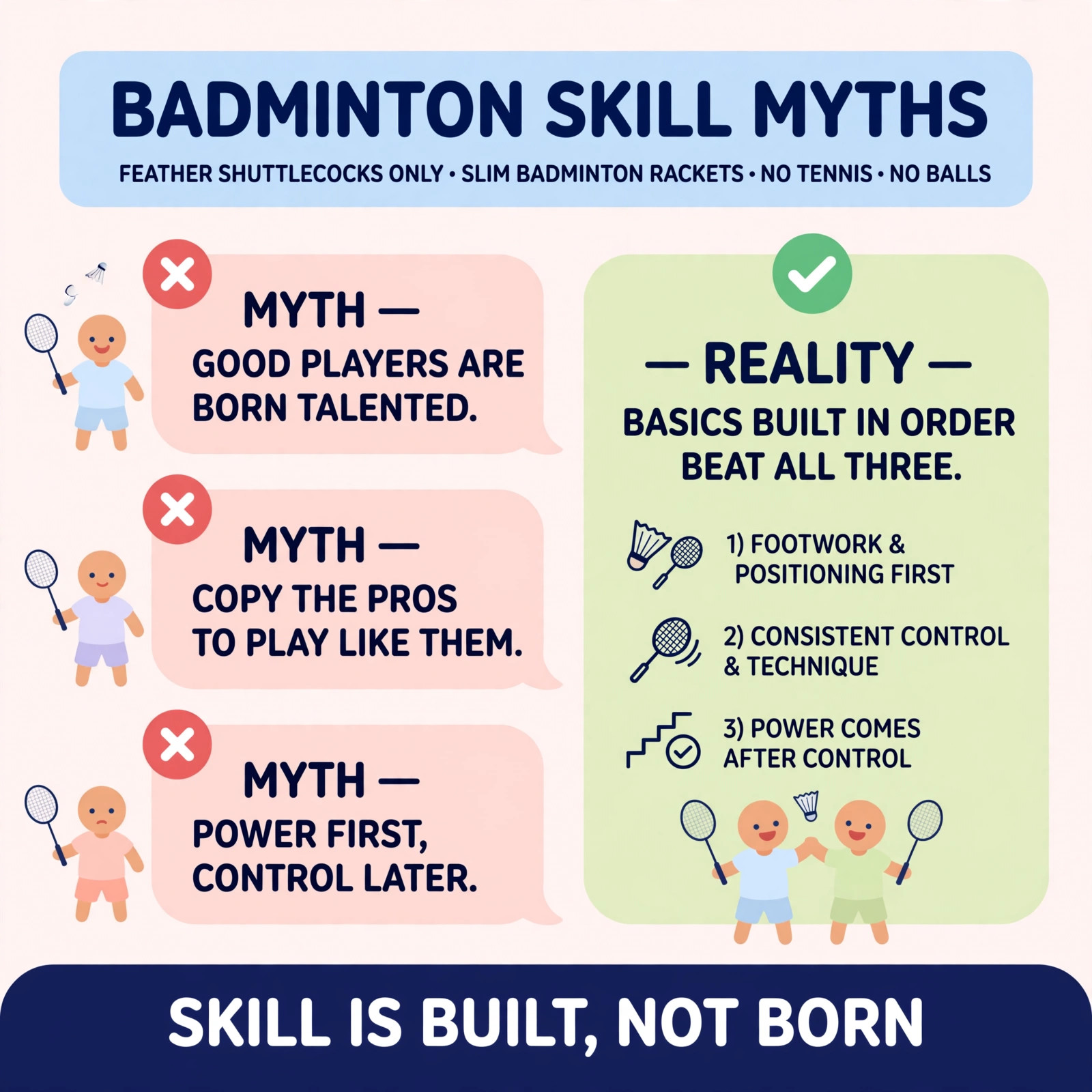
Myth: “Good players are born with talent; skills are just polish.” Reality: what looks like talent is almost always basics learned early and practised properly. The players who improve fastest are not the most gifted, they are the ones whose grip, feet and core shots were built in order, so every new skill had something solid to stand on.
Myth: “Copy the professionals and you will play like them.” Reality: professional shots sit on professional footwork, timing and strength built over years; copying the finish without the foundation produces injuries and strange habits. Myth: “Power comes first, control can come later.” Reality: control is what makes power usable; a hard shot that lands out is a gift to your opponent.
Myth: “Once you know a skill, you know it forever.” Reality: skills fade without use and warp under bad habits, grips creep, split steps vanish, recoveries get lazy. Even strong players return to basics blocks regularly. Skill development is not a staircase you finish; it is a set of habits you maintain, which is why coached structure keeps helping long after the beginner stage.
Why Choose Us
One Map for Every Level
At ST Badminton Academy, skill development is the whole curriculum. Our Singapore classes run in small groups capped at max 4 students, grouped by level, so the coach can build each player’s current layer properly, correcting a grip in one rally, a recovery step in the next. Students always know what they are working on and what comes next.
Mr Eric Chuar has over 15 years of coaching experience in Singapore and Malaysia. His teaching starts where this guide starts: check the grip, check the feet, then build the shots. Players who come to him with one problem shot usually discover the fault sits one layer lower, and fixing the layer, not the symptom, is what makes the improvement stay.
Our original academy base is in Setapak, Kuala Lumpur, and our classes also run in Singapore in the same small-group format. If you are in Singapore and want your skills built in the right order, or rebuilt, if they were never built that way, message us with your level and the days you are free, and we will point you to the right group.
FAQs: Badminton Skill Development in Singapore (SG)
These are the questions players in Singapore ask us most about developing badminton skills. If your question is not here, message us, tell us your level and where your game feels stuck, and we will give you a straight answer about which skill layer to work on first.
How do I start developing badminton skills as a beginner in Singapore?
Start with the foundation: grip, ready position and footwork patterns, learned slowly with a coach’s eye on them. In our Singapore classes, beginners build those layers in small groups of max 4 students before chasing bigger shots, which is why their clears and drops arrive sooner than players who start with the smash.
Which badminton skills should a player learn first in Singapore?
The grip and the feet, in that order. A wrong grip quietly limits every shot you own, and late feet make even good strokes fail. Most players who feel stuck are not missing a new technique, one of those two foundations has a fault in it. Fix the foundation and the shots you already know start working again.
How often should a player practise skill drills at a steady level?
Twice a week suits most players in Singapore: one session weighted towards technique and drills, one towards games where the skills get tested. Short home practice between sessions, shadow footwork, wall serves, keeps the habits warm. Steady weeks build more skill than one exhausting session followed by a fortnight off.
Can a school player start building skills while still in school?
Yes, school players are at the best stage to build skills in the right order, before hard rallies teach them shortcuts. Our coaches keep school-age groups focused on grip, footwork and clean contact, with games built in so the basics never feel like a punishment. Habits formed at school level tend to stay for a player’s whole career.
What should a player bring to the first class they enter?
Bring a racket you swing comfortably, non-marking court shoes with sideways grip, a towel and a water bottle. Wear sports clothes you can lunge and stretch in. That is the whole list, if your racket’s grip or strings look tired, bring it anyway; checking students’ gear is a normal part of a first session with us.
Does ST Badminton Academy run skill development classes in Singapore?
Yes, ST Badminton Academy runs small group classes in Singapore, capped at max 4 students and grouped by level. Message us with your level and the days you are free, and we will confirm which Singapore group fits you and what to bring to the first session.
Does your academy teach shot technique and footwork in Singapore?
Yes, shot technique and footwork are the core of how ST Badminton Academy teaches in Singapore: grip first, movement patterns second, the core shots third, then serving, positioning and shot selection. Students learn each layer in drills, then test it in conditioned games, so technique and decisions grow together instead of in separate boxes.
Where does ST Badminton Academy hold classes for skill development?
ST Badminton Academy runs classes in Singapore in small groups of max 4 students, grouped by level. Message us before your first session, tell us your level and which area suits you, and we will confirm the venue details, what to bring and which group fits you best.
What makes Mr Eric Chuar a suitable coach for skill development and badminton?
Mr Eric Chuar has over 15 years of coaching experience in Singapore and Malaysia, and skill development is where that experience shows most: he reads which layer a player’s game is missing, grip, feet, shots or decisions, and rebuilds from there. Students get one clear focus at a time, practised properly, instead of ten tips at once.
Badminton Skill Development in Action


What It Takes to Build Real Skill
A player meets our skill standard when five habits hold: the grip stays relaxed and correct under pressure, the split step starts every movement, the core shots land on their targets, serves follow the same routine every time, and the player recovers to base ready for the next shot. Our skill standards below are the checkpoints our coaches use at every level.
| Factor | Random Learning | Building in Order LAYERS |
|---|---|---|
| Frequency | 1 or 2 times a week. Mostly for fun and sweat. | Grip and footwork first, so every shot learned later has a foundation under it. |
| Drills Focus | Basic static feeding. Minimal footwork pressure. | Core shots trained against targets, then deception added only on clean basics. |
| Physical Conditioning | Rarely included. Just playing games on court. | Core, agility, and speed training included in every session to prevent injury and build stamina. |
| Tactical Awareness | "Just hit it over." No real game plan. | Video analysis, point construction, and learning to read the opponent's game. |
| Coach Ratio | Large groups (8-10 kids). Coach barely watches you. | Max 4 students. Mr Eric Chuar personally corrects every stroke and movement detail. |
| Goal Setting | Fun and exercise. | Serves, positioning and shot selection layered in once the strokes hold together. |
| Long Term Result | Good recreational player. | A player whose whole game keeps improving, because nothing underneath is broken. |
Badminton Skill Development in Singapore
This page covered essential badminton skill development: grip and racket skills, footwork patterns, the core shots, serving and positioning, and how skills are built in order. ST Badminton Academy teaches it in small group classes of max 4 students in Singapore. Message us and start building your game properly.






