Badminton And Endurance: Cardiovascular Training For Long Matches (Cardio Guide)
Every player who has reached a third game knows the feeling. The shots are still in your hands, but the feet start arriving half a step late, clears fall a metre short, and the rallies you were winning at the start begin to run away from you. That fade is rarely a technique problem. It is an engine problem. Cardiovascular fitness is the base that refills your energy between rallies, and badminton matches are won or lost on how fast that refill happens. This guide covers cardiovascular training for long matches the way we build it at ST Badminton Academy in Setapak, Kuala Lumpur: the aerobic base, effort zones you can judge by feel, off court cardio that suits the game, and a week that fits it all in.
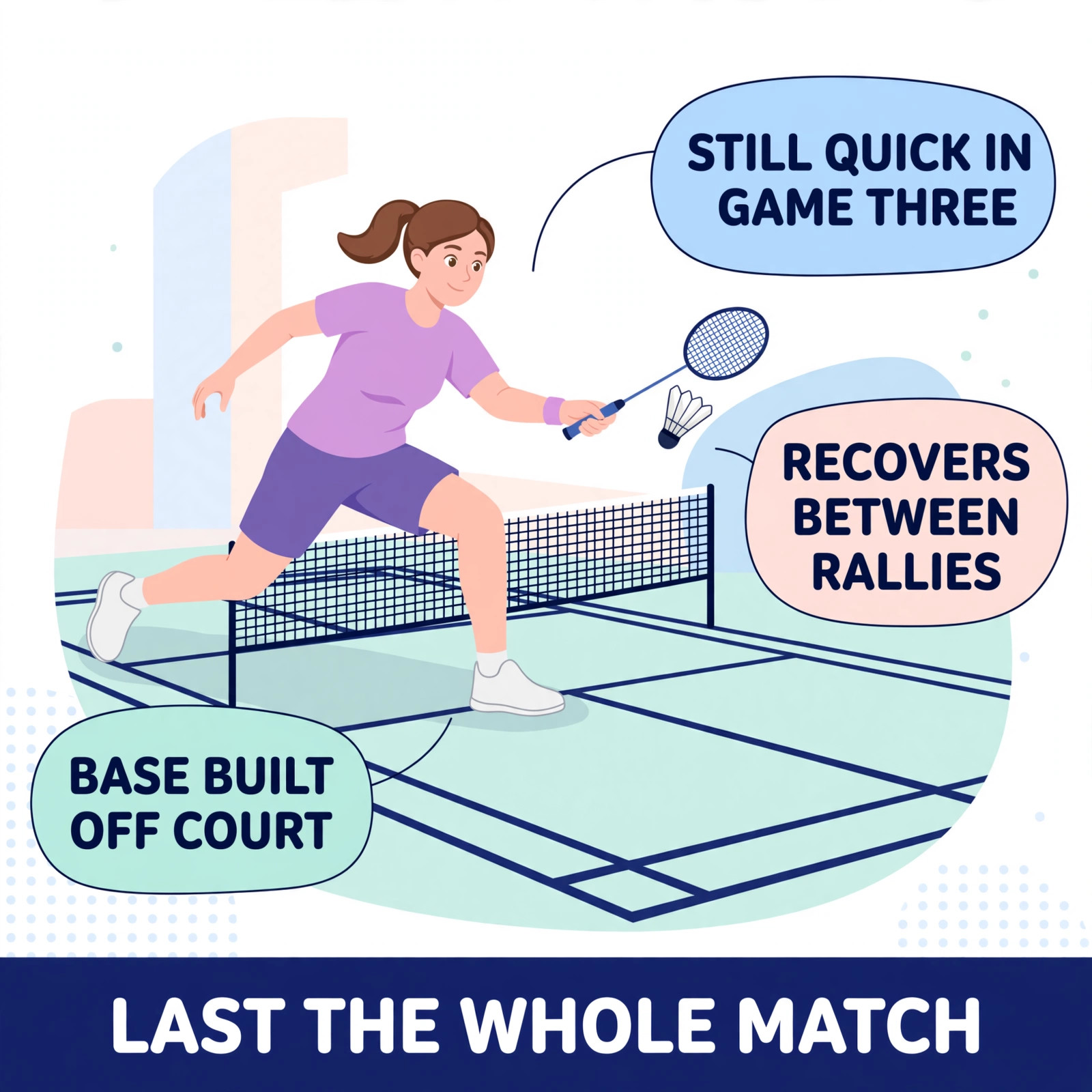
Cardio Check #1
Why Long Matches Test the Engine
A long match is not one effort. It is hundreds of small ones: a burst to the front, a recovery to base, a drive exchange, a jump at the back, with ten or twenty seconds of walking and breathing between rallies. Your heart and lungs do their real work in those gaps. The faster they bring your breathing down, the more of the next rally you play at full quality. A player with a strong engine does not feel fresh at the end. They feel in control at the end, and control is what the third game takes away first.
This is why fading skill is often fading fitness in disguise. When the base is thin, the feet arrive late, and late feet force rushed shots: clears clipped under pressure, net shots played from below the tape, smashes swung on tired legs. Coaches watching a third game can usually read the engine before they read the technique. The fix is not always more badminton. Sometimes the fix is a base built away from the court, so the badminton you already own survives to the final rally. That base is trainable at any age, and it is what the next sections build.

Cardio Check #2
The Aerobic Base: Fitness That Lasts
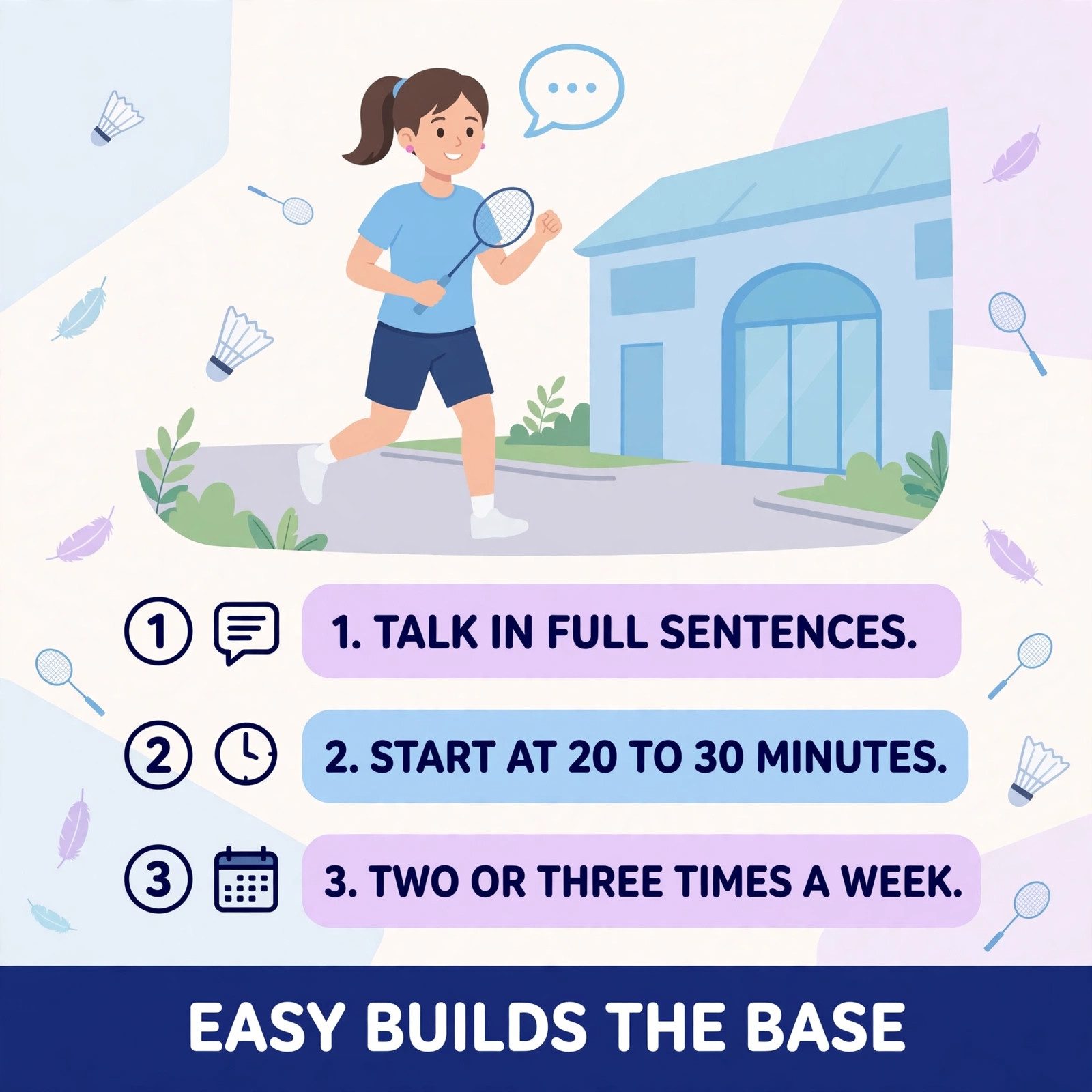
The aerobic base is your background fitness: the steady system that handles easy and moderate work and refills the tank between hard efforts. Base training is done at a pace you can hold while talking in full sentences. Easy jogging, relaxed cycling, steady swimming, brisk walking on a hill: the activity matters less than the feel. At base pace your body learns to produce energy calmly and to clear the waste of hard efforts quickly. That second skill, recovery inside the rally gap, is exactly what a long match keeps asking for.
Building it is simple and unglamorous. Start with twenty to thirty minutes, two or three times a week, at talk test pace. Most players start too hard, turn base work into a weekly suffering contest, and quit within a month. The talk test protects the plan: if you cannot chat, you are no longer building base, you are racing. A heart rate watch can confirm the feel, but it is not required. Your breathing is the gauge, and it is honest if you let it be.
Give the base weeks, not days. Add a few minutes to one session each week before you ever add speed. Keep at least one full rest day, because the base grows during recovery, not during the jogging. And keep your court training as the main dish: the base exists to serve your badminton, not to replace it. Players who respect that order find, usually within a school term, that the third game stops feeling like a different sport. The rallies did not change. The engine underneath them did.
Cardio Check #3
Effort Zones in Plain Words
Effort comes in zones, and you can read them without any equipment. In the easy zone you can talk in full sentences; this is where base work lives. In the steady zone you can manage short phrases; this is the top of a hard training rally. In the hard zone you can get out a few words at most; this is a smash chase, a long defensive scramble, the last points of a tight game. Long matches are mostly easy and steady work with hard moments sprinkled in, which is precisely why the base matters more than the sprint.
Most of your cardio week should sit in the easy zone, and that surprises players who believe hard work is the only honest work. Hard efforts have a place: short pickups at the end of a base session, a few fast finishes, the occasional harder day. But daily hard cardio steals the freshness your court sessions need, and it stalls the base it claims to build. The discipline of base training is holding yourself back on purpose. Easy is not lazy. Easy is the assignment.
Breathing ties the zones to the rally. Train yourself to breathe out on the effort and to take slow, deliberate breaths in the gap between rallies, the way you would between points in a tight third game. On court, use the talk test on yourself: if you cannot speak at all between early rallies, the pace you are playing at is borrowed, and the bill arrives later. Players who manage their breathing early are the ones still choosing their shots late. Zones are not a watch setting. They are a habit of honesty about how hard you are actually working.

Cardio Check #4
Off Court Cardio That Suits Badminton
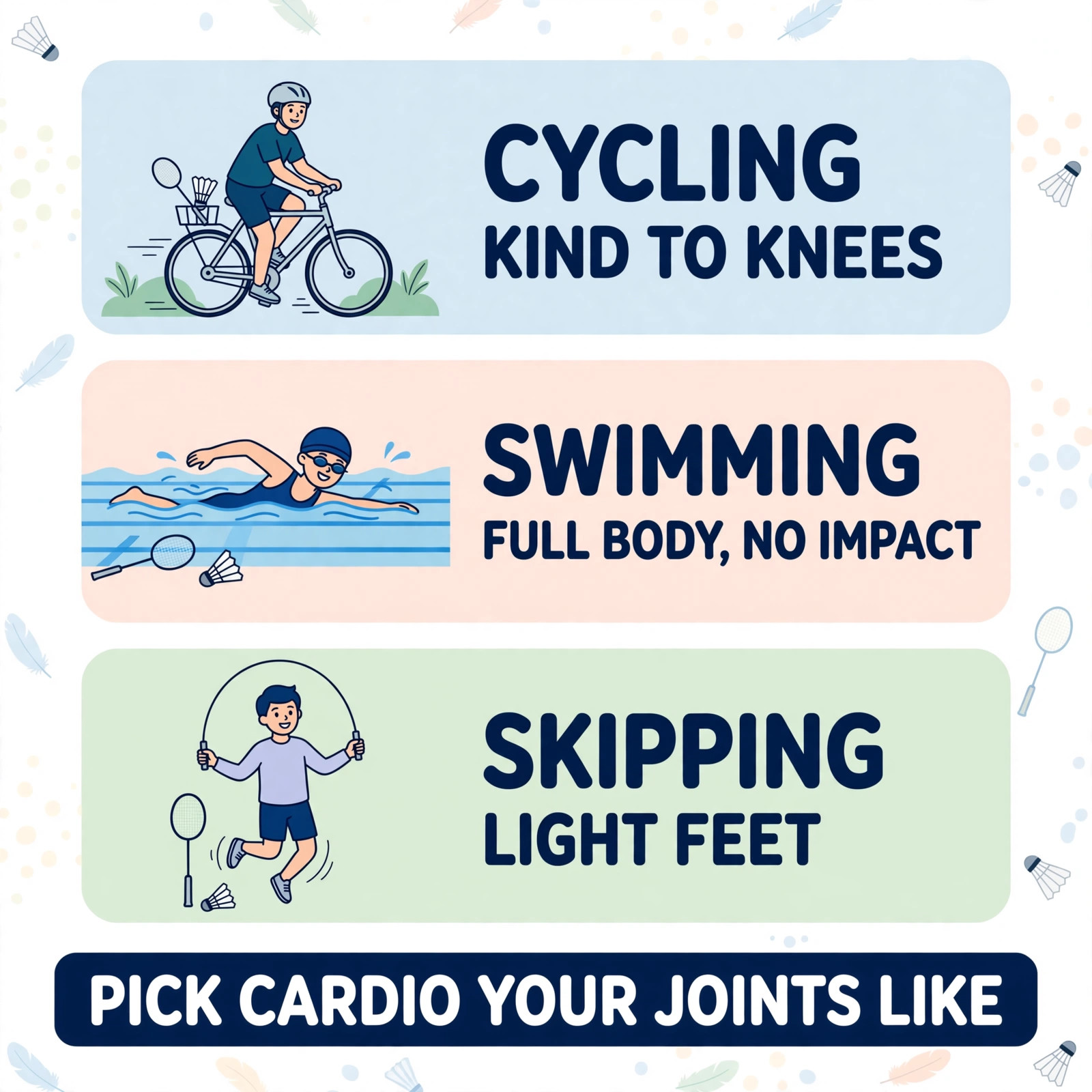
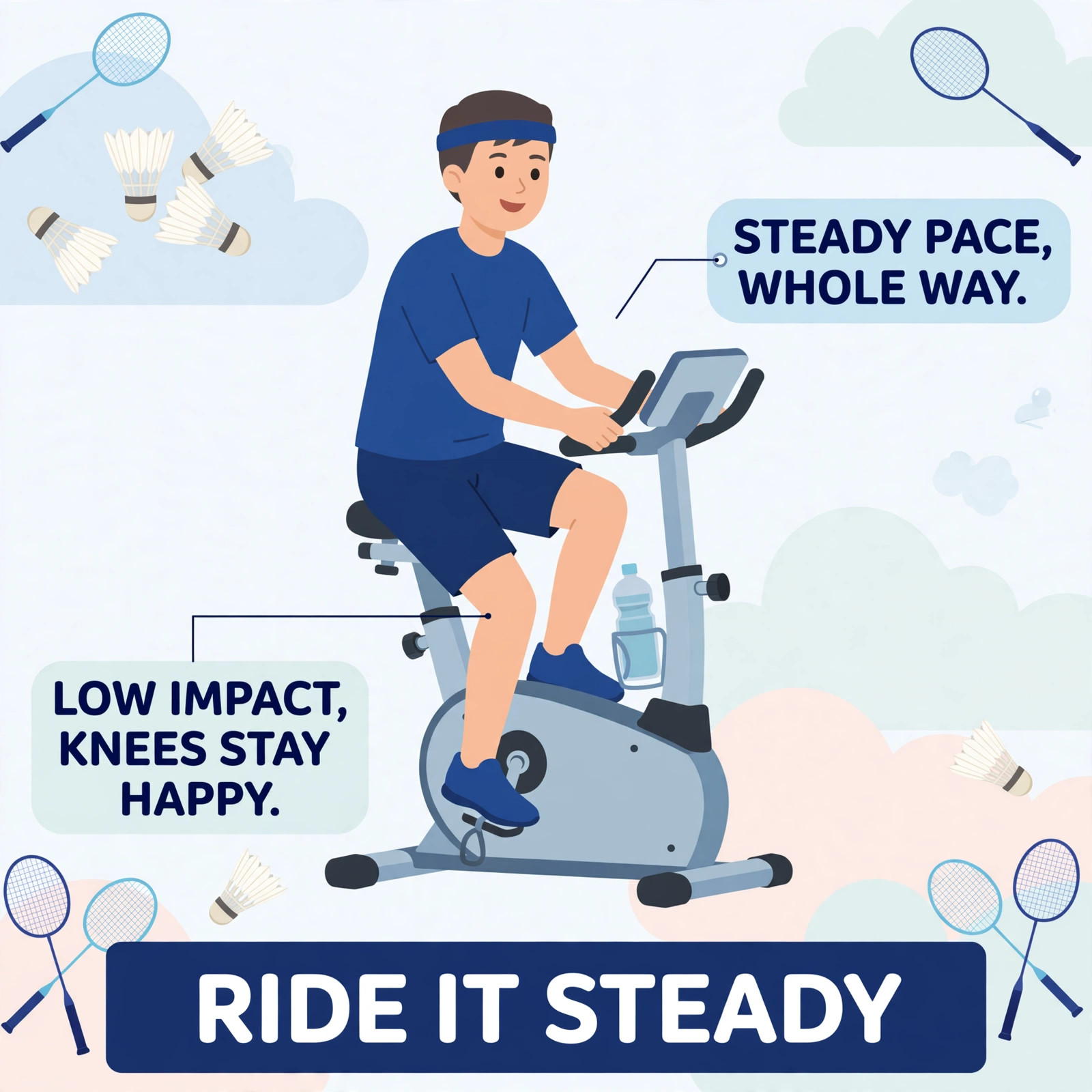
Cycling and swimming are the two kindest ways to build a badminton engine. Badminton already loads the knees, ankles and calves with lunges, landings and changes of direction. A bike and a pool build the heart without adding more of that impact. In Malaysia both are easy to reach: a stationary bike in any gym, a pool in most condos and public complexes. Thirty steady minutes on either, at talk test pace, is a complete base session. Your legs will thank you on court the next day.
Rowing, brisk incline walking and skipping round out the menu. Rowing works the whole body in one smooth pull and teaches rhythm. Hill walking builds leg endurance gently. Skipping deserves a special mention for badminton players: it is cheap, it fits in a corridor, and the light, quick feet it trains are the same feet your footwork wants. Pick one or two forms you genuinely enjoy. The best cardio for a badminton player is the cardio that still happens in week twelve.
Two rules keep off court cardio in its place. First, it supports court training and never replaces it: your first sessions of the week belong to badminton. Second, it should never wreck the next day. If a cardio session leaves your legs too sore for footwork practice, it was too hard or too long, whatever the plan said. Cross cardio done right is almost boring: steady, repeatable, and easy to recover from. Save the drama for match point.
The Week
A Cardio Week That Fits Your Training
Here is a week that works for many club players. Court training on your usual days, with skill and games first. Two easy base sessions of twenty to forty minutes on the days between, on a bike, in a pool or on foot. Once a week, if the base feels solid, finish one session with four or five short faster pickups, a minute each, with full recovery between them. One full rest day. That is the whole design: nothing heroic, everything repeatable, and the total load small enough to survive a busy working week in Kuala Lumpur.
Tournaments test the gaps as much as the games. Between matches on the same day, the players who recover best treat the gap like a job: water early and often, a real meal with carbohydrates and protein inside the first hour if the body allows, shade and rest instead of standing around in the heat, and legs up when there is a bench. Fatigue between games is partly fitness and partly housekeeping. The base you built in training buys you the right to recover. The habits in the gap decide whether you use it.
Measure the engine, or you will stop feeding it. Once a month, repeat the same easy route or the same bike setting and write down how it felt: could you talk the whole way, how fast did your breathing settle at the end. On court, the honest test is your own third game: are your feet arriving in the last rallies of practice matches. Heart rate numbers can help if you enjoy them, but feel and notes tell the same story. Progress in base fitness is quiet. Notes make it visible.

Myth vs Reality
Myths About Cardio Training
Myth: “Cardio for badminton means long runs, full stop.” Reality: the base does not care how you build it. Bikes, pools, hills and ropes all work, and the kindest options spare the knees badminton already loads. Running is one choice, not the entrance exam.
Myth: “A cardio session only counts if it ends in exhaustion.” Reality: most base work is easy by design, and exhaustion is a cost, not a medal. Myth: “A watch decides how fit you are.” Reality: the talk test and your recovery between rallies tell you more, and they are free.
Myth: “Enough cardio can replace court training.” Reality: the engine supports the skill; it cannot play the shots for you. Myth: “More cardio is always better.” Reality: total load decides. Cardio that wrecks your footwork days is not helping your badminton, whatever it does for your heart.

Why Choose Us
Cardio Coaching for Badminton Players
At ST Badminton Academy KL, cardiovascular conditioning is built inside small group classes capped at max 4 students, with base homework set for the days between. In groups that small, the coach sees whose engine fades first, sets each player an honest talk test pace, and checks the notes players keep on their off court sessions.
Mr Eric Chuar has over 15 years of coaching experience in Singapore and Malaysia. His cardio rule is plain: base first, hard days rare, and judge a player by the third game, not the first. He teaches effort by feel before any gadget, so players can run their engine on any court, in any hall, with nothing but their own breathing.
Our academy is based in Setapak, Kuala Lumpur, convenient for players from Wangsa Maju, Melati Utama, Danau Kota and Gombak. If your matches keep slipping away in the last game, bring us the pattern. We will test whether the fade starts in the engine, the legs or the patience, and build the base block that fits your week.
FAQs: Cardiovascular Training in Malaysia (KL)
These are the questions players ask us most about cardiovascular training for badminton in Malaysia. If your question is not here, message us, tell us how your long matches usually end, and we will give you a straight answer about where your base should start.
How can I build my cardio base for long matches if I live in Setapak or Gombak?
Start with two easy sessions a week, twenty to thirty minutes at a pace where you can talk in full sentences: cycling, swimming, jogging or brisk hill walking. Add a few minutes weekly. In our Setapak classes we set this homework per player inside small groups of max 4 students.
What matters most in cardiovascular training for badminton in KL?
Consistency at the right feel. The base grows from repeated easy sessions at talk test pace, week after week, with hard efforts kept rare. Recovery between rallies is the skill being trained, so protect sleep, water and rest days. In our training the plan is small enough to survive a busy week.
How many cardio sessions a week should I plan to build endurance for long level?
For most club players, two or three base sessions a week alongside normal court training is a strong dose. Keep them easy enough to talk through, and space them between training days. Quality and consistency beat volume. In our classes the dose is set per player and built in small steps.
I play twice a week but still fade late in matches. What am I missing?
The base underneath the bursts. Playing gives you hard efforts but very little easy background work, so recovery between rallies stays slow. Add two talk test pace sessions a week, check your sleep and water honestly, and give it six to eight weeks. In our sessions we test where your fade starts.
How can I measure my cardio progress over the weeks?
Repeat one easy route or bike setting every month and write down two things: whether you could talk the whole way, and how quickly your breathing settled at the end. On court, judge the third game of practice matches. Fitness that you can see improving is fitness you keep training.
Do you coach cardiovascular conditioning in classes near Wangsa Maju?
Yes. Conditioning is part of regular group classes at our Setapak base, a short trip from Wangsa Maju. Base work is set as homework between sessions, and class time checks the engine on court with feeding and rally games. Groups are capped at max 4 students, so your dose is watched.
Can the academy help me prepare my fitness for long matches and tournaments in Malaysia?
Yes, with an honest timeline: a base takes weeks to build, so start well before the event. We set the cardio block, test your recovery between rallies in class, and plan the between games habits for tournament day. Our small groups mean the work is matched to your current engine.
Where is ST Badminton Academy KL located for cardio training?
We are based in Setapak, Kuala Lumpur, close to Wangsa Maju, Melati Utama, Danau Kota and Gombak. Conditioning runs inside small group classes of max 4 students, with base homework set between sessions. Message us for the current class schedule and we will place you in a group at your level.
What does Mr Eric Chuar teach about building an engine in badminton?
Fifteen years of coaching in Singapore and Malaysia, and an engine philosophy of feel before gadgets: base first, hard days rare, breathing managed on purpose. Eric sets talk test paces per player, reads the third game rather than the first, and builds conditioning inside small groups where effort is actually seen.
Cardiovascular Training in Action



What It Takes to Last the Whole Match
A player meets our cardio standard when five habits hold: base sessions happen two or three times a week without drama, the talk test sets the pace honestly, hard efforts stay rare and planned, one rest day a week is protected, and progress gets written down once a month. When those five hold, long matches stop being a lottery.
| Factor | Just Plays More | Builds the Base ENGINE |
|---|---|---|
| Frequency | 1 or 2 times a week. Mostly for fun and sweat. | Two or three easy cardio sessions a week at talk test pace sit underneath the court training. |
| Drills Focus | Basic static feeding. Minimal footwork pressure. | Most cardio work stays easy enough to chat through, with short harder efforts used rarely and on purpose. |
| Physical Conditioning | Rarely included. Just playing games on court. | Core, agility, and speed training included in every session to prevent injury and build stamina. |
| Tactical Awareness | "Just hit it over." No real game plan. | Video analysis, point construction, and learning to read the opponent's game. |
| Coach Ratio | Large groups (8-10 kids). Coach barely watches you. | Max 4 students. Mr Eric Chuar personally corrects every stroke and movement detail. |
| Goal Setting | Fun and exercise. | Breathing settles faster between rallies, and the same training route feels easier month by month. |
| Long Term Result | Good recreational player. | A player whose feet still arrive on time in the third game of a long match. |
Cardiovascular and Endurance Training in Kuala Lumpur
This page covered cardiovascular training for long badminton matches from the base outward: why the third game exposes a thin engine, how to build the aerobic base at talk test pace, effort zones you can read by feel, off court cardio that spares your joints, and a week that fits training, homework and rest together. Bring your third game problem to a session in Setapak and let us build your engine.






