Choose The Perfect Badminton Racket For Your Game (Racket Guide)
A racket is the one piece of gear you touch on every shot, and the wrong one quietly taxes your game: clears fall short, defence arrives late, the shoulder aches by the third game. The right one disappears in your hand, you stop thinking about the racket and start thinking about the rally.
This guide explains how to choose the perfect badminton racket for your game: weight classes, balance point, shaft flex, grip size, strings and tension, and how to test a racket before you pay for it, the same checks our coaches run with students at ST Badminton Academy in Setapak, Kuala Lumpur.

Racket Check #1
What Does Racket Weight Really Change on Court?
Racket weight is measured in U classes, and the numbers run backwards from what most people expect: the bigger the U, the lighter the racket. A 3U racket weighs about 85 to 89 grams, a 4U about 80 to 84 grams, and a 5U about 75 to 79 grams. Most club players in Malaysia play happily with 4U, light enough for fast defence, heavy enough to clear without swinging out of the shoulder.
Weight is a trade, not a contest. A heavier racket carries more momentum into smashes for players with the arm and technique to swing it all match. A lighter racket changes direction faster, which is what defence and flat drives are made of. Beginners and juniors usually learn better on 4U or 5U: their swings stay fast and their shoulders stay healthy while technique is still forming. Chasing a heavy racket before your swing is ready buys power you cannot control.

Racket Check #2
Head-Heavy or Head-Light: Where Should the Balance Sit?
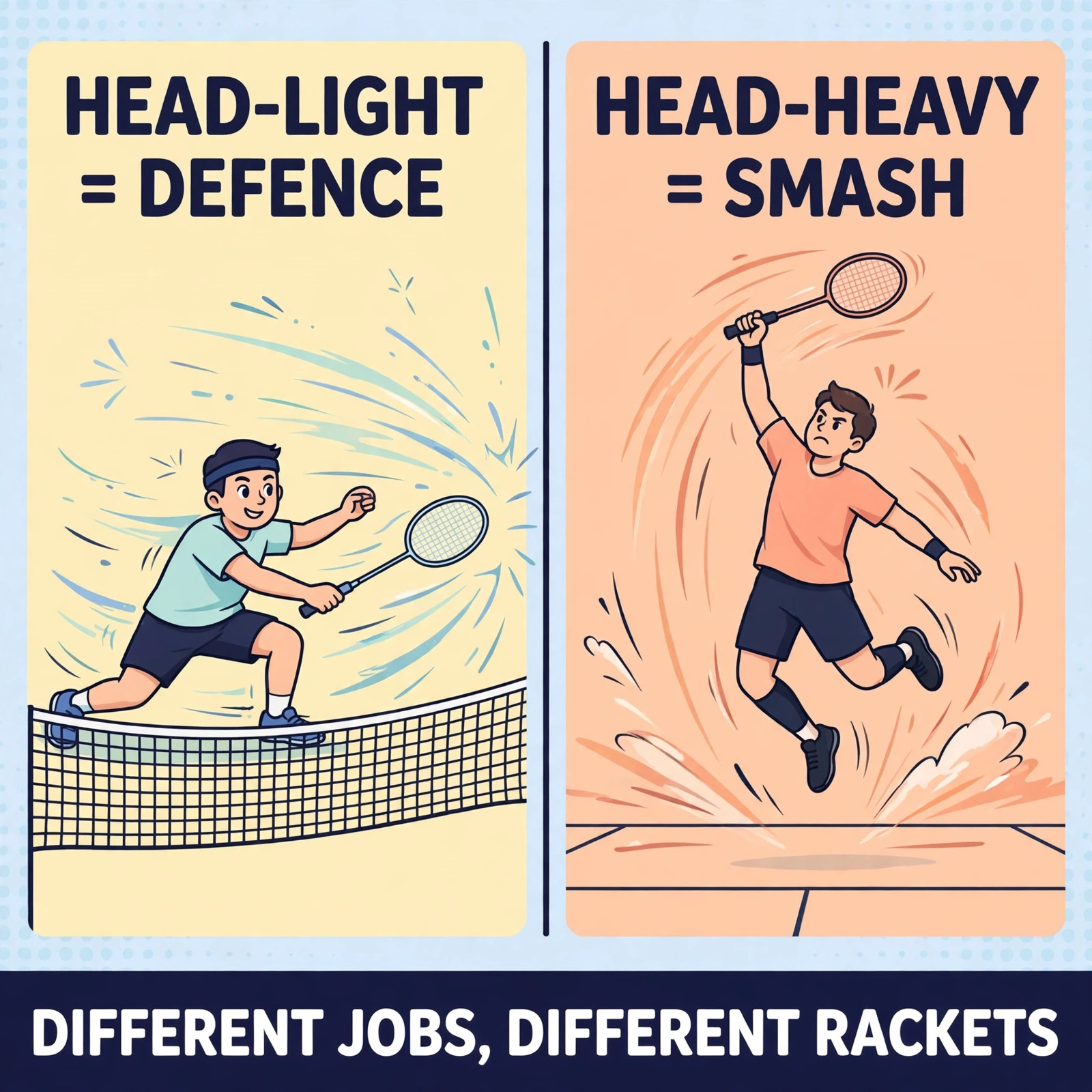
Balance point is where the racket balances on a finger, measured in millimetres from the butt of the handle. Around 295 millimetres and above, a racket feels head-heavy: the head pulls through smashes and clears with extra weight behind them. Below about 285 millimetres it feels head-light: the racket whips around for defence, drives and fast net play. Between them sits the even-balance all-rounder most social players enjoy.
Match balance to the game you actually play. Singles players who live at the back of the court often like a touch of head weight for clears and smashes. Doubles players, who win rallies with speed in the flat game, usually prefer even or head-light rackets that recover quickly between shots. Neither is better, a head-heavy racket in slow hands loses more rallies in defence than it wins in attack.
Hold the number loosely, though. Two rackets with the same balance point can feel different because grip size, shaft flex and even the string tension change the swing. Balance is a starting filter when you shop, not a verdict, the real test is always how the racket swings in your hand, at your speed, on your shots.

Racket Check #3
Stiff or Flexible Shaft: Which Suits Your Swing?
The shaft bends during your swing and straightens at contact, and how stiff it is decides who the racket suits. A stiff shaft bends little and snaps back fast: it rewards players with quick, compact swings and good technique, giving them accuracy and a crisp feel. In slower hands the same shaft feels dead, the player cannot bend it, so the shuttle gets no help and the arm does all the work.
A flexible shaft bends more and stores energy for players whose swings are still developing. It helps beginners and social players send clears deep without perfect technique, but it can feel vague when a strong player attacks, the head arrives a fraction late and placement wanders. Medium flex is the honest middle ground, and it is where most improving players belong.
So read flex labels with your own swing in mind, not a professional’s. If your clears land short and your arm tires, a whippy shaft in a lighter racket often fixes more than lessons in power. If your shots sail and scatter despite a fast swing, a stiffer shaft may be the control you are missing. Our coaches check this on court: the racket must match the swing the player has today, while leaving room for the swing they are building.

Racket Check #4
How Do You Get Grip Size Right?
Grip size is the most ignored spec in badminton and the one your hand feels on every shot. Grip labels differ between brands, G4, G5, S2 and the rest do not line up across makers, so numbers alone cannot choose for you. The test is in the hand: hold your normal forehand grip and look at your fingers. There should be a small gap, roughly a fingertip’s width, between your fingertips and the base of your thumb.
A grip that is too small makes you squeeze, and a squeezing hand is a slow hand: the forearm tightens, the wrist locks, and elbow and shoulder pain often follow. A grip that is too big is just as costly, the racket turns in the hand and quick grip changes for defence get clumsy. Most adults end up on a mid-size grip with one overgrip added, which is also the cheapest fine-tuning in the sport.
Build the grip up, never down. You can always add an overgrip to make a handle thicker; you cannot shave a thick handle smaller without ruining it. Sweaty palms in Malaysian halls argue for towel grips or fresh overgrips changed often, a slippery grip forces the same squeezing problem as a small one. Replace worn grips before they cost you a racket on a wet smash follow-through.

Strings and Feel
What Do Strings and Tension Do to Your Shots?
Strings are where the racket meets the shuttle, and they age long before the frame does. Badminton strings are synthetic, fine nylon-based cords built for feel and durability. Thin strings give better feel and bite on the shuttle but break sooner; thicker strings last longer with a slightly duller touch. When strings lose tension and start to feel dead and trampoliny at the same time, it is restringing time, whatever the calendar says.
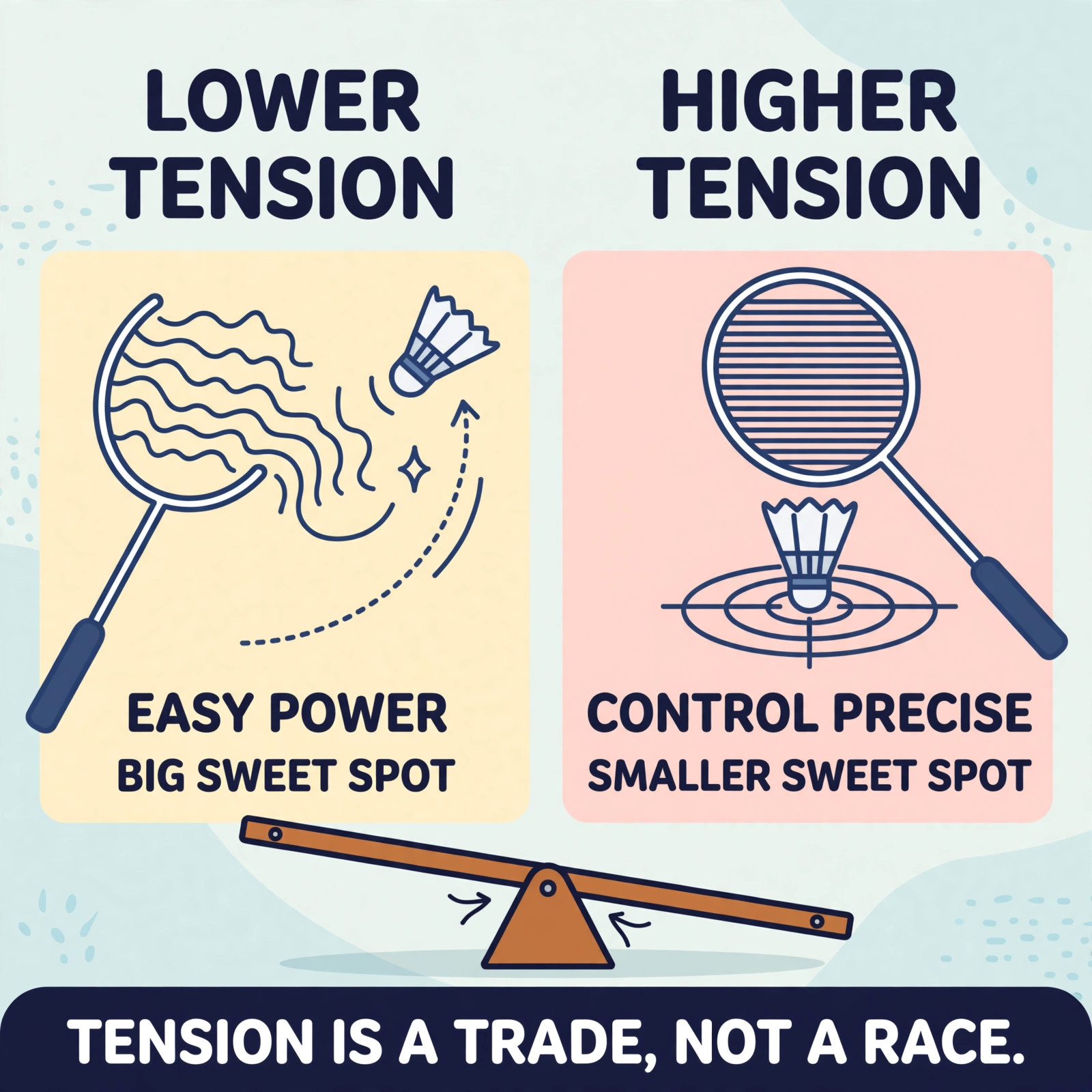
Tension is a trade between power and control, and it is widely misunderstood. Lower tension stretches more and returns energy, which gives easier power, beginners and social players usually play best around the low twenties in pounds. Higher tension gives a firmer, more precise string bed for players whose swings are fast enough to use it; it also shrinks the sweet spot and punishes off-centre hits. Copying a professional’s very high tension with a developing swing is the fastest way to make a good racket feel terrible.
Head shape finishes the picture. Isometric heads, squarer at the top, offer a larger sweet spot and forgive off-centre hits, the sensible default for most players. Classic oval heads concentrate the sweet spot smaller and reward clean strikers. Whichever you choose, test properly before buying: shadow your smash, play clears to the back line, defend a few drives, and change grips at speed. A racket that survives your real shots in the hall is worth more than any spec sheet.
Myth vs Reality
Myths About Racket Buying
Myth: “The most expensive racket is the best racket.” Reality: price buys lighter materials and tighter manufacturing, not a better match for your arm. A mid-priced racket that fits your weight, balance and flex will outplay a flagship that fights your swing, fit decides, price follows.
Myth: “Heavier always means more powerful.” Reality: power comes from swing speed meeting the shuttle cleanly; a racket too heavy for the player slows the swing and loses power. Myth: “Beginners should use the same specs as the professionals.” Reality: professional specs, stiff shafts, very high tension, punish developing swings and reward only finished technique.
Myth: “A racket lasts until it breaks.” Reality: strings go dead and grips wear smooth long before a frame cracks, and both quietly change how the racket plays. Myth: “One perfect racket exists for everyone.” Reality: there is only a perfect match between one player, one swing and one racket, which is why testing beats researching.

Why Choose Us
Honest Racket Advice for Every Player
At ST Badminton Academy KL, we would rather a student spend on coaching than on a flagship racket. In classes capped at max 4 students, coaches can see when a racket is fighting a student, clears dying from a stiff shaft, defence late from a head that is too heavy, and say so plainly, with a borrowed racket on court to prove the difference before any money is spent.
Mr Eric Chuar has over 15 years of coaching experience in Singapore and Malaysia. His racket rule for parents is famous in our hall: buy for the player your child is this year, not the player in the poster. A light, medium-flex racket with the right grip teaches clean technique; the heavy professional frame can wait until the swing has earned it.
Our academy is based in Setapak, Kuala Lumpur, convenient for players from Wangsa Maju, Melati Utama, Danau Kota and Gombak. Bring your current racket to a session if you are unsure about it, grip check, string check and a swing test take five minutes, and honest advice here is free because we would rather fix your setup than sell you a new one.
FAQs: Choosing a Badminton Racket in Malaysia (KL)
These are the questions players and parents ask us most about choosing a badminton racket in Malaysia. If your question is not here, message us, tell us your level, how you play and what your current racket does wrong, and we will give you a straight answer about what to change first.
How do I choose a racket if I play in Setapak or Gombak?
Start with the four checks: weight class, balance point, shaft flex and grip size. For most players in Setapak or Gombak, a 4U even-balance racket with a medium-flex shaft and a grip that leaves a fingertip gap is the honest starting point. From there, adjust one thing at a time based on how your shots actually behave.
What does the balance point mean for a player in KL?
Read the balance point in millimetres from the butt end. Around 295 and above feels head-heavy and helps clears and smashes; below roughly 285 feels head-light and speeds up defence and drives. Most social players in KL enjoy the middle. Two rackets with the same number can still feel different, so always swing before deciding.
How high a string tension should a player use at any level?
Set tension to your swing, not to a poster. Lower tension gives easier power and suits beginners and social players; higher tension gives control to fast, clean swings but shrinks the sweet spot. At any level, if your clears fall short and your arm aches, the tension is probably too high for you today.
Can a junior start with a light racket when he or she is 13 or 14?
Yes, at thirteen or fourteen a light racket is the right start: 4U or 5U, medium or flexible shaft, sensible tension. Young arms are still building the swing, and a heavy, stiff frame teaches muscled shots and sore shoulders. Upgrade weight and stiffness later, when technique is grooved and strength has caught up.
How should you test a racket before a purchase you enter?
Swing it the way you play. Shadow a smash, hit clears to the back line, defend some fast drives and change grips quickly between forehand and backhand. Then check the frame, strings and grip with fresh eyes. If the racket feels like an extension of your arm during those tests, it passes.
Do you check rackets for students in classes near Wangsa Maju?
Yes, racket checks sit inside our coaching at the Setapak academy, a short drive from Wangsa Maju, Melati Utama and Danau Kota. Coaches check grip size, string condition and whether weight and flex match the student’s swing, and students test borrowed rackets on court before any parent spends on a new frame.
Does your academy teach racket choice and setup in Malaysia?
Yes, choosing the right racket is part of how ST Badminton Academy teaches in Malaysia: weight, balance, flex, grip and strings explained in plain words, tested on court, and matched to the player’s level. Parents tell us this saves them from the classic mistake, an expensive professional-spec racket that a young swing cannot use.
Where is ST Badminton Academy KL located for gear advice and training?
ST Badminton Academy KL is based in Setapak, Kuala Lumpur, where our classes run in small groups of max 4 students. The academy is convenient for players from Wangsa Maju, Melati Utama, Danau Kota and Gombak. Message us before your first session and we will confirm the venue details and what to bring.
What makes Mr Eric Chuar a suitable coach for racket advice and badminton?
Mr Eric Chuar has over 15 years of coaching experience in Singapore and Malaysia, and his rule is simple: the racket must fit the swing the player has today. He checks grips and strings himself in class and stops parents buying professional-spec frames for children whose technique is still forming.
Badminton Rackets in Action



What It Takes to Choose Your Racket
A player meets our racket standard when five checks pass: the weight class suits their arm, the balance matches their game, the flex bends for their swing, the grip leaves a fingertip gap, and strings are fresh at a tension their technique can use. Our racket standards below are the checkpoints our coaches use before any student buys a new frame.
| Factor | Guessing From Specs | Testing on Court TESTED |
|---|---|---|
| Frequency | 1 or 2 times a week. Mostly for fun and sweat. | Weight, balance and shaft flex matched to the player's arm and style before any money is spent. |
| Drills Focus | Basic static feeding. Minimal footwork pressure. | Grip sized in the hand with a fingertip gap, then fine-tuned with an overgrip. |
| Physical Conditioning | Rarely included. Just playing games on court. | Core, agility, and speed training included in every session to prevent injury and build stamina. |
| Tactical Awareness | "Just hit it over." No real game plan. | Video analysis, point construction, and learning to read the opponent's game. |
| Coach Ratio | Large groups (8-10 kids). Coach barely watches you. | Max 4 students. Mr Eric Chuar personally corrects every stroke and movement detail. |
| Goal Setting | Fun and exercise. | Strings and tension set for the player's level, and replaced when they go dead. |
| Long Term Result | Good recreational player. | A player whose racket disappears in the hand, so the rally gets all the attention. |
Badminton Racket Guide in Kuala Lumpur
This page covered choosing the perfect badminton racket: weight classes, balance point, shaft flex, grip size, strings and tension, and how to test before you buy. ST Badminton Academy KL teaches gear judgement inside small group classes of max 4 students in Setapak. If you are in Wangsa Maju, Gombak, Cheras or nearby, contact us today.






